
You are sitting in a breakout room at an AMSA regional conference. Each person at the table is from a different campus—UCLA, Ohio State, UT Southwestern, a small liberal arts college—and you realize something very specific: each chapter is reinventing the same projects in isolation. Same community clinic ideas, same MCAT bootcamps, same advocacy letter‑writing campaigns. No shared infrastructure. No continuity year‑to‑year.
You start thinking: what would it actually take to build a national, multi‑campus AMSA initiative that survives leadership turnover, spans premed and medical schools, and creates real, measurable impact?
This is the blueprint for doing exactly that.
Step 1: Clarify the “Why” at a National Scale
Before logistics, you need intellectual clarity. National collaborations die when the “why” is fuzzy or purely aspirational.
Ask a more precise question: What problem exists at multiple campuses that is too large or inefficient to solve chapter‑by‑chapter?
You want problems that:
- Occur across many institutions
- Benefit from shared resources or data
- Require broader geographic legitimacy (e.g., national advocacy, multi‑site research, standardized curriculum)
Typical AMSA‑sized national initiative domains:
Advocacy and Policy
- Example: A coordinated “National Prior Authorization Reform” campaign where chapters collect patient stories, track delays in care, and present consolidated data to state medical societies or legislators.
- Why national: Legislators pay attention when 30+ campuses share aligned data and messaging, not when one premed club emails their office.
Curriculum and Education
- Example: A multi‑campus “Racism in Medicine Teaching Series” where students co‑develop cases, slides, and reading guides that can be plugged into local AMSA meetings or interest group sessions.
- Why national: You avoid 50 variations of the same introductory lecture with uneven quality and no shared evaluation.
Research and Data Projects
- Example: A “National Medical Student Burnout Snapshot” repeated annually, collecting standardized survey data across premed and medical campuses.
- Why national: Single‑campus data rarely change dean‑level decisions. A multi‑institution dataset starts to move policy.
Service and Community Engagement
- Example: A “National Health Literacy Week” where every participating AMSA chapter runs standardized workshops in local schools or community centers, using centrally developed materials.
- Why national: Shared branding, shared metrics, shared lessons learned. Media and school administrators take it more seriously.
You should be able to write a one‑sentence national‑scale problem statement:
“There is no standardized, student‑driven, multi‑campus framework for ___________, leading to duplicated work, inconsistent quality, and missed opportunities for collective impact.”
If you cannot fill that blank concretely, the initiative will not survive beyond enthusiasm.
Step 2: Define a Specific, Multi‑Year Initiative Structure
National projects die when they are vague. “We will collaborate” is not a structure; it is a wish.
For AMSA, you want your initiative to have:
A clearly defined product or output
- A toolkit
- A national data report
- A curriculum
- A recurring national day/week of action
- A centralized resource hub (website, shared drive, repository)
A multi‑year roadmap Think in 3 phases:
- Year 1: Pilot and infrastructure
- Year 2: Scale and standardization
- Year 3: Evaluation and institutionalization (e.g., integrating with AMSA national structures or external partners)
A modular structure Each campus should be able to:
- Join or exit the initiative with clear, minimal onboarding.
- Choose subcomponents (e.g., advocacy only vs. full curriculum + research).
- Contribute at different intensity levels (e.g., small liberal arts college vs. large academic medical center).
An example structure for a “National AMSA Health Equity Curriculum Collaborative”:
Core outputs:
- A shared online curriculum repository
- Standard case templates
- Recorded student‑led sessions
- Annual white paper summarizing outcomes and adoption
Year 1 (4–8 campuses):
- Create 4–6 core modules (e.g., structural determinants, implicit bias, immigration and health).
- Test delivery via AMSA chapter sessions.
- Collect standardized pre/post surveys.
Year 2 (15–25 campuses):
- Formalize module format, instructor guides, and implementation manual.
- Recruit additional campuses and run a coordinated calendar (e.g., “Module X delivered in October across all campuses”).
Year 3 (30+ campuses):
- Publish combined evaluation data.
- Seek endorsements or integration with AMSA national leadership, specialty societies, or institutional curricula.
- Build transfer plan for next leadership cohort.
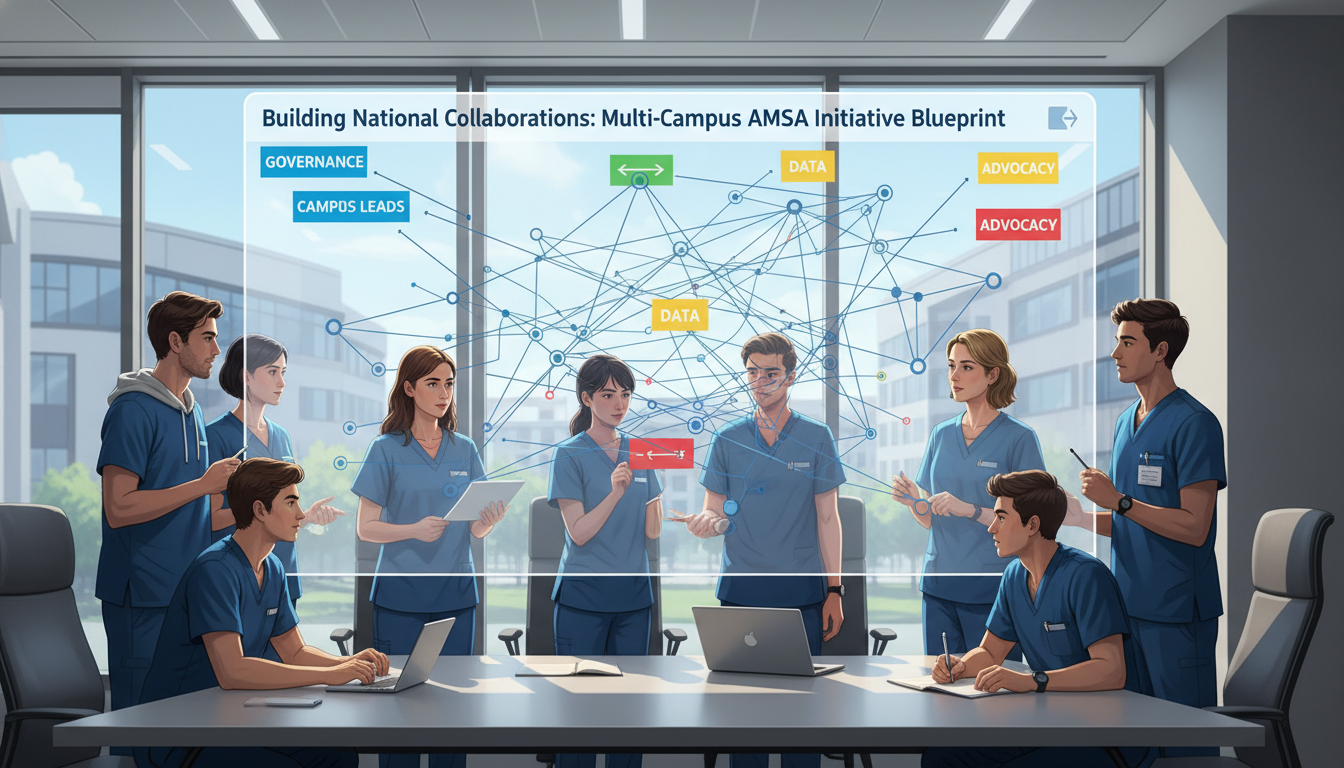
Step 3: Governance: How to Structure Multi‑Campus Leadership
Without clear governance, multi‑campus AMSA projects become endless group chats and no execution.
You want a lean but robust structure:
3.1 Core Leadership Roles
At minimum:
National Initiative Director(s)
- 1–2 people responsible for overall direction, external communication, and interfacing with AMSA national leadership.
- Should commit for at least 18–24 months when possible (e.g., late M1 to early M3, or gap year + M1).
Operations Lead
- Manages timelines, task tracking, meeting scheduling, documentation.
- Often the difference between “idea” and “product.”
Campus Liaison Coordinator
- Manages recruitment, onboarding, and retention of campus leads.
- Runs regular liaison calls.
Data / Evaluation Lead
- Designs and manages data collection.
- Handles IRB considerations for research‑type projects.
Optionally, depending on your initiative:
- Communications / Social Media Lead
- Curriculum / Content Lead
- Advocacy / Policy Lead
- Tech / Platform Admin (for websites, shared drives, simple databases)
3.2 Campus Roles
Each participating campus needs a designated point person:
Campus Lead (Premed or Medical Student)
- Single accountable individual per campus, even if they form a local team.
- Responsible for:
- Local implementation of national plans.
- Attending monthly national calls.
- Reporting metrics.
Faculty / Staff Advisor (strongly recommended)
- Not to “control” the project, but to:
- Help navigate IRB, data security, and institutional approvals.
- Provide continuity when student leaders graduate.
- Not to “control” the project, but to:
3.3 Decision‑Making Structure
Decide early:
- Which decisions are national leadership only (e.g., core messaging, data collection instruments, partnerships)?
- Which are open to campus input through:
- Quarterly feedback calls
- Anonymous forms
- Periodic surveys
A simple model:
- Operational decisions: National leadership + direct stakeholders.
- Strategic shifts (e.g., expansion to new domains): Discussed in an annual summit involving all campus leads.
Document this in a 2–3 page Initiative Charter that covers:
- Mission and scope
- Governance roles
- Decision‑making processes
- Expectations for participating campuses
- Communication norms
Step 4: Communication Infrastructure That Actually Works
Group chats alone will kill a national project. You need layered communication.
4.1 Synchronous Communication
Monthly All‑Campus Call
- Agenda circulated 48 hours before.
- Use a consistent platform (Zoom, Google Meet).
- Record calls and share minutes with action items and owners.
Quarterly Strategic Call (Leadership + Key Advisors)
- Deep dive on trajectory, partnerships, and problems.
Office Hours
- Monthly or bi‑monthly open drop‑in time for campus leads needing help with local implementation.
4.2 Asynchronous Communication
Your stack should be minimal but deliberate:
Email listserv or Google Group
- For formal updates and documents.
Collaboration Platform
- Google Drive or OneDrive folder with:
- Master folder for the initiative
- Subfolders for: Curricula, Data, Campus onboarding, Meeting minutes, Templates
- Google Drive or OneDrive folder with:
Task Management
- Trello, Asana, or Notion.
- One board per year, with sections:
- Backlog
- In Progress
- Review
- Completed
Chat (Slack / Discord / WhatsApp)
- For quick questions and informal cross‑campus exchange.
- Set clear expectations that major decisions and official documents live elsewhere.
The critical piece: Documentation discipline.
Every meeting → agenda, minutes, and action items posted in a predictable location. This is what allows new leaders to on‑ramp rapidly.
Step 5: Building a Multi‑Campus Onboarding and Participation Model
Your initiative needs to accommodate different campus realities: large public universities, small private colleges, DO schools, MD schools, urban and rural.
5.1 Participation Tiers
Define these from the start. For example:
Tier 1: Full Participation
- Implements the complete national protocol (e.g., full curriculum series, full data collection, advocacy actions).
- Provides complete metrics.
- Participates in most calls.
Tier 2: Partial Participation
- Adopts some modules or elements.
- Provides limited but useful data.
- Serves as a “light” site, often where bandwidth is lower.
Tier 3: Observer
- Listens in on calls.
- May adopt materials locally without contributing data.
- Potential future full participant.
Each tier should have:
- Eligibility criteria
- Expectations
- A clear path to move between tiers
5.2 Standardized Campus Onboarding
Create an Onboarding Package that can be sent to any new campus in < 24 hours:
- 2‑page initiative overview (PDF)
- Role description for Campus Lead
- Timeline for the academic year
- Implementation checklist
- IRB or privacy notes (if relevant)
- Sample email to recruit local volunteers
- Local presentation slides to introduce the initiative to their AMSA chapter
Run a group onboarding webinar at specific times (e.g., every August and January) and record it. Campus leaders should not depend on 1:1 sessions to understand the basics.
Step 6: Data, Evaluation, and IRB: Doing This Right
If your initiative involves surveys, patient interaction, educational research, or multi‑site data:
You must think like a multi‑site research project.
6.1 Clarify: QI vs. Research
With faculty advisor guidance, determine whether your project requires IRB oversight:
Quality Improvement / Program Evaluation
Typically:- Internal use, focused on improving the initiative.
- No intention to generalize to broader populations.
- Many institutions consider this “non‑human subjects research” and IRB‑exempt, but you still need documentation.
Human Subjects Research
- Intention to publish in peer‑reviewed journals.
- Comparative analyses across sites.
- Potentially sensitive or identifiable information.
For national AMSA initiatives, most projects aiming for abstracts or manuscripts are functionally research. Plan for that from day one.
6.2 Multi‑Site IRB Models
Common approaches:
Single IRB (sIRB) model
- One institution (often a large academic medical center) serves as IRB of record.
- Other institutions cede review via reliance agreements.
Local IRB at each site
- Each campus obtains local IRB review / exemption.
- You provide a standard “IRB packet” (protocol, consent, instruments).
Central Non‑Institutional IRB
- Less common for student organizations due to cost.
Practical path for students:
- Recruit a faculty PI at an institution with strong IRB infrastructure to serve as coordinating PI.
- Have the Data / Evaluation Lead coordinate:
- Standard protocol and survey instruments.
- Template IRB applications for local sites.
- A tracking sheet of each campus’s IRB status.
6.3 Data Infrastructure
Decide on:
Data collection tools
- REDCap (ideal, if an institution can host)
- Qualtrics
- Secure institutional survey tools
- Avoid unregulated free tools for sensitive data.
Data dictionary
- Define each variable, allowable values, and coding.
- Crucial for multi‑site consistency.
Data use and authorship policies
- Who can access raw data?
- How will authorship on abstracts and papers be determined?
- How will campuses that contribute data but have limited writing bandwidth be credited?
Document this clearly. Nothing sours a collaboration faster than opaque data policies.
Step 7: Alignment with AMSA National and External Partners
You are not building in a vacuum. Smart national initiatives:
Align with AMSA’s existing national campaigns
Example: If AMSA is prioritizing reproductive justice, create a multi‑campus initiative that feeds evidence, stories, and local chapters into that national advocacy stream.Leverage AMSA governance structures
- National committees
- Action committees
- Convention programming
- Toolkits
Identify external organizations with aligned missions:
- Specialty societies (e.g., ACP, AAFP, ACEP trainee sections)
- Advocacy groups (e.g., Physicians for Human Rights, Doctors for America)
- Public health departments
- Community organizations
The key is to preserve student leadership while using external partners for:
- Expertise
- Legitimacy
- Small grants or in‑kind support (e.g., meeting spaces, Zoom licenses, printing capacity)
Step 8: Sustainability and Leadership Handover
This is where most ambitious AMSA projects break.
You must design for the fact that:
- Premed leaders may graduate and move to different states entirely.
- M3s vanish into clerkships.
- Interest fluctuates year‑to‑year.
8.1 Leadership Pipeline
Set explicit expectations:
- Shadowing year → full leadership year → advisory year
- For example:
- M1: Shadow and co‑lead a small subproject.
- M2: Serve as National Initiative Director.
- M3: Move to an advisory role with limited operational workload.
- For example:
For premed‑heavy initiatives:
- Use a similar 3‑year cycle anchored around your undergraduate timeline.
8.2 Documentation for Handover
Non‑negotiables:
“How this works” document (5–10 pages):
- Origin story
- Governance
- Annual cycle
- Lessons learned
- Landmines to avoid
Leadership playbooks for each core role:
- Role objectives
- Key recurring tasks and timelines
- Step‑by‑step guides (e.g., “How to run the August onboarding webinar”)
Handover meeting structure:
- Outgoing leaders present:
- What worked
- What failed
- Priority items for the next 6–12 months
- Invite faculty advisors so they understand the new configuration.
- Outgoing leaders present:
8.3 Branding and Identity
Give the initiative:
- A distinct name (beyond “AMSA project X”)
- A consistent logo and color palette
- A single‑page public overview (e.g., Google Site or simple webpage)
This helps incoming leaders feel they are joining an established, ongoing entity rather than starting from scratch.
Step 9: Example Blueprints for Specific AMSA National Initiatives
To ground this, let’s outline two concrete example initiatives.
9.1 Example 1: National AMSA Primary Care Access Mapping Project
Goal: Create a multi‑campus, student‑generated national map of primary care access deserts and barriers.
Structure:
Outputs:
- Interactive web map
- Policy brief per state or region
- Annual national report
Participants:
- Medical and premed AMSA chapters across rural, suburban, and urban settings.
Key Components:
- Standardized data collection protocol:
- Clinic locations, insurance types accepted, average wait times, transportation access, language services.
- Campus Leads:
- Identify 1–2 representative communities per campus.
- Conduct standardized environmental scans and limited stakeholder interviews.
- Central Team:
- Data / Evaluation Lead:
- Oversees GIS integration (with faculty or grad student support).
- Advocacy Lead:
- Translates data into state or regional policy asks (e.g., loan repayment incentives, FQHC expansions).
- Data / Evaluation Lead:
Timeline (Year 1):
- Fall:
- Recruit 10 campuses across 5 regions.
- Finalize data dictionary and IRB strategy.
- Winter:
- Data collection and validation.
- Spring:
- Compile and release first “snapshot” report.
- Present at AMSA convention.
9.2 Example 2: AMSA National Student‑Led Anti‑Racism Curriculum Network
Goal: Create a shared, high‑quality bank of student‑developed sessions and cases that can be deployed at AMSA chapters and pitched to institutional curricula.
Structure:
Outputs:
- 8–10 modules with facilitator guides, slides, and suggested readings.
- Repository of student‑generated cases.
- Evaluation framework (pre/post measures).
Participants:
- Mix of premed and medical students, intentionally diverse in geography and institution type.
Key Components:
- Working groups by topic:
- Racism and maternal health
- Immigration and detention health
- Carceral health and policing
- Environmental justice
- Each working group:
- Includes 3–5 campuses.
- Co‑creates one module per year.
- Evaluation:
- Common pre/post survey across campuses running the modules.
- Site‑specific modifications allowed but core items preserved.
Timeline (Year 1):
- Summer:
- Recruit working groups and faculty mentors.
- Fall:
- Draft modules, pilot at 2–3 campuses each.
- Spring:
- Revise modules based on feedback.
- Roll out national curriculum series.
Step 10: Practical Pitfalls and How to Avoid Them
Multi‑campus AMSA efforts typically fail for predictable reasons.
10.1 Over‑Ambition Without Infrastructure
Problem:
- Starting with “50 campuses” before your systems are tested.
Fix:
- Pilot with 4–8 sites first.
- Document everything.
- Scale once you have a working template.
10.2 Role Confusion
Problem:
- “Everyone is responsible” → no one is responsible.
Fix:
- Single owner per task.
- Use a simple RACI (Responsible, Accountable, Consulted, Informed) framework for major workstreams.
10.3 Vanishing Leaders
Problem:
- Key leader disappears into Step 1 studying, MCAT, clerkships.
Fix:
- Co‑leads for critical roles.
- Documented backup plans.
- Make handover dates explicit and early.
10.4 Faculty Exclusion
Problem:
- Students delay involving faculty, then hit IRB or institutional barriers.
Fix:
- Identify at least one faculty advisor early, ideally with experience in:
- Multi‑site research
- Community engagement
- Medical education scholarship
10.5 No Visible Wins
Problem:
- Participants lose motivation without seeing outputs.
Fix:
- Build short‑cycle deliverables:
- Quarterly updates with maps or brief data summaries.
- Early toolkits or mini‑modules shared even before the full set is finished.
- Abstract submissions to student or specialty conferences.
FAQs
1. How early in training can a student realistically lead a national AMSA initiative?
Premed and early medical students can absolutely lead, but the project scope must match bandwidth and timeline. Many successful initiatives are led by late‑stage premeds (gap year, post‑bacc) or M1/M2 students who have at least 2 years to oversee the project. Pairing a younger student as co‑lead with a slightly more senior student helps bridge transitions and maintain momentum.
2. What is the best way to recruit campuses beyond my immediate network?
Start via existing AMSA structures: email AMSA national listservs, ask to present briefly at regional meetings or conventions, and request to be added to newsletters. Then target specific schools using a simple, 1‑page invitation that explains expectations and benefits. Cold‑email AMSA chapter presidents or faculty advisors, and offer a 15–20 minute call with a clear ask (“We need 1 Campus Lead and willingness to run 2 sessions this year”).
3. How do we handle differences in institutional policies, especially around IRB and data sharing?
Assume heterogeneity from the start. Provide a central protocol and then allow each institution to adapt formatting as required. Track which sites have full IRB approval, which have exemptions, and which are not participating in data collection. For institutions that cannot share raw data externally, allow them to contribute de‑identified, aggregated results while still benefiting from the national network and materials.
4. How can premed students at undergraduate institutions integrate with medical school‑based AMSA chapters?
Create intentional pairing or “sister site” structures. For example, match a premed AMSA chapter at a college with an AMSA medical school chapter in the same region. They can share educational sessions, co‑lead community events, and even co‑present data. Use national calls to spotlight such pairs, and design participation tiers that do not require medical school‑level clinical access for meaningful involvement.
5. What if my campus does not have an active AMSA chapter or any chapter at all?
You have three paths. First, you can revive or start an AMSA chapter with the help of AMSA national (they have procedures and templates for this). Second, participate as an individual site without formal chapter status, especially for research or curriculum‑focused initiatives. Third, partner through another student organization (e.g., SNMA, LMSA) while still connecting to the AMSA initiative nationally. The key is having at least one designated local lead, even if the local banner is not formally “AMSA.”
6. How can we demonstrate impact to deans, residency programs, or future employers?
Translate your initiative into concrete outputs and metrics. Maintain a running list of: number of campuses, number of participants reached, events held, policy changes influenced, publications/posters produced, and curricular adoptions. Create a concise annual report and, where possible, peer‑reviewed outputs or national conference presentations listing student leaders as first or co‑authors. These products carry far more weight on CVs and in interviews than vague statements about “national leadership.”
Key Takeaways
- Successful multi‑campus AMSA initiatives require clear problem definition, deliberate governance, and structured communication—not just enthusiasm.
- Think in multi‑year cycles with pilot, scale, and institutionalization phases, backed by rigorous documentation, IRB‑aware data practices, and explicit leadership pipelines.
- Design your collaboration so any motivated student at any campus can plug in quickly, contribute meaningfully, and see tangible impact within a single academic year.