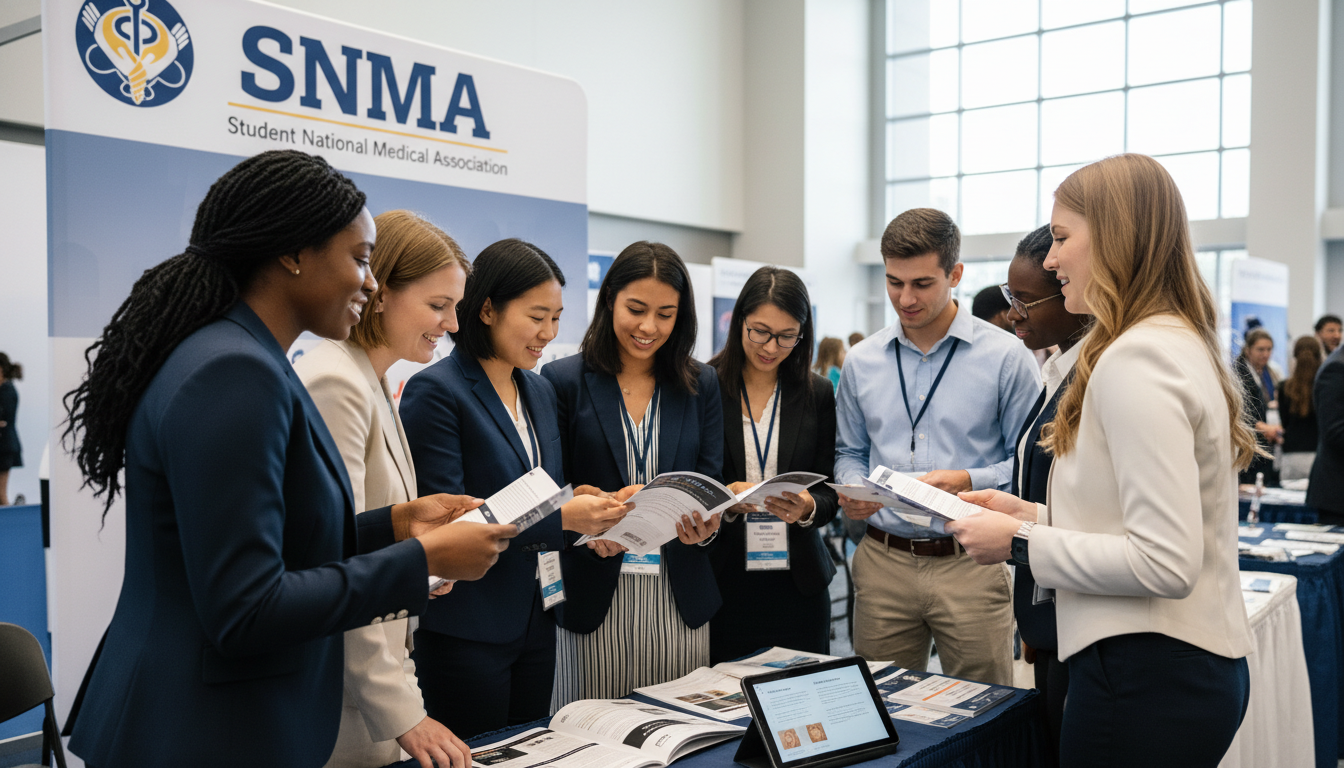
The assumption that SNMA is only for underrepresented minority students is wrong—and that misunderstanding quietly hurts both applicants and schools.
If you think “SNMA membership = Black student, identity-only space, not for me,” you’re operating off an outdated and incomplete picture of what the Student National Medical Association actually is and what it signals to admissions committees.
Let’s strip away the mythology and look at what SNMA really represents in the premed and medical education ecosystem—and what membership actually tells schools about you.
(See also: Does Paying Dues to AMSA or SNMA Actually Boost Your Match Chances? for more details.)
What SNMA Is Actually For (And Who It’s Actually For)
Start with the mission, not the rumor mill.
SNMA’s stated mission, going back to 1964, is:
“To support current and future underrepresented minority medical students, address the needs of underserved communities, and increase the number of clinically excellent, socially conscious, and culturally competent physicians.”
A few key words here: support, underrepresented, underserved, culturally competent.
Nowhere does that mission say:
- “Only URM students may join”
- “Only Black students may attend meetings”
- “Non-URM students are unwelcome”
In practice, SNMA chapters:
- Run pipeline programs for high school and college students (e.g., MAPS, HPREP, community STEM days)
- Host MCAT, Step, and board prep sessions
- Organize mentorship between premeds, med students, residents, and attendings
- Do health fairs, blood pressure screenings, vaccination drives, and health education in underserved communities
- Advocate around issues like health equity, bias in medicine, and access to care
All of those things need bodies, not just “URM bodies.”
Here’s the real pattern, across multiple schools: chapters are majority Black or URM at many institutions, but regularly include:
- Non-URM members who care about health disparities and equity
- International students
- Non-traditional students
- Pre-health majors who are still exploring
URM students are prioritized as the population being served and supported, but that is different from being the only ones allowed to participate.
That distinction matters to admissions more than most applicants realize.
Myth: “If I’m White or non-URM, I’ll Look Weird Joining SNMA”
This is the unspoken fear: “If I’m not URM, SNMA membership will look performative, tokenizing, or just strange.”
Schools are not confused about what SNMA is. They’ve been sending faculty advisors to SNMA chapters for decades. They send admissions deans to the SNMA Annual Medical Education Conference (AMEC) to recruit students and give talks.
What they see when they encounter SNMA-involved applicants—URM or not—is pretty consistent:
- Interest in underserved populations and health equity
- Willingness to engage across lines of difference
- Comfort being in spaces where you’re not necessarily at the center
Those are not soft, “feel-good” traits. They’re practical predictors of how you’ll handle:
- Caring for patients who don’t share your background
- Working in safety-net hospitals and clinics
- Interacting with colleagues from different racial, cultural, or socioeconomic backgrounds
Does that mean everyone should join SNMA to signal this? No. It means if your genuine interests align with SNMA’s mission, you’re not “out of place” by definition.
The applicants who get into trouble aren’t the non-URM students in SNMA. They’re the ones who:
- Put “SNMA member” on a list with zero real involvement
- Can’t articulate what SNMA does at their school
- Frame SNMA as a résumé line, not a community or a mission
Admissions committees are allergic to hollow signaling. That’s the actual risk—not your demographics.
What SNMA Membership Actually Signals to Schools
Let’s get specific. What signal does “SNMA member” send in an application?
On its own? Almost nothing. Like any student org, membership without context is basically noise.
What matters is:
- Your level of engagement
- The type of work you did
- How you describe it in your application and interviews
When fleshed out, meaningful SNMA involvement tends to signal three things:
1. Exposure to Structural and Social Determinants of Health
SNMA’s programming is disproportionately focused on:
- Health disparities by race, income, and geography
- Access to care issues in Medicaid, community health centers, FQHCs
- Mistrust in medicine and historical context (e.g., Tuskegee, Henrietta Lacks)
- Cultural competence and communication
If you’ve spent multiple semesters or years in SNMA, you’ve probably:
- Worked health fairs in neighborhoods your peers rarely visit
- Seen how language, transportation, insurance, and housing affect patient outcomes
- Talked with physicians who practice in resource-limited settings
When you write about that concretely—“I realized a patient’s biggest barrier wasn’t their A1c, it was their eviction notice”—you’re signaling a deeper understanding of medicine as a social system, not just a biochemical one.
Admissions committees, especially at urban and mission-driven schools, value this heavily.
2. Comfort Addressing Race and Equity Without Melting Down
Many applicants dance around anything related to race, inequity, or disadvantage. They’re scared of saying the wrong thing or look like they’re ticking a box.
Someone who’s been in SNMA, worked on initiatives, attended workshops, and actually listened in those spaces sends a different signal:
- You’ve heard URM peers and mentors talk about experiences of bias in classrooms and clinics
- You’ve seen real-time examples of how “colorblind medicine” fails real patients
- You’ve been in rooms where discomfort wasn’t a reason to shut down the conversation
When you articulate that in a mature, grounded way—without centering yourself as the hero—you’re telling schools: “I can handle the real conversations that happen in modern medicine.”
That’s a huge contrast from the applicant whose only mention of equity is “I believe all patients should be treated the same.”
They don’t mean harm. But they also don’t understand the territory yet.
3. Actual Service, Not Just Shadowing
SNMA’s bread and butter isn’t shadowing and research; it’s direct service and pipeline work:
- Running MAPS events for undergrads
- Tutoring local high school students in STEM
- Organizing premed conferences or suturing workshops
- Coordinating vaccine clinics or mental health awareness events
- Boot camps for MCAT or Step 1/2 for peers
These activities look like:
- Planning
- Logistics
- Accountability
- Working with community partners
On an application, that’s leadership under constraints—exactly what residency programs later screen for.
SNMA is one of the more “work-heavy” organizations. Schools know that. So when they see sustained involvement, it often signals more grind than a low-commitment premed club.
Premeds vs Med Students: How SNMA Plays Differently
SNMA functions on two levels:
- Undergraduate level through MAPS (Minority Association of Pre-Medical Students)
- Medical school level as SNMA proper
They’re connected but not identical.
As a Premed (MAPS / SNMA Chapter)
On the premed side, being involved in a MAPS chapter or an SNMA-affiliated premed org usually signals:
- Early interest in health equity and underserved communities
- Comfort learning from URM medical students and physicians
- Willingness to work on longer-term projects (e.g., semester-long pipeline programs)
Flags for admissions readers here:
- Did you just “attend meetings” or did you build anything?
- Can you name specific initiatives or outcomes?
- Do your essays show real reflection, or just “diversity buzzwords”?
Where it looks especially strong:
- You held an officer role (president, outreach chair, pipeline coordinator)
- You helped start or revive a dormant chapter
- You built a partnership with a school, clinic, or community org
- You mentored multiple younger students over time
Again, not about your race. About your work.
As a Med Student (SNMA Proper)
During medical school, SNMA involvement more strongly intersects with:
- Student government and curriculum committees
- Diversity, equity, and inclusion (DEI) efforts
- Community outreach projects with real institutional backing
What this can signal to residency programs later:
- You’ve been at the table in sometimes tense conversations (e.g., shelf exam bias, learning environment issues)
- You’re likely to contribute to the residency’s community work
- You’re comfortable with peer leadership
It doesn’t automatically make you a “social justice warrior” in the caricature sense. It shows you engage with one of the most persistent issues in medicine, instead of pretending it does not exist.
“Will Non-URM SNMA Membership Look Like I’m Overcompensating?”
Here’s the part everyone tiptoes around.
Could a non-URM applicant in SNMA come across as performative? Yes—if the rest of the application is inconsistent or shallow.
Admissions committees look for coherence. They’re asking:
- Do your activities form a believable story?
- Does your writing demonstrate insight, not just slogans?
- Are the communities you “care about” actually present in your experiences, or just in your essays?
Examples of incoherent profiles:
A non-URM applicant:
- Lists “SNMA member”
- No other equity/underserved experiences
- Personal statement about “cutting-edge neurosurgery and innovation”
- Zero mention of health disparities, access, or underserved work anywhere else
That reads as: “I thought this line would score diversity points.”
A URM applicant:
- Deep SNMA leadership
- No patient-facing or community-facing work
- Entire application framed as “I want to give back” but no specific evidence
That signals a mismatch between stated values and actual behavior.
On the other hand, coherent profiles might look like:
A White or Asian applicant:
- SNMA membership, tutor in pipeline program, officer role
- Volunteered in a free clinic in a largely Black neighborhood
- Did a capstone project on hypertension control in safety-net clinics
- Writes specifically about what they learned from mentors in SNMA
That reads as genuine, mission-aligned involvement.
A Black or Latino applicant:
- SNMA regional officer, health fair coordinator
- Started a mentoring program at their old high school
- Worked with the dean’s office on bias reporting or curriculum improvement
That reads as both identity- and mission-driven engagement, with execution behind the rhetoric.
The membership label is neutral. The story you tell around it is what carries weight.
How to Talk About SNMA in Your Application Without Sounding Like a Slogan Machine
If you want SNMA involvement—URM or not—to land well, you need to ditch vague language.
Admissions readers glaze over when they see:
- “I am passionate about diversity and inclusion.”
- “I learned the importance of cultural competency.”
- “I want to give back to my community.”
Instead, you should be doing three things:
Be concrete
- “As SNMA pipeline chair, I organized monthly mentorship sessions pairing 15 local high school students with our premed volunteers. We tracked their college application progress and saw 11/15 matriculate to four-year colleges.”
Describe tension and learning
- “At one SNMA meeting, students debated whether our pipeline program should prioritize GPA cutoffs or open access. Hearing from a classmate who’d started college in remedial courses challenged my assumptions about who ‘looks ready’ for STEM.”
Connect to your future behavior, not just your feelings
- “These experiences didn’t just make me ‘care more’ about equity. They taught me that outreach fails when it’s drop-in and sporadic. As a physician, I want to work in clinics that make longitudinal community partnerships a core part of their mission.”
Notice what’s missing: generic DEI buzzwords.
You don’t need to say “equity” for a reader to understand you’re doing equity work. You just need to describe reality well.
So, Who Should Be in SNMA?
Not everyone.
If your genuine interests are:
- Lab-based bench research with minimal people contact
- Pure health policy without any community-facing work
- Sports medicine in private practice with no real focus on underserved populations
Then SNMA may not naturally fit your story. That is fine.
However, you should seriously consider SNMA (or MAPS) if:
- You’re interested in working in underserved or safety-net settings
- You want to understand how race, class, and history affect patient trust and outcomes
- You care about pipeline work and mentorship
- You want longitudinal, community-based experiences instead of just one-off “volunteer hours”
And if you’re not URM but fit the criteria above?
You’re not an outsider. You’re potential capacity. Chapters need help. Most will be glad you showed up ready to work and ready to listen.

What Schools Actually See When They See SNMA
Strip away the labels, and here’s what admissions committees really infer when SNMA shows up in an application with substance behind it:
- You’ve operated in a mission-driven organization, not just a social club.
- You’ve had exposure to health disparities and equity issues beyond what’s in a textbook.
- You’re at least somewhat comfortable being in diverse, sometimes uncomfortable conversations.
Your race or URM status shapes your experience in SNMA, but it doesn’t define the value of the membership from an admissions lens.
The mistake is assuming SNMA is either:
- A restricted space “for URM only,” or
- A magical diversity badge that guarantees admissions points.
It’s neither.
It’s a context. A training ground. A set of experiences you can either leverage thoughtfully or squander as a bare bullet point.

The Bottom Line
Three key truths to keep straight:
SNMA is mission-specific, not race-exclusive. It exists to support URM students and underserved communities, but membership and meaningful participation are open to anyone serious about that mission.
Membership alone signals almost nothing; sustained, concrete work signals a lot. Admissions committees care about what you did through SNMA—leadership, pipeline work, community engagement—not just the acronym on your activity list.
For non-URM students, SNMA isn’t off-limits; it’s a test of sincerity. If your interests genuinely align, involvement can be a powerful, coherent part of your story. If you treat it as cosmetic, it will look cosmetic.
Get the myth out of your head: SNMA isn’t “only for URM students.” It’s for people willing to put in the work of making medicine less inequitable—and admissions committees can tell who actually has.