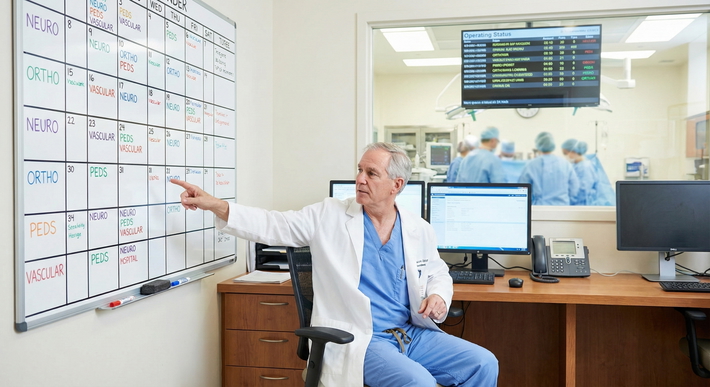
ACGME logs show the average general surgery resident finishes training having logged over 1,000 operations. Yet, ask a graduating chief resident what they're proudest of, and they won't talk about their 150th laparoscopic cholecystectomy. They'll brag about the single Whipple, the isolated pheochromocytoma excision, or the rare retroperitoneal sarcoma they scrubbed into once in 2023.
That is a clinical tragedy.
Before you prioritize those rare procedures, consider why big case logs can mislead surgical applicants.
Data from surgical ergonomics and motor-learning research consistently reveals a blunt truth: exposure to rare, complex "index" procedures does shockingly little to build surgical competence. In fact, single-digit exposures to complex cases actually impair technical acquisition by overloading cognitive capacity.
We have built a surgical education culture obsessed with rarity. We trade away high-repetition practice of fundamental skills to let trainees stand third-assist on an eight-hour unicorn case where they hold a retractor and learn virtually nothing. It's time to kill the rarity fetish.
Before chasing volume blindly, review case volume benchmarks for complex GI vs bread-and-butter surgery to understand where your focus should lie.
The Rare Case Obsession: A Statistical Mirage
Let's look at how adults actually acquire complex motor skills. It isn't through sporadic novelty. It's through deliberate, high-frequency repetition of core mechanics.
When a trainee scrubs into an extraordinarily rare procedure, say, an aortoenteric fistula repair, their cognitive load spikes to 100%. Psychologists call this intrinsic cognitive load: the mental energy required simply to process unfamiliar anatomy, unexpected pathology, and novel surgical steps. Because the trainee's working memory is completely maxed out just trying to figure out where the vascular clamp goes next, zero bandwidth remains for germane cognitive load, the actual mental processing required to encode long-term motor pathways.
High Novelty/Rarity --> Maximum Cognitive Load --> Zero Bandwidth for Motor Encoding
High Repetition/Routine --> Low Cognitive Load --> Deep Neuromuscular Automation
Trainees in these cases aren't learning how to operate. They're surviving the afternoon.
For those worried about their logged numbers, consult this guide on under-logged cases? a practical checklist to rebuild your case log.
Data confirms this. Studies analyzing surgical learning curves demonstrate that technical skill transfer doesn't flow backward from complex cases to simple ones. Performing one complex hepatobiliary resection doesn't magically make your tissue handling gentler during a routine hernia repair. However, perfecting your tissue planes, knot tying, and two-handed economy of motion across 100 routine hernia repairs directly elevates your performance when you finally do encounter aberrant anatomy.
For those unsure how to balance their training, learn more about how program directors quietly judge your surgical case logs to align your strategy.
Seeing a rare index case once or twice doesn't equal clinical mastery. It equals observational acquaintance. Claiming you know how to manage a pelvic exenteration because you held a suction tip for six hours during PGY-4 year is like claiming you can land a Boeing 747 because you sat in first class during a thunderstorm.
The Math of Mastery: Why Volume Wins
Surgical dexterity is not an innate gift; it's a myelinated neural pathway. Every time a surgeon executes a precise vector of traction and counter-traction during a standard appendectomy, the brain reinforces the neural circuits governing that movement.
"Bread-and-butter" volume is the primary vehicle for this neuromuscular patterning.
Consider the Ebbinghaus forgetting curve. When procedural steps are separated by months, which is inevitably the case for rare index procedures, decay sets in. The brain forgets the tactile resistance of the tissue. The hands lose the micro-adjustments needed to control tension. Every rare case becomes a reset button where the trainee starts from near-zero.
Contrast that with high-density, routine volume. Doing four laparoscopic cholecystectomies in a single day creates tight feedback loops. The trainee adjusts instrument angle on case two, refines cystic duct dissection on case three, and achieves genuine visual automaticity by case four.
Look at the surgical outcome data across broad patient registries like NSQIP. Complication rates do not plummet when surgeons hit case number 2 on a rare procedure. They plummet along a steep downward curve that stabilizes only after a surgeon has executed dozens, or hundreds, of routine instances of that core procedure family.
Why? Because high-volume routine exposure eliminates the "plateau effect."
Early in training, residents hit an initial performance plateau around case 15 or 20 of a standard operation. They can finish the case without getting into trouble, so they check the box and tune out. But real surgical mastery lives past that initial plateau. Between cases 50 and 200, the baseline task becomes so automated that the surgeon's brain frees up situational awareness. They start noticing subtle tissue color changes, microscopic capillary bleeding, and slight anatomical variations seconds before a complication occurs.
Volume buys cognitive headroom. Novelty drains it.
Deconstructing the Residency Log: Quality Over Rarity
If we want to build safer, sharper surgeons, we need to completely overhaul how residency programs evaluate clinical logs and structure rotations. Right now, program directors treat index case minimums like a scavenger hunt. Did the resident log their required pediatric cases? Did they get their three thoracic resections?
This box-checking model incentivizes quantity of unique CPT codes over depth of technical execution.
We need to force a structural shift. Here is how program directors and trainees should reorganize their approach to surgical education:
1. Rebuild Rotations Around High-Density Procedural Blocks
Stop sending residents to low-volume tertiary care sites just to chase exotic case logs. Prioritize high-volume community or regional centers where a junior resident can perform six to eight fundamental cases a day. Two months of uninterrupted, high-repetition abdominal wall reconstruction or basic laparoscopic surgery builds foundational dexterity that lasts a career.
2. Extract Micro-Skills from Macro Cases
Stop viewing a routine laparoscopic cholecystectomy as a monolithic, boring chore. Turn it into a laboratory for deliberate practice. Use case #75 to focus exclusively on non-dominant hand tissue tension. Use case #76 to practice zero-waste economy of motion, eliminating unnecessary instrument passes. Every "simple" case contains dozens of micro-skills that directly apply to the most complex operations in existence.
3. Measure Automation, Not Just Completion
Current logging systems track binary completion: Did you do the case? Yes or No. We should be tracking cognitive and technical automaticity. Can the trainee dissect the triangle of Calot while talking through the management of an intraoperative cholangiogram without breaking flow? That is the real metric of competence.
The narrative in surgical training needs an immediate reset. Stop parading rare case logs like badge collections. A trainee who has executed 250 flawless, high-efficiency, low-complication standard operations will handle an unexpected intraoperative disaster infinitely better than a trainee who stood on the sidelines for ten exotic procedures they will never perform again.
Mastery isn't performing the exceptional once. It's executing the routine flawlessly, every single time.
Key Takeaways
- Rarity Hinders Early Learning: Complex, rare index cases cause severe cognitive overload in trainees, preventing effective motor-pathway encoding and technical skill acquisition.
- Volume Drives Automaticity: High-repetition "bread-and-butter" procedures are the primary engine for neuromuscular patterning and tissue handling efficiency.
- Outcomes Track Repetition: Surgical registry data shows complication rates drop off sharply as volume increases within standard procedure categories, not from exposure to rare cases.
- Redefine Mastery: True surgical competence is defined by the ability to execute routine operations with zero wasted motion and total situational awareness, not by chasing low-frequency CPT codes.