
The obsession with surgical case numbers is misleading—and sometimes dangerous.
Everyone wants a number. “How many cases do I need to feel competent?” Residents ask it. Medical students whisper it on sub-I’s. Applicants grill program directors about it on interview day. The assumption: more cases = more competence.
That’s only half true.
Here’s the real answer: case volume matters a lot, but it’s less about the total number and more about the right number of the right cases with the right level of responsibility. Still, I’ll give you the ranges and benchmarks you’re actually looking for—and then tell you why those alone won’t save you.
1. The Short Answer: Rough Volume Targets by Level
Let me be concrete first, then explain.
These are ballpark numbers across common surgical paths. They’re not perfect, but they’re grounded in ACGME minimums, typical residency logs, and what practicing surgeons actually say makes them comfortable.
| Stage | Total Cases | Key Point |
|---|---|---|
| MS3-4 (core + electives) | 50–150 | Exposure, not competence |
| General surgery residency | 850–1,200+ | ACGME min ~850, good programs >1,000 |
| Surgical subspecialty fellowship | 400–1,200+ | Depends heavily on field |
| First 2 years in practice | 400–800/year | Where real competence consolidates |
Now procedure-specific estimates—rough ranges to feel reasonably competent doing something independently (not as your first year intern, but by graduation / early practice):
- Laparoscopic cholecystectomy: ~50–100 as primary surgeon
- Open inguinal hernia: ~30–50
- Appendectomy (open + lap): ~30–50
- Basic bread-and-butter endoscopy (EGD/colonoscopy): ~200–300
- C-section: ~50–100
- Cataract surgery: ~200–300
- ACL reconstruction: ~50–75
- Basic trauma laparotomy: ~25–40 as real primary, not “I closed skin”
Are these hard cutoffs? No. But if you finish training with half those numbers and feel “fully competent,” you’re probably overconfident.
2. Why Raw Case Numbers Lie (And What Actually Matters)
You can hit 1,500 cases and still feel shaky. I’ve seen it. You can also see someone with 900 cases operate circles around people with double their volume. Why?
Because not all cases are equal. Four key variables matter more than the raw count:
Complexity mix
Doing 200 simple ports or skin lesions is not the same as 200 real major cases. You need:- Bread-and-butter (the bulk of your future work)
- Moderate complexity (lap colectomy, pancreatitis gallbladders, revisional hernias)
- A realistic sample of high acuity (trauma, intra-op disasters, septic abdomens), even if you will refer some in future practice.
Your role in the case
“Assistant” on 300 cases is not the same as “primary” on 150, which is not the same as primary with minimal attending rescue on 100. Ask yourself bluntly:- How many cases did I truly do skin-to-skin?
- How often did I make the key decisions—approach selection, conversion, bailout plan?
- When things went wrong, did I manage the complication or just watch?
Deliberate practice vs. mindless repetition
Ten gallbladders where you:- Reviewed anatomy pre-op
- Mentally rehearsed steps
- Debriefed what went well/poorly
will move your skill more than 30 cases where you just hold the camera and think about lunch.
Feedback and reflection
A high-volume, low-feedback environment can produce fast hands and terrible judgment.
A slightly lower-volume but strongly mentored program can produce safe, thoughtful surgeons.
So yes—volume is necessary. But not sufficient.
3. Real Benchmarks: What Good Training Actually Looks Like
Let’s walk through typical phases so you can benchmark where you are and where you’re heading.
Medical Student: You Don’t Need Huge Volume
You do not need 300 cases in medical school.
As a student, the goal is:
- Comfort in the OR environment
- Basic sterile technique and assisting
- Rough map of common procedures
- Developing OR communication skills
If you graduate with:
- 50–100 cases observed/assisted total
- Including at least 10–20 “core” cases (appys, choles, hernias, C-sections, scopes, common ortho cases)
You’re fine. You’re not supposed to be “competent to operate” yet. You’re building familiarity, not independence.
Residency: Here’s Where Numbers Start to Matter
For general surgery, ACGME minimums are usually in the ~850 total case range by graduation. Good programs exceed that. Very strong programs often push you into the 1,100–1,400 zone.
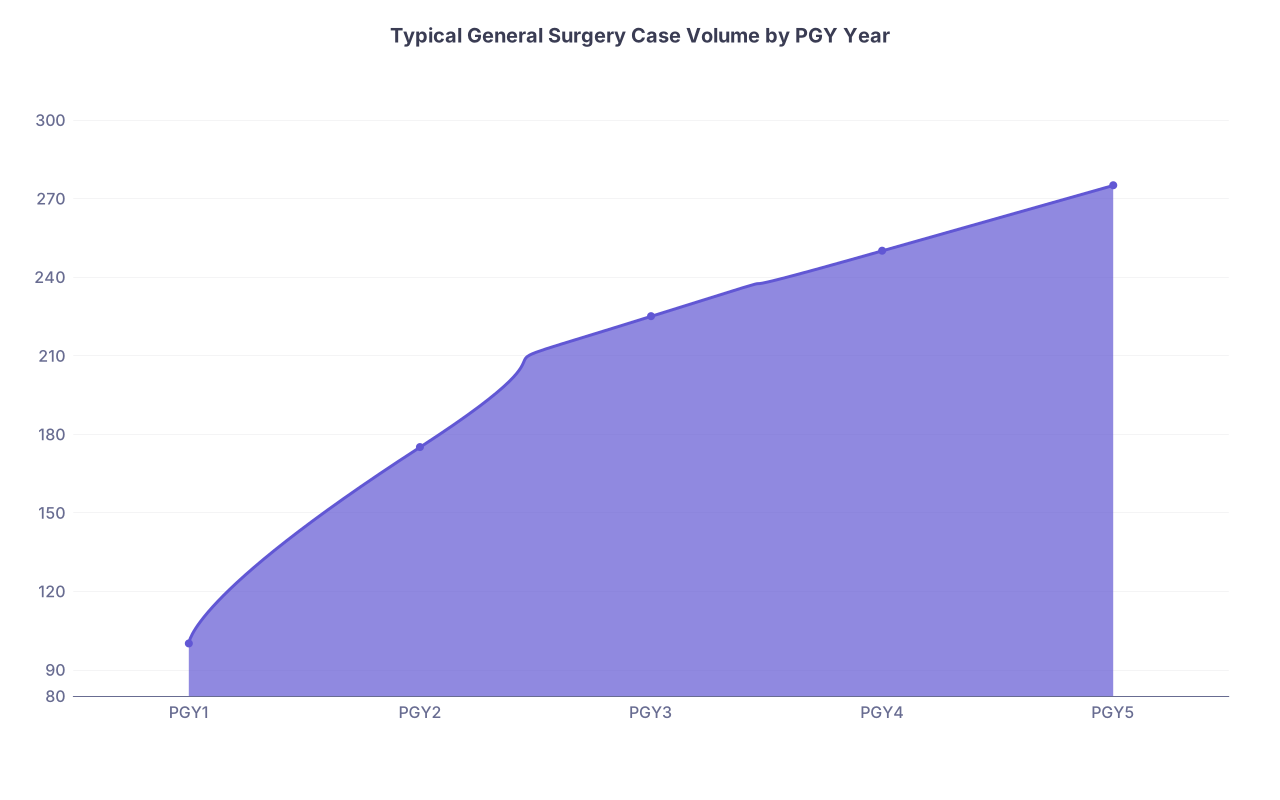
| Category | Value |
|---|---|
| PGY1 | 100 |
| PGY2 | 175 |
| PGY3 | 225 |
| PGY4 | 250 |
| PGY5 | 275 |
Here’s what I consider bare minimum vs solid training for a graduating chief in general surgery (numbers approximate, vary by program):
| Case Type | ACGME-ish Min | Solid Training Target |
|---|---|---|
| Total major cases | ~850 | 1,000–1,300 |
| Laparoscopic cholecystectomy | ~60 | 80–120 |
| Inguinal hernia (open + lap) | ~30 | 40–80 |
| Appendectomy (open + lap) | ~25 | 35–70 |
| Basic endoscopy (EGD/colo) | ~100 | 200–300 |
| Thyroid/parathyroid | ~20 | 30–50 |
| Trauma laparotomy | ~10 | 20–40 |
If you’re graduating below the minimums, you should be worried. If you’re at the solid targets, you’ll still feel nervous in July—but appropriately nervous, not paralyzed.
Subspecialty Fellowship: Depth Over Breadth
For fellowship (ortho, ENT, plastics, vascular, colorectal, etc.), you’re looking less at total cases and more at high-volume repetition of key procedures.
Examples:
- Orthopedic sports: 60–100 ACLs, 100+ shoulder arthroscopies
- Colorectal: 60–100 colorectal resections, strong exposure to lap/minimally invasive approaches
- Vascular: 50–100 open vascular cases, 100+ endovascular interventions
Again, this isn’t just logging 600 cases. It’s doing the cases you’ll actually perform in practice—enough times that the steps and pitfalls are in your muscle memory.
4. How Many Cases to Actually Feel Competent?
Competent is not “perfect.” It’s:
- Safe, reproducible technique
- Reasonable speed (not painfully slow, not reckless fast)
- Ability to handle the common variations and minor complications without panicking
Here’s a practical framework for a single procedure you’ll do regularly, like a lap chole:
0–10 cases: You’re a liability. You’re trying to remember steps. You barely know what you don’t know.
10–25: You can complete the procedure with help. Still fragile.
25–50: Big improvement. You start to recognize patterns, common variations, easy vs. hard setups.
50–100: For most residents, this is where “I can actually do this” starts feeling real. You can usually get through even moderate difficulty cases with minimal rescue.
100–200: Now you’re not just executing; you’re troubleshooting, anticipating complications, and teaching juniors the operation.
That curve applies to a lot of repetitive procedures: scopes, C-sections, cataracts, straightforward arthroscopies, etc. Complex, high-risk, or rare operations can take much longer to feel comfortable with—if you ever do.
5. The Competence Equation: Volume × Intentionality × Responsibility
If you want a mental formula, use this:
Perceived competence ≈ (Number of relevant cases) × (How actively you were operating/thinking) × (How much real responsibility you held).
You can hack this in your favor:
- Stop logging “fluff” as if it’s equal. That skin tag you watched? Not the same currency as a primary lap colectomy.
- Before each OR day, pick 1–2 cases you will deeply own. Know the patient, imaging, steps, alternatives, complications.
- During the case, call out anatomy in your head, think a step ahead, anticipate instruments. Act like the primary even if you’re technically “assistant.”
- After the case, write a 2-minute note to yourself: what worked, what went sideways, what you’ll do differently next time.
You’ll get more competence out of 600 cases with that mindset than 1,200 cases on cruise control.
6. Specialty-Specific Reality Checks
Some fields are procedural-heavy by nature; some are more judgment-driven with fewer, bigger cases.
Here’s a rough feel:

- General surgery: Breadth is massive. You will not feel truly competent in everything at graduation. You’re aiming for solid comfort in core bread-and-butter operations, plus enough exposure to know when to call for help or refer.
- Orthopedics: Repetition is your friend. High-volume joint, trauma, and sports fellowships can make you very technically confident on a subset of procedures by the end.
- Ophthalmology: Very high-volume, highly standardized procedures (like cataract) mean you can get technically slick—but complications are catastrophic, so judgment matters more than sheer volume once you pass the early learning curve.
- Neurosurgery / CT surgery: More complex, lower-volume, higher stakes. You need more years, not just more cases, because complication management and long-term outcomes force deeper judgment.
Bottom line: do not compare your lap chole numbers to someone’s CABG numbers and think you’re behind or ahead. Different game.
7. How to Tell If Your Case Volume Is Actually Enough
Here’s a quick self-audit that’s more honest than staring at your log:
- Pick your top 10 procedures you’ll do in independent practice.
- For each, ask:
- How many have I done as real primary (not token primary)?
- Have I done enough “ugly” versions—obesity, chronic inflammation, prior surgery, borderline anatomy?
- Have I personally managed at least a couple complications for each (bile leak, anastomotic leak, wound dehiscence, etc.)?
- Gut check: If your attending disappeared at the midpoint of a moderate difficulty case, could you:
- Safely finish?
- Or at least bail out safely (convert, drain, close, defer)?
If the honest answer is “no” across most of your key procedures, you either need:
- More focused volume on those cases, or
- A fellowship, or
- A very intentional early-practice environment with strong backup.
8. Future of Case Volume: Why This Question Keeps Getting Harder
Here’s the uncomfortable truth: the “golden age” of crazy-high-volume, open, do-everything-yourself residency is largely gone.
Several trends are squeezing case numbers and complexity:
- More subspecialization
- More minimally invasive and endovascular approaches shifting cases to certain centers or fellowships
- Duty-hour limits
- Simulation and robotic platforms changing how early operative exposure looks
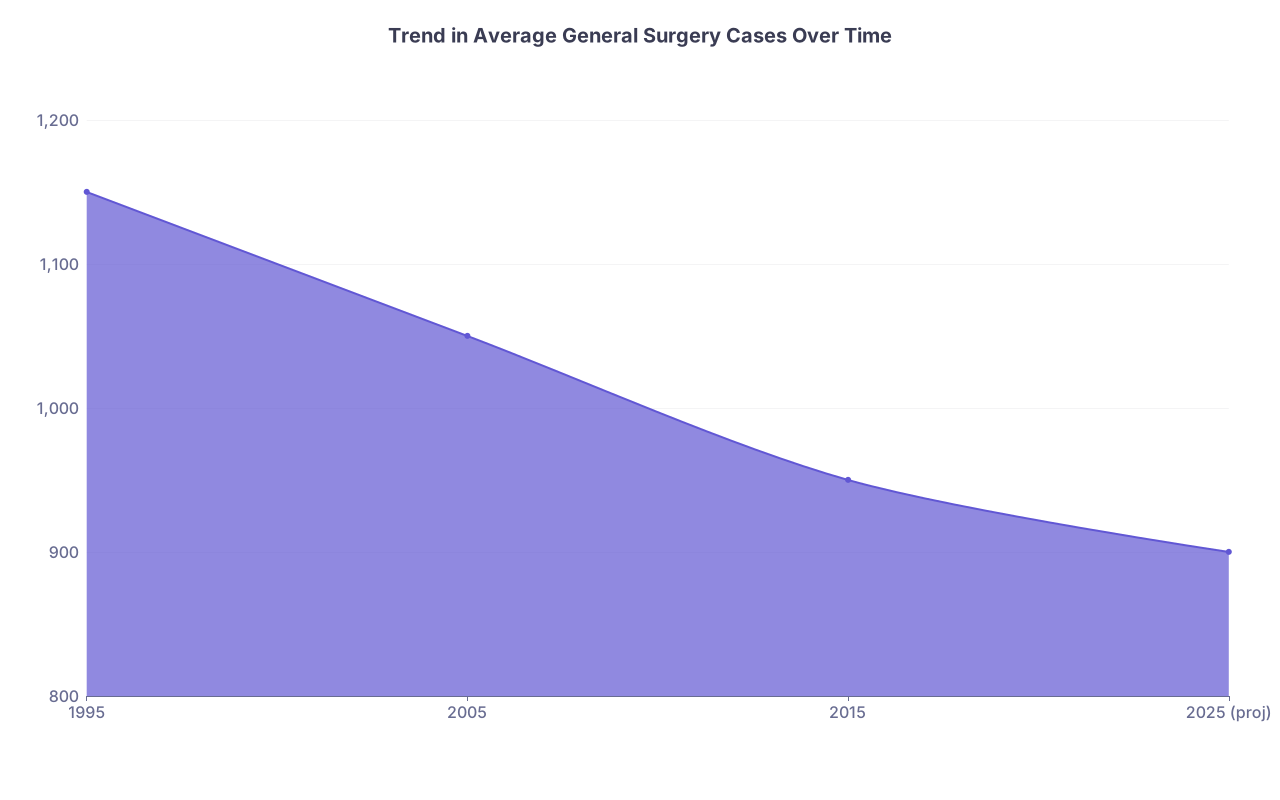
| Category | Value |
|---|---|
| 1995 | 1150 |
| 2005 | 1050 |
| 2015 | 950 |
| 2025 (proj) | 900 |
You’re not going to get the same exposure a 1990s resident did. But that does not automatically make you worse—if training changes smartly.
Expect more of this:
- High-fidelity simulation and VR for early learning curves
- Structured, graded autonomy pathways (“you own this case” models)
- Data-driven tracking of not just volume but outcomes by surgeon even in training
- Narrower practice scopes—being excellent at a smaller set of procedures instead of mediocre at everything
The question “How many cases do I need?” will slowly morph into “How many of which cases, with what demonstrated outcomes, under what supervision model?”
9. Practical Advice If You’re Worried Right Now
If you’re a student:
Stop counting cases. Focus on:
- Getting comfortable in the OR
- Learning anatomy and steps of key procedures
- Watching how surgeons think, not just what they do with their hands
If you’re a junior resident:
- Push early for hands-on time in bread-and-butter cases
- Ask explicitly: “Can I run this case from incision to closure?”
- Log accurately—don’t inflate. Lying to yourself is worse than lying to ACGME.
If you’re a senior resident and your numbers are low in critical areas:
- Sit down with your PD with your actual log and a list of your top 10 procedures. Be direct: “I need more primary experience in X, Y, Z before graduation. How do we make that happen?”
- Trade where you can: pick up call, take less desirable rotations, volunteer for night cases.
- Consider a fellowship that truly fills the gaps you care about, not just any fellowship for prestige.
If you’re new in practice:
- Your first 2 years are where real competence solidifies.
- Start with a narrower scope than you think you can handle.
- Track your own outcomes—complications, reoperations, conversions. Numbers don’t lie.

| Step | Description |
|---|---|
| Step 1 | Student exposure |
| Step 2 | Junior resident volume |
| Step 3 | Senior resident autonomy |
| Step 4 | Fellowship depth |
| Step 5 | Early practice consolidation |
| Step 6 | Stable independent competence |
FAQ: Surgical Case Volume and Competence
1. Is there a universal “magic number” of total cases to be a competent surgeon?
No. If you forced me to give a ballpark, I’d say ~1,000 well-distributed cases with real primary responsibility across core procedures is where many general surgery graduates start to feel functionally competent. But it’s not universal. Field, case mix, quality of supervision, and how much you actually operated all change the equation.
2. I’m a rising chief with “only” ~800 cases. Am I in trouble?
Maybe, maybe not. Look at your distribution. If you have:
- Strong numbers in bread-and-butter cases you’ll actually do in practice
- Real autonomy in those cases
- Enough experience with complications and bailouts
You can be okay at 800. If, instead, you’ve got a bloated log full of assistant roles and scattered, rare cases with no repetition, then yes, you should be concerned and push hard in your last year (and seriously consider targeted fellowship training).
3. How many times do I need to do a procedure before I stop feeling terrified?
For common, moderate-difficulty operations like lap chole or C-section, most people start feeling reasonably less terrified around 30–50 cases as primary, and genuinely comfortable around 50–100. Terror isn’t always a bad sign. Overconfidence with 10–15 cases under your belt is way more dangerous than a healthy level of anxiety at 60.
4. Do simulation labs and VR actually reduce the real-life case numbers I need?
They help with the early part of the learning curve—basic psychomotor skills, familiarity with instruments, gross steps. That can shave off a chunk of your first 10–20 “real” cases. But they do not fully replace real, messy, bleeding, imperfect anatomy. Think of sim as multiplying the value of your first 50 real cases, not a reason to accept 50 fewer.
5. If I realize late that my volume is weak, is it too late to fix?
Not necessarily. You have levers:
- Push aggressively for targeted experiences as a senior
- Choose a high-volume, high-autonomy fellowship that fills your gaps
- Start practice in a setting with strong mentorship and backup, with a narrower initial scope
What you can’t do is pretend the gap doesn’t exist. Competence in surgery is brutally transparent over time. Better to confront it early and intentionally than have it exposed by complications you weren’t ready for.
Key takeaways:
- Raw case numbers matter, but case mix, responsibility, and deliberate practice matter more.
- For most surgeons, real comfort in a given procedure usually starts around 50–100 quality primary cases, not 5–10.
- If your log looks thin in the procedures you’ll actually perform, you don’t need reassurance—you need a plan.