
You’re on call, it’s 1:30 a.m., and you just finished a laparoscopic appy where you held the camera and helped close. Walking back to the workroom, you open your logging app and freeze at the drop-down: “Role – Surgeon Junior? Assistant? Observer?” You know this case felt meaningful… but does it “count”? Are you gaming the numbers if you log it too high, or selling yourself short if you log it too low?
Here’s the answer you’re looking for: “meaningful” isn’t mystical. Programs, boards, and future employers are all basically asking the same thing:
Did you do work that actually contributed to the operation and your development as a surgeon?
Let’s break that down in a way you can actually use when you’re logging cases at midnight.
1. What “Meaningful Role” Really Means (Without the Buzzwords)
Strip away the jargon and politics. A meaningful role in a surgical case log usually means three things at once:
- You were physically scrubbed and in the OR for the key portion(s) of the case.
- You had defined responsibilities that affected the conduct or outcome of the operation.
- You actually learned or practiced a surgical skill, not just watched.
Being in the room doesn’t make it meaningful. Being scrubbed doesn’t automatically make it meaningful either. The real test: if you disappeared halfway through, would anyone have noticed enough to change what was happening?
If the honest answer is yes, you had a meaningful role.
If the honest answer is no, you’re probably in “observer” territory.
2. Translating “Meaningful” Into Case-Log Roles
Most systems (ACGME, ACS/Case Log, etc.) divide roles into a few standard buckets. The labels differ slightly by specialty and country, but they almost always map to something like this:
| Role Label | Typical Abbreviation | Real-World Meaning |
|---|---|---|
| Primary Surgeon | S / Surgeon | Led and performed key portions |
| Teaching Assistant | TA | Assisted while teaching another |
| First Assistant | A / FA | Essential assistant work |
| Second Assist | SA | Helpful but not essential |
| Observer | O | Watched, maybe retracted briefly |
Here’s the practical translation you actually care about.
Primary Surgeon (Junior / Senior)
You count as primary (or “surgeon junior/senior”) when:
- You performed most of the critical steps appropriate for your level.
- The attending’s hands were off or only intermittently involved.
- If you’d walked out, the case would have been significantly disrupted.
Examples that do qualify as meaningful primary roles for trainees:
PGY-2 doing an open inguinal hernia where you:
- made the incision
- dissected to the sac
- opened the external oblique
- did the repair with mesh under supervision
- closed the wound
PGY-4 doing a laparoscopic cholecystectomy where you:
- obtained access and insufflation
- performed the dissection in Calot’s triangle
- clipped and divided cystic duct and artery
- took the gallbladder off the liver bed
You don’t need to do every step. But you should clearly be the main operator at your PGY level.
Teaching Assistant
This is meaningful when:
- You’re scrubbed.
- You could do the case yourself, but your main goal is to let a more junior resident operate.
- You’re actively guiding, retracting smartly, exposing, and giving real-time feedback.
If you’re a chief letting a PGY-3 do the laparoscopic appy while you handle the camera, troubleshoot views, and coach through the dissection — that’s a meaningful teaching assistant role. You’re shaping the case, just not doing every move.
First Assistant
First assist is where a lot of residents undersell or oversell themselves.
You’re a meaningful first assistant when:
- Your retraction, suction, or stapling directly enables the critical steps.
- You’re controlling instruments that, if done badly, would create complications (e.g., vascular control, stapler firing, tension on tissue).
- You anticipate needs, manage field exposure, and occasionally perform important steps.
Examples:
- Holding the uterus and providing traction during a TAH/BSO so the attending can safely dissect vessels.
- Managing the camera and controlling one additional working port during laparoscopy, shaping the visual field and exposure.
- Placing and firing endoscopic staplers for bowel transection or anastomosis under supervision.
This absolutely counts as a meaningful role. It’s not “just watching.”
Second Assist vs. Observer
Second assist can still be meaningful, but it’s thinner ice.
Second assist, meaningful:
- You’re doing targeted tasks: controlling suction around a bleeding field, helping with limb positioning, or alternating retraction in deep, limited spaces.
- Your absence would make the case harder, slower, or less safe.
Observer:
- You’re scrubbed late, mostly watching, maybe hold a lap pad for 5 minutes.
- You stand at the foot of the bed, never really part of the operation.
- You don’t know the step sequence, and no one is directing you specifically.
If you’re hesitating whether it’s second assist or observer, it’s probably observer.
3. What Boards and Programs Actually Care About
You’re not logging cases for fun. You’re logging to prove something: that your experience was deep enough, frequent enough, and meaningful enough to make you a safe independent surgeon.
, Case diversity, Meaningful role, Progression over time](https://cdn.residencyadvisor.com/images/articles_svg/chart-relative-importance-of-case-log-attributes-1089.svg "Relative importance of case log attributes")
| Category | Value |
|---|---|
| [Case volume](https://residencyadvisor.com/resources/surgical-case-volume/does-surgical-case-volume-matter-more-than-reputation-for-training) | 30 |
| Case diversity | 25 |
| Meaningful role | 30 |
| Progression over time | 15 |
Most program directors and certifying boards look at four things:
- Total volume – Did you hit the raw numbers?
- Breadth – Did you cover the major index procedures for your specialty?
- Level of responsibility – Were you primary/teaching assistant often enough, especially by senior years?
- Trajectory – Did your role advance over time (PGY-1 mostly assist, PGY-5 mostly primary/TA)?
Here’s the key: they know trainees inflate. Everyone does. So what they look for is pattern, not perfection.
Red flags I’ve seen when reviewing logs:
- PGY-2 logging “surgeon” on complex hepatectomies or Whipples. No chance.
- Resident with massive volume, but almost all as “assistant” or “observer” even in PGY-4/5. Suggests they never really took the knife.
- All attendings are “Dr. ChiefResident” — never sharing cases among faculty. That screams fantasy or copy-paste logging.
If your log shows a believable progression from observer → assistant → primary/TA, with reasonable complexity for your level, you’re fine. That’s what “meaningful” looks like to them.
4. Case Scenarios: What You Should Actually Log
Let’s walk through the typical gray zones where people get stuck.
Scenario 1: Camera Holder in Lap Appy
PGY-1, first month. Laparoscopic appendectomy.
You:
- Held the camera the entire time.
- Adjusted angles, zoom, and horizon when asked.
- Helped close port sites.
Attending and senior resident did the dissection and stapling.
How to log:
- Role: Assistant / First Assist.
- Was it “meaningful”? Yes — if you were truly controlling visualization and not zoning out. Camera work is not trivial.
Scenario 2: Long Vascular Case, Minor Tasks
You:
- Retracted occasionally.
- Cut some sutures.
- Never controlled a vessel or major structure.
- Could have left without changing how the case went.
How to log:
- Role: Observer or Second Assist, but educationally this is closer to observer.
- Meaningful surgically? Not really. Educationally, maybe — but it doesn’t “prove” much about your technical ability.
Scenario 3: You Did Most of an Index Case, Attending Did the Hardest Part
Open colectomy.
You:
- Made the incision.
- Mobilized colon.
- Performed most of the dissection and division of the mesentery.
- Attending did the anastomosis and critical vasculature.
- You closed.
How to log:
- Role: Surgeon Junior / Primary is appropriate, especially as mid-level or senior.
- Don’t overthink that the attending did some key steps. That’s normal. It’s still a meaningful primary role.
Scenario 4: Chief Letting Junior Run the Show
PGY-5 chief, PGY-3 junior.
Lap chole. You:
- Ran the camera and occasionally assisted with retraction.
- Coached the junior through safe dissection.
- Stepped in briefly during a tough part.
How to log:
- Chief: Teaching Assistant – meaningful as hell; boards and programs want to see this.
- Junior: Surgeon Junior / Primary – they did the bulk of the operating.
5. What Doesn’t Count As Meaningful (Even If the EMR Says You Were There)
Let me be blunt. These are things people try to log as “assistant” or “surgeon” that are mostly meaningless from a competency standpoint:
- Scrubbed for <10 minutes of a 4-hour case to help close skin only.
- Standing at the back table for “learning” without touching the patient.
- Logging brief bedside procedures (removing staples, simple dressings) as full “cases.”
- Double-logging the same role when two residents are both barely helping.
You still might log them in your system if required, but don’t kid yourself: they don’t demonstrate much about your ability to operate.
A good internal test:
If you had to justify this role in front of an oral boards examiner, could you clearly explain what you did technically and why it mattered?
If you’d be embarrassed to say it out loud, downgrade the role.
6. Ethical Logging: Avoiding the Two Big Traps
There are two ways people screw this up:
- Inflating roles to pad numbers.
- Underselling themselves from impostor syndrome.
Both are bad. The first is unprofessional; the second hurts you and gives a false impression of your growth.
Don’t Inflate
Overselling your role:
- Erodes trust with faculty when they review your logs.
- Can raise questions at promotion or credentialing.
- Leaves you exposed if your logged experience doesn’t match your actual skill in the OR or on boards.
If you were essentially an observer, log observer. If you were second assist, don’t call yourself primary.
Don’t Undersell
On the flip side, I routinely see residents — especially quieter or underconfident ones — log:
- “Assistant” on cases where they clearly ran the show.
- “Observer” because the attending stepped in for 20% of the case.
That hurts you later. Your log is part of your training story. If you reasonably acted as the main operator for your level, log it that way.
When in doubt, ask this:
Who was the primary learner and actor in the case?
If it was you, not the attending, you’re probably “surgeon junior” or TA.
7. A Simple Decision Flow You Can Use After Every Case
Here’s a stripped-down mental algorithm that takes 10 seconds once you get used to it.

| Step | Description |
|---|---|
| Step 1 | Finished a case |
| Step 2 | Observer |
| Step 3 | First Assist |
| Step 4 | Second Assist |
| Step 5 | Surgeon Junior or Primary |
| Step 6 | Teaching Assistant |
| Step 7 | Was I scrubbed for key steps? |
| Step 8 | Could I have done most of this case myself? |
| Step 9 | Did my work enable critical steps? |
| Step 10 | Was I the main operator or teacher? |
If you follow that honestly, your log will look clean, credible, and defensible.
8. How “Meaningful” Roles Should Evolve Over Training
If you’re looking ahead — good. A meaningful case log isn’t just today’s entry; it’s the whole arc.
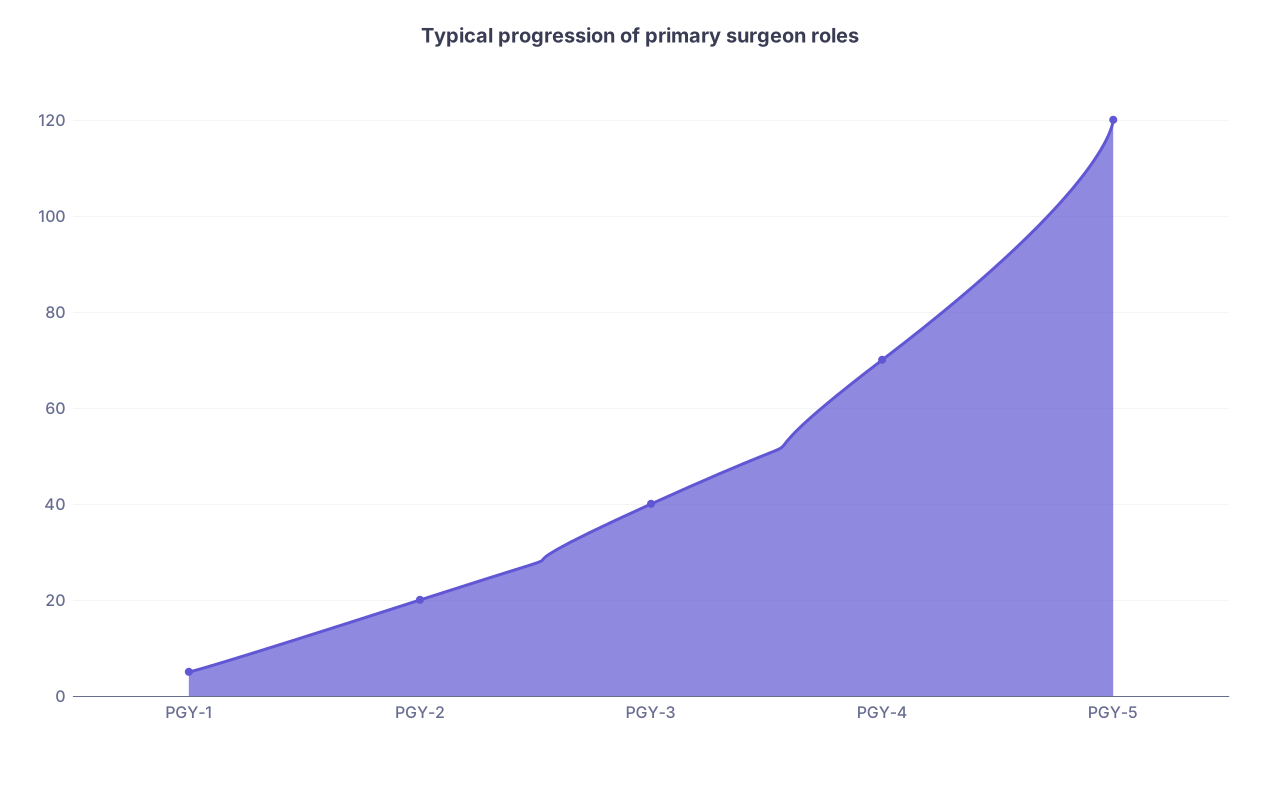
| Category | Value |
|---|---|
| PGY-1 | 5 |
| PGY-2 | 20 |
| PGY-3 | 40 |
| PGY-4 | 70 |
| PGY-5 | 120 |
A healthy progression usually looks like this:
- PGY-1 – Mostly assistant, some observer, a handful of primary on minor procedures (port removals, I&Ds, simple hernias).
- PGY-2–3 – More first assist, increasingly primary on bread-and-butter cases at appropriate complexity.
- PGY-4 – Majority of index cases as primary (with supervision), some teaching assistant on easier ones.
- PGY-5 – Mostly primary or teaching assistant. Very few cases where you’re “just” assisting.
If you’re a PGY-4 and still mostly logging “assistant” on routine cases, that’s not a logging problem. That’s a training problem. Talk to your PD or mentors to fix that in real life, not in the case log after the fact.
9. A Quick Word on Non-OR “Cases”
Minor procedures, endoscopy, bedside procedures — they muddy the waters.
The rule doesn’t actually change:
- If you did the procedure yourself (or essentially all of it) under supervision → primary.
- If you were just watching someone else scope or place a line → observer.
- If you were hands-on but not leading (helped with positioning, held the scope occasionally) → assistant.
Don’t try to pad surgical experience with a thousand minor bedside procedures logged as “primary surgeon.” Boards can tell.
10. Bottom Line: What Counts as “Meaningful” in Your Log
You don’t need to obsess over every single entry. You do need to be honest and consistent.
Three takeaways:
- Meaningful = you contributed in a way that changed the case and built your skills, not just stood there.
- Log your real role, not the role you wish you’d had — but don’t undersell when you truly operated.
- Your pattern over time matters more than any one case: early assist/observe, then steadily more primary/teaching assistant as you advance.
If you can defend your entries in plain language — “Here’s what I did, here’s why it mattered” — you’re logging your surgical case experience the right way.