
The myth that “no one actually looks at your case logs” is dangerously wrong. Credentialing boards do review case volume—just not in the simplistic, every-chart-audited way residents imagine.
Here’s the real story: they look more often than you think, but differently than you expect.
The Short Answer: When Do They Actually Look?
Let me be direct.
Your case volume is actively reviewed at three main points:
- When you first request privileges at a hospital or surgery center
- At scheduled recredentialing cycles (usually every 2 years)
- When there’s a trigger: complication, complaint, outlier, or new procedure request
No one is sitting there reading through all 800 of your lap chole notes line by line. But your numbers—volumes, mix, and outcomes—absolutely get pulled, summarized, and discussed.
If you’re expecting a “do they / don’t they” yes-or-no answer, here it is:
They do. Routinely at reappointment. Intensively when there’s a problem. Selectively when you ask for more.
Let’s break that down by phase of your career and type of board.
What “Credentialing Boards” Are Actually Looking At
First, clarify who we’re talking about. “Credentialing board” can mean several different groups, and they each touch your case volume differently.
| Reviewer Type | Typical Timing | Depth of Case Volume Review |
|---|---|---|
| Hospital Credentials Committee | Initial + q2 years | Moderate–High |
| Department/Service Chief | Initial + focused reviews | High for complex cases |
| Medical Executive Committee | Escalated/appeals only | Targeted, issue-driven |
| Health Plan / Insurer | Initial + periodic | Low–Moderate (summary data) |
| Specialty Board (MOC) | At recert intervals | Low–Moderate (case logs/samples) |
They’re not all combing through your individual operative notes. But they absolutely look at:
- Your total volume per procedure
- Trends over time (increasing, stable, or dropping off a cliff)
- Whether you meet their defined minimums for specific privileges
- Outlier patterns: complication rates, returns to OR, mortality, LOS
And yes, that includes your robotic cases, your complex spine work, your advanced endoscopy—the things that get people in trouble when their training and their volume don’t match their ambitions.
Initial Credentialing: Where Case Volume Matters Most
Your first credentialing at a new institution is where your case logs matter the most. This is where they decide what they will actually let you do.
Typical flow:
- You fill out your application and privilege request form.
- You submit operative logs or a procedure summary (often from your training program or previous hospital).
- Medical staff office assembles the packet.
- Department chief / section head reviews your requested scope vs your documented volume.
- Credentials Committee and then the Medical Executive Committee sign off.
That step with the department chief? That’s where your case volume is very much looked at.
Common scenarios I’ve seen:
- Young ENT wants complex skull base privileges with 5 cases in fellowship. Denied or limited to “under supervision / joint cases” until volume increases.
- General surgeon requests advanced laparoscopic bariatrics with low case numbers and no fellowship. Committee pushes back, asks for proctoring or more documentation.
- Cardiologist wants structural heart privileges but has 15 TAVRs as assistant, 2 as primary. Delayed until higher volume or formal letter from training program.
Here’s what they actually do with your numbers:
- Compare your requested privileges to your documented case volume and training letters
- Cross-check against internal criteria (e.g., “initial robotic privileges require 20 proctored cases” or “bariatric requires 100 lifetime primary cases”)
- Look at recency—10 cases 7 years ago carries less weight than 10 cases last year
Are they reading every operative note? Usually not. But if your requested scope seems aggressive relative to your training and logs, they absolutely start spot-checking.
Recredentialing: How Often and How Deep?
Most hospitals recredential every 2 years. That’s when your volume and outcomes get re-reviewed.
What happens then:
- A standardized report is generated from the EHR / OR system:
- Number of each key procedure
- Basic outcomes: mortality, readmissions, returns to OR, infections
- Peer review flags or serious events
- Department chief reviews your numbers relative to:
- Peers in the same specialty
- Institutional minimums for maintaining privileges
- Credentials Committee sees a summary, not raw logs
Typical depth: they look at totals and trends. If anything looks odd, they dig deeper.
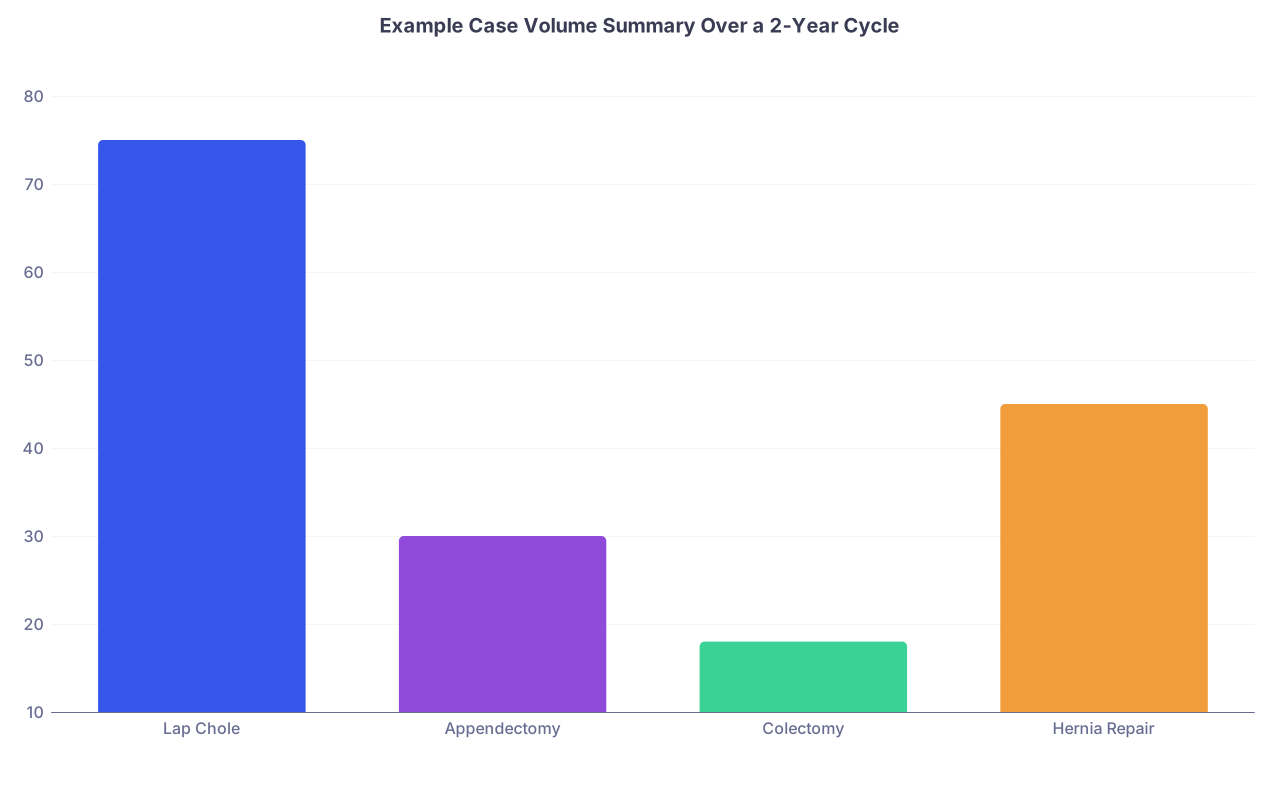
| Category | Value |
|---|---|
| Lap Chole | 75 |
| Appendectomy | 30 |
| Colectomy | 18 |
| Hernia Repair | 45 |
If those numbers dropped to 5, 2, 1, and 3, and you’re a “general surgeon,” that triggers questions.
Where they get serious:
- Extremely low volume for a high-risk procedure (e.g., 2 open AAA repairs in 2 years)
- Volume far below peers for something you want to keep doing
- Complication patterns: multiple bile duct injuries, multiple leaks, repeated returns
This is where minimum volume thresholds start to matter.
Some hospitals quietly enforce things like:
- “Maintain carotid privileges with ≥10 cases every 2 years”
- “Maintain robotic privileges with ≥15 cases every 2 years”
- “Maintain TAVR privileges with ≥25 per year (team-based metric)”
Are these universal? No. But more systems are implementing them, especially for high-risk, high-cost procedures.
Triggered Reviews: When Your Case Volume Is Scrutinized Hard
Most intensive reviews are not routine. They’re reactive.
Four common triggers:
Sentinel event or catastrophic outcome
- Major complication that leads to death, litigation, or media attention
- The hospital reviews not just that case, but your volume and outcomes for similar cases
Pattern of complications
- Multiple CLABSI in your central lines
- Unusually high anastomotic leak rate
- Excessive conversions to open or returns to OR
Complaints from colleagues or staff
- “We keep having to take this surgeon’s patients back to the OR”
- “This proceduralist is very slow and unsafe with X procedure”
Request to expand your scope
- Adding advanced robotics, new structural procedures, complex endovascular
- Board wants to see that your base volume and outcomes are solid
During these reviews, your case volume isn’t just “glanced at.” It’s dissected:
- How many similar procedures you’ve done in the last 12–24 months
- How your complication rate compares with peers
- Whether your volume is so low that you can’t possibly stay sharp
- Whether the event looks like a one-off or the tip of the iceberg
I’ve seen surgeons lose specific privileges when a bad case exposed a total lack of recent volume. “You’ve done three of these in five years” is not a fun conversation.
Insurance Panels, Specialty Boards, and Case Volume
Hospitals are not the only ones who care.
Health plans / insurers
Commercial plans and Medicare Advantage networks sometimes request:
- Total annual case volume by CPT category
- Supporting documentation for high-cost procedures (LVAD, TAVR, bariatrics)
- Evidence that you meet “centers of excellence” criteria for certain procedures
They’re not reading your operative notes, but they absolutely may use volume benchmarks to:
- Approve or deny “in-network” performance of certain surgeries
- Designate you as part of a preferred network or center
- Push cases to higher-volume centers
Specialty boards (MOC and recertification)
Most surgical and procedural boards now include some kind of practice assessment:
- Case logs for a specified period
- Outcome reports
- Morbidity/mortality reflection modules
Are they cross-checking every line item against your EHR? Nearly never. They’re operating on professional honesty and random audits.
But for subspecialty certification (e.g., complex spine, interventional cardiology):
- Case volume requirements are explicit and enforced
- You may have to submit detailed logs, with board staff doing spot checks
Bottom line: the higher the risk and the more niche the skill, the more likely someone is tracking your volume.
Robotic, Endovascular, and “Cutting-Edge”: Extra Scrutiny
Anything labeled “advanced,” “complex,” or “robotic” gets more attention. Because that’s where the hospital’s risk is.
Common patterns:
- Initial credentialing requires:
- Specific fellowship or vendor training course
- Letter from proctor or program director
- Minimum initial case numbers (e.g., 20 supervised robotic cases)
- Ongoing privileges require:
- Minimum annual or biennial volume
- Low enough complication rates compared to peers
If you used the robot a ton in your fellowship and then barely touch it in practice, some institutions will quietly let those specific robotic privileges lapse at recredentialing. Especially if you’ve done zero in 24 months.
Same story for advanced endoscopy, EVAR, TAVR, complex spine, and advanced stroke interventions.
How Cases Are Actually Pulled and Reviewed (Mechanics)
This is the unglamorous part, but it explains what’s realistic.
Most modern hospitals:
- Use the EMR / OR system to generate volume reports automatically
- Define “core procedures” by specialty that show up on those reports
- Route those summary reports to department chiefs and the credentials committee
No one is hand-tallying your cases. The system is:
- Counting by CPT or procedure code
- Flagging complications via diagnosis codes, readmissions, returns to OR
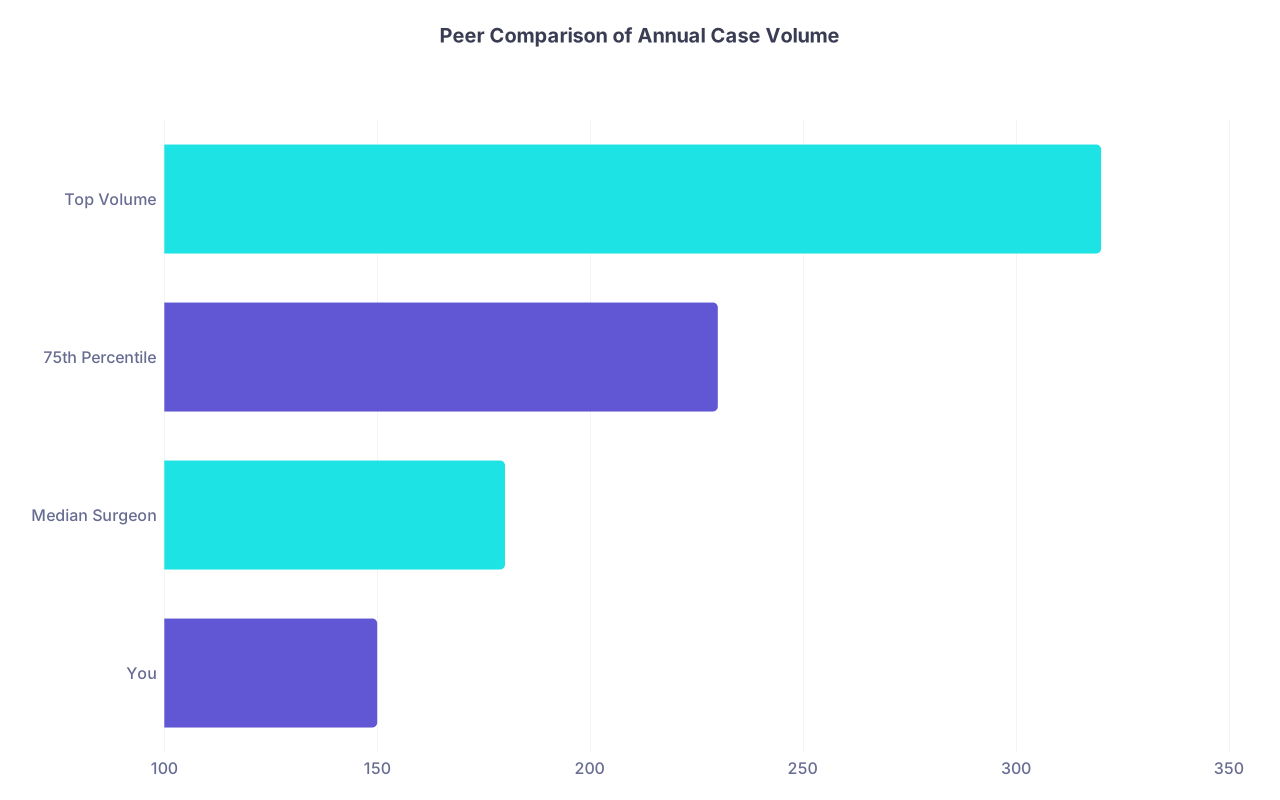
- Comparing you against peer medians and 75th/25th percentiles
| Category | Value |
|---|---|
| You | 150 |
| Median Surgeon | 180 |
| 75th Percentile | 230 |
| Top Volume | 320 |
If your numbers look something like that—modestly below median but not extreme—most committees won’t hassle you. You’ll get a quiet pass.
But if it looks like:
- You: 12
- Median: 140
for a high-stakes procedure, someone is asking what you’re doing with that privilege.
Future Direction: More Data, More Automation, Less Wiggle Room
This is the part people underestimate.
Credentialing used to be a paper file and some polite nodding. That era is ending.
Here’s where things are moving:
- Automated dashboards for every surgeon/proceduralist
- System-level minimum volumes built into privileging rules
- Real-time quality flags tied directly to credentialing reviews
- Integration of NSQIP, STS, NCDR, or other registry data into your profile
- Cross-facility aggregation of your case volume in large health systems
Think:
- “If < 10 carotids in 2 years → automatic notice to department chief at recredentialing”
- “If complication rate > 90th percentile for colon surgery → mandatory focused review”
The technology to do this at scale already exists. Plenty of big systems are quietly using it.
So the future answer to “how often do they review your case volume?” is trending toward:
- Continuously at the data level
- Formally every 2 years
- Intensively whenever a trigger hits

| Step | Description |
|---|---|
| Step 1 | Cases Performed |
| Step 2 | Automated Data Capture |
| Step 3 | Quality and Volume Dashboard |
| Step 4 | Routine Recredentialing |
| Step 5 | Focused Review |
| Step 6 | Modify or Restrict Privileges |
| Step 7 | Privileges Renewed |
| Step 8 | Thresholds Met |
What This Means For You (Practically)
A few hard truths:
- If you rarely do a complex procedure, you’re on borrowed time for that privilege
- “But I did 50 of these in fellowship” stops helping once your recent volume drops to near-zero
- When a bad outcome happens, your lifetime volume and recent volume will both be scrutinized
- For high-risk, low-volume operations, regionalization and volume standards are coming, whether you like it or not
If you want to keep a procedure on your card:
- Maintain consistent volume or proactively scale back your scope
- Document your training and proctoring well for new tech/procedures
- Be honest early about low volume instead of waiting for a problem-triggered review

Key Takeaways
- Credentialing boards absolutely review case volume—routinely at recredentialing, carefully at initial privileging, and intensely when anything goes wrong or when you push into new territory.
- They rarely read every note, but they always look at trends, totals, and outliers, especially for high-risk or “advanced” procedures.
- The future is more automated, data-driven scrutiny of your volume and outcomes, not less—so plan your scope of practice around what you can do often and safely, not just what you once trained to do.