Is It Better to Focus on Bread-and-Butter or Rare Cases in Training?
You’re logging cases, trying to hit numbers, and a senior casually says, “Honestly, you should chase the zebras while you’re a resident; you’ll never see them again.” The next day, your PD tells you, “Master the basics. No one cares if you’ve seen three Whipples if you can’t do a safe lap chole.”
So who’s right? Should you be chasing bread-and-butter or collecting rare cases like trading cards?
Let me be blunt: if you have to pick one, you pick bread-and-butter. Every time.
But that’s not the whole story.
The real answer is more strategic: you build your foundation on high-volume, common operations, then layer in exposure to complex or rare cases deliberately, not randomly. If you reverse that, you graduate looking impressive on paper and unsafe in the OR.
Let’s break this down in a way that actually helps you decide what to do tomorrow on your rotation.
What Actually Makes You a Safe, Employable Surgeon?
Not faculty narratives. Not cool stories from rare cases. Outcomes.
Patients, hospitals, and partners will judge you on how well you handle:
- The common procedures
- The common complications
- The occasional weird thing without panicking
And that hierarchy matters.
In almost every procedural field—general surgery, ortho, ENT, OB/GYN, even IR—you’ll spend the bulk of your early career doing “routine” work:
- General surgery: lap choles, hernias, appendectomies, bowel resections, ports
- Ortho: fractures, arthroscopies, joint replacements, carpal tunnel releases
- OB/GYN: C-sections, hysterectomies, salpingectomies, D&Cs
- ENT: tonsils, tubes, FESS, septoplasties, trachs
If you come out of training shaky on these, you’re a liability. Period.
Here’s the uncomfortable truth I’ve seen over and over:
Residents who spend a disproportionate amount of time chasing rare and complex cases often:
- Struggle with efficiency in routine cases
- Have inconsistent technique (because they haven’t repeated the same operation enough)
- Need more hand-holding as new attendings than they should
On the flip side, residents who grind through a ton of bread-and-butter cases:
- Develop consistent, reproducible technique
- Get a feel for tissue handling and speed that you simply cannot simulate
- Learn to recognize “this doesn’t look right” earlier, which prevents complications
Rare cases make you interesting. Common cases make you safe. And employed.
Why Volume in Bread-and-Butter Cases Is Non‑Negotiable
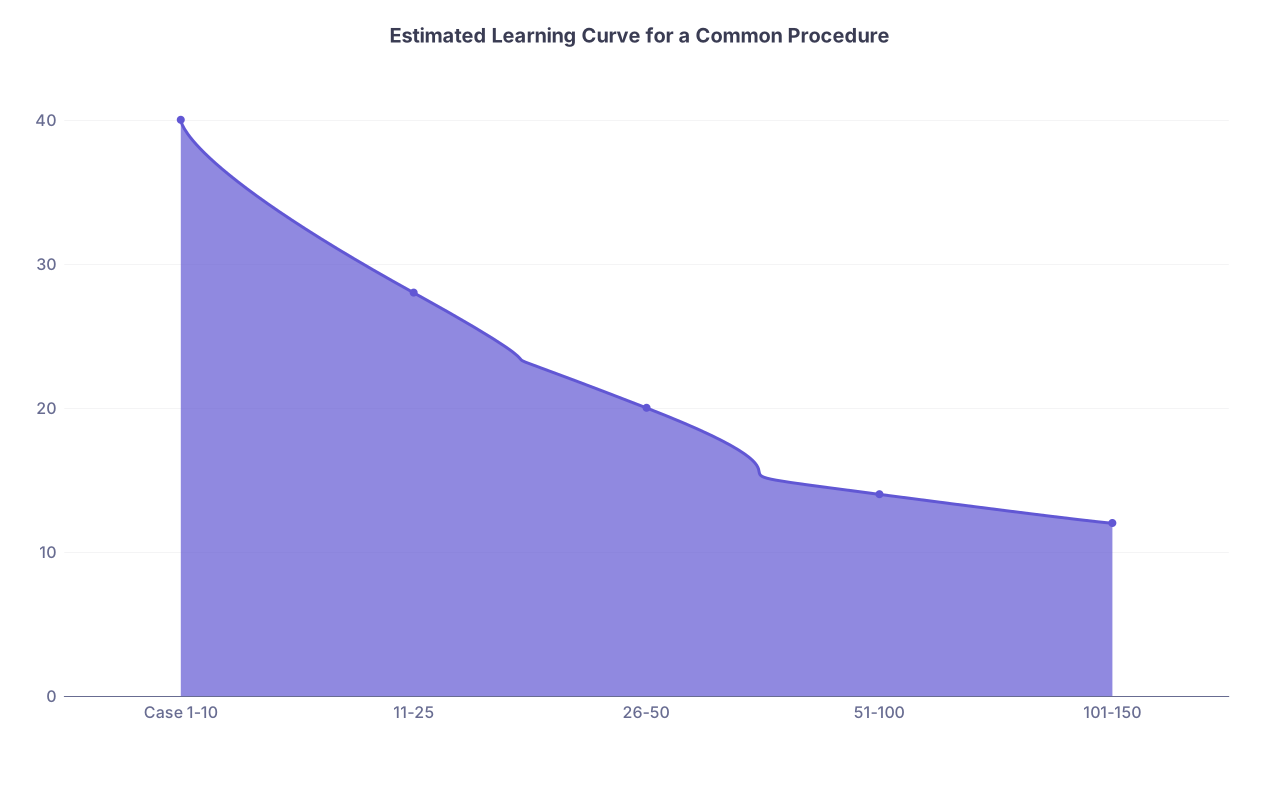
You’ve probably seen the learning curve graphs: outcomes improve as volume increases. That isn’t just for Whipples and transplants. It’s true for lap choles, C-sections, and carpal tunnel releases.
| Category | Value |
|---|---|
| Case 1-10 | 40 |
| 11-25 | 28 |
| 26-50 | 20 |
| 51-100 | 14 |
| 101-150 | 12 |
Think of “40 minutes” vs “12 minutes” for a basic case like a straightforward lap appendectomy. Same anatomy. Same steps. Very different impact on:
- Turnover and OR efficiency
- Patient exposure to anesthesia
- Your stress level when something non-routine happens
You only get this kind of efficiency and fluidity from repetition. Not from watching attendings do the cool stuff while you struggle with the basics a few times a month.
Here’s what high-volume bread-and-butter training buys you:
Pattern recognition
You start seeing variations in “normal” anatomy and pathology. That means you’re less surprised when something odd shows up, and more likely to handle it calmly.Cognitive offloading
When the basic steps of a procedure are automatic, your brain is free to think about strategy, anticipate the next move, and plan for complications.Complication management
You don’t really learn how to manage a bile leak or post-op bleed from one heroic case; you learn it from repeatedly seeing the full spectrum of post-op courses across common procedures.
If you’re still mentally rehearsing the steps of a basic case in your head every time you scrub, you don’t need a rare tumor resection. You need another twenty bread-and-butter cases.
Where Rare and Complex Cases Actually Matter
Now, let’s be fair. Ignoring rare or complex cases is also a mistake. You’re in training; this is literally your one protected window to see things you might never encounter again.
Rare or complex cases are useful when they:
- Teach principles you can apply to many other operations
- Force you to think in systems (ICU care, multidisciplinary planning)
- Show you the edges of what’s possible in your field
Examples:
- A Whipple teaches you about anatomy, planes, anastomotic technique, and post-op physiology in a way no number of lap choles can.
- A placenta accreta case makes you think hard about blood loss, massive transfusion, and when to push vs abort a plan.
- A complex revision arthroplasty shows you what happens long-term when things go wrong or when implants fail.
These experiences stretch your thinking. They also help you recognize when you’re out of your depth later in practice.
But here’s the key: complex cases amplify skills you already have from bread-and-butter work. They don’t replace them.
If you can’t safely and independently run a standard C-section, adding a placenta percreta to your case log doesn’t make you advanced. It makes you unbalanced.
How to Balance Your Case Mix Strategically
Let me give you a practical framework instead of vague “get both” advice.
Step 1: Lock Down Your Core Procedures by PGY Level
Early training (intern + PGY-2):
- You should be obsessed with the fundamentals: safe exposure, closure, drains, lines, ICU basics, post-op orders.
- Take every bread-and-butter case you can.
- If there’s a choice between observing a rare complex case vs being primary on a straightforward one, you should usually pick the one where you’re primary.
Middle training (PGY-3–4, or equivalent):
- Make sure your core index procedures are on track for numbers and independence.
- Start deliberately targeting harder or less common variants of common operations: difficult gallbladders, obese patients, hostile abdomens, revision cases.
- Add in selected rare/complex cases—where you’ll actually do something meaningful, not just retract.
Late training (senior/chief):
- You should be functioning as the primary surgeon on almost all bread-and-butter cases.
- Now’s the time to lean more into complex cases—pancreatic, major oncologic resections, complex reconstructions—but again, as an actual operator, not wallpaper.
If you’re a senior and still feel nervous about a routine lap hernia, you don’t need more zebras. You need a remedial rotation of pure basics.
Step 2: Look at Your Numbers and Gaps Honestly
Most programs give you an ACGME-style or equivalent case log dashboard. Don’t just log and forget. Use it.
| Case Type | Target by Graduation | Current PGY-4 | Status |
|---|---|---|---|
| Lap Cholecystectomy | 125 | 90 | On track |
| Inguinal Hernia Repair | 75 | 40 | Behind |
| Appendectomy | 50 | 60 | Ahead |
| Whipple | 10 | 4 | Limited |
| Complex Ventral Hernia | 20 | 8 | Behind |
If your common procedure numbers are weak, you prioritize filling those. Even if it means saying no to a rare case that looks interesting.
Common trap I see: people obsess over “big name” oncologic or transplant cases while quietly underperforming on basic hernias, lap cases, scopes. That catches up with you during independent practice, not during residency, which is why people ignore it. Short-term pain, long-term disaster.
Step 3: Be Selective About Which Rare Cases You Chase
You don’t need every rare case. You need a representative sample of well-chosen ones.
Ask yourself before chasing a complex case:
- Will I actually operate, or just hold a retractor for six hours?
- Does this case teach principles I won’t get elsewhere?
- Is this case relevant to the kind of practice I might have?
If the answer is “I’m standing in the corner while the attending and fellow do everything,” that’s observership, not training. You can afford a few of those for learning and exposure. You cannot build your training around them.
Much better to:
- Aim to follow one or two high-yield complex patients from clinic → OR → ICU → floor → follow-up.
- Prioritize rare cases where the attending deliberately plans to let you do major parts of the operation.
Specialty-Specific Nuances (Because Yes, It Varies)
No, the balance is not identical in every field. But the principle still holds: strong base, targeted complexity.
- General surgery: Bread-and-butter is non-negotiable. But if you’re fellowship-bound (HPB, colorectal, vascular), you want at least enough exposure that you’re not starting at zero as a fellow.
- Ortho: Nail trauma, arthroscopy basics, and bread-and-butter joints. Then layer in complex foot/ankle, spine, or tumor depending on interest.
- OB/GYN: You must be solid on C-sections, vaginal deliveries, basic gyn surgery before spending tons of time on oncology or advanced minimally invasive cases.
- ENT, urology, plastics: Same pattern—tons of common office-based and OR procedures first, advanced reconstruction or malignancy management second.
If your program skews heavily toward either extreme—only basics, or almost entirely referral-complexity—be intentional about seeking away rotations, electives, or even moonlighting (late, when allowed) that fill in your missing side.
How the Future of Medicine Changes This Calculation
Here’s the twist: as medicine evolves, the dividing line between “bread-and-butter” and “rare” is shifting.
- Robotics has made some previously complex open cases more standardized and reproducible.
- Centralization of care means some complex cases are clustered in tertiary centers while community surgeons do more of the true bread-and-butter.
- AI-driven imaging, planning tools, and enhanced ERAS pathways are making complex peri-op care more protocolized.
So what does that mean for you?
It means the premium is rising on:
Mastery of standard procedures in new modalities (laparoscopic, robotic, endoscopic). The “new bread-and-butter” for your generation may be robotic ventral hernias, not open ones.
Systems thinking and team leadership. Rare and complex cases matter as training grounds for leading multidisciplinary teams—even if you don’t reproduce the exact case often.
Knowing when to refer. You don’t have to personally do every exotic case. But training needs to give you enough exposure that you recognize which situations belong at a tertiary center.
The future doesn’t reduce the importance of bread-and-butter. It raises the bar for what counts as “basic” and expects you to handle it across more tools and platforms.
The Short, Honest Answer
If you strip away the noise, here’s the ranking:
- You must be independently excellent at bread-and-butter cases.
- You should have thoughtful exposure to rare/complex cases that teach advanced principles.
- You should avoid trading real hands-on work in common cases for passive observation of rare ones just to pad your log or your ego.
So if you feel that pull—“Do I scrub the seventh lap chole this week or go watch this giant rare tumor case?”—ask the hard question:
- Am I already rock-solid and efficient on lap choles?
- If yes: go see the tumor, ideally with a defined role.
- If no: you stay with the lap chole and perfect it.
That decision, repeated across training, is what separates a flashy CV from a competent surgeon.
Today’s actionable step:
Open your case log or recent OR schedule and identify the one bread-and-butter operation you still don’t feel truly automatic with. Then, over the next two weeks, intentionally volunteer for every single version of that case you can get—even if it means skipping a few “cool” zebras.