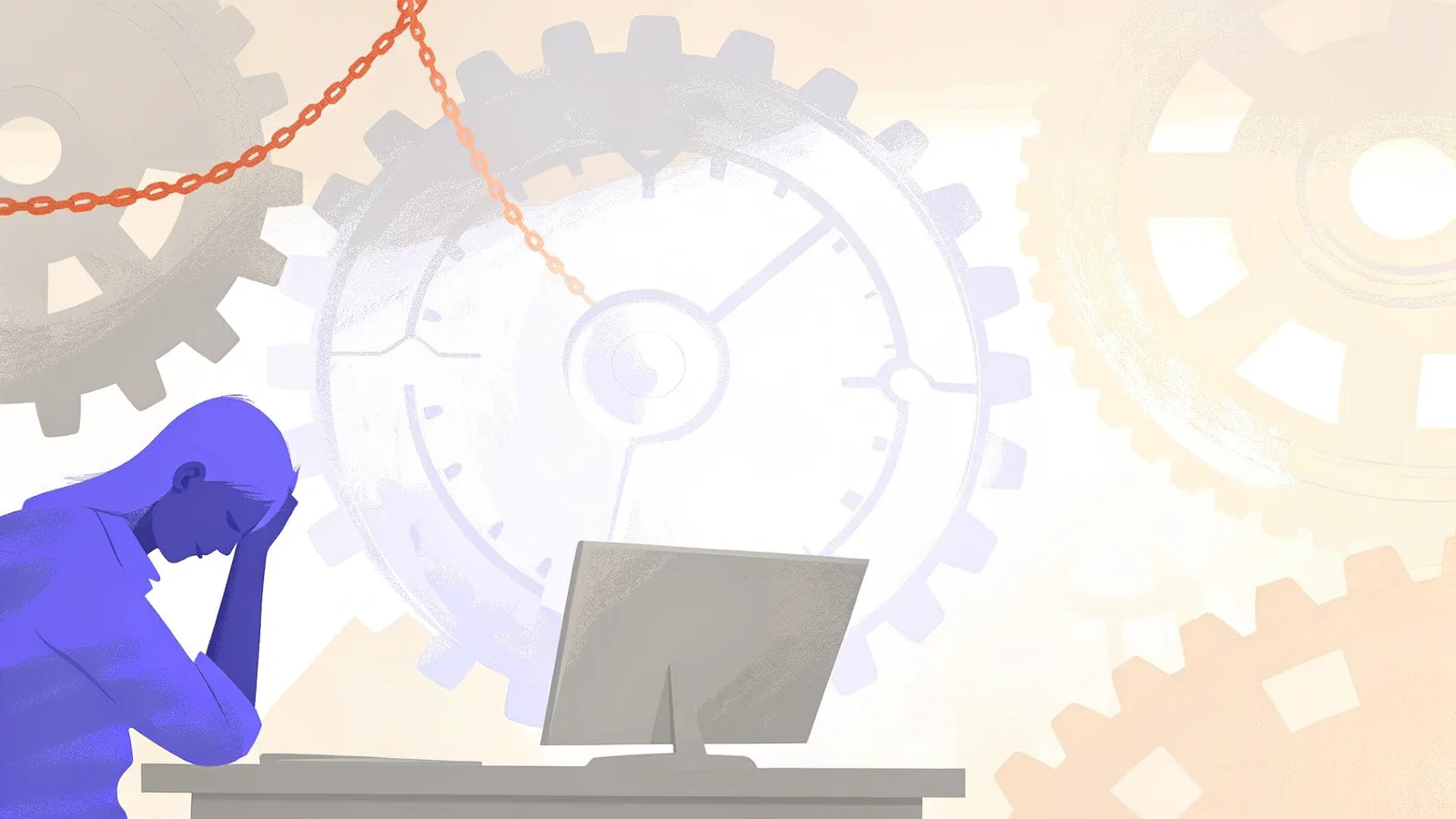
Here's the uncomfortable truth nobody posts in the group chat: the student with the most elaborate score-tracking spreadsheet isn't necessarily the one who performs best on Step. In fact, I'd argue they're often the one walking into the testing center with a fried nervous system and a false sense of precision.
Score-tracking before Step Day has become a ritual. You finish a block of UWorld, log every percentage into a color-coded sheet, cross-reference it against last week's NBME, and recalculate your predicted score for the fourth time before lunch. It feels like doing something. It feels like control.
It usually isn't.
The problem isn't the data itself. It's the compulsive monitoring without a decision rule. You're collecting numbers the way a hypochondriac collects symptoms, hoping that if you check often enough, you'll catch a disaster before it catches you.
Let me be blunt: that strategy backfires more often than it helps.
This article is for educational purposes only. It is not financial advice, not legal advice, and not tax advice. Figures vary by individual circumstances, so consult a qualified professional before acting.
Here's what's actually happening in your brain when you check your scores for the twelfth time today.
Repeated checking reinforces threat monitoring. Your brain interprets "I need to look again" as "there's a threat I haven't detected yet." That keeps you in a low-grade alert state, which sounds productive, but actually makes studying less effective. A brain scanning for danger isn't a brain consolidating pharmacology mechanisms. It's a smoke detector that keeps going off during a cooking class.
The variability you see in practice scores? Most of it isn't signal. It's noise. Form difficulty, how you slept, whether you did the block before or after rounds, whether you had caffeine at 4pm, these factors swing scores by several points week to week. A 10-point drop on a Tuesday doesn't mean you suddenly forgot nephrology. And a 15-point jump on Friday doesn't mean you're guaranteed to match into dermatology.
But score-obsessed students don't think in distributions. They think in verdicts. One bad block becomes "I'm regressing." One great NBME becomes "I've arrived." Neither conclusion survives contact with the next data point.
Then there's the distortion effect on studying itself. I've watched students abandon their weakest areas, cardiology, say, because they got a 62% on a cardio-heavy block and felt demoralized. Instead, they pivot to subjects they're already scoring well on, chasing the dopamine of a high percentage. The weak area stays weak. The spreadsheet says they're improving. The Step exam has other plans.
The myth here is that more data automatically improves decisions. In high-stakes test prep, that's often false. Excess metrics create noise, not clarity. You need a filter, not a firehose.
Look at that chart for a second. Every single factor here, form difficulty, sleep, fatigue, timing, can swing your score on any given day. But when you track obsessively, you attribute every swing to the one thing you can't measure: "knowing enough." That's not analysis. That's self-flagellation with extra steps.
The hidden cost: score-tracking can worsen test anxiety and decision fatigue
Every time you open that score dashboard, you're forcing yourself into a micro-evaluation. Am I on track? Am I behind? Should I panic? Is this enough for my specialty? Should I push my test date?
Multiply that by fifty check-ins a day, and you've spent real cognitive energy on questions that don't have actionable answers. That's decision fatigue. By the time you actually sit down to review a block, your working memory is already depleted.
The cycle looks like this:
Uncertainty makes you check. Checking gives you a hit of relief, briefly. Then you see a score you don't like, or a score that's "fine" but not "great," and the anxiety spikes higher than before. So you check again. Meanwhile, you're over-adjusting your study plan based on noise. Two days of biostatistics because you missed three questions in a row? That's not strategy. That's a panic response with a clipboard.
And then there's the comparison trap. Online score reports, Reddit threads, the classmate who casually mentions they got a 255 on their last NBME, it's all fuel for catastrophic thinking. You're comparing your worst, most sleep-deprived day against someone else's curated highlight reel. That's a rigged game, and you're the only one playing it.
Emotional regulation matters on Step Day. The exam doesn't just test recall, it tests whether you can stay steady when a block feels brutal. If you've spent months training your brain to spiral whenever a number disappoints you, good luck regrouping after a hard section.
What to do instead: replace tracking obsession with a decision system
So if constant tracking is the problem, what actually works?
A decision system. One that tells you when to look, what to pay attention to, and what to change based on what you find.
Here's the framework I'd give any student who'll listen:
1. Schedule check-ins. Don't impulse-check. Pick one or two times per week, say, Sunday evening and Wednesday evening, for score review. Outside those windows, the spreadsheet stays closed. If you feel the urge to check after every block, treat that as information about your anxiety, not about your readiness.
2. Interpret trends, not single scores. Three consecutive practice blocks where you're dropping the same cardiology concept? That's a signal. One bad Tuesday? That's weather. Track whether themes repeat across weeks, not whether your daily percentage went up or down.
3. Use a decision rule. Before you change your study plan, force yourself to answer: Is this a content gap, a timing issue, a stamina problem, or a test-taking strategy problem? Each one demands something different. Content gaps need review. Timing issues need untimed practice. Stamina needs longer blocks. But if you can't name which category you're in, you're changing things just to feel less anxious.
4. Prioritize process metrics. These are boring. That's why they work. Completed blocks per day. Error review quality (did you actually rewrite the logic, or just read the explanation and nod?) Sleep consistency. Missed breaks. Burnout level. These predict long-term performance far better than the exact number of your last NBME.
5. Pass/fail thresholds in the final weeks. Late in prep, your score only matters in three buckets: comfortably above passing, borderline, or clearly not ready. Most fluctuations within the "comfortably above passing" range don't require any action. Stop treating a 238 versus a 241 like a moral crisis.

I've seen students replace the daily spreadsheet with a one-page weekly reflection. Nothing fancy. Three questions:
- What repeated mistake did I actually fix this week?
- What's one content area I avoided because it feels bad?
- Am I sleeping like someone who wants to pass?
That's it. It takes five minutes. And it gives you more usable information than forty-two data points you'll never act on.
A calmer pre-Step routine: how to stay informed without spiraling
In the last one to two weeks, your score exposure should drop dramatically. Not because data is dangerous, but because at that point, you've made your bed. The goal is to arrive at the testing center rested and calibrated, not to squeeze out one more confirming data point.
The pre-Step self-talk script I'd recommend: I do not need perfect certainty to perform well. I need a stable plan and enough sleep.
That's not a platitude. That's the actual cognitive requirement for peak performance. Certainty was never on the table. If you've been chasing it through spreadsheets, you've been chasing a ghost.
Mute group chats. Stop cross-checking specialty score averages. And for the love of everything, skip the "one more practice exam to make sure" trap. That's not a strategy; that's a compulsion.

Success on Step isn't knowing every number your practice tests have ever produced. It's walking in on exam day with a brain that's been allowed to consolidate, a nervous system that isn't fried from constant monitoring, and the ability to stay steady when a block throws you something unfamiliar.
The student with the fanciest spreadsheet isn't the one who wins. The one who knows when to put the spreadsheet away is.
Take the data seriously. Check it deliberately. Then close the laptop and go live your life enough to sleep properly. That's the evidence-based move. Everything else is anxious busywork wearing a lab coat.