
What If One Bad Exam From Anxiety Follows Me Forever?
What if that one exam you bombed because of anxiety is the thing that quietly ruins everything? Residency. Fellowships. Jobs. What if that single number becomes your whole story?
That’s the loop my brain likes to play at 2 a.m.
Let me guess your inner monologue, because I’ve been there:
- “Everyone else had the same exam. Only I tanked it. So maybe I’m just not cut out for this.”
- “What if this shows up on every dean’s letter, every PD’s desk, every future job?”
- “What if programs think, ‘If they choked once, they’ll choke again when a patient is crashing’?”
You’re not crazy for thinking like this. You’re just anxious. And anxious brains are really, really good at taking one data point and turning it into a lifelong curse.
Let’s pull this apart before you convince yourself your career died on exam day.
How Much Does One Bad Exam Actually Matter?
Short answer: way less than your anxiety is telling you, but not zero.
It depends what we’re talking about:
| Exam Type | Long-Term Impact |
|---|---|
| Single block/quiz | Basically none |
| Course midterm/final | Minor, local to course |
| Shelf exam | Noticeable but fixable |
| NBME/CBSE practice | Almost none |
| Step 1 / Step 2 | Moderate–high |
Let’s break that into real situations.
Scenario 1: You Bombed a Course Exam
You studied. You knew the material. Then you sat down, and your body said: fight-or-flight time.
Heart pounding. Hands sweating. Brain gone.
You walk out 30 minutes early because you can’t even read the questions anymore. Score comes back: way below class average.
Is this going to follow you forever? No.
Course exams live mostly inside your school. They may affect:
- That specific course grade
- Class rank (slightly)
- Your own ego (a lot)
But residency programs aren’t sitting there scrolling through each of your individual course exam scores. They mostly see:
- Transcript with final course grades
- MSPE (dean’s letter) summary of performance
- Board scores
- Clinical evals
So if this bad exam still results in a B or even a C in one preclinical course? Annoying. Embarrassing. Not a career-ender.
Scenario 2: You Got Hammered on a Shelf Exam
This one stings more because shelves are closer to “real” data that programs might glance at.
Let’s say you:
- Did fine on IM and Peds shelves
- Completely cratered on Surgery because anxiety + fatigue + you were on nights the week before
Programs may see a pattern like: “Mostly High Pass, one Low Pass.”
Do they love that? No.
Does it blacklist you from life? Also no.
People have bad rotations. PDs know that:
- Some sites are notorious for brutal shelves
- People have stuff going on (family issues, health, etc.)
- Test anxiety is real, whether schools like to admit it or not
If everything else is solid—good comments, good Step 2, upward trend—that one shelf becomes “the weird outlier,” not “the smoking gun of incompetence.”
The Nightmare: What If It’s a Board-Style Exam?
This is where everyone panics: “What if my anxiety screws me on Step 1/2 or on a major school-required exam?”
Fair. Because now we’re in higher-stakes territory.
But even here, anxiety tells a worse story than reality.
Step 1 (Now Pass/Fail)
If your anxiety made Step 1 preparation a train wreck… but you still passed?
Then the main damage is probably internal. You feel like a fraud. You’re convinced everyone else cruised. (They didn’t.)
Programs now care a lot more about:
- Step 2 score
- Shelves/clinical performance
- Narrative comments
A pass on Step 1 is like… crossing a checkpoint. Messy, painful, whatever—you got through. Most places don’t care exactly how you felt on the way through.
Step 2 (Still Scored, Still Stressful)
This one matters more numerically.
Let’s say:
- You have strong shelves, good comments
- Then your Step 2 is lower than your practice tests because anxiety nuked you the night before and during the exam
Is that visible? Yes.
Is it the end? Not automatically.
You’re imagining PDs saying, “Oh, they dropped 10–15 points below their practice average, guess they’re trash.” That’s not how this works.
Programs see:
- A single number
- In the context of everything else
They don’t see the story (you crying in the car at Prometric, the two hours of sleep, the heart rate at 140 for half the test).
They see: “Okay, score is a bit lower. Rest of app?”
If the rest of your app screams “competent, reliable, good team member,” that number is just one noisy data point.
The Part That’s Actually Scary: Anxiety Patterns, Not One Exam
Here’s the harsh truth I wish someone had told me:
The issue isn’t “Will one anxious exam follow me forever?”
It’s “Will I let this pattern run my life for the next 5–10 years?”
Because yes, if you:
- Never address your test anxiety
- Keep white-knuckling every exam
- Burn out your nervous system before residency
Then the fallout builds. Not from one exam. From ten. From twenty.
But that’s not destiny. That’s just what happens if you pretend anxiety is a personality trait instead of a problem that can be treated.
What “Fixing It” Actually Looks Like (Beyond ‘Just Relax’)
I hate the advice “Just calm down, you’ll be fine.” It’s useless. So here’s what people who actually turn this around usually do.
1. They Get Documented
Not because they’re weak. Because med school is not a fair fight with untreated anxiety.
If your anxiety is:
- Causing physical symptoms (nausea, shaking, tunnel vision)
- Making you blank on things you definitely know
- Leading to repeated underperformance on high-stakes days
You’re not just “stressed.” You might have:
- Performance anxiety
- Generalized anxiety disorder
- Panic disorder
That’s treatable. But you need:
- A real evaluation (primary care, psychiatrist, psychologist)
- Documentation if you ever need:
- Testing accommodations (extra time, separate room)
- Leaves of absence
- Flexibility with exam schedules
Programs don’t see that documentation. That stays with your school/board.
2. They Train for the Physiologic Freak-Out
This is the part everyone skips. They “study more” instead of training their body not to freak out.
You need reps in exam conditions with:
- Timed blocks
- No phone
- Same start time as real exam
- Same break structure
And while doing that, you practice:
- Breathing patterns you can actually use in the exam
(4 seconds in, 4 hold, 6–8 out — it’s boring, but it brings your heart rate down) - Grounding: 5 things you can see, 4 you can touch, 3 you can hear, 2 you can smell, 1 you can taste
- “Worst-case scripting”: literally writing out “If I blank on a question, I will…” so your brain has a plan, not just panic
You’re not trying to become “calm.” You’re aiming for “functional while anxious.”
3. They Use One Bad Exam as Data, Not Identity
That disaster exam? It is telling you something.
But not: “You’re dumb.”
More like:
- Your current coping system collapses under real pressure
- You’re trying to brute-force anxiety with more Anki / more hours
- Your self-talk on exam day is toxic
Listen to that.
Instead of obsessing, “Will this follow me forever?” ask, “What is this exam trying to tell me about how I function under stress?”
Because residency is not magically calmer. If you don’t build tools now, your nervous system is going to be screaming during night float with a septic patient too.
How Do Programs Actually View One Bad Exam?
Let’s be brutally honest.
Program directors are not:
- Zooming in on one weird outlier score and cackling
- Building personality profiles out of your second-year neuro exam
- Memorizing your grade in renal path
They are:
- Skimming hundreds of files
- Looking for red flags or obvious trends
- Trying to guess: “Will this person show up, work hard, not melt down, and not be a jerk?”
One bad exam does not equal a red flag. Patterns might:
- Repeated failures with no explanation
- Big mismatch between narrative (“amazing student”) and numbers (chronically low)
- Evidence that you fall apart under pressure and don’t recover
But honestly? I’ve seen:
- People fail Step 1, regroup, pass on second try, match fine into IM, FM, psych, peds
- People with very average scores crush rotations, get killer letters, and match into solid programs
- People with great scores but terrible interpersonal skills struggle to match where they want
Your anxious brain acts like this:
“One bad exam → no residency → no career → lifelong shame.”
Reality is more like:
“One bad exam → temporary hit to confidence → opportunity to change how you approach tests and stress → still very much in the game.”
Building a Story That Makes Sense of the Bad Exam
You can’t erase the score, but you can shape the story around it.
If you have to talk about it (for example, in an advisor meeting, or a personal statement if it’s something huge like a board failure), the frame is:
- Acknowledge it
- Explain, without sounding like you’re making excuses
- Show what you changed
- Show the results afterward
Something like:
“I struggled with severe performance anxiety early in med school, which contributed to underperforming on X exam despite strong course work. I sought professional help, implemented specific strategies, and since then my performance on Y and Z exams and clinical evaluations has been consistent with my actual understanding and abilities.”
Boring? Yes. But it tells the truth without groveling.
They’re not looking for perfection. They’re looking for growth and insight.
The “Forever” Part Is Mostly in Your Head
Here’s the quieter, uglier part: sometimes it’s not the exam that follows you. It’s the shame.
You start to:
- Avoid certain specialties because “they’d never take someone like me”
- Compare yourself relentlessly to classmates
- Tell yourself, “I’m the one who cracked under pressure”
- Let one score live rent-free in your head for years
That’s the real danger.
Medical training is long. You will mess up again. On exams. With patients. On call.
You need a way to say: “I screwed that up. It hurt. But it doesn’t define me unless I decide it does.”
Because if you don’t, you’ll bleed confidence slowly every year. And not because anyone else is punishing you. Because you are.
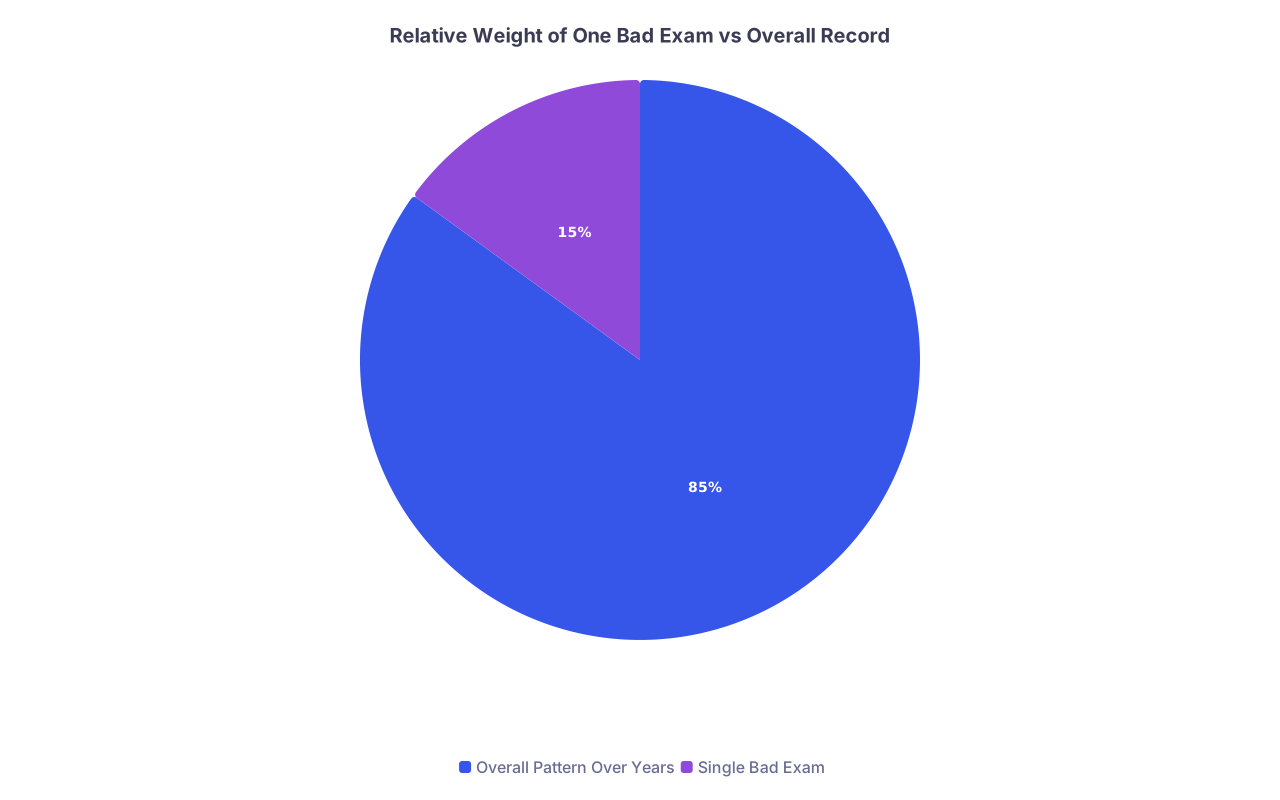
| Category | Value |
|---|---|
| Overall Pattern Over Years | 85 |
| Single Bad Exam | 15 |

| Step | Description |
|---|---|
| Step 1 | Bad Anxiety-Driven Exam |
| Step 2 | More anxiety, repeated issues |
| Step 3 | Better tools, improved pattern |
| Step 4 | Multiple weak scores |
| Step 5 | Stronger overall trajectory |
| Step 6 | Harder to explain to programs |
| Step 7 | One outlier, easy to contextualize |
| Step 8 | Response |

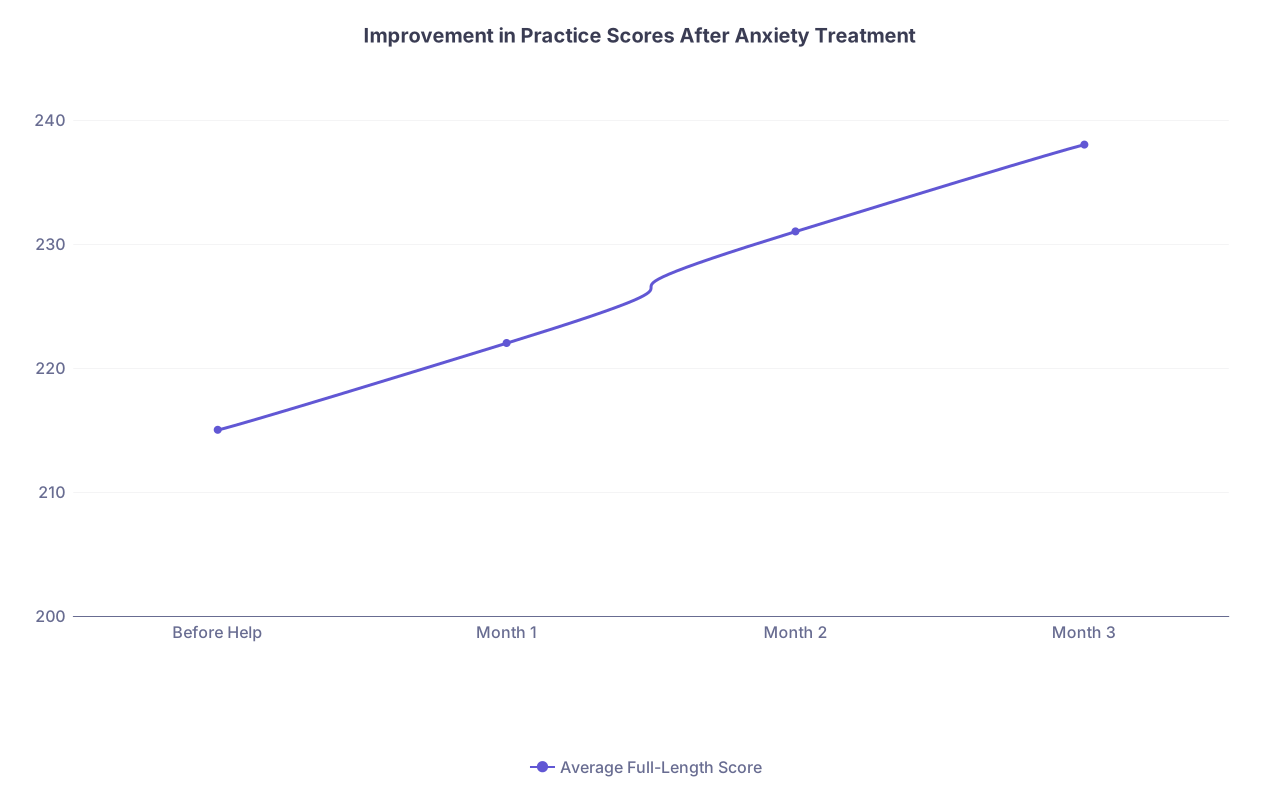
| Category | Average Full-Length Score |
|---|---|
| Before Help | 215 |
| Month 1 | 222 |
| Month 2 | 231 |
| Month 3 | 238 |
What You Can Actually Do This Week
If you’re spiraling over that one exam, here’s a concrete, non-magical plan.
Get the facts:
- What will actually show up on transcript/MSPE?
- How much does this exam count for the final grade?
- Is there any remediation or retake policy?
Talk to a real human who’s seen hundreds of students:
- Academic dean
- Learning specialist
- Upperclassman in your specialty of interest
- Someone who can say, “I’ve seen worse, here’s where they matched”
Start treating anxiety like a medical problem, not a character flaw:
- Book an appointment (PCP/psych/therapy)
- Be brutally honest about exam days
- Ask about both therapy and, if appropriate, medication options
Build an exam-day protocol:
- Night-before routine
- Morning-of plan (food, caffeine, arrival time)
- In-exam reset steps for when panic hits
Decide how you’ll frame this in your own head:
- “Evidence that I’m broken” is one option
- “First loud signal that something needs to change” is another
Only one of those is survivable long-term.

FAQ: Exactly 6 Questions
1. What if I failed one course because of anxiety—will every program see that forever?
They’ll see the grade, not the whole meltdown behind it. One failed course with a later pass/remediation, surrounded by mostly normal grades, is usually just a minor blip. It might come up as a “tell me about this” question, but it’s not an automatic rejection. How you explain it—and what you did afterward—matters far more than the raw F/P on your transcript.
2. Do I need to disclose my test anxiety to residency programs?
No. You don’t owe anyone your diagnosis. You only talk about it if you choose to, usually in a very summarized way (“I struggled with performance anxiety early on, sought help, and my later performance reflects that”). Programs care about reliability and growth, not your ICD code. Your disability/testing documentation stays between you and the relevant offices.
3. Can a single bad Step 2 score completely block me from competitive specialties?
For the top 5–10 ultra-competitive programs in something like derm, plastics, ortho? It can definitely hurt. But “hurts your chances at the very top” is not the same as “you’re banned from the specialty forever.” A lot depends on the rest of your app: research, letters, school reputation, and whether your score is bad-bad or just “lower than you wanted.” People match with non-perfect scores every single year.
4. Will getting accommodations for anxiety make programs think I’m weak or unreliable?
They don’t see your specific testing accommodations. They see your scores and performance. Getting extra time or a quiet room doesn’t make you weak; it makes you realistic about how your brain works. Frankly, I trust the person who got help more than the one pretending everything is fine while falling apart inside.
5. How do I know if I’m just “normal nervous” vs having a real test anxiety problem?
Some nerves = you feel jittery but can still recall info and reason through questions. Problem-level test anxiety looks more like: mind going blank on questions you later easily answer, physical panic symptoms (racing heart, shaking, nausea), crying episodes before/after exams, and a consistent pattern of underperforming on big tests compared to practice. If that’s you, stop telling yourself you’re just “bad at tests.” You’re likely dealing with anxiety that needs treatment.
6. What if future attendings or employers judge me for my past bad exams?
Most attendings don’t know your exam history unless you tell them. What they actually judge is: Do you show up prepared? Do you own your mistakes? Do you improve? If you carry yourself like someone who’s permanently broken because of one exam, that’s more noticeable than the exam itself. If you use it as fuel to build stronger habits and coping skills, it just becomes a story you might mention once in a while as “Yeah, that was rough, but I changed a lot after that.”
Key points, stripped down:
- One bad exam isn’t your whole career; patterns matter more than single hits.
- Untreated test anxiety can absolutely snowball—but it’s highly treatable if you take it seriously.
- Your job now isn’t to erase the score; it’s to make sure it becomes the outlier in a much stronger, more stable story.