
Most medical trainees are not “too anxious”; they are undertrained in how to recognize when anxiety has crossed the line into pathology.
Let me be blunt: calling every pre‑exam freak‑out “test anxiety” is lazy, and it hurts people. You end up ignoring students who are genuinely impaired and over-pathologizing those who are just experiencing a normal physiologic stress response before a high‑stakes exam.
You need a sharper filter. I will give you one.
1. The Core Distinction: Discomfort vs. Impairment
Normal exam stress is uncomfortable. Pathologic test anxiety is impairing.
That single sentence is the backbone of this whole discussion. Now let’s make it clinical.
The working definitions
Normal test stress:
- Time‑limited anxiety clustered around exams
- Intensity roughly proportional to the stakes
- Functions as a motivator more than a barrier
- Does not cause sustained academic, functional, or medical harm
Pathologic test anxiety:
- Recurrent, excessive fear tied to exams that is out of proportion to the situation
- Causes functional impairment: studying, performance, or daily life is meaningfully disrupted
- Often linked to broader anxiety, perfectionism, or prior trauma with failure
- Persists across multiple exam cycles and settings
If you remember DSM language, the key words show up fast: “excessive,” “out of proportion,” “clinically significant distress or impairment.” That is the frame.
The quick clinical question set
When I am screening a student in trouble, I essentially ask four questions in different ways:
- Can you actually study?
- Can you sleep enough to retain anything?
- Can you sit down and complete the exam with close to your baseline cognitive function?
- Is this pattern repeating across multiple test situations?
If the answer is “no” to 1–3 or “yes” to 4, I start thinking pathologic rather than “typical stress.”
2. Symptom Domains: What Normal vs Pathologic Actually Looks Like
You cannot distinguish this cleanly unless you break it down into domains. Let’s go granular.
| Domain | Normal Test Stress | Pathologic Test Anxiety |
|---|---|---|
| Onset/Timing | Days–week before exam | Weeks–months, with spikes but chronic worry |
| Sleep | Mildly reduced, fragmented night before | Chronic insomnia, multiple nights to weeks |
| Concentration | Mildly distracted, can still study | Repeatedly cannot sustain study sessions |
| Physical Symptoms | Butterflies, mild tachycardia, sweating | Panic attacks, chest pain, GI distress |
| Behavior | Increased study, minor avoidance | Major avoidance, procrastination, cancellations |
| Performance Impact | Slight dip or unchanged | Marked underperformance vs. practice/knowledge |
1. Cognitive symptoms
Normal:
- “I am nervous. I really hope cardiology is not as hard as everyone says.”
- Some intrusive thoughts before big blocks, but can redirect and work.
Pathologic:
- Persistent thoughts like:
- “I will fail and get kicked out.”
- “If I do not honor this, I will never match.”
- “I blank every time. Something is wrong with me.”
- Catastrophizing—jumping straight from one bad exam to total career collapse
- Ruminations that derail studying for 30–60 minutes at a time
- Mental rehearsals of worst‑case scenarios more than rehearsals of actual content
2. Emotional patterns
Normal:
- Nervousness, irritability, a bit “on edge” during exam week
- Relief returns reasonably quickly after the exam
Pathologic:
- Intense dread on the calendar (“I feel sick when I see the exam date”)
- Shame and self‑disgust, not just worry (“I am a fraud,” “I don’t belong here”)
- Anxiety lingering long before and long after exams
- Possible mixed depressive features—loss of pleasure, hopelessness, crying when thinking about exams
3. Physical and autonomic symptoms
Every med student knows cortisol. The question is degree and pattern.
Normal:
- Sweaty palms walking into the test center
- Mild tachycardia, restless sleep before the exam
- Maybe a slightly upset stomach or decreased appetite the morning of
Pathologic:
- Full‑blown panic attacks: palpitations, chest tightness, dizziness, feeling like you will faint
- Recurrent GI symptoms: diarrhea for days before each exam, vomiting, severe abdominal pain requiring medical evaluation
- Migraine flares tied specifically to exam periods
- Significant weight loss over months due to chronic “exam” anxiety that never really turns off
At this level, I stop calling it “normal.” The body is screaming.
4. Behavioral manifestations
This is where you see the real damage.
Normal:
- Double‑checking resources, maybe over‑reviewing UWorld explanations
- Slight increase in caffeine or late nights
- Some procrastination, but work still gets done
Pathologic:
- Extreme avoidance:
- Not opening question banks for days because it feels unbearable
- Repeatedly delaying NBME practice tests; “I’ll take it when I feel ready” but that day never comes
- Ritualistic overstudying that is clearly inefficient:
- Re‑reading the same chapter 6 times in one night
- Writing out entire textbooks by hand “to feel safe”
- Last‑minute cancellations or no‑shows for exams or OSCEs
- Rule‑driven study behavior: “If I cannot get every question right in this block, I’m not allowed to schedule the exam.”
Pathology shows itself in your calendar and your click patterns, not just in your feelings.
3. Mapping to DSM‑5 Categories (Without Drowning in Jargon)
You are in medicine. You might as well understand where this fits diagnostically.
Pathologic test anxiety is usually one of three things:
- Specific phobia, situational type (exams)
- Social anxiety disorder (if the fear is about negative evaluation or appearing incompetent)
- Generalized anxiety disorder, with tests as a major focus
Sometimes you also see:
- Panic disorder (uncued panic attacks that cluster around testing situations)
- Performance‑related OCD themes (checking, rituals to avoid failure)
No attending in student affairs actually cares what box it fits in as long as the impairment is real and documented. But for you as a trainee, this matters because:
- Specific phobia and performance anxiety respond very well to exposure‑based CBT and targeted skills training.
- GAD patterns may require broader cognitive restructuring and sometimes pharmacotherapy.
The mistake I see constantly: treating a specific, performance‑linked anxiety like a vague motivation problem or “lack of resilience.” It is not.
4. Performance Data: The Objective Red Flags
Here is where you stop hand‑waving and start using numbers.
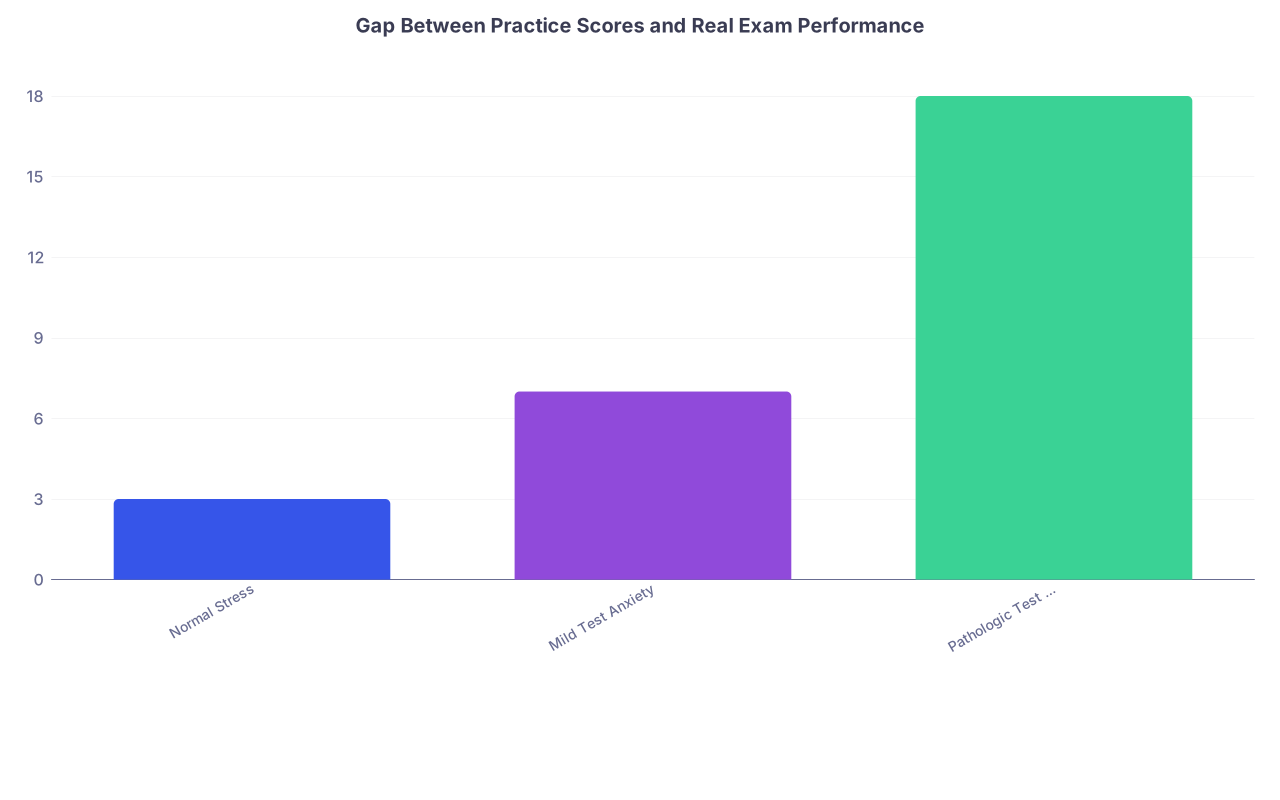
| Category | Value |
|---|---|
| Normal Stress | 3 |
| Mild Test Anxiety | 7 |
| Pathologic Test Anxiety | 18 |
(Values above: mean point drop from practice to real exam, just as an example pattern. Real numbers vary, but the shape is recognizable.)
Normal stress profile
- Practice exam scores and real exam scores are roughly aligned
- Maybe a small drop (2–5 points on a shelf, or a few percent) due to fatigue and nerves
- Performance is broadly predictable
Pathologic test anxiety profile
- Stable or improving practice scores
- Dramatic underperformance on actual high‑stakes exams by 10–20+ points or a full grade tier
- Student can articulate specific exam‑day meltdown:
- Blank mind in the first 10 questions
- Re‑reading stems 3–4 times, running out of time
- Needing to leave for the bathroom repeatedly due to panic or GI symptoms
This pattern—high practice, low performance with clear physiologic arousal and cognitive shutdown—is essentially the hallmark of test‑specific performance anxiety.
If your practice is erratic, content coverage is weak, and strategies are nonexistent, that is not test anxiety. That is being unprepared. The two often coexist, but conflating them is dangerous.
5. Risk Factors That Push Stress Into Pathology
You can usually predict who is at risk long before Step 1.
1. Perfectionism and maladaptive standards
The classic story:
- “Anything less than honors is failure.”
- “If I do not score above the 75th percentile, it means I am not smart enough for this specialty.”
That student will almost certainly develop pathological anxiety around high‑stakes evaluative settings. The internal standard becomes physically impossible to meet consistently, so every test is experienced as a potential identity collapse, not just an assessment.
2. Prior academic trauma
I use the word “trauma” deliberately.
Examples:
- Failing a major exam or course in undergrad or M1, especially if shamed publicly or threatened with dismissal
- Being told by a mentor, “People like you do not honor surgery,” or “You are not competitive for that field”
- Coming from a background where academic success was the only perceived path out of poverty or instability
These experiences create powerful conditioned responses. The body remembers. Your amygdala does not care that this is “just a shelf.”
3. Underlying psychiatric conditions
- Generalized anxiety disorder
- Major depression
- PTSD
- ADHD (untreated, leading to chronic under‑performance and associated anxiety)
If you stack these with high stakes exams, you are essentially pouring gasoline on an already active fire.
4. Structural pressures in medical training
This part is systemic, not just personal weakness.
- Step 1 going pass/fail shifted anxiety downstream to Step 2 CK and shelf exams
- Hyper‑competitive specialties (derm, ortho, plastics) amplifying the perceived cost of any non‑stellar score
- Grading systems that heavily weight a few exams instead of longitudinal performance
You do not control these, but you must factor them into how you interpret your own stress response. High‑stakes environments push many students from normal stress into pathologic territory.
6. A Practical Clinical Checklist: Normal vs Pathologic
When I am advising a student or teaching a faculty advisor, I use a very simple decision frame.
Ask yourself:
Is the anxiety persistent outside the immediate exam window?
- If it is only 48 hours before and during the exam, more likely normal.
- If it is week‑to‑week rumination for months, more concerning.
Is there functional impairment?
- Missed exams, cancelled OSCEs, incomplete question banks, or failing rotations because you cannot show up fully.
Is performance worse than your demonstrated knowledge?
- Large practice‑to‑real gaps; oral exams going okay but written scores inexplicably tanking when stakes are highest.
Are there severe physical symptoms?
- Recurrent panic attacks, ED visits for anxiety‑related chest pain, or daily GI disturbance around exam periods.
Is this a recurrent pattern across contexts?
- Not just one catastrophic exam during a personal crisis, but a repeating theme.
If you are hitting “yes” on 3 or more, you are not just “stressed.” You are dealing with clinical‑level test anxiety and deserve treatment like any other health condition.
7. What Normal Stress Management Looks Like vs When to Escalate
You asked about distinguishing, but distinction without an action plan is useless. So let’s talk thresholds.

| Step | Description |
|---|---|
| Step 1 | Recognize Exam Stress |
| Step 2 | Use Standard Study & Coping Tools |
| Step 3 | Screen for Pathologic Anxiety |
| Step 4 | CBT Skills, Coaching, Peer Support |
| Step 5 | Formal Mental Health Referral |
| Step 6 | Consider Accommodations & Med Management |
| Step 7 | Ongoing Monitoring Across Rotations |
| Step 8 | Impairment Present? |
| Step 9 | Severe Symptoms or Failed Exams? |
Normal exam stress: manage with skills and structure
If your stress:
- Peaks in the 3–5 days before an exam
- Does not block you from studying or sleeping decently
- Does not destroy your performance relative to practice
Then you use:
- Solid study schedules, spaced repetition
- Evidence‑based test‑taking strategies (timing, flagging, triage)
- Basic anxiety tools: brief mindfulness, controlled breathing, pre‑exam routines, caffeine moderation
- Social support: studying with peers, reality‑testing catastrophic thinking together
You do not need a psychiatrist for “I am nervous before Step 2.” You need training and structure.
Pathologic test anxiety: this crosses into treatment territory
You should escalate if you see:
- Repeated exam failures despite evidence of knowledge
- Panic symptoms so severe the exam becomes barely survivable
- Sleep disruption and physical symptoms persisting weeks at a time
- Significant avoidance and demoralization (“Maybe I should drop out”)
Then the approach shifts:
- Formal evaluation with a mental health professional
- Targeted CBT for performance anxiety or test‑specific phobias
- Possible medication (e.g., SSRIs, and in select situations, as‑needed beta‑blockers for prominent autonomic symptoms)
- Documentation for accommodations: extra time, separate room, breaks, depending on the pattern of impairment
If a trainee meets criteria for an anxiety disorder and is failing major gatekeeping exams, not offering structured treatment is malpractice, in my opinion.
8. Common Misdiagnoses and Traps
A few patterns I have seen over and over.
“You just need to work harder”
This is the classic attending line given to a student who:
- Is already studying 10–12 hours a day
- Has near‑perfect attendance on the wards
- Has NBME practice scores comfortably in the passing or even strong range
Telling this student to “work harder” when they are actually experiencing disabling performance anxiety is not only wrong, it is cruel. The answer is not more hours. It is better targeted help.
“You just have test anxiety” as a throwaway label
Sometimes the opposite problem shows up: a student with:
- Weak basic science foundation
- Minimal question practice
- Poor time management
…and they bomb Step 1. Someone labels this “test anxiety.” That lets them avoid the uncomfortable reality: they were not ready.
You have to be ruthless about differentiating:
- Anxiety that explains a performance gap
- Versus anxiety that is simply co‑occurring with under‑preparation
Often both are present. You have to treat both.
Over‑reliance on last‑minute benzodiazepines
I have watched multiple trainees get prescribed a benzo for “test anxiety” 48 hours before Step 1 with exactly zero behavioral work. This is lazy practice.
Problems:
- Sedation and cognitive blunting on exam day
- Potential dependence if used recurrently
- Zero change in the underlying conditioned response to testing
If medication plays a role, it should be inside a thoughtful, longitudinal plan. Not as a last‑minute chemical bandage.
9. What You Can Monitor Yourself as a Trainee
You are not a passive victim of your own nervous system. You can track and course‑correct early if you are honest with yourself.
Start simple:
- Log your sleep for the 2 weeks before each major exam
- Track practice test scores vs real exam scores
- Write brief bullet notes after each exam: physical symptoms, mental state, pacing problems
- Note how early anxiety starts when a new exam is scheduled
Over 2–3 exam cycles, patterns emerge.
If you see:
- Escalating pre‑exam insomnia
- Widening gap between practice and real performance
- Increasing avoidance and dread of any graded setting
That is your cue to stop treating this as “quirky nerves” and treat it like you would any other health issue.
FAQ (Exactly 5 Questions)
1. How do I know if my test anxiety is “bad enough” to see a professional?
If anxiety is:
- Causing you to significantly underperform compared to your practice scores or day‑to‑day knowledge,
- Interfering with sleep or functioning for more than a week around exams, or
- Leading to avoidance behaviors (skipping tests, canceling last minute, not studying because it feels unbearable),
then you are already in the territory where a structured evaluation is justified. You do not wait until you fail multiple high‑stakes exams.
2. Can pathologic test anxiety develop suddenly, even if I was fine before?
Yes. I have seen students cruise through undergrad and early pre‑clinical exams, then unravel at Step 1, shelf exams, or OSCEs once the stakes and scrutiny increase. Often there is some triggering event—poor performance, harsh feedback, or a personal crisis—that fuses “exam” with “threat” in a way that did not exist before. Once that association forms, the anxiety can generalize to every subsequent test unless it is treated deliberately.
3. How do I distinguish “I did badly because of anxiety” from “I did badly because I was unprepared”?
Start with objective data. Look at your practice question percentage, NBME or UWorld self‑assessments, and how accurately you could teach or explain material before the exam. If those suggest you were at or above passing and you cratered on exam day with clear physical panic or cognitive shutdown, anxiety is a major driver. If your practice data were weak and your content coverage was incomplete, under‑preparation is core. Many students have both; you handle the content with structured study, and you handle the anxiety with targeted interventions. Blaming everything on “anxiety” blocks real improvement.
4. Do accommodations for test anxiety actually help, or do they just label me?
When used properly, they help enormously. Extra time, a reduced‑distraction environment, or scheduled breaks can reduce the physiologic arousal enough that your actual knowledge has a chance to show up on the page. The goal is not to give you an advantage; it is to neutralize a disabling condition. Programs that know what they are doing do not see accommodations as a weakness marker; they see them as a routine part of supporting disabled learners. The key is proper documentation and pairing accommodations with ongoing treatment, not using them as a standalone fix.
5. What is the single best early action I can take if I suspect my anxiety is crossing the line?
Document and externalize. Instead of staying in your head, write down: when anxiety starts relative to the exam, how it affects sleep, what happens to your concentration, and how your practice scores compare to real exams. Then bring that to someone who actually understands trainee performance—student affairs, a trusted faculty advisor, or a mental health clinician familiar with medical training. That combination of subjective report plus objective data usually clarifies very quickly whether you are dealing with normal stress, a study problem, or true pathologic test anxiety that warrants structured treatment.
Key points:
- Normal exam stress is uncomfortable but time‑limited and does not significantly impair preparation or performance; pathologic test anxiety is excessive, recurrent, and functionally impairing.
- Performance gaps (practice vs real exam), persistent physical symptoms, and avoidance behaviors are the most reliable red flags that anxiety has crossed into pathology.
- Treat pathologic test anxiety like any other clinical condition: assess systematically, intervene early with evidence‑based strategies (and sometimes medication and accommodations), and stop calling it “just nerves.”