
You can destroy months of board prep in the final 72 hours by wrecking your sleep architecture. And yes—most medical students do exactly that.
Let me break this down specifically, because “get good sleep before boards” is useless advice if you do not understand what in your sleep actually matters, how anxiety sabotages it, and which levers you can realistically pull in the last 1–2 weeks.
This is not a wellness sermon. This is about memory consolidation, reaction time, and emotional control on test day. Neurocognitive performance, not vibes.
The Core Idea: You Are Not Just “Sleep Deprived” – Your Sleep Is Mis-Structured
Everyone talks about sleep quantity. Far fewer people talk about sleep architecture:
- How much time you spend in N2, deep N3, and REM
- When those stages occur in the night
- How anxiety, caffeine, and last-minute cramming distort those cycles
And for a board exam (Step 1, Step 2, COMLEX, shelf exams), the architecture matters more than the total hours the night before.
Because:
- Deep N3 early in the night is critical for consolidating factual and spatial memory – your pharm tables, neuroanatomy, ECG patterns.
- REM later in the night is critical for integrating, pattern-recognizing, and emotional regulating – exactly what you need for 9 hours of vignettes and uncertainty.
You can sleep 8 hours and still have garbage performance if that sleep is fragmented, REM-suppressed, or shifted too late because you were doing UWorld until 2:30 a.m. for two weeks.
So let us walk through:
- What normal sleep architecture looks like
- How test anxiety and med student habits deform it
- What, concretely, you should optimize in the 7–10 days before boards
- What is realistically salvageable if your exam is in 48 hours and your sleep is already a mess
Sleep Architecture 101 – The Only Parts That Matter for Boards
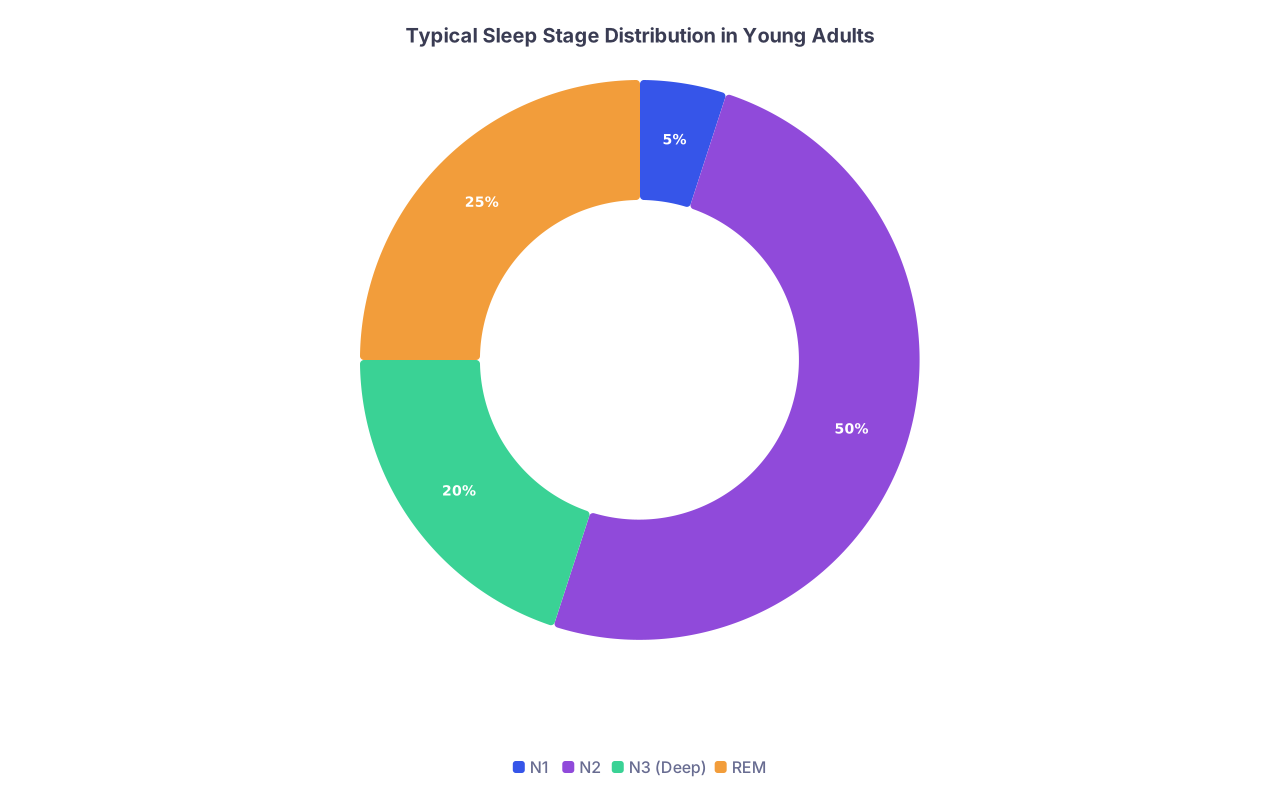
Normal sleep in a young adult (you) follows a predictable pattern across 4–6 cycles per night, each ~90 minutes:
- N1 – lightest sleep, transition from wake
- N2 – light sleep but crucial for memory; spindles and K-complexes, 45–55% of total sleep
- N3 (slow-wave / deep sleep) – heavy, restorative sleep, high-amplitude delta waves, mostly in the first third of the night
- REM sleep – rapid eye movements, dreaming, more prominent in the last third of the night, cycles lengthen as night progresses
Think of the night as front-loaded with N3 and back-loaded with REM.
| Category | Value |
|---|---|
| N1 | 5 |
| N2 | 50 |
| N3 (Deep) | 20 |
| REM | 25 |
Here is what specifically matters for your exam brain:
N2 – The Workhorse You Ignore
N2 gets dismissed because it is “light” sleep. Bad mistake.
N2 is critical for:
- Procedural learning and skills
- Memory consolidation via sleep spindles, which help integrate hippocampal (short-term) learning into cortical (long-term) storage
- Keeping your sleep stable; plenty of N2 protects against awakenings
For exam prep, N2 is where your daily question blocks are being “indexed” and stabilized.
If your sleep is fragmented by anxiety or late caffeine, you keep being kicked back toward wakefulness and N1, and you break up N2. That means:
- Less efficient transfer of what you studied today into long-term storage
- Higher likelihood that “I know I saw this” stays as a vague familiarity rather than retrievable knowledge
N3 (Deep Sleep) – The Facts and Tables Engine
N3 is where your brain does heavy lifting:
- Consolidation of declarative memory (facts, lists, formulas, drug names)
- Glymphatic clearance and metabolic restoration
- Growth hormone release and general body repair
Most N3 is loaded into the first 2–3 hours of sleep. If you:
- Go to bed at 2:30 a.m.
- Wake at 6:30 a.m. for an 8:00 a.m. exam
you still get some N3. But you have dramatically reduced total N3 across multiple nights, and you often compress it into too short a window. And if you are anxious, that early-night N3 is notoriously fragile and easily fragmented.
REM – The Pattern-Recognition & Emotional Regulator
REM is the most underrated asset on test day.
Functions that matter:
- Integration of complex, associative memory – linking symptoms, imaging, labs, and pathophysiology into coherent patterns
- Creativity and flexible problem-solving
- Emotional regulation and extinction of stress responses
Most REM happens in the last third of the night. So:
- If you sleep 12:30–7:30 – you get multiple, long REM periods. Good.
- If you sleep 2:30–6:30 – you crush the REM-heavy portion of the night. You just sacrificed what you need for nuanced vignettes and staying calm when you hit your third “I have no idea” question in a row.
Add in this problem: anxiety and alcohol both absolutely shred REM.
How Test Anxiety Deforms Your Sleep Architecture
Med students do a specific dance before boards. I have watched it repeatedly:
- Bedtime gradually drifts from 11 p.m. → 12 → 1 → 2 a.m. the final week
- Evening question blocks creep later “because I’m behind”
- Caffeine timing drifts later and later
- The night before the test, panic hits, and they either:
- Sleep 3–4 fragmented hours
- Or pass out from exhaustion at 3 a.m. and wake feeling hungover despite “sleeping 6 hours”
Let us dissect how anxiety interacts with the architecture.

1. Hyperarousal and Delayed Sleep Onset
High anxiety → increased sympathetic tone, cortisol, rumination.
You lie in bed:
- Replaying UWorld questions
- Mentally scanning your weak systems (renal, heme-onc)
- Checking the clock: “If I fall asleep now, I still get 5 hours…”
That pushes back sleep onset, compressing the entire night. Your first two cycles still try to allocate N3, but with less total time. You end up with:
- Less N3 for factual consolidation over multiple preceding nights
- Less total REM because the back half of the night is squeezed or eliminated
2. Fragmented N3 – You Keep Crashing Back to Light Sleep
Early-night awakenings (especially around sleep onset) disrupt N3. Your brain is trying to transition from N2 into slow-wave deep sleep; anxiety jerks you back up.
Result:
- You stay in shallow stages (N1/N2), never fully entering long, continuous N3 blocks
- You wake feeling “lightly rested” but cognitively dulled
- Even if total hours look okay on paper (7–8), the restorative slow-wave portion is chopped up
3. REM Suppression From Stress, Alcohol, and Sometimes Meds
REM is sensitive:
- Stress and cortisol can reduce REM density and increase awakenings during REM
- Alcohol in the evening – lots of students have “just one drink to relax” – initially sedates but suppresses REM in the first half of the night, then leads to rebound, fragmented REM later
- Some SSRIs/SNRIs reduce REM percentage; you cannot change that in the last week, but you should not add new sedating agents haphazardly
When REM is suppressed or fragmented:
- Pattern recognition is impaired
- Emotional thresholds are lower – you are more likely to panic mid-block, catastrophize, or mentally spiral after a few tough questions
What Actually Moves the Needle in the 7–10 Days Before Boards
You cannot redesign your entire chronotype in a week. You can, however, rescue your sleep architecture enough to protect your score.
This is where people either get too idealistic (perfect 8–9 hour routines) or too nihilistic (“Too late, I will just brute force it”). Both are wrong. You need targeted, architecture-aware decisions.
1. Lock Your Wake Time First, Then Nudge Bedtime
The brain anchors circadian rhythm primarily to wake time, not bedtime.
So:
- Choose your exam-day wake time (e.g., 6:00 a.m.).
- For 7–10 days before the exam, wake within ±15 minutes of that every single day. Yes, including weekends.
Then work backward:
- Aim for 7–8 hours in bed: 10:30–11:00 p.m. bedtime for a 6:00 a.m. wake.
- If you are currently at 1:30–2:00 a.m., pull it back by 20–30 minutes every night, not in one huge shift.
Why it matters for architecture:
- Stable wake time → more consistent timing of N3 and REM bands
- Your REM-heavy last third of the night will start occurring predictably before your alarm instead of after it
2. Protect the First Half of the Night From Stimulation
Your first two cycles (first 3 hours of sleep) are N3-heavy. You want them as undisturbed and deep as possible.
That means:
- No intense question blocks in the last 90–120 minutes before bed
- No highly emotional conversations about scores, NBME performance, or “what if I fail” right before sleep
- Low stimulation: light reading, non-cognitive TV, or a short, structured wind-down
I have seen multiple students push 40-question blocks to 10–11 p.m., then try to sleep at midnight. They fall asleep, but their brain is still processing adrenaline and cognitive load. N3 gets hammered.
If you must do questions: finish them by 8 p.m. and use the later evening for low-intensity review (flashcards, notes you already understand) or just stopping.
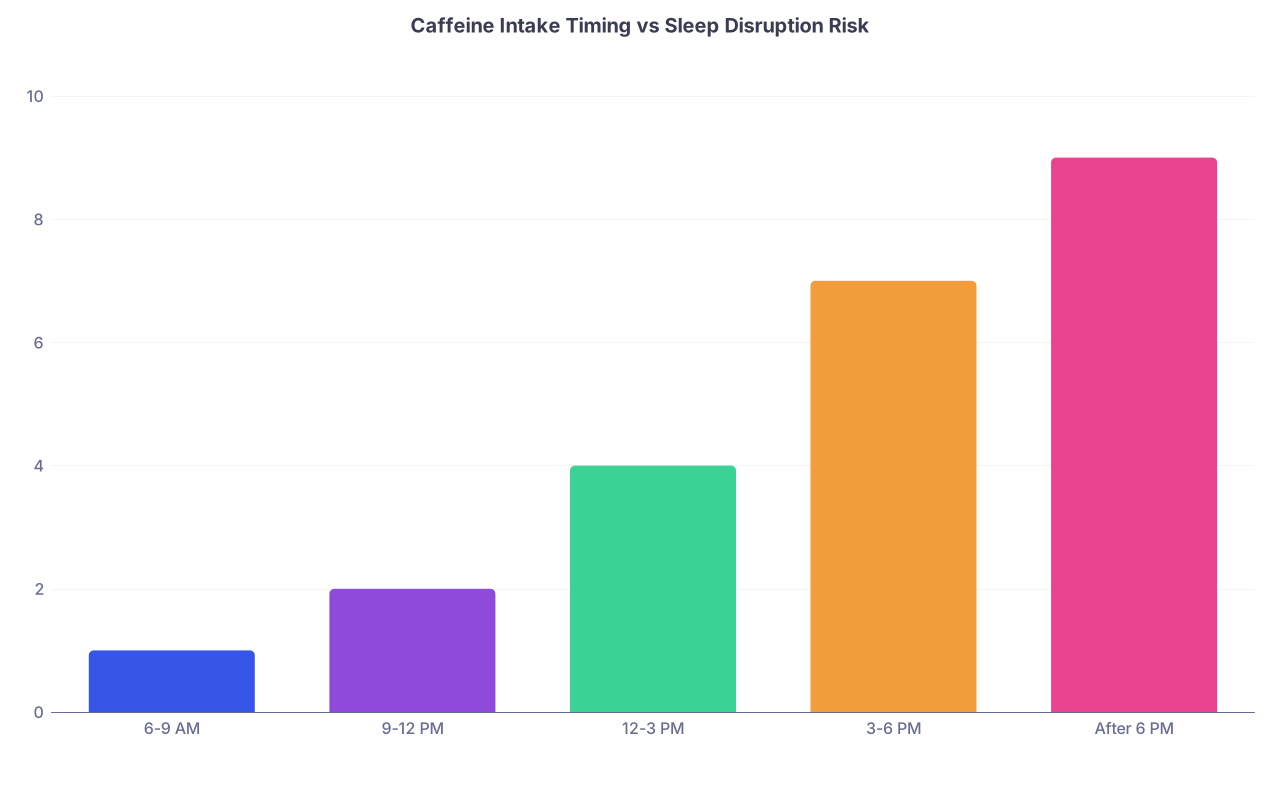
3. Cut Caffeine Timing, Not Necessarily Total Dose
I am not going to tell a med student in dedicated boards prep to “just don’t drink caffeine.” That is fantasy.
What actually matters:
- Caffeine has a half-life of ~5–6 hours. Quarter-life ~10–12 hours.
- Your N3 and sleep onset are most vulnerable to late-day caffeine.
Practical rule that works:
- Last meaningful caffeine by 2 p.m. if your bedtime target is ~10:30–11 p.m.
- You can keep morning caffeine and maybe a small late-morning dose. The point is not zero caffeine. It is getting it out of your system by the time you hit the N3-heavy portion of the night.
If you must push: on days 3–4 before exam, start shifting your biggest caffeine dose toward earlier in the morning, then taper slightly by 1–2 p.m.
| Category | Value |
|---|---|
| 6-9 AM | 1 |
| 9-12 PM | 2 |
| 12-3 PM | 4 |
| 3-6 PM | 7 |
| After 6 PM | 9 |
(Scale 1–10: higher = more likely to disrupt sleep onset/N3.)
4. Stop Using Evenings for New, Hard Material
One brutal but honest rule: Do not learn entirely new, complex content in the last 2 hours before bed the final week.
Why?
- New, emotionally threatening material (like discovering entire weak areas) spikes anxiety
- That anxiety then shows up as difficulty transitioning into N3
- You go to bed spun up, not settled
Use late evenings for:
- Lightly reinforcing already-known material (flashcards, summary tables you have seen before)
- Reviewing incorrects you already processed earlier in the day
- Or, frankly, not studying. Yes, that is allowed the last 60–90 minutes.
Your goal is to hit sleep with the mental equivalent of “digestible leftovers,” not raw, spicy content.
The 48-Hour Window: Damage Control With Sleep Architecture in Mind
Students love to sabotage themselves in the final 48 hours and then blame the exam.
The reality: the last 48 hours are not for gaining knowledge; they are for stabilizing retrieval. Which lives or dies on sleep stages.

| Step | Description |
|---|---|
| Step 1 | 48 Hours Out |
| Step 2 | Set fixed wake time for both days |
| Step 3 | Day -2: Normal study until early evening |
| Step 4 | Stop new hard content by 7 PM |
| Step 5 | Wind-down routine, bed on schedule |
| Step 6 | Day -1: Light review only |
| Step 7 | No full blocks after 2 PM |
| Step 8 | Relaxing evening, protect first half of night |
| Step 9 | Exam Day: Wake as practiced, no sleep debt |
Day -2 (Two Days Before Exam)
You can still study relatively normally with a few strict conditions:
- No full-length practice exam
- No radical diagnostic NBME that might shatter your confidence
- No caffeine after ~2 p.m.
Study focus:
- Consolidation – hitting your highest-yield notes
- Trying to identify major holes earlier in the day, not at 9 p.m.
Evening:
- Stop all “new” content by 7–8 p.m.
- Light review or no studying after that
- Aim for full sleep window at your planned exam-week bedtime
Your N3 this night is still contributing to consolidation of content you studied that day. Your REM helps with integration of the last few practice problems and clinical reasoning.
Day -1 (The Day Before the Exam)
This is where people ruin everything.
Your priorities are now:
- Protect sleep architecture
- Reduce physiological arousal
- Maintain rhythm similar to exam day
Study rules:
- No full, 7-block simulator. That ship sailed.
- If you must do questions:
- 1–2 light blocks in the morning only
- Review high-yield summary sheets or Anki in the early afternoon
- Hard stop on timed blocks by 2 p.m.
After 3 p.m.:
- Only light review: formulas, key tables, simple recall
- Nothing that will produce existential dread
Evening before:
- Early, carb-inclusive dinner (you want tryptophan and satiety on your side)
- No alcohol. Not even “just a beer.” It will fragment sleep and distort REM.
- Wind-down ritual: shower, stretch, brief walk, whatever calms your nervous system and is repeatable
In bed:
- You will probably feel wired. That is normal.
- Do not catastrophize “if I don’t sleep 8 hours, I’m doomed.” That creates a self-fulfilling insomnia loop.
- Your goal is restful time in bed with eyes closed, low stimulation. Even if you sleep 80% of the night instead of 100%, your architecture will still give you some N3 and REM.
Anxiety Tricks That Actually Matter (And a Few That Don’t)
Test anxiety is not going away. The point is not to eliminate it, but to keep it from blowing up your sleep stages.

Helpful for Sleep Architecture
Scheduled worry period – earlier in the evening
Give your brain 15–20 minutes at, say, 6:30 p.m. to write down all exam-related worries and action plans. That way, when your brain tries to ruminate at 11:30 p.m., you can say: “We did this already. Not now.”Body-based downregulation
- 5–10 minutes of slow breathing (4–6 breaths per minute, elongated exhale)
- Short, low-intensity stretching routine
These lower sympathetic drive, making N2→N3 transitions smoother.
Cognitive reframe about imperfect sleep
Studies in sleep research show: the belief that “I got terrible sleep” is often more damaging than the objective sleep quality itself.
Tell yourself very explicitly:- “Even 5–6 hours with some deep sleep and REM is enough to access what I’ve already learned.”
- “My preparation, spread across months, matters more than this single night.”
Strict phone rules in bed
Doomscrolling r/Step2 just before sleep is idiotic. The combination of blue light, social comparison, and fear stories is a perfect N3-killer.
Mostly Useless (or Risky) the Night Before
Trying a new sedative or “sleep aid” for the first time
Z-drugs, trazodone, diphenhydramine, melatonin in huge doses – they all have tradeoffs. First-dose effects can be paradoxical.
If you have specific meds from a physician that you have used reliably before, fine. But do not experiment the night before.Heavy exercise late at night
Lifting at 10 p.m. when you are not used to it will spike body temperature and cortisol. Better to do moderate activity earlier in the day.Massive carb binges right before bed
A normal dinner with some carbs is helpful. A huge sugar rush at 11:30 p.m. trying to “knock yourself out” often backfires and causes restless sleep and nocturnal awakenings.
How Poor Sleep Actually Shows Up During the Exam
This is not abstract. On test day, poor sleep architecture produces very specific failure modes. I see the same story over and over.
| Sleep Issue | Exam-Day Effect |
|---|---|
| Shortened N3 (several nights) | “I’ve seen this but can’t pull the fact.” |
| REM suppression | Rigid thinking, trouble with long vignettes |
| Fragmented night | Early mental fatigue, need for longer breaks |
| Caffeine too late | Jittery, racing thoughts, rushing questions |
| Very late bedtime shift | Sleep inertia, foggy first 1–2 blocks |
Common patterns you will recognize:
- Block 1–2 mental fog – Usually from circadian misalignment and sleep inertia (late bedtime, pushed REM into morning).
- Block 4–6 emotional crash – Often REM disruption: you cannot buffer the stress, each tough question feels catastrophic.
- “Tip-of-the-tongue” overload – Shallow, fragmented N3 over prior nights; knowledge is there but retrieval is unreliable.
The goal of your sleep planning is to blunt these patterns, not chase a fantasy of “waking up perfectly rested and zen.”
Special Situations: Rotations, Night Shifts, and Real Life
Not everyone has the luxury of a clean, protected dedicated period. If you are on an inpatient month before Step 2 or a brutal sub-I, you are playing on hard mode. The strategy is different.
If Your Schedule Is Irregular
- Prioritize consistent wake time on the 4–5 days immediately preceding the exam, even if the weeks before were a mess.
- Use strategic 20–30 minute naps early afternoon to reduce sleep pressure without cutting into N3 at night.
- Accept that you are not reaching ideal sleep architecture, and double down on:
- Hydration
- Early-day light exposure
- Morning movement (quick walk or light exercise) to clear sleep inertia
If You Have Chronic Insomnia or Anxiety Disorders
You are not fixing chronic insomnia in 10 days. But you can avoid making it worse.
- Stick to the same pre-sleep routine every night, even if the sleep itself is bad. The brain loves cues and predictability.
- Avoid high-dose melatonin and random OTC mixes; they can wreck REM or make you groggy.
- If you have a psychiatrist or physician managing this, do not suddenly change or stop meds. Stability beats last-minute tinkering.
The Non-Negotiables: If You Remember Nothing Else
Let me compress this, because if you are reading this during dedicated, your attention span is already stretched.
Lock your wake time to your exam time window at least 7 days out. Let bedtime slide earlier in small increments; do not yo-yo. This stabilizes when your N3 and REM occur.
Protect the first 3 hours of sleep from stimulation. No question blocks or panic conversations right before bed. That is your N3 engine.
Respect REM’s territory. Do not compress the final third of the night with a 2 a.m. bedtime. No alcohol. No last-minute all-nighters. Those destroy pattern recognition and emotional stability on test day.
You studied for months. The last 10 days are not about heroics. They are about not doing something reckless that your sleep architecture—and your board score—cannot quietly forgive.