Neuroscience of Memory Under Stress: Implications for Exam Prep
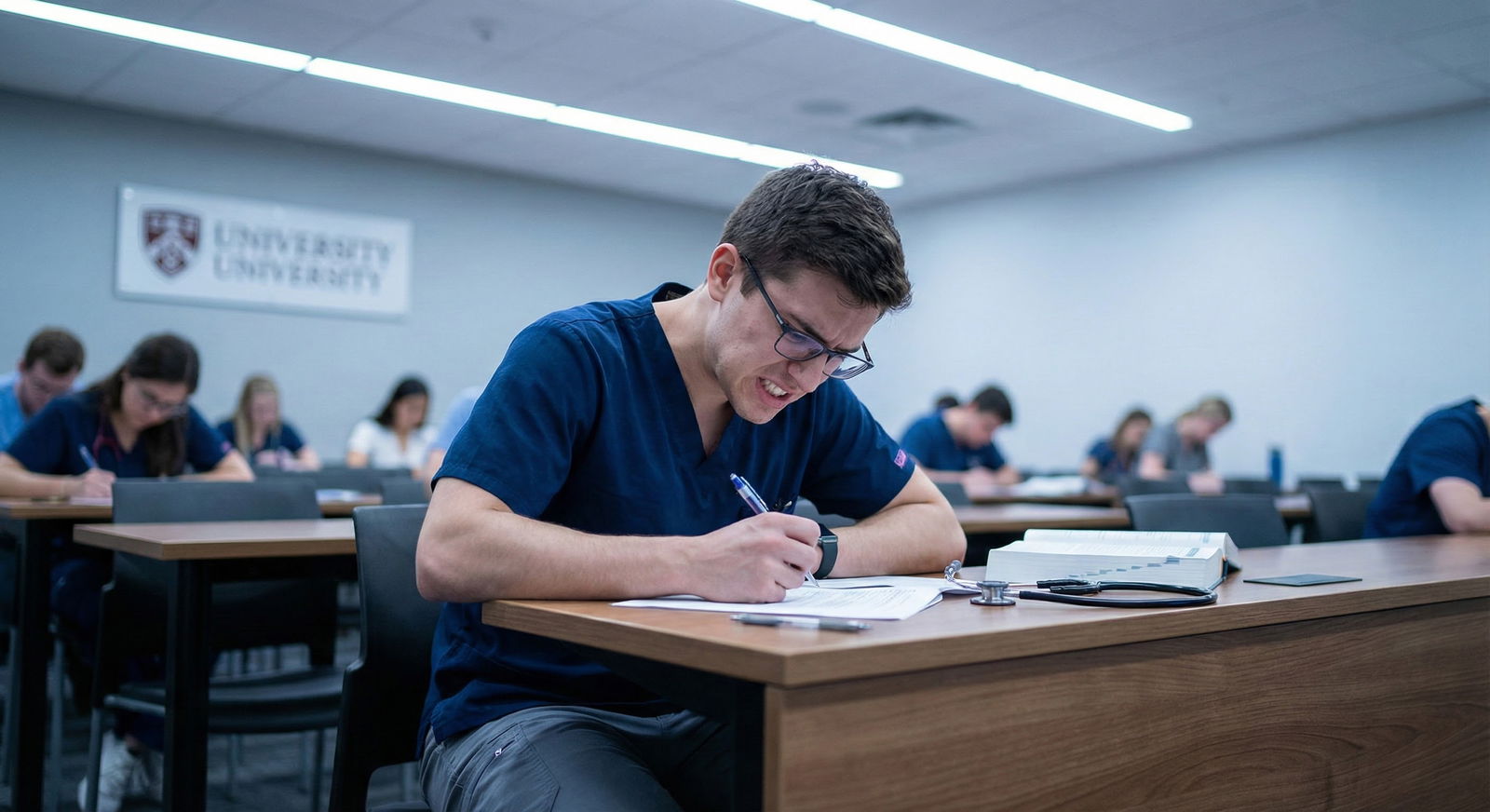
You are in the library at 10:45 p.m. Two weeks before your medicine shelf. You have UWorld blocks left, Anki reviews overdue, and a brain that feels like it is buffering. You read a paragraph on nephrotic syndrome and realize you have no clue what you just “read.” Heart rate up. Mild nausea. That familiar sense of, “If I don’t memorize every line in this chapter tonight, I’m screwed.”
Here’s the problem: at that exact moment—when you feel most pressure to cram—your brain is sliding into a neurobiological state that is absolutely hostile to memory formation and retrieval.
Let me break this down specifically: test anxiety is not just “in your head” in the casual sense. It is in your hippocampus, in your prefrontal cortex, in your amygdala, and in your cortisol levels. If you do not understand how stress changes memory circuitry, you will keep studying in ways that feel “hardcore” but are, neurologically, a bad investment.
This is fixable. But you have to stop treating your brain like a black box and start treating it like a system with known failure modes.
1. The Core Circuit: How Memory Normally Works (When You Are Not Freaking Out)
Start simple: three main brain players.
- Hippocampus – the “indexer” that binds new information together so you can find it later. Crucial for forming new explicit memories (facts, concepts, cases).
- Prefrontal cortex (PFC) – your mental “air traffic control.” Holds things in working memory, manages attention, suppresses distractions, chooses strategies.
- Neocortex – the long-term storage warehouse. Concepts, integrated knowledge, schemas live here.
When you learn a new concept in path or pharm under decent conditions (not dying of stress), this is what actually happens:
- Sensory input (reading, listening, seeing a question) hits primary sensory cortices.
- Association cortices and PFC hold the information in working memory, manipulate it, compare it to what you already know.
- Hippocampus links it to existing networks—“diabetic patient” + “microalbuminuria” + “ACE inhibitors” + “efferent arteriole dilation”—and tags it so it can be reactivated later.
- During sleep, especially slow-wave and REM, hippocampus “replays” patterns to cortex. That is consolidation: short-term traces becoming more stable long-term representations.
This system is not built for “memorize 600 unrelated facts under chronic fear.” It is built for organized, spaced, meaningful, emotionally reasonable learning.
Under moderate arousal, this works well. Under sustained high stress, parts of this circuit start to misfire.
2. What Stress Actually Does to Memory Circuits
Now the ugly part. Stress is not one thing. It is a set of neurochemical events with time courses.
In acute stress (minutes to an hour), you get:
- Sympathetic activation – norepinephrine surge.
- Hypothalamic–pituitary–adrenal (HPA) axis activation – cortisol release.
Short term, this can sharpen attention. That is why you remember sudden emergencies clearly. But there is a curve.
At low-to-moderate stress, memory and performance improve. At high stress, they tank. That is the Yerkes–Dodson law: the inverted-U between arousal and performance.
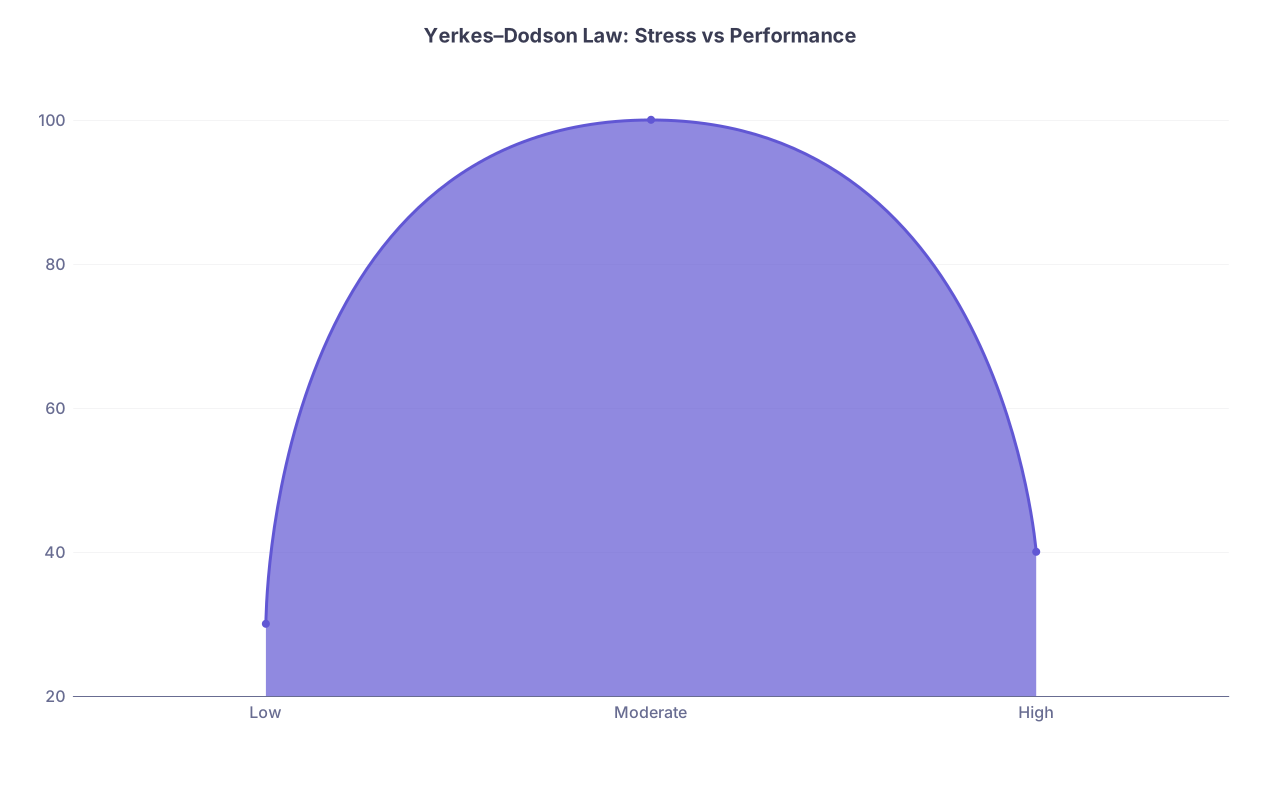
| Category | Value |
|---|---|
| Low | 30 |
| Moderate | 100 |
| High | 40 |
The relevant details for you:
2.1 Hippocampus under stress
- Acute moderate cortisol: can actually enhance encoding for emotional, salient events.
- Chronic or repeated high cortisol: impairs long-term potentiation (LTP) in hippocampus. LTP is the basic synaptic mechanism of learning. You blunt LTP, you blunt learning.
- Animal and human imaging data show decreased hippocampal volume with prolonged severe stress. No, your exam anxiety is not going to physically melt your hippocampus in a month, but running yourself at a high sustained stress level absolutely reduces hippocampal efficiency.
Translation: high, chronic exam stress makes it harder to form new stable memories and to retrieve older ones.
2.2 Prefrontal cortex vs amygdala: who is in charge?
Under strong stress:
Prefrontal cortex (especially dorsolateral PFC) function goes down.
- Working memory capacity shrinks.
- Cognitive flexibility drops.
- Strategic thinking and problem solving get worse.
Amygdala activity goes up.
- Threat detection becomes hypervigilant.
- Emotional salience dominates processing.
So instead of: “OK, stem, vitals, labs, what is the key decision point here?”
You get: “Holy hell 5 minutes left / I’m blanking / I’m definitely failing this block.”
Your attention shifts from task to self-threat. That is neural real estate being stolen from the exam you are supposedly “focusing on.”
I have watched students who know the content cold start making absurd mistakes on NBME practice tests when their baseline stress rises. Same questions. Same knowledge. Different neurostate.
3. Stress, Encoding, and Retrieval: Where Things Actually Break
You care about two phases: learning (encoding/consolidation) and testing (retrieval). Stress hits both, but in slightly different ways.
3.1 Encoding under stress: why “panic cramming” feels hard and sticks poorly
High stress encoding tends to:
- Narrow attention to threat-related or emotionally salient features.
- Reduce your ability to integrate new information with prior knowledge.
- Encourage shallow encoding (rote repetition) because deep processing feels “too slow.”
Examples in your day-to-day:
- You read a cardiology chapter while thinking, “I’m never going to finish this, I’m behind everyone else.” You get through pages. Can you explain HFrEF vs HFpEF mechanisms an hour later? Probably not. Your attentional bandwidth was hijacked.
- During a UWorld block taken in a panicky state, you do not pause to understand the mechanism behind a wrong answer. You just see “Incorrect: 38% got this right,” feel worse, and hit “Next.” Zero consolidation.
Physiologically, high catecholamines and cortisol bias your brain toward habit-like, “just survive” modes rather than effortful, flexible learning. Perfect if you are escaping a fire. Terrible for distinguishing between similar-looking rheumatologic diseases.
3.2 Retrieval under stress: blanking, partial recall, and “I knew this last night”
On exam day, the main job is retrieval. You are pulling stored patterns from cortex with help from PFC and hippocampus.
Under high acute stress:
- PFC function drops, so organizing search strategies gets harder.
- Hippocampal retrieval is impaired by high cortisol.
- Amygdala keeps flagging “threat,” which further distracts PFC.
That produces classic experiences:
- “Tip-of-the-tongue” failure: you know you know it, can almost picture the First Aid page, but you cannot get the name.
- Sloppy pattern matching: you grab the first semi-relevant fact that pops up and commit to it (premature closure), instead of holding multiple options and testing them.
- Time distortion: you feel like you are running out of time, rush questions prematurely, leading to careless errors.
The key point: under heavy stress, you over-rely on overlearned, automatized facts and underuse nuanced, contextual reasoning. That is why brute memorization of isolated facts feels safer to anxious students—they sense that under stress, nuanced reasoning will crumble. They are not wrong. But the solution is not “panic memorize everything.” It is to change how you study and how you manage arousal.
4. The “Goldilocks Zone” of Stress for Exam Performance
You do not want zero stress. Flat, sleepy, apathetic states are bad for motivation and attention. You want moderate arousal, good engagement, and controllable anxiety.
Let me make this concrete for a med student.
| Stress Level | Typical State Description | Memory/Performance Impact |
|---|---|---|
| Very Low | Bored, unfocused, scrolling phone | Poor encoding, low productivity |
| Moderate | Alert, challenged but in control | Best encoding and retrieval |
| High | Anxious, rushed, self-critical | Impaired encoding & retrieval |
| Extreme | Panic, freezing, catastrophizing | Severe performance collapse |
You want to train your brain to associate exam-like tasks with the moderate zone. Not the “I’m dying and everything is at stake” zone.
5. Concrete Implications for How You Study
Now the part you actually need: how to change your prep to work with your neurobiology instead of against it.
5.1 Stop studying in chronic fight-or-flight
If every study session feels like an emergency, you are burning cognitive horsepower for nothing.
Typical self-sabotage patterns I see:
- Doom-timer usage: using Pomodoro but staring at the countdown like it is a bomb.
- Self-talk like, “If I do not master this renal physiology tonight, I will not match internal medicine.”
- Benchmark obsession: checking percentile scores or looking at the Step score conversion after every single block.
These maintain high baseline arousal.
Better:
- Session goal framing: “For the next 60 minutes, I am going to master the mechanism and classic presentations of nephritic vs nephrotic. That is the only job.”
- Defer outcome thoughts: Have an explicit “no thinking about Step score / class rank” rule during blocks of focused work. You schedule time for big-picture planning once a week, not in the middle of Qbank sets.
- Clean environment of triggers: no classmates’ score screenshots, Reddit “I got a 270 with 4 weeks” posts, or chat threads about how behind everyone feels, open on your study laptop.
This is not “soft.” It is stripping away unnecessary threat signals that keep your amygdala on a hair trigger.
5.2 Use spacing and retrieval practice to lower stress-driven cramming
Your brain consolidates better when:
- You revisit material after some forgetting (spacing effect).
- You practice pulling information out (retrieval practice), not just re-reading.
Why this helps with stress:
- You see repeatedly, “I can forget something and then get it back.” That directly undermines the catastrophic belief: “If I do not memorize it perfectly right now, it is gone forever.”
- You reduce “peak stress” before exams because there is less to cram if you have been cycling material all along.
Practically:
- Daily spaced review (Anki or similar) not as a religion but as a principle: every day, do a set volume of old cards before learning new material.
- Mix topics (interleaving). Doing cardio, then renal, then endocrine in one sitting feels harder, but it trains flexible retrieval and prevents the illusion of knowing that comes from massed blocks.
5.3 Train under exam-like but controlled stress
You cannot be totally calm during high-stakes exams. Nor should you try. Instead, you pre-train your brain to function under realistic, moderate stress.
How:
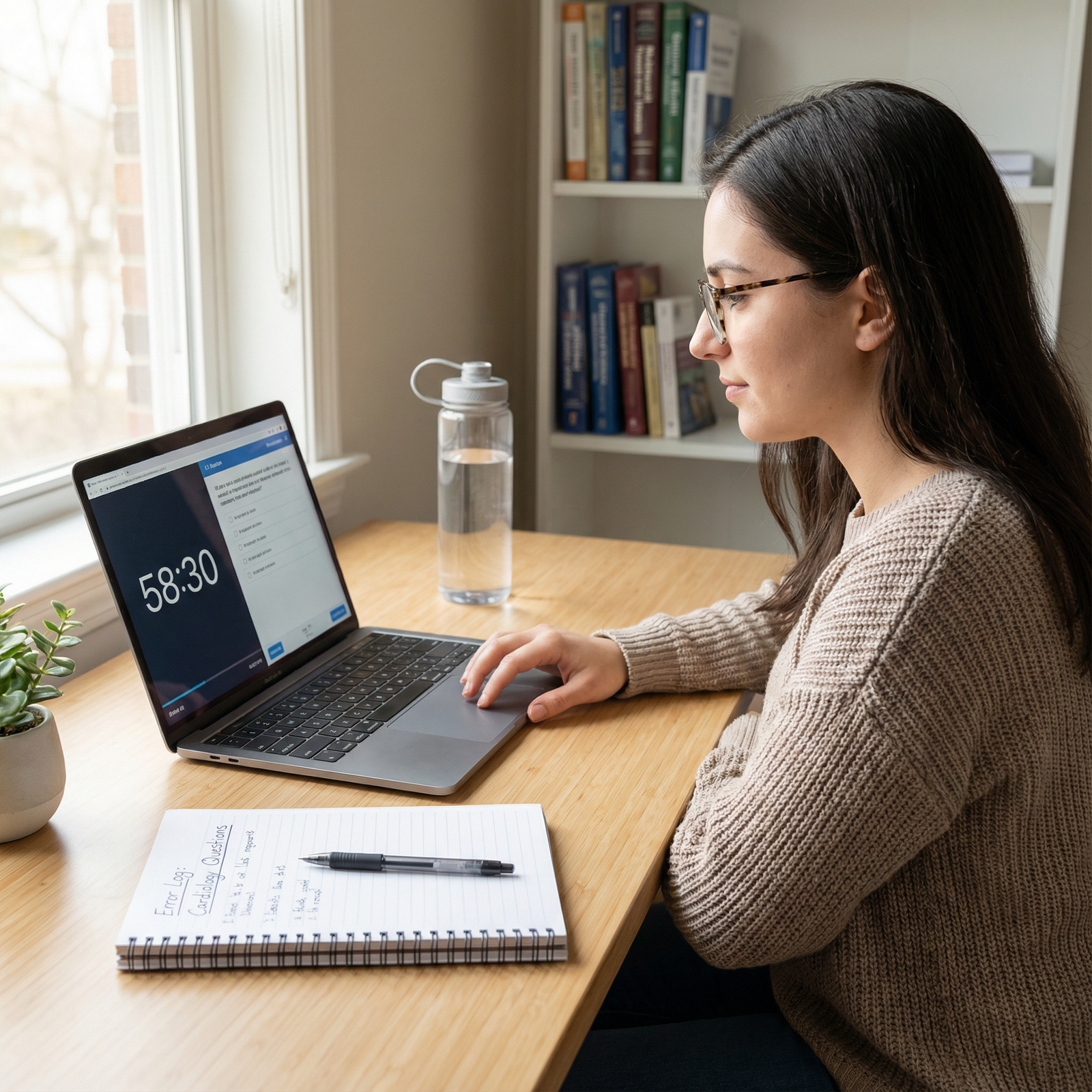
- Timed blocks of mixed questions (e.g., 40 questions in 60 minutes, once you are content-ready). No music, no phone, same scratch behavior as on test day.
- Short, deliberate warm-up before each block:
- 3–5 slow breaths (4s in, 6–8s out).
- One clear intention: “My job is to read stems carefully and rule options out methodically.”
This sounds fluffy. It is not. You are shifting your autonomic state and your PFC–amygdala balance before loading complex cognitive work.
- Post-block stress debrief:
- Not just “What did I get wrong?” but “Where did my stress spike? Did I speed up or slow down? Did I catastrophize after one hard question?”
You are training meta-awareness of stress patterns, which is a PFC skill.
- Not just “What did I get wrong?” but “Where did my stress spike? Did I speed up or slow down? Did I catastrophize after one hard question?”
You want your nervous system to learn: “Timed blocks with hard questions = challenging but survivable, not catastrophic.”
6. Acute Stress Modulation: On-the-Spot Techniques That Are Actually Mechanistic
Let us get more granular. You are sitting in an NBME or real shelf and you feel the wave of panic hitting. What can you do that is not vague “just relax” nonsense?
6.1 Physiologic sigh breathing
Very specific pattern:
- Two inhalations through the nose (first normal, second smaller “top-off”), then a long exhalation through the mouth.
Do that 2–3 times.
Neuroscience behind it: this pattern recruits pulmonary stretch receptors and biases autonomic output toward parasympathetic activation, dropping heart rate and dampening amygdala drive. This is not meditation. It is mechanical. You can do it between questions without anyone noticing.
6.2 Label the state, not the story
Stress is worsened by the cognitive story you attach to it: “I feel anxious” becomes “I am failing” becomes “I will not match.”
Quick mental script that keeps PFC online:
- “This is a stress surge. My heart rate is up. My hands are warm. That is my body mobilizing. I can still read questions.”
You are acknowledging the physiologic state without buying the catastrophic story. This is classic cognitive reappraisal, and there is fMRI data showing it shifts activity from amygdala to PFC.
6.3 Micro-reset between questions
If you blow one question badly or have no idea, the worst thing you can do is carry that emotional residue into the next 10 questions.
Micro-reset ritual (5–10 seconds):
- Close eyes briefly (1–2 seconds).
- One slow exhale.
- Simple cue phrase: “New question, new start.”
You are breaking the emotional chain. Again, small, but repeatedly doing this can preserve PFC function over the full exam length.
7. Sleep, Consolidation, and Why “Just One More Hour” Is Often Dumb
I have seen this movie: 1–2 weeks before Step/Level/Shelf, sleep time starts shrinking “just for a bit.” Midnight becomes 1:30, then 2:00, then 3:00 a.m.
You feel like you are squeezing in more content. Neuroscience says you are deleting consolidation.
What actually happens during sleep:
- Slow-wave sleep (N3): hippocampal replay of recent experiences to cortex. This is when fragile memories become more stable.
- REM sleep: integration, emotional regulation, pattern extraction.
Chronic partial sleep deprivation:
- Reduces hippocampal LTP.
- Impairs PFC function, especially working memory and attention.
- Increases baseline cortisol.
So if you are cutting sleep, you are:
- Encoding worse during the late-night session (because exhausted + higher stress).
- Consolidating less of what you did learn.
- Waking up with a brain that functions more like “high stress” baseline.
On the nights before big exams, the tradeoff is usually blunt:
- One extra hour of half-effective cramming
vs - Better encoding of everything you already studied + sharper PFC + lower cortisol.
I am not romantic about rest. I am telling you, from a purely performance standpoint, that repeated self-imposed sleep debt is one of the dumber ways med students sabotage memory.
8. The Long Game: Chronic Stress, Identity, and Why “I Am Anxious” Matters
Short-term hacks help. But if your entire medical school experience is marinated in “I am an anxious person, I am always behind, I am barely holding on,” your HPA axis is going to run hotter all the time.
Chronic, identity-level stress beliefs:
- Keep baseline cortisol higher.
- Make your amygdala more reactive to any exam-related cue.
- Reduce psychological safety, so every quiz, OSCE, or pimping moment feels existential.
You cannot think your way entirely out of this, but you can change the input:
- Be ruthless about your information diet. Constant comparison with the top 5% of your class on group chats or social media is pure, unnecessary threat signaling.
- Build a more realistic, data-driven self-concept: actually track your Qbank performance over weeks, not based on a single bad day. Most trajectories are noisy; anxiety makes you zoom in on the dips.
- Get real help when it is clearly beyond “normal exam stress”: ongoing insomnia, panic attacks, constant dread, or depressive symptoms are not “med school is just hard.” They are treatable states with major cognitive and memory consequences.
9. Putting It All Together: Designing a Brain-Compatible Exam Prep Plan
Let me sketch a concrete structure that obeys the neuroscience, rather than fighting it.
9.1 Weekly structure
- 5–6 days / week of structured study, 1 real day off or half-days off. You need recovery for consolidation and stress reset.
- Daily:
- 1–2 blocks of questions (untimed early, timed as exam approaches).
- Spaced review (Anki or similar).
- Focused content review of weak areas based on Qbank feedback.
- Built-in stress modulation:
- 5–10 minutes of breath work or light movement before your first heavy cognitive task.
- Hard barrier at a reasonable “lights out” time most nights.
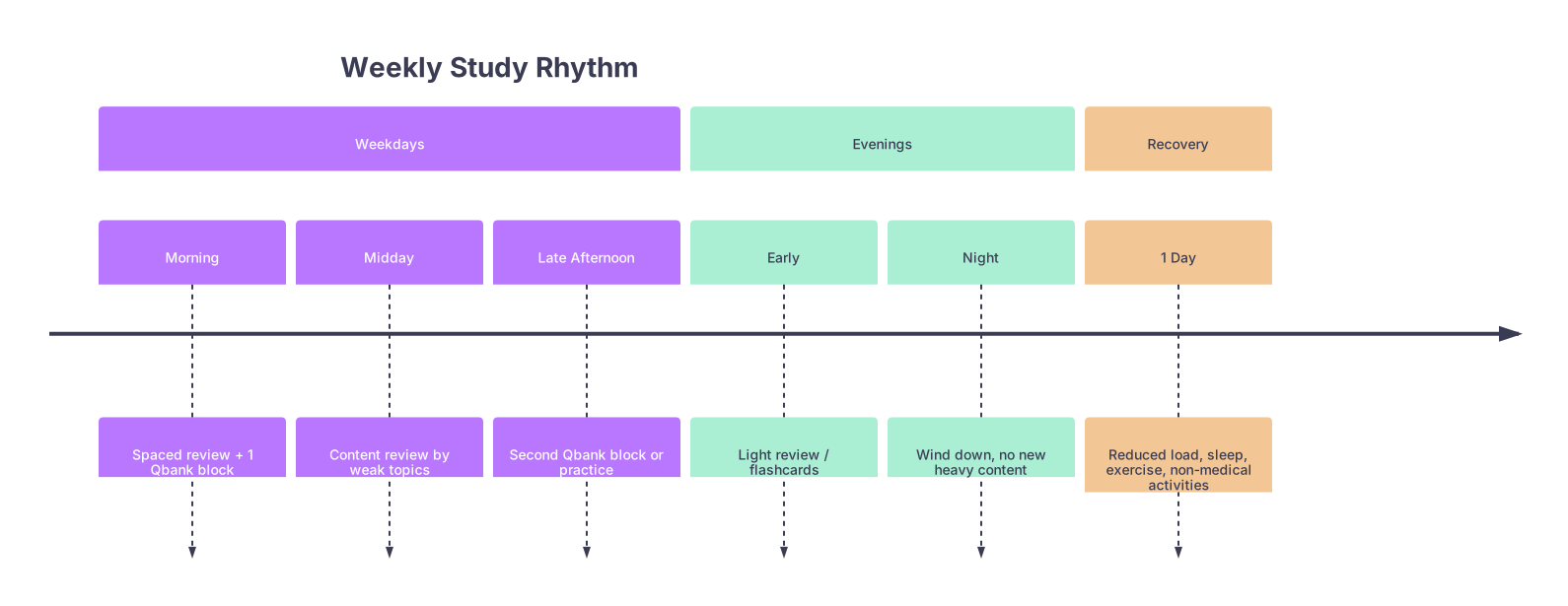
| Period | Event |
|---|---|
| Weekdays - Morning | Spaced review + 1 Qbank block |
| Weekdays - Midday | Content review by weak topics |
| Weekdays - Late Afternoon | Second Qbank block or practice |
| Evenings - Early | Light review / flashcards |
| Evenings - Night | Wind down, no new heavy content |
| Recovery - 1 Day | Reduced load, sleep, exercise, non-medical activities |
9.2 Practice tests as stress training, not just score fishing
When you take an NBME or full-length practice:
- Treat it as a lab for your stress response:
- Where does your anxiety spike? After a string of unsure questions? When you see a long stem?
- What happens to your pacing?
- Afterward, do two reviews:
- Content review (classic).
- Process + stress review: “What did I do when I started to panic? Did any techniques help? What will I try next time?”
You are iteratively training your circuitry to keep PFC online under load.
9.3 Non-negotiable pillars (these are not “nice to haves”)
- Sleep: 7+ hours most nights, last week before major exams as protected as possible.
- Movement: does not need to be heroic. 20–30 minutes of walking or light exercise most days stabilizes mood and lowers baseline sympathetic tone.
- Food & caffeine: not my field per se, but very simply—no wild caffeine spikes right before high-cognitive tasks. High jitter = mimic anxiety = worse PFC.
10. A Quick Reality Check
You are in a profession that structurally incentivizes stress. High stakes, constant evaluation, never-ending content. You are not going to meditate your way into a zen bubble where exams feel like spa days.
But you can:
- Stop doing things that obviously push your brain into dysfunctional stress zones.
- Intentionally build study patterns that match how hippocampus, PFC, amygdala, and sleep actually work.
- Train stress responses the same way you train your knowledge base—deliberately, repeatedly, with feedback.
I have seen students with “test anxiety” labels pull their performance up by double digits on standardized exams once they stopped treating anxiety as a moral failing and started treating it as a modifiable neurobiological state.
You are not powerless here. You are just not taught this stuff in lecture.

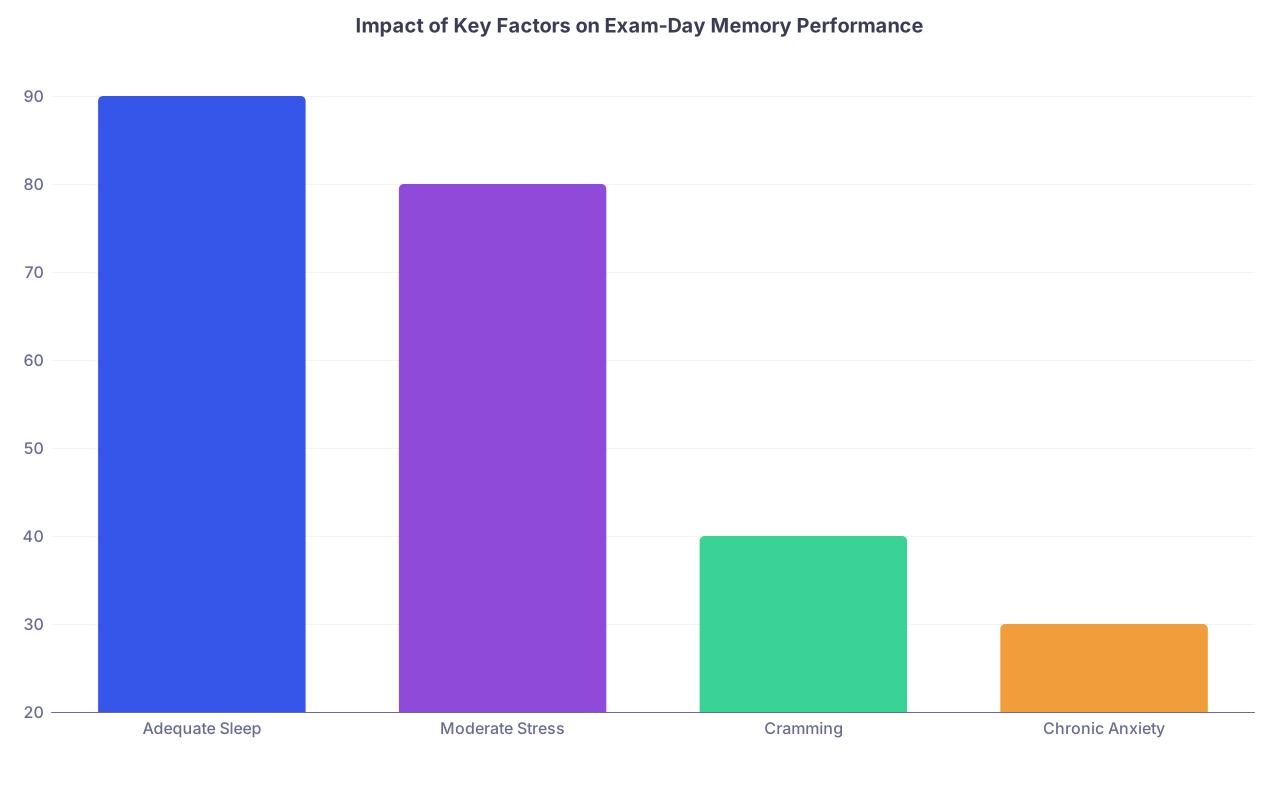
| Category | Value |
|---|---|
| Adequate Sleep | 90 |
| Moderate Stress | 80 |
| Cramming | 40 |
| Chronic Anxiety | 30 |
Key Takeaways
High, sustained stress impairs both encoding and retrieval by disrupting hippocampus and prefrontal cortex while overactivating the amygdala. Studying in panic mode is neurologically inefficient.
You want the “Goldilocks” zone of arousal: moderate stress with good control. Use spacing, retrieval practice, and exam-like but contained practice to train your brain to operate there.
Sleep, acute stress tools (like physiologic sighs and micro-resets), and deliberate reduction of unnecessary threat signals (comparisons, doom-scrolling scores) are not optional wellness fluff. They are core performance interventions if you want your memory to work when it counts.