
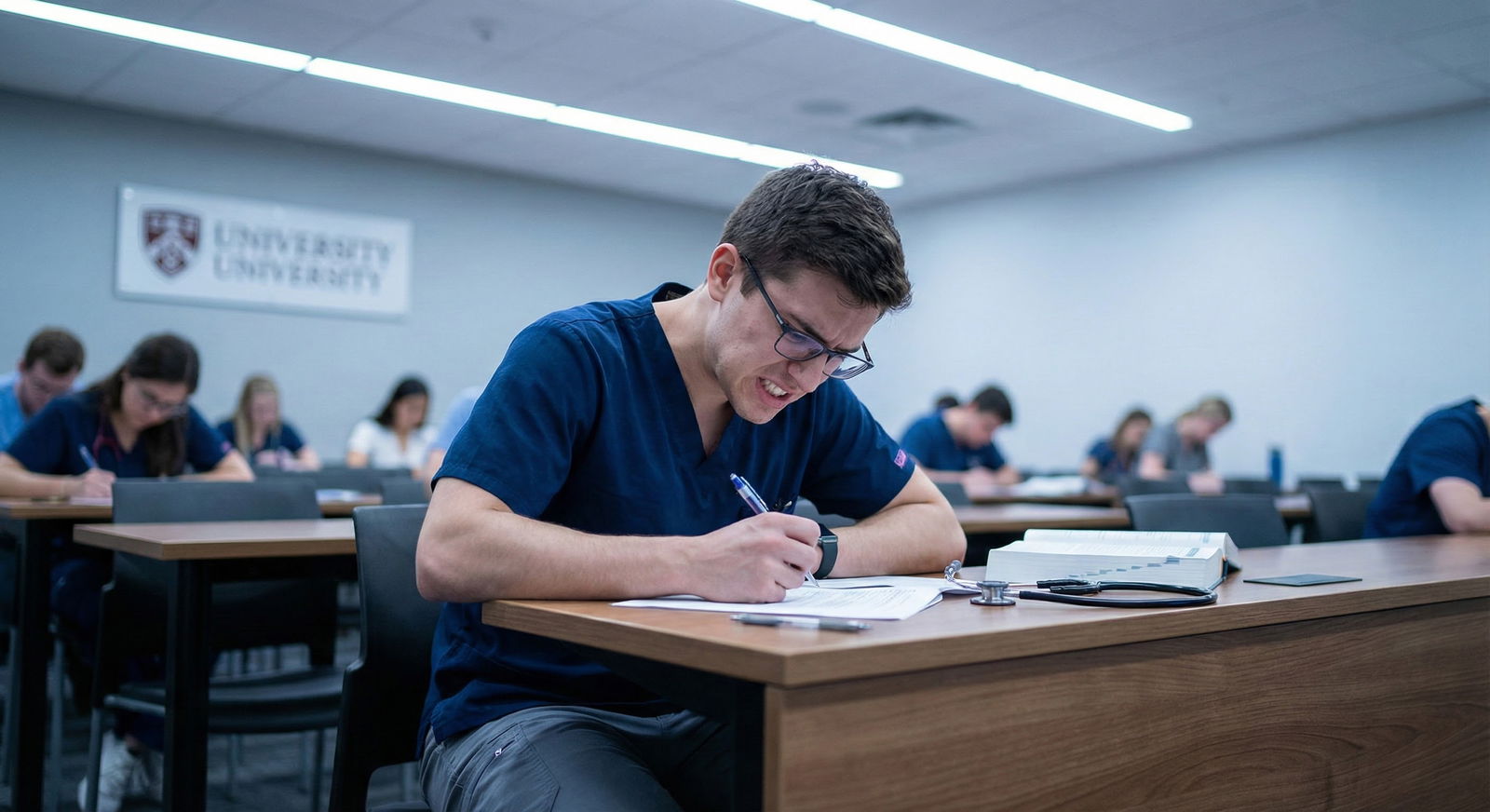
Most medical students blame the wrong anxiety for their exam failures.
You think you have “test anxiety.” In reality, you probably have a messy overlap of performance anxiety and general anxiety, and you are treating neither correctly.
Let me break this down specifically, because this confusion costs people exam points, clerkship honors, and residency spots every single year.
Performance Anxiety vs General Anxiety: The Real Distinction
These two are not just different “levels” of the same thing. They behave differently, show up at different times, and respond to different interventions.
Core definitions (in exam-relevant language)
Performance anxiety
Anxiety that is tightly tied to specific high-stakes situations where you are being evaluated: exams, OSCEs, oral presentations, pimping on rounds, procedures, simulations.
It spikes around the performance window: anticipation → during → immediate aftermath.General anxiety (Generalized Anxiety)
A persistent, baseline tendency toward worry, overthinking, physical tension, and “what if” spirals that extend across many domains: grades, relationships, finances, future, health, social, family.
It is chronic and broad, not limited to exams.
The piece people miss: you can have one, the other, or both. And the “both” group is where most struggling medical students live.
How Each One Actually Shows Up Around Exams
If I sit with a student for 10 minutes and ask pointed questions, I can usually tell which one is running the show.
Performance anxiety: exam-centered, spike-like
Typical profile:
- You study reasonably well.
- You know the material days before the test.
- Your practice questions are fine.
- Then your body betrays you in the testing moment.
Common signs:
Timing of symptoms
Relatively okay week-to-week → spike right before or during:- Night before: racing heart, GI upset, insomnia, catastrophic thoughts about this exam
- During exam: blanking, sweating, tunnel vision, rapid heartbeat, can’t read questions clearly
Pattern across situations
You might be generally functional. But:- NBME / Shelf / Step-style exams → anxiety surge
- OSCE with standardized patient and examiner → anxiety surge
- Attending questioning you in front of team → anxiety surge
Outside evaluation scenarios, you can relax.
Thought content is highly performance-centric:
- “If I fail this exam, I ruin my chances at derm/ortho/IM.”
- “Everyone will finally see I am an impostor.”
- “If I blank in this OSCE, they will know I should not be a doctor.”
Memory and recall break down under pressure
Example: You have seen the exact UWorld question. You remember the stem vaguely. But in the moment, you freeze and click the wrong thing.
This is the person whose baseline life is stressful (it is med school), but they are not lying awake daily with general life worries. Their spikes are tightly tethered to evaluation.
General anxiety: constant background noise that muddies exam prep
General anxiety is quieter and more insidious academically. It compromises you long before the exam.
Common signs:
Timing of symptoms
Worry most days. Not just during exams.- Ruminating about past mistakes for hours
- Chronic muscle tension, headaches, GI issues
- Sleep disrupted by racing thoughts about multiple domains
Pattern across life domains
Exams, yes. But also:- “Did I offend my attending?”
- “What if my partner leaves?”
- “What if I get sick and cannot finish residency?”
- “What if I never catch up to my classmates?”
Thought content is diffuse and repetitive:
- “I am behind.”
- “I am not good enough.”
- “I am going to fail at everything I try.” Even on days without tests.
Study quality is heavily impacted
- You sit down to study → 40 minutes lost in anxious thoughts
- You reread the same page 6 times and absorb none of it
- Procrastination driven by dread, not laziness
Your exam underperformance is partly a preparation problem created by anxiety.
Now the key question you probably care about: which one is actually sabotaging your exams more?
Which One Hurts Scores More: Performance or General Anxiety?
Short answer: chronic general anxiety usually does more total damage, but performance anxiety can produce bigger, more dramatic crashes on single high-stakes exams.
Think of it this way:
- General anxiety → erodes hours of effective study over weeks to months.
- Performance anxiety → erodes percent of potential on the actual exam day.
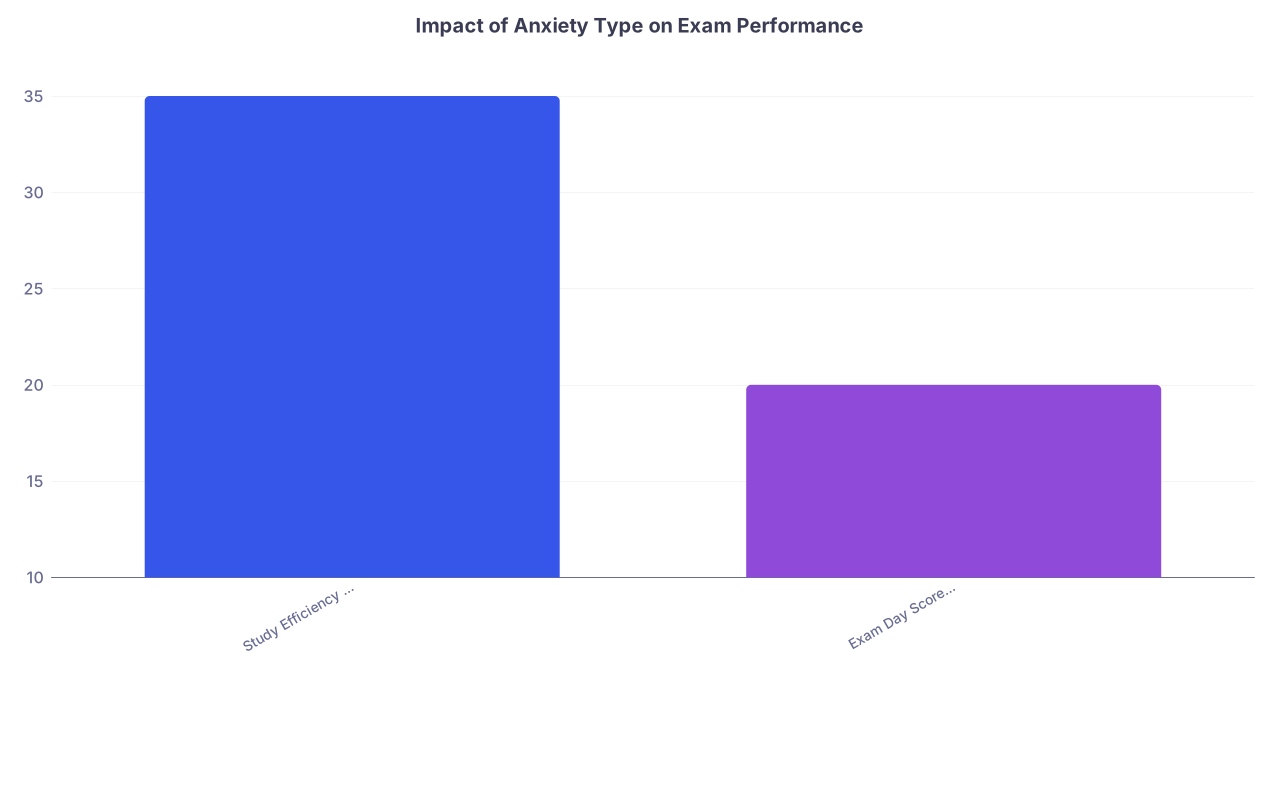
Let’s quantify this.
| Category | Value |
|---|---|
| Study Efficiency Loss | 35 |
| Exam Day Score Drop | 20 |
Interpretation:
- A student with strong general anxiety might lose ~35% of their potential study efficiency (poor focus, procrastination, burnout).
- A student with pure performance anxiety might lose ~20% of their potential exam-day performance (blanking, rushing, misreading).
When you mix both, you get:
- Reduced study input
- Plus impaired output on test day
That is how an intelligent, hard-working MS2 ends up sitting on a 205 NBME when they have 235-level knowledge buried under chronic anxiety and exam-day spikes.
How to Quickly Tell Which One Is Dominant (In You)
You will probably have elements of both. The point is to identify the primary driver, so you stop swinging blindly.
Ask yourself these diagnostic-style questions. Answer honestly, not aspirationally.
Question 1: How is your practice performance vs real exams?
- Practice questions at home, timed blocks:
- If you consistently perform significantly better at home than in proctored or simulated conditions → performance anxiety flagged.
- If you are already underperforming in practice → general anxiety or knowledge gaps are major players.
Question 2: What is your worry baseline 2–3 weeks before the exam?
- If 2–3 weeks out, you can relax during time off, enjoy a meal, watch a show without constant doom thoughts → heavy performance component.
- If your “rest” time is mentally filled with intrusive worries, guilt, and self-critique → general anxiety is in charge.
Question 3: Track your day-to-day function
Over one week, note:
- Hours you plan to study vs hours actually studied
- Number of episodes of:
- Can’t start studying due to dread
- Studying but mind wandering in worry loops
- Physical tension / somatic anxiety with no specific trigger
If the prep phase is chaotic, inefficient, and emotionally draining daily → general anxiety is likely the bigger saboteur.
How Each Type Sabotages Different Parts of the Exam Cycle
Let me break the exam cycle into four steps and show where each anxiety type attacks.

| Step | Description |
|---|---|
| Step 1 | Planning |
| Step 2 | Studying |
| Step 3 | Final Week |
| Step 4 | Exam Day |
1. Planning phase (4–8+ weeks out)
General anxiety:
- Overestimates how much you “should” be doing
- Creates chaotic, unsustainable study plans (14-hour days, no rest days)
- Triggers guilt when you are not constantly productive
- Leads to chronic burnout by week 2–3
Performance anxiety:
- Less active here, unless you are fixated on a single future exam (Step 1, Step 2, a high-stakes shelf).
- You may obsessively read about other people’s scores, which can feed into general anxiety.
2. Studying phase
General anxiety:
- Fragmented attention: starting Anki, then UWorld, then YouTube, then nothing.
- Hyper-focusing on weaknesses but never feeling “allowed” to move on.
- Internal narrative: “Everyone else understands this faster than I do.”
Performance anxiety:
- Can make you over-practice in exam-like conditions too early.
- Drives “if this NBME is bad, I am doomed” thinking.
- But if your anxiety is mostly performance-based, many of your study days will be relatively okay.
3. Final week
This is where they overlap badly.
General anxiety:
- Exhaustion, irritability, cognitive fatigue.
- Belief that you have to “cram everything” because you have been inefficient for weeks.
- Insomnia not driven by just the upcoming exam, but by general overarousal.
Performance anxiety:
- Now fully active.
- Somatic symptoms spike as you visualize the exam room, proctors, NBME interface.
- Constant checking of predictive score calculators, forum posts, “Is a 68% on UWorld enough?”
4. Exam day
Performance anxiety is king here.
- Physiologic arousal too high → impaired working memory and executive function.
- Rushing through stems, re-reading multiple times, second-guessing simple questions.
- Panic during a tough block spills into later, easier blocks.
General anxiety still plays a role:
- You start the exam already sleep deprived and cognitively drained.
- Resilience is low: one bad block sends you into a tailspin of global self-judgment.
So which one sabotages you more?
If you are failing or barely passing multiple exams despite “studying all the time,” general anxiety is usually the bigger thief. If you are plateaued just below where your practice suggests you should score, performance anxiety is often the main bottleneck.
Targeted Strategies: Performance Anxiety vs General Anxiety
Using the same intervention for both is like using acetaminophen for septic shock. Technically “something,” but mismatched to the problem.
Let us separate the toolkits.
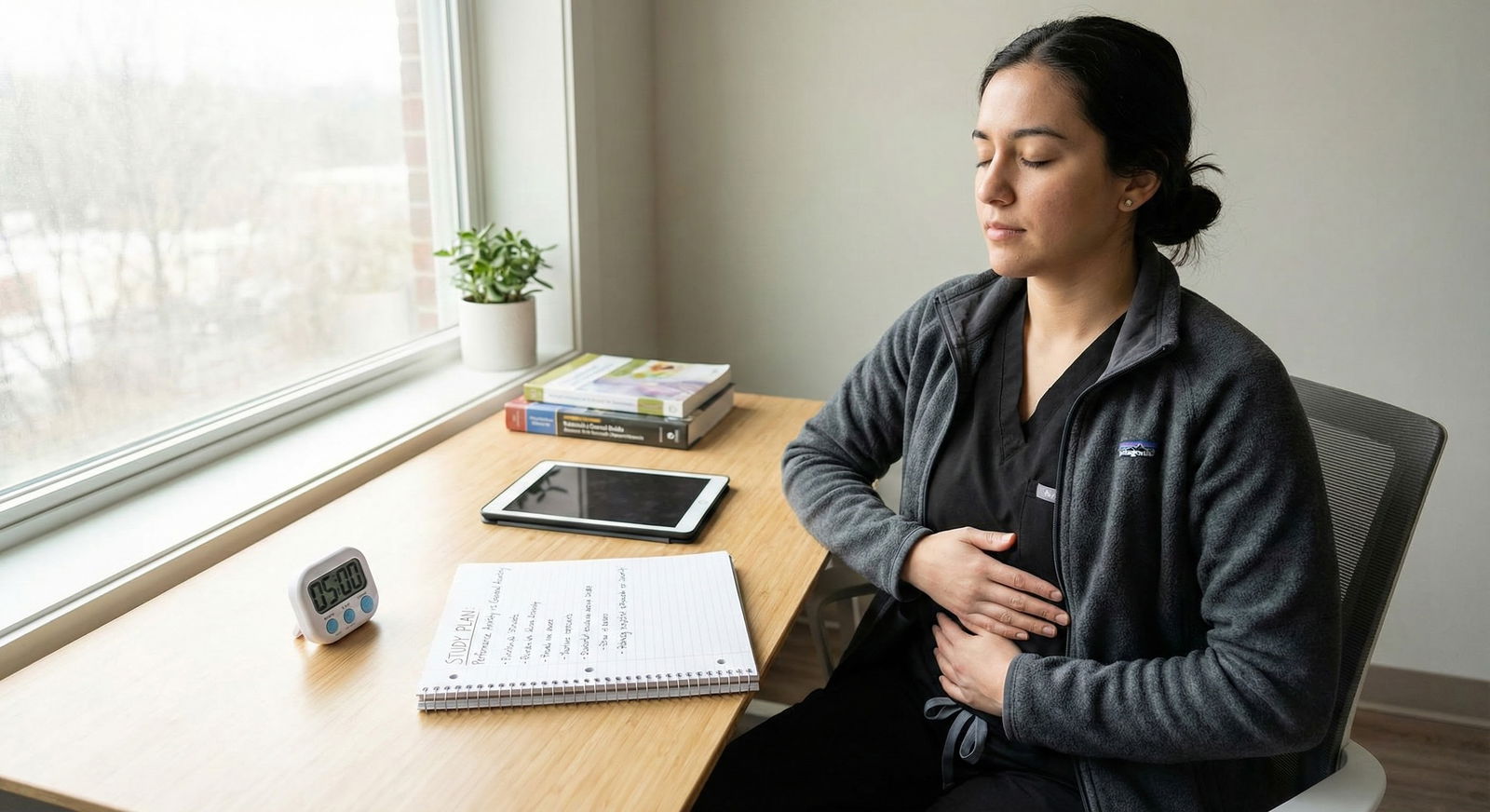
Tools that primarily hit performance anxiety
These are built around skills during high-pressure performance.
Pre-performance routine (PPR)
The best performers in sports and music have this. Medical students rarely do, and it shows.Design a 10–15 minute fixed sequence you do before every practice block and real exam:
- 2–3 minutes of diaphragmatic breathing (4-sec inhale, 6–8-sec exhale)
- 1–2 minutes of specific self-talk: “I will read stems once, trust first instinct, and move on.”
- Brief body scan and muscle release (jaw, shoulders, hands)
- Visualize the exam interface and calmly working through 3 questions
Then, crucial point:
Use this before timed blocks at home, not just on test day. Make it automatic.In-block cognitive anchors
You need simple, mechanical rules to prevent spirals mid-exam:
- One pass per question. Mark and move if you are not 70% sure in 60–75 seconds.
- If you feel rising panic: eyes closed for one breath cycle → reopen → read next question only.
- No global score predictions mid-exam. That mental math is pure anxiety, not data.
Simulated exam exposure
Many “test anxiety” students are massively under-exposed to truly exam-like conditions:
- Full timed blocks, back-to-back, with short breaks only.
- No phone, no snacks at desk, no music, real break timing.
- Same start time as real exam.
Performance anxiety drops when your nervous system realizes: “I’ve been here before and survived.”
Targeted cognitive restructuring
Most performance anxiety is powered by catastrophic predictions about this performance:
- “If I fail Step 1, I will never match.”
- “If I do poorly on this shelf, my evals are ruined.”
You do not need inspirational affirmations. You need more accurate probabilities:
- “One exam matters, but not as much as my brain is claiming.”
- “I can underperform and still have multiple paths forward.” This is not toxic positivity. It is recalibrating from 0% vs 100% thinking.
Tools that primarily hit general anxiety
These are built around changing your baseline mental environment so you can actually study like a human being.
Structured study blocks with scheduled worry
General anxiety loves open, unstructured time. So you box it.
- Use 45–75 minute focused blocks (Pomodoro-like, but for grown-ups).
- Between blocks, give yourself 5–10 minutes of scheduled worry time:
- Write down the worries quickly.
- If they are not solvable now, label them “not today’s problem.”
You are training your brain: worry is allowed, but not always, and not everywhere.
Reduce cognitive load in decision-making
Anxious students waste absurd energy deciding:
- Which resource
- How many questions
- Which topic
Pre-decide a simple weekly structure:
- X UWorld questions per day
- Y Anki cards
- Z hours of content review
Then follow it like a protocol, not a constant debate. General anxiety thrives on indecision.
Baseline physiological regulation
I am not going to preach “sleep 8 hours, exercise, meditate” like an Instagram infographics account. You already know. Let’s be specific.
At minimum:
- A consistent sleep window (e.g., 11pm–7am) even if total sleep is not perfect.
- One short bout of movement daily: 10–20 minutes of brisk walking or bodyweight exercises.
- One anxiety-regulating practice used daily outside study sessions:
- 5–10 minutes of paced breathing
- Or 5–10 minutes of a body scan
You are not aiming for enlightenment. You are pulling your general sympathetic tone down a notch.
Limits on anxiety-driven information consumption
This is repeatedly destructive:
- Obsessively checking Reddit / forums for score reports
- Asking classmates daily about their progress
- Watching “day in the life” or “how I scored 270” videos when you are already behind
Create a rule:
- Max 1–2 check-ins per week with external comparison content.
- No exam-related forums after 9pm.
You cannot out-study a brain that you are constantly flooding with comparison triggers.
When Both Are Present: Combined Strategy
Many of you reading this will recognize features of both types. That is not special; it is standard in med school.
So how do you prioritize?
| Your Pattern | Most Effective First Focus |
|---|---|
| Strong practice, big exam-day drop | Performance anxiety tools |
| Chronic procrastination + fatigue, modest exam-day drop | General anxiety tools |
| Both chronic worry + exam spikes | Start with general, then add performance |
| Near-burnout, multiple near-failures | Professional help + general anxiety focus |
If you have:
- Multiple failed or borderline exams
- Constant worry across life domains
- Sleep destruction
- Loss of joy in almost everything
Then your priority is not one more study hack. It is professional-level intervention: therapy, possibly medication, and real support. I have watched students try to “grind their way out” of a clear generalized anxiety disorder. It does not work. It just delays the inevitable crash.
Red Flags That You Need More Than Self-Management
I am going to be blunt here. If you see yourself in these, you should not try to handle this alone.
- Panic attacks more than once a month, especially around evaluations.
- Passive thoughts like, “If I do not pass this, there is no point continuing,” or anything even vaguely suicidal.
- Complete breakdown of functioning:
- Missing clinical duties
- Skipping exams
- Unable to attend class or respond to emails
- Repeated exam failures despite genuinely consistent studying and multiple attempts at self-directed anxiety management.
At that point, this is no longer just “test anxiety management.” It is a clinical problem interfering with your ability to train as a physician. Schools are actually more flexible and supportive here than students assume—if you approach them early and honestly.
Putting It Together: A 2-Week Micro-Plan
If you have an exam in ~2 weeks and recognize anxiety patterns, here is a compact, realistic structure.
Daily (non-negotiable minimums)
- 2–3 focused study blocks of 60–75 minutes
- 1 short movement session (even 10–15 minutes)
- 5 minutes breathing or body scan outside study time
- Pre-block and pre-NBME mini performance routine
2–3 times per week
- One simulated exam session:
- 2–3 timed blocks back-to-back
- Full performance routine before
- Immediate brief debrief: What was anxiety vs knowledge?
Rules
- No changing resources. Whatever you are using now is what you carry to the exam.
- No reading forums for score comparisons more than once a week.
- No self-judgment labels like “stupid,” “lazy,” “never going to make it” in your inner monologue. Replace with behavioral descriptions: “I did 20 questions instead of 40. Tomorrow, I will do 30.”
This is not a perfect system. It is a containment strategy so anxiety does not run the whole show in the final stretch.
FAQs
1. How do I know if my problem is actually knowledge gaps and not anxiety?
Look at your performance on lower-stakes, realistic practice under reasonable conditions. If, during a calm weekend practice NBME, you are scoring far below your target despite feeling relatively composed, that is knowledge or strategy. If your practice scores are solid but drop sharply on real exams, anxiety (especially performance type) is involved. Often it is a mix, but practice performance sets the floor.
2. Can medication fix performance or general anxiety around exams?
Medication can reduce the baseline intensity of generalized anxiety and sometimes make performance spikes more manageable, but it is not a magic performance enhancer. SSRIs or SNRIs can stabilize chronic anxiety over weeks. Occasional beta-blockers may blunt the physical symptoms of performance anxiety (tremor, tachycardia) for things like OSCEs or presentations. None of these replace the need for behavioral, cognitive, and study-structure changes.
3. Are “test-taking strategies” actually useful if anxiety is my main issue?
Yes, but only if they are integrated with anxiety management. Strategy (e.g., how to approach long stems, marking questions, time allocation) helps reduce cognitive load and gives your brain a script to follow under stress. However, most anxious students over-focus on new tricks and under-invest in practicing them in realistic, anxiety-evoking conditions. Strategy without exposure just adds more to think about while you are panicking.
4. What if I only get anxious for one specific exam like Step 1 or Step 2?
That is classic performance anxiety anchored to a high-stakes milestone. The treatment is the same: repeated simulated exposure, a consistent pre-performance routine, and cognitive restructuring around the meaning of that exam. The fact that you do not feel anxious for other tests is actually good; it means your baseline general anxiety is probably not the main enemy, and targeted performance work can have outsized benefits.
5. How should I talk to my school or advisor about this without looking weak?
You frame it in functional terms: “My practice scores suggest I understand the material, but my performance drops significantly on actual exams due to anxiety symptoms. I am working on strategies, but I need support.” Good schools have seen this dozens of times. You are not the first, and you will not be the last. Ask specifically about counseling referrals, academic coaching, and any policies for accommodations or modified schedules if needed.
6. Is it realistic to improve anxiety in time if my exam is only a few weeks away?
You will not cure generalized anxiety in two weeks, but you can absolutely reduce its impact enough to salvage performance. You focus on behavioral containment: tightening your daily structure, cutting comparison triggers, building a simple pre-performance routine, and doing several realistic practice blocks under exam-like conditions. That will not turn a 190 knowledge base into a 260, but it can prevent a 230-level student from crashing to a 205 on test day.
Key points:
- Performance anxiety and general anxiety are different beasts; most struggling medical students have both, but one usually dominates.
- General anxiety rots your study process; performance anxiety hijacks the exam moment. They require different, targeted tools.
- You cannot grind your way out of significant anxiety. You need structure, specific strategies, and, if red flags are present, professional support—before another exam gets sacrificed.


