

Rumination after exams is not “just stress”; it is a precision-engineered misery machine that will quietly wreck your learning, your confidence, and eventually your scores—unless you dismantle it on purpose.
Let me break this down specifically for medical students, because your brain, your timeline, and your stakes are different from undergrad. You are not just “bad at letting things go”. You are running a predictable cognitive loop that is highly modifiable once you see its structure.
1. What Rumination Loops After Exams Actually Are
Most people throw “rumination” around as a vague term. I want you to think of it as a specific, repeatable sequence.
Post‑exam rumination in med students typically follows this pattern:
- Trigger: The exam ends → abrupt drop in focused activity.
- Cue: You remember 1–3 “iffy” questions or a moment of panic.
- Loop: You start:
- Replaying specific questions.
- Mentally re‑taking sections with “better” answers.
- Checking resources / group chats to verify items.
- Generating predictions: “If I missed that, I probably missed others.”
- Outcome: Temporary illusion of control + huge cost:
- Sleep disruption.
- Impaired consolidation of what you actually learned.
- Dread before the next test.
Rumination is not the same as:
- Reviewing an exam: Structured, delayed, and focused on identifying patterns of error to change future behavior.
- Normal debriefing: “That cardio block exam was rough; I messed up some murmurs.” Then you move on.
- Adaptive reflection: “I panicked when I saw a long stem. I need a specific approach for those.”
Rumination is repetitive, unproductive, and driven by anxiety rather than a plan. The loop feels like thinking, but it does not change your future behavior in a concrete way.
Here’s the key mental shift:
Rumination is a behavior pattern, not a personality trait. Behaviors can be trained, reshaped, and replaced.
2. Why Med Students Are Prime Targets for Rumination
You are more vulnerable to this than almost any other student group. Not because you are weaker, but because the system accidentally optimizes for rumination.
A few specific reasons:
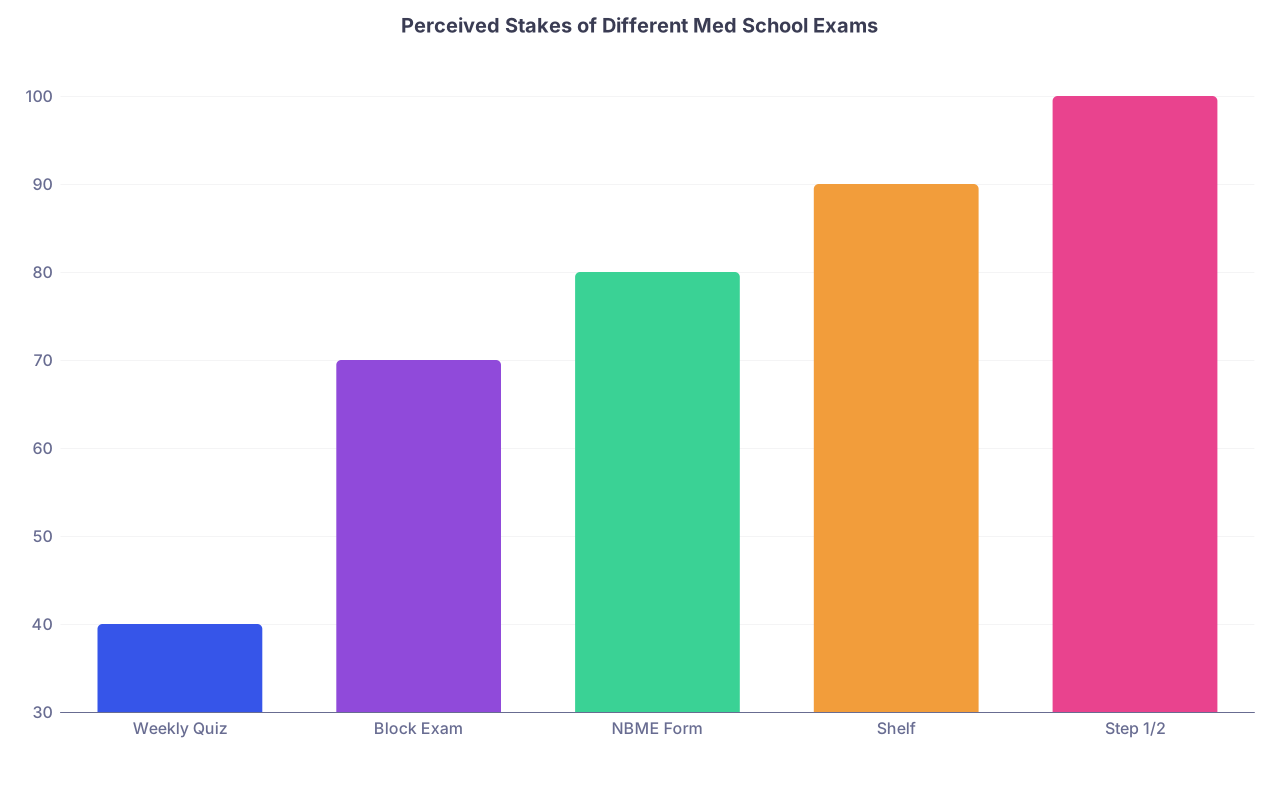
High‑stakes, frequent testing
In preclinical years, you can have:
- Weekly quizzes
- Block exams every 3–5 weeks
- NBME forms, school CBSEs
- Shelf exams if you are integrated
| Category | Value |
|---|---|
| Weekly Quiz | 40 |
| Block Exam | 70 |
| NBME Form | 80 |
| Shelf | 90 |
| Step 1/2 | 100 |
Your brain learns: “Exams = survival.” So once the exam ends, the anxiety does not just vanish. It searches for something to chew on. That something is every uncertain question.
Perfectionism is normalized
You hear:
- “You need Honors if you want Derm.”
- “Everyone else finished with time to spare.”
- “I missed only 4 questions and still got an 82.”
You start interpreting any uncertainty as failure. This fuels post‑exam scanning for errors, which fuels rumination.
Social comparison amplification
Group chats, Discords, and “post‑test debriefs” are gasoline.
Typical pattern:
- Someone posts: “For the question about the 65-year-old smoker with hematuria, it was transitional cell carcinoma, right?”
- You thought renal cell carcinoma.
- You immediately open UpToDate, AMBOSS, or Anki cards.
- Now you are 20 minutes deep into tumor markers and staging—after the exam where it mattered.
Your brain learns: “I must verify everything right now to reduce uncertainty.” That is the exact opposite of what reduces rumination.
Cognitive style: high detail, low tolerance for ambiguity
Med students are selected for:
- High conscientiousness
- High detail orientation
- High fear of being wrong
Great for patient care. Terrible for your ability to shut off mental checking once the exam is over.
You are not broken. You are just running a cognitive style that has not been given guardrails.
3. The Anatomy of a Rumination Loop (And Where to Interrupt It)
You cannot fix what you describe vaguely. So let me map the loop clearly.
Most med students I work with have some version of this sequence:
Exam End → Physiologic Crash
- Adrenaline drops.
- You feel strangely wired and exhausted at the same time.
- Your working memory still holds fragments of the exam.
Intrusive Question Fragments
- “Wait, was it SIADH or CSW?”
- “What was the mechanism of that beta‑blocker?”
- These pop up without you trying.
Interpretation
- “If I am still thinking about it, I probably got it wrong.”
- “If I do not check right now, I am irresponsible.”
- “Everyone else probably knew it.”
Compulsion / Behavior
- Check resources.
- Ask peers.
- Mentally replay the problem.
- Start estimating your score compulsively.
Short‑Term Relief
- “Okay, I know the right answer now.”
- Or: “At least I know I got it wrong, I can prepare for the worst.”
Long‑Term Cost
- Brain learns: “Anxiety → Checking → Temporary relief.”
- Loop is reinforced. It triggers faster and harder next time.
Here is what this looks like as a process map.

| Step | Description |
|---|---|
| Step 1 | Exam ends |
| Step 2 | Intrusive memory of question |
| Step 3 | Check resources / peers |
| Step 4 | Temporary relief |
| Step 5 | Loop reinforced |
| Step 6 | Shift attention |
| Step 7 | Loop weakens over time |
| Step 8 | Interpretation |
Your job is not to “stop thinking” (good luck with that). Your job is to change:
- The interpretation of those intrusive fragments.
- The behaviors you run in response.
You break the loop at the behavior node. Repeatedly. That is how you retrain the system.
4. A Targeted Protocol: Before, During, and After the Exam
This is where we get concrete. You do not fix rumination after the exam alone. You build a protocol that starts before you sit down.
4.1 Before the Exam: Pre‑Commitment and Containment
You need a written plan that your anxious brain cannot easily renegotiate afterwards.
- Define your “No Review Window”
Choose a fixed period after each exam where you will not:
- Check answers
- Ask classmates about questions
- Look up anything related to the exam content
For high‑stakes exams (NBME, block, Step), I recommend a 24‑hour no‑review window as a starting point. For weekly quizzes, 3–6 hours can be reasonable.
Write this down clearly:
“After the Cardio block exam on Friday, I will not check or discuss any exam content until Saturday 6 pm. Period.”
- Create a Short Post‑Exam Plan
Your brain hates blank space after an exam. It will fill it with checking. So pre‑fill that time.
Example:
- 0–30 min: Snack + walk outside, no phone.
- 30–90 min: Low‑stakes admin (emails, scheduling, laundry).
- Evening: One planned enjoyable activity (friend, show, workout), 100% guilt‑free.
- Script Your “Rumination Response Line”
You will have intrusive questions show up. You cannot prevent the thought. You can control your response line.
Write it out ahead:
“That question is over. Knowing the answer now cannot change my score. I will log it and review it properly at the scheduled time.”
That sentence seems trivial until you repeat it 20 times after an exam. It becomes a conditioned cue.
- Set up a “Parking Lot” Capture Tool
Have a single place—a small notebook, Notes app, or Google Doc—labeled: “Post‑Exam Question Parking Lot”.
Rule:
You only write a 3–5 word description of the question. No answering.
Example entries:
- “SIADH vs CSW hyponatremia”
- “Beta‑blocker selectivity question”
- “Child with rash + aspirin mechanism”
This gives your brain a sense of “I will not forget this”, without feeding the checking behavior.
4.2 During the Exam: Micro‑Skills That Reduce Later Rumination
Ironically, some rumination is driven by what you did during the exam.
Two predictable drivers:
- Endless answer‑changing on uncertain items.
- Leaving the exam feeling chaotic and disorganized.
A few specific in‑exam habits help:
- Use a strict “two‑touch” rule for uncertain questions
- First pass: Answer based on best current reasoning. Mark it only if:
- You actually have a concrete reason to revisit (e.g., later Q might give a clue).
- Not just “this feels uncertain”.
- Second pass: When you revisit, you either:
- Change the answer based on a clear new reason, or
- Keep your original answer and unmark it.
Then you let it go. No triple‑checking. The more chaos you allow during the exam, the more your brain obsesses afterwards.
- Name, do not panic, at “blackout moments”
Everyone has the stem where your mind goes blank. Your future self ruminates on those.
Your move:
- Quietly label it: “This is a blank‑out. I have trained for this.”
- Do one mechanical thing: Eliminate 1–2 obviously wrong choices.
- Make a best guess. Move on.
Afterwards, when your brain replays it, your narrative becomes: “I hit a blank‑out, ran my protocol, moved on.” Not “I froze and completely failed.”
- Avoid mental bookkeeping of “definitely wrong” questions
If you keep a mental tally… “That is at least 7 wrong so far” …you are pre‑feeding the post‑exam panic.
Deliberately drop the count. When you notice the urge, label it: “Outcome prediction—unhelpful,” and shift back to the current stem.
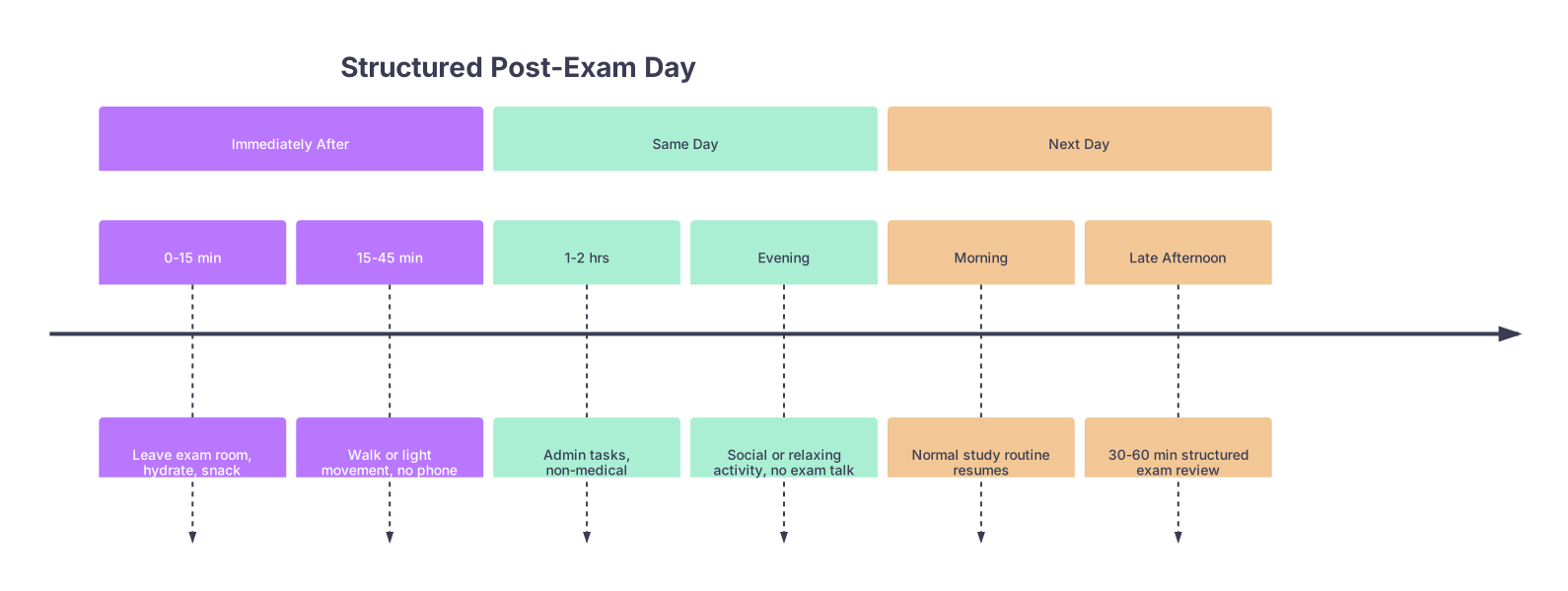
4.3 After the Exam: A Scripted 24 Hours
Here is a concrete 24‑hour post‑exam protocol that I see work repeatedly.
You can adjust timing, but keep the structure.
| Period | Event |
|---|---|
| Immediately After - 0-15 min | Leave exam room, hydrate, snack |
| Immediately After - 15-45 min | Walk or light movement, no phone |
| Same Day - 1-2 hrs | Admin tasks, non-medical |
| Same Day - Evening | Social or relaxing activity, no exam talk |
| Next Day - Morning | Normal study routine resumes |
| Next Day - Late Afternoon | 30-60 min structured exam review |
0–1 hour post‑exam: Move your body, not your browser
- Leave the building. Outside if possible.
- Eat. Carbs + protein. No heroic fasting.
- Walk for at least 15–20 minutes. No exam talk. No group “What did you put for…?” post‑mortem.
If someone tries to start this, you say, calmly:
“I have a no post‑mortem rule until tomorrow. Happy to hang out, but I’m not talking questions.”
Ironically, the more casual you sound, the more they accept it.
1–6 hours post‑exam: Controlled distraction
This is where most rumination disasters happen. You are home, you are tired, your self‑control is low.
You are going for planned, active distraction, not passive scrolling.
Examples that work:
- One hour of cleaning your room or doing laundry with a podcast.
- Grocery run + meal prep for the week.
- Workout with a non‑med friend.
What does not work:
- Sitting alone with your phone “just checking one thing.”
- Joining your class GroupMe discussion “just to see how people felt.”
If you know you are vulnerable, physically remove some triggers. Log out of Discord/GroupMe for that specific day. Move your Anki app off the front home screen.
6–24 hours: Recovery + normal life
Sleep is textbook. Cramming more resources into your brain right after an exam not only does not help that exam (obviously), it also interferes with your brain consolidating the way you approached questions.
You are not being lazy. You are protecting the cognitive machinery you will use for the next test.
5. The Only Kind of Post‑Exam Review That Is Actually Useful
Now let us talk about when it is time to look back.
Your goal is not to relive each missed question. Your goal is to extract patterns that can change your behavior for the next exam.
You are doing diagnostics, not confession.
5.1 Time‑box it
You get a fixed, short window:
- 30–60 minutes for a block exam.
- Maybe 90 minutes if you are reviewing a large standardized exam (NBME practice, etc.).
Set a timer. When it rings, you stop. No “just a few more questions.” Your brain needs to know this is a bounded process, not an endless spiral.
5.2 Use a simple error log that forces pattern recognition
Do not just collect questions and answers. That is trivia.
You want a table or log structured like this:
| Question Tag | Error Type | Actual Cause | Fix for Next Time |
|---|---|---|---|
| SIADH vs CSW hyponatremia | Concept confusion | Mixed up volume status | Make 1-page CSW vs SIADH compare |
| Child rash + aspirin | Recall / memory | Forgot Reye association | Add to Anki, tag as high-yield |
| Long cardio stem | Process / strategy | Panicked, skimmed, missed key word | Use systematic stem underlining |
| Beta-blocker mechanism | Careless reading | Ignored “partial agonist” phrasing | Force myself to circle qualifiers |
Notice what goes under “Error Type”:
- Concept confusion
- Recall / retrieval failure
- Process / strategy
- Careless reading
- Time management
- Emotional (panic, freeze, rushing)
The “Actual Cause” must be one specific sentence. No drama.
The “Fix for Next Time” is one concrete, small action. Not “study cardio harder”. That is useless. Something like:
- “Make 1 attention cue: ‘Check volume status first in hyponatremia.’”
- “Add 5 cards on partial agonists.”
- “Practice 10 long stems with a timer, forcing full reading.”
5.3 Do not chase exact recall of questions
If you do not remember the exact stem, you do not go hunting on Reddit or in the group chat. That is an avoidance of uncertainty, dressed up as “review.”
You work with what you have. If all you can recall is “some question about sickle cell and osteomyelitis bug,” that is enough to log:
- “Sickle cell osteomyelitis organisms” → error type “concept”.
- Fix: Make a tiny table of sickle vs non‑sickle usual bugs.
Your brain learns: “I do not need perfect recall to extract a lesson.”
6. Targeting the Thoughts That Drive Rumination
Up to now we have focused heavily on behavior. Good. That is where most change lives.
But the thoughts that keep feeding the loop are fairly stereotyped in med students. You will recognize yourself in at least one of these.
, Perfectionism, Comparison to peers, Uncertainty intolerance, Identity/self-worth tied to scores](https://cdn.residencyadvisor.com/images/articles_svg/chart-common-rumination-driving-thoughts-in-med-students-9211.svg "Common Rumination-Driving Thoughts in Med Students")
| Category | Value |
|---|---|
| [Fear of catastrophic failure](https://residencyadvisor.com/resources/test-anxiety-tips/breaking-down-catastrophic-thinking-before-step-1-and-step-2-ck) | 25 |
| Perfectionism | 20 |
| Comparison to peers | 20 |
| Uncertainty intolerance | 15 |
| Identity/self-worth tied to scores | 20 |
Let us take a few and give them precise counter‑moves.
Thought 1: “If I do not check my answers, I am being irresponsible.”
Counterframe:
- Responsible = maximizing future performance, not soothing current anxiety.
- Checking answers you cannot change is emotional scratching. It feels like work, but it is anti‑work.
Replacement thought:
“My responsibility is to extract patterns later, not to verify trivia now.”
Thought 2: “If I got that one wrong, I probably failed the whole exam.”
This is the classic emotional generalization from one item to the entire outcome.
Concrete response:
- You challenge the logic with numbers:
- “This exam had 80 questions. One question is 1.25%.”
- “Even 10 misses is still 87.5% if the curve is reasonable.”
- You explicitly state the uncertainty:
“I do not know my exact performance. I will know when the score comes out. Until then, I am guessing—and guessing is not a good use of my time.”
Then you shift to behavior: walk, call someone, or do literally anything else not exam‑related.
Thought 3: “Everyone else finished early and is not stressed. Something is wrong with me.”
This one is almost always wrong when you look behind the curtain. The people who look calm are frequently:
- Hiding their anxiety
- Overcompensating
- Or actually underestimating their errors, which is not better
Seen this repeatedly on wards—students who appear “chill” about exams and then quietly melt down later.
Replacement thought:
“Speed is not mastery. Visible calm is not internal calm. I only have data on my own habits.”
Thought 4: “I must replay the exam or I will repeat the same mistakes.”
No. Replaying is not reviewing. It is exposure without structure.
You swap that for:
“I will repeat mistakes if I do not analyze them systematically during my review block. Random replay does not count.”
7. Special Cases: NBME/Step Exams and Shelf Exams
High‑stakes exams magnify everything. Let me be blunt: uncontrolled rumination between NBMEs or during dedicated Step study will burn weeks of your calendar.
7.1 After NBMEs or practice exams
Your protocol for a full NBME or UWorld self‑assessment should be even more disciplined.
Suggested sequence:
- Immediately after:
- 30–60 minutes off screen. Light movement. Hydrate. Snack.
- Same day:
- Do not open the score yet if you are highly reactive. Open it once you have 60–90 minutes blocked to:
- View score.
- Brief emotional reaction (yes, this will happen).
- Immediately move into structured review with an error log.
- Do not open the score yet if you are highly reactive. Open it once you have 60–90 minutes blocked to:
- Let the score be data, not identity:
- Your error log is your primary product.
- The score is an index of where you are today, not a verdict.
You do not spend hours re‑predicting your final Step score based on each new NBME. That is rumination disguised as “planning.”
7.2 During clerkships (shelf exams)
On rotations, you have an even bigger problem: rumination bleeds into clinical performance.
Picture this:
- You took your IM shelf yesterday.
- Today, on rounds, you are semi‑present because your brain is still replaying a question about hepatorenal syndrome.
- You miss clinical learning and your anxiety stays high.
Your solution is the same protocol but adapted:
- Strict boundary: Once the shelf is over, you have 24 hours of zero exam discussion, then a single 30–60 minute review.
- After that, shelves leave your head entirely. They are done. Your cognitive real estate goes back to patients and the next rotation.
I have seen students’ comments from attendings improve just from cutting off post‑shelf rumination. They suddenly look awake and engaged again.
8. Training Your Brain Out of Rumination: Expect Relapse, Measure Progress
You will not flip a switch and stop ruminating. You are unwiring months or years of habit.
Measure progress in these ways, not perfection:
- Latency: How long do you stay stuck in loops right after an exam?
- Week 1: 3 hours of on‑off replay.
- Week 4: 30 minutes then you remember your protocol.
- Intensity: How much does it interfere with sleep or appetite?
- Do you lose the whole night? Or is it just a few intrusions that you handle?
- Compliance with your plan:
- Did you respect your “No Review Window”? Even if anxiety was high, that counts as a win.
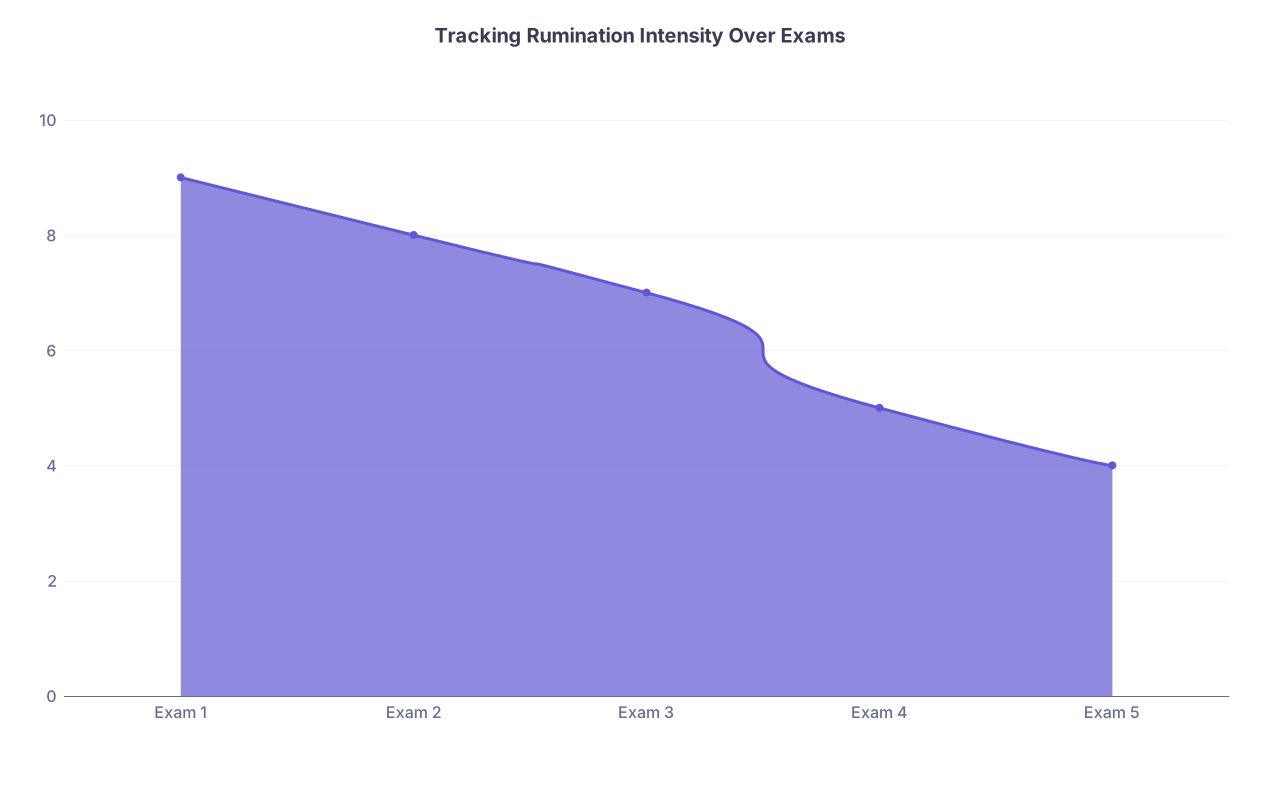
A simple 0–10 rating after each exam can help you see trends:
- 0 = No rumination at all.
- 10 = Dominated my day; I kept checking, talking, predicting.
| Category | Value |
|---|---|
| Exam 1 | 9 |
| Exam 2 | 8 |
| Exam 3 | 7 |
| Exam 4 | 5 |
| Exam 5 | 4 |
You want the general direction to go down. It will bump up again for a particularly scary exam. That is normal. You just return to the protocol.
If rumination is:
- Interfering with sleep for multiple nights
- Paired with panic attacks
- Leading to serious avoidance (skipping next exams, falling behind badly)
…then you are not weak, you are symptomatic. That is where you bring in a therapist or your school’s mental health services, ideally someone who understands CBT or ACT (acceptance and commitment therapy). They can layer in targeted tools fast.
9. A Concrete Example: Cardio Exam, Two Different Outcomes
Let me show you what this looks like in real life.
Student A: No Plan, High Rumination
- Finishes cardio exam at 2:00 pm.
- Immediately outside the room, classmates gather: “What did you put for the guy with the new holosystolic murmur?”
- Conversation spirals. They check UpToDate. Student A realizes they missed at least 3 cardiomyopathy questions.
- Goes home, opens the lecture slides, tries to find each question.
- 3 hours later, exhausted, anxious, no real studying done, no real rest.
- That night, wakes up twice thinking about aortic regurgitation.
- Next day, feels foggy. Tries to start GI block content but keeps drifting back to cardio.
- By the time the grade posts, they have lived the exam 10 times.
Student B: Same Exam, Trained Protocol
- Same 2:00 pm finish.
- When the post‑mortem starts outside the room, they say: “I’ve got a no‑debrief rule until tomorrow. I’ll catch you all later,” and leave.
- Walks around campus for 20 minutes with music. Eats.
- Goes home, does laundry while listening to a non‑medical podcast. Phone is on Do Not Disturb, no Discord.
- Has 1–2 intrusive question memories:
- Jots “holosystolic murmur new onset CHF” into their Parking Lot note.
- Repeats their line: “That question is over; I’ll review patterns tomorrow.”
- Meets a friend for dinner. No exam talk.
- Sleeps a bit restless, but overall decent.
- Next afternoon, sets a 45‑minute timer:
- Opens notes + resources.
- Looks up “new holosystolic murmur,” realizes they confused MR vs VSD acute presentations.
- Logs it: Type = concept; Fix = 1 small table on murmurs post‑MI.
- Timer ends. Closes everything. Goes back to GI.
Student B has the same sensitivity to anxiety. They did not magically become carefree. They just had a plan and executed it at the behavioral level. Their brain will get less reactive with each iteration.
10. The Bottom Line
Three key points and then I am done.
Rumination loops after exams are learned behavior chains, not personality flaws.
They have identifiable triggers, interpretations, and behaviors. That means they are trainable.You do not “think” your way out of rumination; you behave your way out.
Pre‑commit to a no‑review window, script your post‑exam hours, and use a structured, time‑boxed review later that focuses on patterns, not score predictions.Progress is gradual and measurable.
Expect intrusive thoughts. Your job is not to prevent them, but to change your response—again and again—until your brain finally learns: post‑exam = move forward, not spiral backward.


