
Most of what you are telling yourself about Step 1 and Step 2 CK is not true.
It feels true. It feels urgent. But it is distorted, catastrophic thinking—and it is wrecking both your studying and your sanity.
Let me break this down specifically.
You are not just “stressed.” You are running a constant mental simulation of the worst possible future: failing, repeating a year, not matching, disappointing your family, financial ruin, life over. That loop is not motivational. It is cognitive poison. And if you do not get a handle on it, you will underperform below your actual knowledge level.
This is not a character flaw or “weakness.” It is a predictable brain response under high stakes, uncertainty, and chronic fatigue. Step boards are basically a laboratory to grow catastrophic thinking.
We are going to dissect it like a path specimen: define exactly what catastrophic thinking looks like in Step prep, show how it distorts performance, then walk through concrete, test-day-level strategies to dismantle it before it dismantles you.
1. What Catastrophic Thinking Actually Looks Like in Step Prep
Catastrophic thinking is not just “being negative.” It is a specific cognitive pattern: jumping quickly from a small trigger → to a global, extreme, irreversible conclusion.
Here is what it sounds like in Step 1 and Step 2 CK prep:
- “I missed that easy endocarditis question. If I am missing easy stuff, I’m going to bomb the exam.”
- “My NBMEs are going down. I’m clearly getting dumber. I’m not cut out for medicine.”
- “Everyone else is at 240+ by now. I am behind. I will not match.”
- “If I do not get at least a 250, competitive specialties are off the table. My career is basically decided already.”
- “I blanked on that UWorld block. What if that happens on test day and I fail? My school will think I am a disaster.”
Notice the features:
All-or-nothing language
“Fail”, “bomb”, “never”, “always”, “everyone”, “no chance”, “over.”Global judgments from single events
One bad block → “I am incompetent.”
One low NBME → “I am doomed.”Time distortion
“This one exam equals my entire future” thinking. No sense of course-correction, retakes, or alternate paths.Emotional reasoning
“I feel terrified, so that must mean something is truly wrong.”
You might think you are just “being realistic,” but the logic is off. You are selectively pulling data that reinforces danger and ignoring anything that contradicts it.
That pattern is exactly what drives severe test anxiety.
2. Why Catastrophic Thinking Is So Common Before Step 1 and Step 2 CK
Your brain is not malfunctioning in a vacuum. The Step ecosystem basically breeds this.
A few very specific drivers:
Opaque stakes + perfection culture
You hear: “Step 1 pass/fail now, but programs still care.” “Step 2 CK is the new Step 1.” “You really only get one shot.” No clear threshold, lots of vague dread. Perfect for catastrophizing.Relentless social comparison
Group chats: “Just hit 260 on my last NBME.”
Reddit: “Devastated by my 245, any shot at derm?”
You selectively remember only the top percent of stories and treat them as normal.High-achiever identities
Many med students have never really “failed” academically. So even the possibility of failing boards feels like identity death, not just an exam risk.Chronic sleep deprivation and burnout
When you are exhausted, your prefrontal cortex (rational thinking, perspective) is offline. The amygdala (threat detection) takes the wheel. That biological setup amplifies catastrophic thoughts.Ambiguity of preparation
You never truly feel “done” for these exams. There is always more UWorld, more Pathoma, more Anki. The absence of a clear finish line makes your brain continually scan for danger.
So no, you are not uniquely broken. You are a stressed brain in a context designed to push it toward extremes.
3. The Performance Cost: How Catastrophic Thinking Tanks Your Score
This is not just “mental health” talk. Catastrophic thinking has direct, concrete effects on your performance for Step 1 and Step 2 CK.
Three big ones.
A. Working Memory Hijack
On test day, you need working memory intact to:
- Hold details from the question stem.
- Compare 2–3 close answer choices.
- Keep prior knowledge online (e.g., “This sounds like nephritic, not nephrotic.”).
Now imagine this happening mid-block:
You miss a question you “should” know →
Thought: “I am screwing this up. I am failing. This is going terribly.” →
Emotion: Heart rate spikes, hands sweat, chest tight, tunnel vision.
Your working memory is now packed with self-monitoring and fear. Not renal physiology.
That is how you end up re-reading the same sentence 4 times. Or staring at 2 answer choices you understand but feel unable to decide between.
B. Panic-Driven Behavior
Catastrophic thinking in the weeks before the exam leads to:
Endless resource switching
“My score dropped. Boards and Beyond is not enough. I need Sketchy, Bootcamp, maybe another Qbank…”Self-sabotaging schedules
“I am so behind, I have to do 160 UWorld questions per day” → you burn out → retention tanks.Avoidance
“I am scared of seeing a low NBME, so I’ll just keep doing ‘content review’ and delay taking one.”
Then you walk into the real exam with less calibration.
On test day itself:
- You might rush through questions or overslow and time-out because you are hyper-focused on outcome, not the immediate task.
- Some students even void or reschedule impulsively at the testing center because the fear spikes so high.
C. Impaired Learning During Prep
Catastrophic thinking during study:
- Narrows your attention to perceived weaknesses only, often chaotically.
- Encourages passive studying (“I do not trust myself with questions right now, I will just re-watch videos.”).
- Makes every low-score moment feel so threatening that your brain avoids encoding the actual lesson of the miss.
So you get emotional fatigue without proportional learning.
4. Step-Specific Triggers and Thought Patterns
Let us pull this even tighter around Step 1 versus Step 2 CK, because the flavor of catastrophic thinking shifts slightly.

Step 1 (Including Pass/Fail Era)
Typical Step 1 catastrophes:
- “If I fail Step 1, I will be delayed a year, lose my friends’ class, and never recover.”
- “Even if it is pass/fail, if I barely pass, programs will secretly hate me.”
- “This NBME predicted borderline pass. That means objectively I am not smart enough for medicine.”
Here the distortion is overgeneralizing from a standardized score to intelligence or long-term potential. The identity-level threat makes the catastrophizing more intense.
Step 2 CK
Step 2 CK catastrophes sound like:
- “Step 2 is the new Step 1. If I do not crush this, my residency options are over.”
- “My shelf scores were mediocre. I obviously have no clinical reasoning talent.”
- “I did fine on Step 1, so if I underperform on Step 2, programs will think I got lucky.”
You get a special blend of:
- Pressure from the shift to Step 2 weighting.
- Increased self-criticism because this exam is supposed to reflect “real” clinical ability.
The thinking error: treating one high-stakes metric as destiny, rather than part of a composite picture with grades, letters, and interviews.
5. The Core Skill: Cognitive Restructuring for Catastrophic Thoughts
You will not “positive-think” your way out of this. You need a structured way to catch and dismantle distorted thoughts in real time.
Here is the 4-step process I actually see work with med students:
- Catch the thought – verbatim
- Label the distortion
- Interrogate it like a bad H&P
- Replace with a grounded alternative
Let me walk you through what that looks like with real Step scenarios.
Step 1: Catch the Thought, Word for Word
Do not just notice “I feel anxious.” You need the sentence running in your head.
Example during UWorld:
“I am missing 50% on this block. I am going to fail Step 1. This is proof I am not ready and probably not capable.”
Write that down, somewhere. I am not guessing; actually externalize it: notebook, Notion, Remarkable, whatever.
Your brain loses some of its grip the second it sees its own thoughts in black and white.
Step 2: Label the Distortion
Use specific labels. The main cognitive distortions in Step prep are:
- Catastrophizing (“If this, then absolute worst-case.”)
- All-or-nothing thinking (“Either I crush it or I fail totally.”)
- Overgeneralization (“One bad performance means I am bad overall.”)
- Mind reading (“Programs will think I am dumb if…”)
- Fortune-telling (“I know I will bomb the exam based on this.”)
Back to our example:
“I am missing 50% on this block. I am going to fail Step 1. This is proof I am not ready and probably not capable.”
Distortion tags:
- Catastrophizing
- Overgeneralization
- All-or-nothing
That alone starts separating “me” from “my thoughts.”
Step 3: Interrogate It Like Bad Data
Treat the thought as a shaky consult note: you do not accept it at face value. You question it.
Ask direct, specific questions:
- “What is the actual evidence for this thought?”
- “What is the evidence against it?”
- “If a classmate showed me this data, what would I realistically conclude about them?”
- “Am I jumping from a data point to a global verdict?”
- “What is a more statistically likely outcome?”
Example interrogation:
- Evidence for “I am going to fail Step 1”:
- One 50% UWorld block on a topic I dislike.
- Evidence against:
- Prior blocks: 63%, 58%, 65%.
- UWorld percentiles: around average or slightly above.
- Content review is 70% completed.
- NBMEs: borderline but trending up.
- Many students with similar trajectories pass comfortably.
Conclusion: The original thought is extreme and not supported by complete data.
Step 4: Replace with a Grounded Alternative Thought
This is not “I am amazing and will score 270.” That is just fantasy in the other direction.
You want a statement that:
- Acknowledges the discomfort.
- Stays aligned with the full evidence.
- Focuses on controllable actions.
Example replacement:
“This 50% block feels scary and shows I have gaps, but one block does not determine my Step outcome. My averages are in a pass range, and I still have weeks to target weak areas. The useful move now is to review these missed questions carefully and adjust my plan for this topic.”
You should feel maybe 15–40% less anxious after this, not 0%. That is success. You just want your brain under the panic threshold where working memory returns.
6. Practical Tools: Turning Theory Into Daily Habits
This is where most people fail: they understand the theory, but they never operationalize it. Let’s translate this into concrete moves tied to your Step schedule.
| Time | Action |
|---|---|
| Morning | 3–5 minute thought check-in |
| After blocks | 1–2 catastrophic-thought rewrites |
| Evening | 5-minute reflection + plan tweak |
| Weekly | Score review with data framing |
A. The 3–5 Minute Morning Thought Check-In
Before you start UWorld or NBMEs:
Write down the first 2–3 anxious thoughts that show up about Step.
- “Today’s NBME will show I am not improving.”
- “If I underperform on this block, it means I wasted my week.”
Label them quickly. (Catastrophizing, overgeneralization, etc.)
Write one grounded response for one thought.
This is mental warm-up. You are tuning your brain to notice distortions before they go wild mid-block.
B. Post-Block Thought Decontamination
After each Qbank block:
Look at your percentage and name the first automatic thought:
- “63%? Average. I am stuck. I am never going to hit my goal score.”
Spend 2 minutes doing the 4-step process on that single thought:
- Catch → Label → Interrogate → Replace.
Do not do this for every emotion. That is overkill. Just the loudest catastrophic line.
You are basically training a reflex: low score → analyze data, not self-worth.
C. Weekly Data Review: Stop Letting Single Scores Dictate Your Identity
Once a week, sit down and look at your scores like you would look at a patient trendline, not a one-off lab.
Use a simple log:
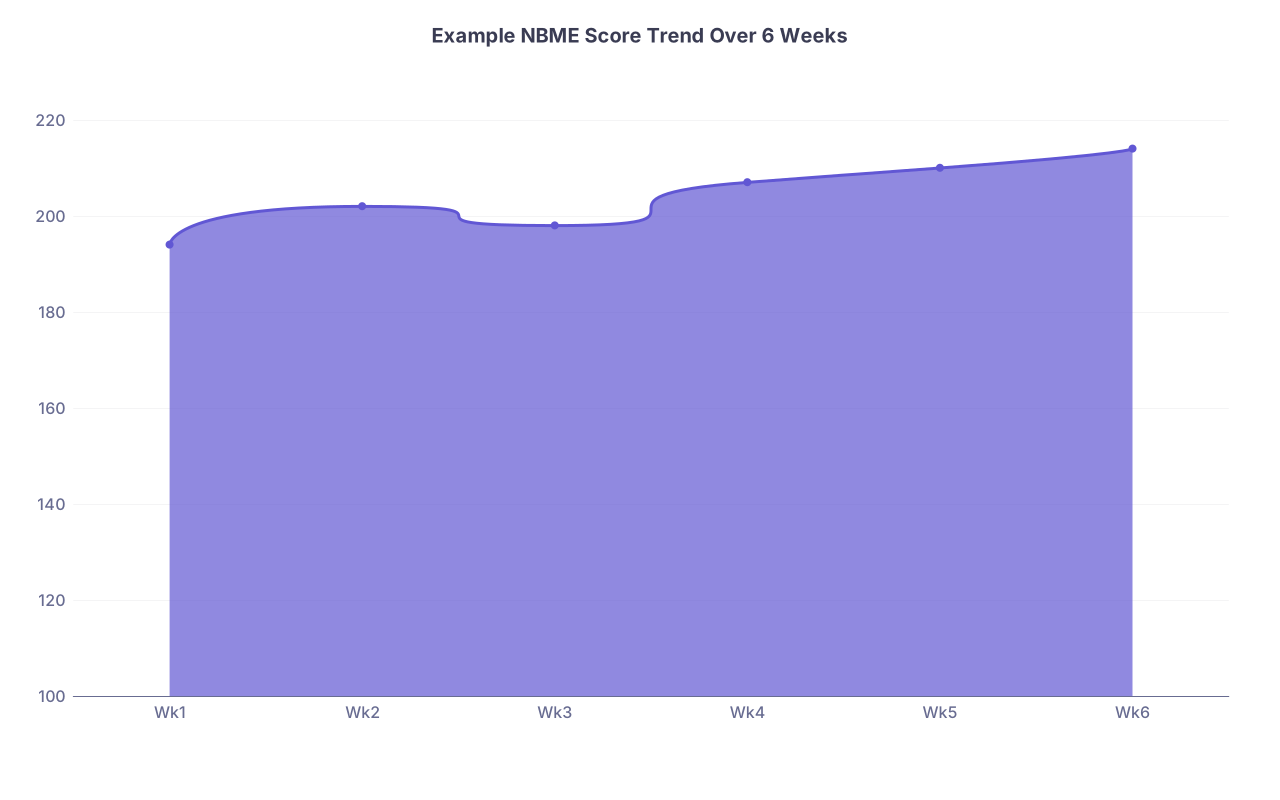
| Category | Value |
|---|---|
| Wk1 | 194 |
| Wk2 | 202 |
| Wk3 | 198 |
| Wk4 | 207 |
| Wk5 | 210 |
| Wk6 | 214 |
When a student shows me something like this and says, “I am crashing, I got a 198 in week 3,” I know catastrophic thinking is running the show.
Questions to ask:
- What is the overall direction?
- Are there local fluctuations but a generally upward trend?
- What specific content clusters correspond to dips?
That analysis yields a concrete plan (e.g., “Neuro is dragging me down; I will intensify neurology for 4 days”), not a global conclusion (“I am hopeless”).
7. Test-Day Strategies: In-the-Moment De-Catastrophizing
I want to be very explicit here. You need tactics for during Step 1 / Step 2 CK, not just before.

| Step | Description |
|---|---|
| Step 1 | Trigger: hard question or panic spike |
| Step 2 | Notice catastrophic thought |
| Step 3 | Label it: catastrophizing / all-or-nothing |
| Step 4 | Micro-breath: 3 slow breaths |
| Step 5 | Grounded statement: 1-2 sentences |
| Step 6 | Return attention to current question only |
Scenario: Mid-Block Meltdown
You are on block 2 of Step 2 CK. The questions feel harder than any UWorld session you have done in the past 2 weeks. You are behind on time.
The internal monologue arrives:
“This is going terribly. I am failing this entire exam. I will have to retake and lose a year and never match into anything competitive.”
Here is the exact script I want you to run:
Name the thought explicitly
(Silently but clearly.)
“I am having the thought: ‘I am failing this entire exam and my career is over.’”Label the distortion
“This is catastrophizing and fortune-telling. I literally do not have outcome data yet.”Micro-reset with the body
- Take 3 slow breaths: in for 4, hold 2, out for 6–8.
- Relax your shoulders and jaw deliberately.
Grounded replacement – one sentence only
Example:
“I have one job right now: do the best I can on this single question in front of me. I can evaluate the exam later when I actually have a score.”Narrow focus to the question stem
- Re-read just the last 2 lines.
- Identify: What are they really asking? Diagnose? Next step in management? Best initial test?
That 20–40 second intervention is not about feeling “good.” It is about keeping you functional.
Repeat as needed between questions. Not every time you feel a flicker of doubt. Only when the catastrophic monologue spins up.
8. Specific Workflows for Step 1 vs Step 2 CK
The general principles are the same, but let me give you some targeted advice for each exam phase.
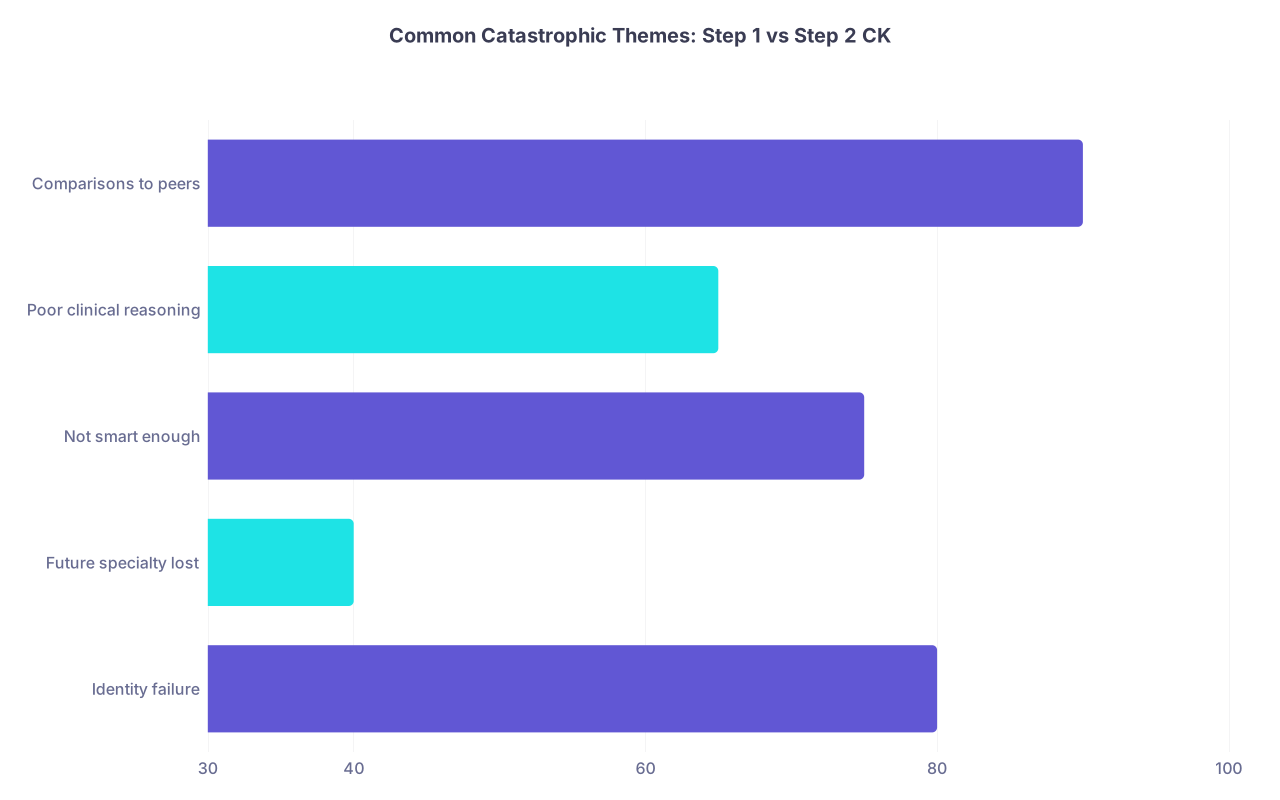
| Category | Value |
|---|---|
| Identity failure | 80 |
| Future specialty lost | 40 |
| Not smart enough | 75 |
| Poor clinical reasoning | 65 |
| Comparisons to peers | 90 |
(Interpretation: High prevalence of these themes across students, not literal percentages. You get the idea.)
A. Before Step 1
Typical thought:
“If I fail Step 1, I am not cut out for medicine. This will define me.”
Reframe path:
Evidence check:
- Count how many classmates needed remediation or repeats for some exam and are now doing fine. You know at least a few.
- Look up your school’s Step 1 pass rate and national pass rates. Most are very high.
Alternative statement:
- “Step 1 is a hard exam, and failing it would be painful, but it would be a setback, not the end. Many physicians I respect had bumps like that. My job now is to study effectively enough that this scenario stays unlikely.”
Process shift:
- Instead of doom-scrolling Reddit, spend that same 20–30 minutes integrating missed UWorld questions into Anki. It is boring, unglamorous, and exactly what moves the needle.
B. Before Step 2 CK
Typical thought:
“Step 2 is the new Step 1. If I do not get X score, my dream specialty is dead.”
First, yes: Step 2 now carries more weight. But the absolutist version of the thought is usually wrong.
Consider:
- Many programs do holistic review more than you think, especially non-ultra-competitive specialties.
- A strong Step 2 can offset a mediocre Step 1; the reverse is also true.
- Letters of recommendation, clinical performance, research, and interviews are not trivial.
Alternative statement:
“Step 2 CK matters a lot, especially for competitive specialties, but my entire residency outcome does not hinge on a single exact score cutoff. My realistic goal is to maximize my performance given my starting point and timeline. Panicking adds nothing to that effort.”
Then anchor to controllable behaviors:
- High-yield: UWorld complete with detailed review, NBME/Free 120 calibration, targeted review of repeatedly weak systems.
- Low-yield: endless re-decisions about specialty driven by fear before you even know your actual score.
9. What to Do When Catastrophic Thinking Feels Completely Out of Control
Some of you are not dealing with everyday test anxiety. You are dealing with full-on panic attacks, derealization, or paralyzing dread whenever you try to study.
Red flags:
- You repeatedly sit down to study and end up frozen, scrolling, or crying instead.
- You are having frequent intrusive images of failing, telling your family, losing your future, etc.
- You are barely sleeping from racing thoughts.
- You have physical panic episodes: palpitations, chest tightness, tingling, feeling like you will pass out.
At that level, you need a multi-layered approach:
Professional support
A psychiatrist, psychologist, or therapist with experience in performance/test anxiety. Ideally someone who knows medical training or works with students from your school. Medication may be appropriate; so is structured CBT.Real conversation with your dean or academic support office
Not the sugar-coated version. Say plainly: “My anxiety is impacting my ability to prepare; I am worried about crashing on test day.” They have seen this before. They can help adjust timelines or get you resources.Rebuild the basics like you would for a patient
- Sleep: set non-negotiable windows, even if you must scale back Qbank volume temporarily.
- Movement: even 15–20 minutes of walking daily changes baseline arousal.
- Nutrition and caffeine boundaries: 600mg+ caffeine + high anxiety is a nightmare.
You cannot out-think catastrophic thinking from a body stuck in chronic fight-or-flight. It becomes a biochemical problem, not just a cognitive one.
10. Pulling It Together: A Realistic Mental Game Plan
Let me give you a compact picture of what a healthier mental approach looks like during your Step months. Not Zen monk level. Just functional and sustainable.

Your Inner Script Shifts From:
- “Every low score is proof I am failing.”
- “This exam will decide my entire life.”
- “Everyone else is doing better than me.”
- “I have to feel confident or I am not ready.”
To Something More Like:
- “Scores are data, not verdicts. My job is to extract the lesson from each one.”
- “Step 1/Step 2 is very important, but it is one major exam in a long career.”
- “People online are a biased sample. I will compare myself to my own past performance, not anonymous posts.”
- “I can feel scared and still perform. Confidence is nice, but not required.”
And your behavior reflects that:
- You track trends, not obsess over single bad days.
- You schedule NBMEs regularly instead of avoiding them.
- You stop dramatically overhauling your plan after every dip.
- You explicitly practice the Catch → Label → Interrogate → Replace cycle a few times each day, so it is automatic by test day.
None of this will make you love the boards. But it will allow you to show up as the version of yourself that your months (or years) of training deserve.
You are not trying to become fearless. You are trying to become functional in the presence of fear.
That is the skill that carries beyond Step 1 and Step 2 CK—into shelf exams, residency in-service exams, board certification, and every high-stakes decision in clinical life.
You are still early in that trajectory. Getting your catastrophic thinking under control now is one of the few things that will keep paying dividends for decades.
With this mental framework in place, you can finally let your actual knowledge, not your worst-case fantasies, drive what happens on test day. The next step is just as concrete: structuring your study plan to match your baseline, your timeline, and your target score. But that is a breakdown for another day.