

It is 11:47 p.m. You have an NBME in 10 hours. Your UWorld incorrects sit at 38%. Your Anki due count is flashing an accusatory 612.
You are not actually studying anymore. You are staring at a missed cardiology question from three hours ago, still replaying why you picked the wrong answer.
And underneath all of that: one tight, rigid thought.
“I cannot afford to miss questions. I have to nail this exam.”
That is the perfectionism–test anxiety loop. And in medical school, it is gasoline on an already burning fire.
Let me break this down specifically: not all anxiety is perfectionism, and not all high standards are bad. But the perfectionistic style that a lot of med students carry is almost designed to generate, magnify, and sustain test anxiety.
We will walk through how that happens—mechanistically, not just “stress is bad”—and then what to do differently at the level of thoughts, behaviors, and exam strategy.
Step 1: Understand the Flavor of Perfectionism You Are Dealing With
Most medical students do not walk around saying “I am a perfectionist” as a flex. They say it defensively. “I know I am being perfectionistic, but…” and then they justify it with Step scores, match stats, or that one attending who said “Residency programs look at patterns.”
Perfectionism in med school usually shows up in a few recognizable flavors.
| Pattern Type | Core Fear | Typical Thought |
|---|---|---|
| Self‑Critical | Being inadequate or average | "If I miss too many, I do not belong." |
| Achievement‑Obsessed | Losing opportunities | "One bad exam will ruin my career." |
| Detail‑Rigid | Making any mistake | "I must know *everything* on this test." |
| Approval‑Driven | Disappointing others | "They will think I am lazy if I score low." |
Now connect this to test anxiety.
Perfectionism turns a test from “performance sample on a random Tuesday” into a referendum on:
- your identity (“Am I smart enough to be a doctor?”)
- your future (“Will I match?”)
- your worth (“Do I deserve to be here?”)
Once a 2-hour endocrine exam becomes a proxy for your entire self-concept, your nervous system behaves accordingly. Full fight-or-flight, as if there is a lion in the testing center.
Let me be more concrete. Here is what perfectionism actually does in the exam context:
- Inflates the stakes far beyond reality
- Narrows your focus to what is wrong, missing, or incomplete
- Turns “feedback” into “evidence of failure”
- Blocks flexible problem-solving (you are scared to guess, experiment, or move on)
- Pushes you toward unsustainable study behaviors (marathon days, zero rest, constant comparison)
Those are not personality quirks. They are conditions that make test anxiety almost inevitable.
Step 2: How Perfectionism Hijacks the Test Anxiety Cycle
Test anxiety is not some vague cloud of nerves. It has a pretty standard cycle. Perfectionism plugs into each part and dials it up.
1. Pre‑Exam: Catastrophic Standards
A standard, ambitious med student thought:
“I want to score well on this exam. I will do what I can.”
A perfectionistic med student thought:
“If I score below 85%, it is humiliating. 90+ is the minimum acceptable. Anything less means I did not work hard enough.”
Same goal, different mental poison.
That “minimum acceptable” concept is the problem. You create a razor–thin band of what is okay and label everything else failure.
What follows:
- You study from a place of fear rather than curiosity or mastery.
- You keep moving the goalpost. Hit an 80? Now you need 85. Hit 85? “But others are at 90.”
- Sleep, exercise, and food become negotiable. “I will relax when I am at 100% ready” (which never comes).
By the week of the test, your baseline anxiety is already high. You have been living in a chronic stress state where your brain has rehearsed catastrophic outcomes every night in bed.
2. During the Exam: Hyper‑Monitoring and Freeze
Here is the real damage. On test day, perfectionism does three very specific things:
Shifts attention internally
Instead of reading the stem cleanly, you are busy watching yourself.
“Why is my heart racing? I am blanking. I should know this. I cannot afford to miss this.”That internal commentary steals working memory. You are spending cognitive bandwidth monitoring your own performance rather than solving the problem in front of you.
Interprets normal uncertainty as danger
Every exam in medicine has questions you are not sure about. That is built into the design.
A non-perfectionistic brain: “This one is tough. Eliminate, guess, move.”
A perfectionistic brain: “I am unsure. This is proof I did not study enough. This means I am failing.”That interpretation spikes anxiety in the moment, which worsens recall and narrows your thinking further. Spiral.
Locks you onto mistakes
You miss one question early. You notice. You cannot let it go.
Now question 7–12 are all contaminated by your brain replaying question 3.
This is how you end up with a test-day performance that is significantly lower than your practice performance—even when your knowledge base is similar. The problem is not just “I was anxious.” The problem is perfectionistic processing of perfectly normal test phenomena.
3. Post‑Exam: Self‑Flagellation and Reinforcement
After the exam, most perfectionistic students do not recover. They autopsy.
They:
- Reconstruct questions in their heads
- Check answers on Reddit or with classmates
- Count “confirmed wrongs” and extrapolate a predicted failure
- Decide this confirms they are behind, not smart enough, or permanently at risk
Your brain then links:
- Test → humiliation, exhaustion, self-disgust
So the next exam triggers anxiety even earlier, because your nervous system has learned: “Exams = threat to self.”
This is where chronic test anxiety in med school gets built. Not just from hard tests. From how your perfectionism reacts to them.
Step 3: The Cognitive Mechanics – The Distortion Grid
Let me put this in clean cognitive-behavioral language. Perfectionistic med students tend to run the same set of cognitive distortions before and during exams.
You will recognize these.
All‑or‑Nothing Thinking
“Either I crush this exam or I blew it.”
“Either I am near the top of the class or I do not belong here.”The exam is seen as binary. No room for “solid” or “acceptable” or “good enough for now.”
Overgeneralization
“If I do poorly on this block exam, I will fail Step. If I fail Step, I will not match.”
One small data point, massive conclusion.Mental Filtering / Discounting Positives
You answer 60 questions. Miss 8. You cannot recall any of the 52 you handled correctly.
The entire narrative in your head is built around the 8.Should Statements
“I should have known that. A real med student would get that.”
“This should not feel this hard. I studied for weeks.”“Should” talk adds shame on top of normal performance variability.
Mind Reading and Comparison
“Everyone else finished on time. I am the only one who struggled.”
“They say this was easy; I am clearly behind.”
Each of these distortions does the same thing: magnifies threat, collapses nuance, and collapses your ability to treat the exam as a specific test of specific material on a specific day.
That is what fuels anxiety.
Step 4: Behavioral Patterns That Keep the Anxiety Alive
Now the part people like to ignore: what you do to cope with perfectionism can quietly maintain test anxiety.
Because some of the most “disciplined” looking study habits are actually driven by fear. And anxiety loves fear-driven behavior.
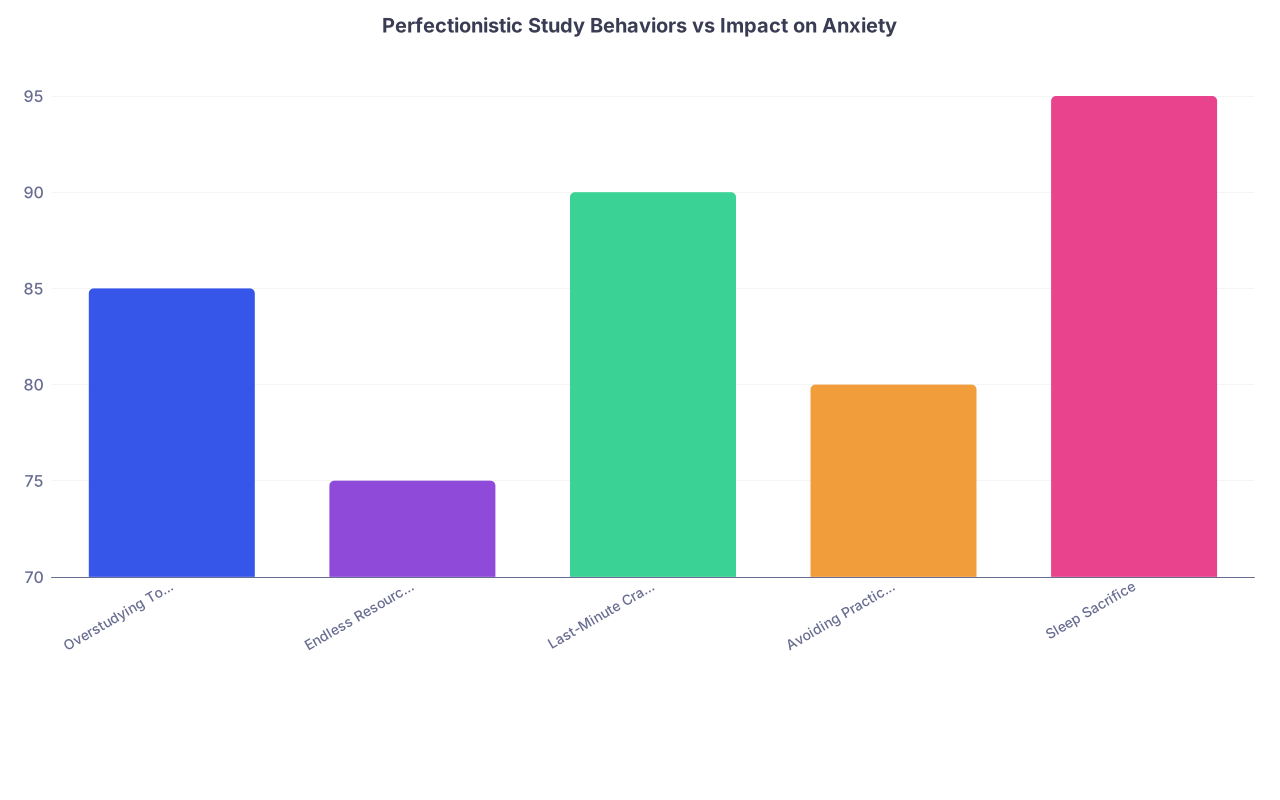
| Category | Value |
|---|---|
| Overstudying Topics | 85 |
| Endless Resources | 75 |
| Last-Minute Cramming | 90 |
| Avoiding Practice Exams | 80 |
| Sleep Sacrifice | 95 |
(Values here approximate how strongly these behaviors tend to increase test anxiety in my experience, roughly out of 100.)
Let me spell these out.
Overstudying “To Be Safe”
Example: You scored 80–85% consistently on cardiology questions. But the thought “What if there is some obscure congenital lesion?” leads you to spend 4 extra hours on rare variants, simultaneously neglecting weaker high-yield topics.
Net effect:
- You feel temporarily better (“I covered everything”), but
- You have reinforced the belief: “If I do not overprepare, disaster follows.”
This keeps the stakes artificial and anxiety high.
Endless Resource Switching
Every anxious med student has said this:
“Maybe I should add Boards and Beyond / another Qbank / that path deck / Sketchy again, just to be safe.”
Perfectionism hates constraints. It wants every possible angle covered.
So you:
- Add too many resources
- Never feel done
- Rarely reach real mastery in any single approach
- Carry a constant sense of “I am behind” because your to-do list is structurally impossible
That chronic “behind” feeling is a direct input to test anxiety.
Avoidance of True Conditions
This one is subtle but huge.
Perfectionistic students will sometimes avoid:
- Full-length practice tests
- Timed blocks
- Doing mixed blocks early
Why? Because those will expose imperfect performance. They would rather live in the illusion of “I know this when I see it” than face a 55% block two weeks out.
The logic: “I will do serious practice when I am more ready.”
Reality: You never feel ready. And now there is no desensitization to testing conditions, so your anxiety spikes massively when the real exam comes.
Your brain has never gotten used to that environment. Of course it freaks out.
Step 5: Directly Targeting the Perfectionism–Anxiety Link
You do not need to change your entire personality. You do need to change how your perfectionism operates around exams.
Think of it this way: keep your high standards for professionalism, preparation, and patient care. Turn down the self-destructive parts that make tests feel like execution chambers.
Here is where to intervene.
A. Rewrite the Stakes – On Purpose and in Writing
Your perfectionistic brain defaults to: “This exam is life or death.”
You are not going to out-argue that with vague positivity. You need specific, written counter–frameworks.
For each major exam (block exam, NBME, shelf, Step-style), write two columns:
- Column 1: “My perfectionistic brain says this exam means…”
- Column 2: “Realistic function of this exam in my training / career…”
For example:
- “If I do poorly, I will fail residency” → “Single shelf is a data point; residency sees full transcript, narrative, and Step scores; remediation exists.”
- “Anything under 90% is unacceptable” → “My school’s pass is 70%; honors may require ~85–90%; my functional target based on my career goals and current life constraints is X.”
This is not fluffy reframing. It is setting an explicit performance band that is not microscopic.
You are giving your nervous system permission to see this as important, but not existential.
B. Practice Graded Imperfection Before Test Day
You want a nervous system that has practiced tolerating imperfection in test-like contexts.
That means scheduling, not avoiding, the following:
Timed 40-question blocks where your explicit goal is:
“I will move on from any question at 90 seconds, even if I feel an urge to stay stuck.”Practice tests where you do not review every single explanation in obsessive detail.
Instead:- Flag highest-yield misses
- Extract patterns (“I keep missing 2-step endocrine questions”)
- Move on
Study sessions where you stop at a planned time, even when you feel “I am not done.”
You are training a new association:
“Imperfect preparation + imperfect performance = still safe, still functional, still progressing.”
That new association is anti-anxiety.
Step 6: In-the-Moment Test Strategies Specifically for Perfectionists
You already know generic test tips. Hydrate, sleep, blah blah. Let us be more surgical.
Here are tactical moves tuned to how perfectionistic anxiety behaves during the exam.
1. Hard Cap on Question Time
Perfectionistic students tend to overinvest in a small subset of questions, then panic-rush the rest.
Set a strict rule:
- ~90 seconds for straightforward questions
- Up to ~120–130 seconds only if you are actively reasoning, not looping
And then you enforce it using a simple internal script:
- “I have done what I can. Banking a guess. This question is not worth sacrificing five others.”
Is that uncomfortable? Yes. That is the point. You are choosing higher overall score over the fantasy of individually perfect questions.
2. Structured “Reset” After a Trigger Question
You hit a question you feel you “should” know and you freeze. Here is the sequence I teach students:
Notice the thought explicitly:
“I am telling myself I should know this. That is my perfectionism, not reality.”Physically break eye contact with the screen for 3 seconds.
Look at the corner of the room or your hands. That breaks the loop.Take one slow breath with a quiet internal cue:
“One question. One task.”Decide:
- If you can eliminate at least 1–2 options → eliminate, pick best, mark, move.
- If you are utterly blank → best guess, move immediately.
You do not “earn” the right to move on by feeling comfortable. You move on because that is how high scorers and non-perfectionists perform.
3. Compartmentalized Post-Block Review
On multi-block exams (NBMEs, Step-style), the perfectionistic brain tends to drag the last block into the next.
A rule that works: between blocks, you are forbidden to:
- Replay individual items
- Do postmortems (“I cannot believe I missed that nephron question”)
- Recalculate imaginary scores
Instead, you zoom out: “Am I following my system? Question time cap, breathing, moving on?” Focus on process, not outcome. Trust the math: preserving attention for the next 40 questions is always higher yield than ruminating about the last 3.
Step 7: Changing the Self-Talk Template Around Performance
Perfectionistic test anxiety is maintained by a certain style of internal commentary. It is not just “mean.” It is strategically unhelpful.
You can swap in a different style without becoming a “low standards” person.
Take these common thoughts and install sharper, more accurate alternatives:
Original: “If I miss this, it shows I did not work hard enough.”
Replacement: “One missed question measures my performance on this item, not my work ethic.”Original: “Everyone else is probably getting this right.”
Replacement: “On every exam, many students miss many questions. I have no idea how others are doing, and it does not help me to guess.”Original: “I cannot afford any dumb mistakes.”
Replacement: “I will make some mistakes. My job is to maximize total points, not achieve perfection.”
This is not affirmation culture. It is shifting from global, identity-level language (“I am a failure”) to task-level, specific language (“I mishandled that one, I can adjust”).
The nervous system calms down when the threats are concrete and local, not existential.
Step 8: Building a Test Anxiety Plan that Honors, but Tames, Your Perfectionism
Let us put it all together in something that would actually live on your desk or wall.
You want a one-page “Exam Mode Plan” that includes:
Stakes statement
Two to three sentences: “This is an important but not defining exam. My target range is X–Y. Anything within that range is success. Below that is data for adjustment, not proof of failure.”Rules of engagement
- Max 90–120 seconds per question
- Move on when stuck; no triple-checking unless time at end
- No revisiting previous blocks mentally during breaks
Distortion call-outs
A short list of your top 3 perfectionistic thoughts with alternative responses. For example:- “I must know everything” → “No one knows everything. I need enough to pass / honor based on my chosen goal.”
- “I am behind” → “I am following my plan for this exam. Behind compared to what is an unhelpful question.”
Recovery protocol after the exam
- No answer-checking or Reddit for 24 hours
- Deliberate decompression activity (walk, talk to a non-med friend, workout)
- Schedule a specific, time-limited review of how your process went before focusing on the score
This is not overkill. Based on what I have seen, it is exactly the level of structure perfectionistic brains need to not invent their own harsher system on the fly.
Step 9: When Perfectionism + Anxiety Has Crossed the Line
Medical school culture quietly rewards perfectionism. High scorers get praise. Neurotic over-preparers are told “You are going to be such a great doctor.”
So people miss when it has become pathological.
Red flags that this is not just “I care a lot” anymore:
- You regularly lose sleep (hours, not minutes) before tests
- You experience physical symptoms (nausea, dizziness, shortness of breath) every exam cycle
- Your practice scores are significantly higher than your real exam scores
- You avoid certain rotations or electives purely due to fear of evaluations
- You cannot stop rehashing exams for days, even when you try
That is where professional support becomes not just “nice” but efficient. A few sessions of focused CBT, especially with someone who understands medical training, can compress years of trial-and-error into weeks.
And no, that does not mean “you are too weak to handle med school.” It means you are treating a performance-limiting pattern as you would any other clinical problem: with targeted intervention instead of magical thinking.
Step 10: Keeping the Ambition, Losing the Misery
One last thing. There is a quiet fear underneath a lot of perfectionistic students:
“If I let go of this harshness, I will become mediocre.”
That fear keeps people married to destructive habits because the alternative feels like apathy.
Reality is not that clean. The highest performers I have watched long-term—people who crush Step, match into competitive specialties, and do not look 30 years older at graduation—share a few traits:
- Strong standards, yes
- But flexible goals over time
- A willingness to accept imperfect days and imperfect exams as part of the normal distribution
- Deep investment in process (question strategy, consistent daily work) rather than identity (“I must always be top X%”)
They experience anxiety. They just do not let a perfectionistic narrative drive every study choice and response to every exam.
You do not have to choose between being good and being humane with yourself. You do have to choose which internal voice you privilege on test day: the catastrophizing perfectionist, or the more ruthless, pragmatic part that says:
“This is one exam. I am prepared enough. My job is to move through these questions efficiently, accept uncertainty, and keep my head clear.”
That is how you still care about your performance, still aim high, but stop letting perfectionism choke your test-taking brain.

| Step | Description |
|---|---|
| Step 1 | High Standards |
| Step 2 | Perfectionistic Thoughts |
| Step 3 | Inflated Stakes |
| Step 4 | Test Anxiety |
| Step 5 | In-Exam Performance Drop |
| Step 6 | Harsh Self-Criticism |
| Step 7 | Increased Perfectionism |
| Step 8 | Targeted Strategies |
| Step 9 | Reframed Stakes |
| Step 10 | Reduced Anxiety |
| Step 11 | More Accurate Self-Assessment |
| Step 12 | Healthier Standards |
You are in the middle of medical school life and exams right now. The next block, the next shelf, Step 2, OSCEs, in-service exams—there is always another test coming.
You are not going to remove testing from this journey. What you can remove, piece by piece, is the specific perfectionistic fuel that keeps turning every exam into a threat to your worth.
Once you have that under control—even partially—you free up a ridiculous amount of cognitive and emotional bandwidth for what comes next: actually enjoying clinical work, building real clinical judgment, and learning how to perform under pressure when it is a patient in front of you, not a Scantron.
That next phase of performance under real-world stakes is coming. And you will handle it better if you stop burning yourself out on the practice runs.


