

It’s 11:47 p.m. Your exam date is staring at you from the screen—COMLEX, Step, a block exam, whatever beast you’re dealing with—and your cursor is hovering over the “Reschedule” button. Your heart is doing that weird pounding thing. You’re thinking:
“If I push it back, I’ll have more time and feel calmer… right?”
And at the exact same time:
“If I push it back, I’m just going to drag this out and feel anxious longer. What if I never feel ready? What if this is a trap?”
So you sit there, paralyzed. Refreshing Reddit. Checking group chats. Recalculating how many pages/questions/videos you should have done by now versus what you actually did.
Welcome to the classic anxiety trap: thinking rescheduling is automatically “safer.”
Let me spoil the ending for you: there is no universally “safer” choice. There’s only a smarter choice for your specific situation—and your anxiety is absolutely trying to lie to you about which one that is.
Let’s dissect this like an OSCE station.
What’s Actually Going On When You Want to Reschedule
You’re not just thinking, “I need more time.” Underneath that, it's usually:
- “If I push it back, I won’t have to feel this level of terror yet.”
- “Future me will be more disciplined, more focused, less tired.”
- “I can’t risk failing. I need to feel 100% ready before I go in.”
Here’s the harsh but honest part: “I’ll feel ready later” is almost always a lie anxiety tells.
Readiness isn’t a feeling. It’s a pattern of performance.
Most people I’ve seen in med school and during big boards prep who keep rescheduling are dealing with one (or more) of these:
- Perfectionism: They want UWorld percentages to hit some magical number that never arrives.
- Avoidance: Taking the test means facing a score, and facing a score means facing whether their self-story (“I’m smart, I belong here”) holds up.
- Panic-cycle: Feeling anxious → studying less effectively → seeing bad scores → feeling more anxious → wanting to reschedule.
Rescheduling can be smart. But anxiety will always vote for rescheduling, so its vote doesn’t count by default. You have to look at data, not feelings.
When Rescheduling Is Actually the Safer Choice (Not the Anxiety Choice)
Sometimes your fear is trying to protect you, and it’s not completely wrong. There are situations where pushing the exam is the more reasonable move.
Think about it like this: would a calm, rational version of you—zero anxiety, just looking at the facts—say, “Yeah, this timing is not great”?
Here are the kinds of things that push me toward “yes, reschedule is safer”:
| Factor | Red-Flag Situation |
|---|---|
| Practice Scores | Consistently far below passing |
| Trend | Scores stuck or dropping despite genuine effort |
| Time | Major content gaps with truly no way to cover them |
| Life Events | Severe illness, family emergency, crisis |
| Functioning | Panic attacks, can’t sleep, can’t study at all |
Let me put numbers to it so it’s not vague:
- For a high-stakes exam like Step 1/2/COMLEX, if your NBME/COMSAE scores are 15+ points below your goal or 10+ points below passing and you’ve been studying consistently, rescheduling is at least worth a brutally honest conversation with yourself or a mentor.
- If your trend is flat or downward after several weeks of real effort, not just half-hearted doomscrolling, that’s another yellow-to-red flag.
Also, big life chaos matters. I’ve seen people try to push through:
- A parent in the ICU.
- A breakup where they’re not sleeping or eating.
- A new major medical diagnosis.
- True burnout where they cry every time they open Anki.
In those situations, sometimes forcing the date is like trying to run a marathon on a stress fracture. You might finish. But the damage can be worse than if you stopped, stabilized, and tried again later.
So yes. There are times rescheduling is the grown-up decision, not the avoidant one.
But then there’s the other reality.
When Rescheduling Makes Anxiety Worse (And You Don’t See It Yet)
There’s a specific pattern I’ve watched way too many people fall into:
- They feel behind → panic.
- They reschedule → instant short-term relief.
- Because there’s “more time,” urgency drops.
- They study less efficiently, feel guilty, and procrastinate more.
- New test date approaches → panic is worse because now they’ve already delayed once.
- Repeat.
That relief you feel when you think about postponing? That’s avoidance getting rewarded. Your brain learns: “Oh, when I feel anxious, I just move the scary thing away.” It’s the same logic as not opening your email when you think there might be bad news.
The dirty secret: most people who reschedule once without a very clear, fixed plan… end up rescheduling more than once. Or taking it later with only marginally better preparation and much higher emotional misery.
Signs you’re wanting to reschedule for the wrong reason
Here’s where I’d challenge you hard if you told me you’re thinking of pushing the date:
- Your practice scores are borderline but not disastrous, like a few points below passing or barely passing.
- Your trend is slowly upward, even if it feels like “not enough.”
- You kinda know you haven’t been using your current time well but are secretly hoping “more time” will magically fix your habits for you.
- You’re telling yourself things like, “I just want to be sure I pass,” as if certainty is possible in these exams.
Anxiety craves guarantees. Medicine doesn’t give guarantees. Not with patients, not with exams.
For a lot of anxious test-takers, the safest long-term move (emotionally and academically) is actually:
Take it on the original date with a focused, realistic final push.
Because then you:
- End the chronic anticipatory anxiety cycle.
- Get real data if you need to retake.
- Prove to yourself you can act with anxiety instead of waiting for it to vanish.
How to Decide: A Simple, Brutally Honest Framework
Let’s walk through a decision process that isn’t just “what feels less scary tonight at midnight.”
Step 1: Look at your actual data, not your feelings
Write this down on paper, not just in your head:
- Last 2–3 practice exams (NBME, UWSA, COMSAE, school-written)
- The dates and scores
- Percentage correct on your last 300–500 Qbank questions
- Rough hours/day of actual studying in the last 10 days (not “sitting at your desk” hours)
Now ask:
- Is my trend up, flat, or down?
- Am I within ~10 points of passing or way below?
- Did I truly use my time, or did anxiety completely eat it?
If your trend is up and your scores are hovering near or just below passing, but your brain is screaming “You’re doomed,” that’s anxiety, not reality.
If your scores are far below & not moving at all, that’s a structural issue, not just nerves.
Step 2: Ask the question everyone avoids
“If I give myself 2–4 more weeks, specifically what will be different?”
Not the fantasy answer. The real one.
- Will you change your study method?
- Will you finally get through X resource you’ve been avoiding?
- Will you actually have enough time to cover the highest-yield weak areas?
- Is your life situation going to be calmer, or is it just “more of the same but dragged out”?
If your honest answer is, “I’d probably study kind of the same, just with more panic and guilt,” then rescheduling is just procrastination with a calendar invite.
If your answer is, “I’m literally only halfway through core content, my COMSAE was 60 points below passing, and I’ve been sick for a week,” okay—that’s different.
Step 3: Consider the consequences you’re trying not to think about
Nobody likes this part, but you need it.
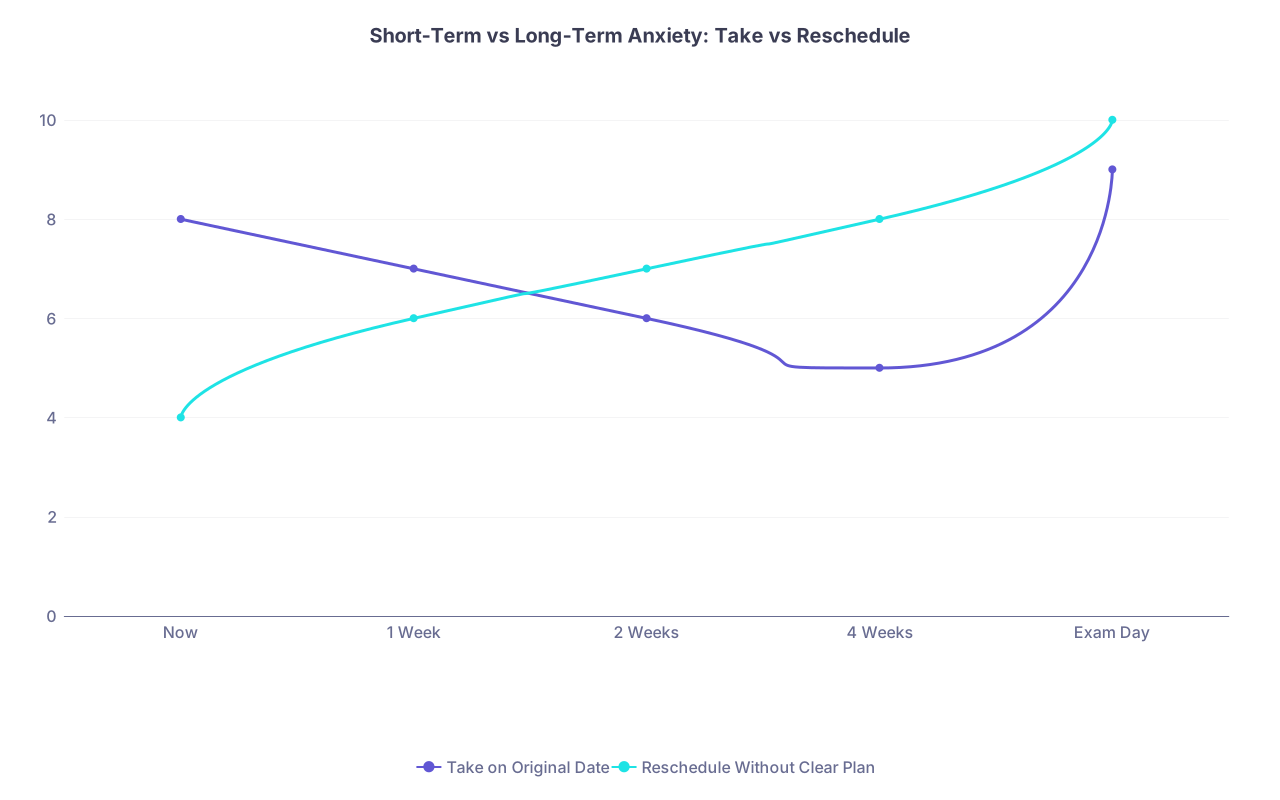
| Category | Take on Original Date | Reschedule Without Clear Plan |
|---|---|---|
| Now | 8 | 4 |
| 1 Week | 7 | 6 |
| 2 Weeks | 6 | 7 |
| 4 Weeks | 5 | 8 |
| Exam Day | 9 | 10 |
(Scale is subjective anxiety, 1–10. Notice how postponing buys you immediate relief but climbs right back up—and often higher—if nothing fundamental changes.)
Also think about:
- Financial cost of rescheduling.
- Impact on rotations, graduation, residency timelines.
- Emotional cost of dragging this anxiety out another month or two.
Sometimes “playing it safe” by postponing is actually choosing a longer, more painful version of the same fear.
Dealing With the Anxiety Either Way
Here’s the nasty truth: whether you take it as scheduled or postpone, the anxiety isn’t going to instantly disappear.
So the real question isn’t “Which choice removes my anxiety?” It’s:
“Which choice can I live with, and how do I function with the anxiety I’m stuck with?”
If you don’t reschedule
You need to treat your last stretch like a short, focused sprint—not a panicked chaos blur.
Nail down:
- A realistic daily question target.
- One pass through your highest-yield weak topics.
- A hard cut-off time at night, even if you’re “not done.”
You’re not going to fix everything in the last 7–14 days. Your job is to sharpen the arrow you already have, not build a whole new one.
And mentally, you shift from “I must crush this” to:
“I will go in on this date, with this brain, and do the best I can with what I have. Then I’ll deal with whatever the score is.”
That’s not defeatist. It’s adult.
If you do reschedule
You cannot just “buy time” and hope.
You need a specific, written plan that starts tomorrow, not “next week when I feel better.”
At minimum, answer:
- What exact resources am I using (and dropping)?
- What’s my question goal per week?
- When is my next full-length practice exam, and what score would tell me I don’t need to delay again?
- How am I managing my mental health—sleep, therapy, exercise, meds if needed—so I’m not just as wrecked later?
And you need accountability. A friend, mentor, academic support person, therapist—someone who knows your new date and your plan and will call you out if you start sliding back into avoidance.
The Honestly-Annoying Middle Ground: You’re Probably More Ready Than You Feel
This is the part almost nobody wants to admit in the moment: most anxious high-achiever med students are actually closer to ready than their brain allows them to believe.
You’re comparing yourself to:
- People posting insane practice scores in group chats.
- Perfect Anki streak screenshots.
- That one classmate who said, “Yeah, I did like 3,000 questions and felt fine.”
You never see:
- The people quietly barely passing.
- The people who took it late because they kept postponing.
- The ones who failed once but never told you.
Your anxiety is telling you: “If I don’t feel calm, I’m not ready.”
Reality: people walk into these exams with heart rates of 120, numb fingers, and a stomach that hates them. And they pass. Comfort is not a prerequisite. Competence is.
Which means this: the real “safer” choice is the one that respects your current level of preparation and your long-term mental health, not the one that gives tonight’s anxiety a quick hit of relief.
And a lot of the time, that means:
You hold your ground. You don’t reschedule. You go in scared and prepared enough.

| Step | Description |
|---|---|
| Step 1 | Feel urge to reschedule |
| Step 2 | Check practice scores & trend |
| Step 3 | Identify life/health barriers |
| Step 4 | Likely anxiety-driven |
| Step 5 | Reschedule with written plan |
| Step 6 | Fix plan first, then decide |
| Step 7 | Keep date, adjust final study plan |
| Step 8 | >10 pts below passing OR flat/drop trend? |
| Step 9 | Have clear plan to use extra time? |
FAQ: Anxiety, Rescheduling, and “Playing It Safe”
1. What if I don’t reschedule and I fail? Won’t that ruin everything?
No, it won’t ruin everything. It will suck. It will be heavy. But people fail big exams and still graduate, still match, still become excellent physicians. I’ve watched it happen. Programs care more about what you did after than the single number. A failure with a strong comeback often looks better than someone who keeps avoiding hard things.
2. How do I know if my anxiety is “bad enough” to justify postponing?
If your anxiety is so intense that you literally can’t get through a study block, can’t sleep more than a couple hours, are having full-blown panic attacks regularly, or are relying heavily on substances just to cope—that’s not “normal nervous.” That’s a mental health problem that deserves real help. In that case, talking to student health or a therapist and seriously considering a delay is rational, not weak.
3. My friends all say I’m fine to take it, but I feel like I’m faking it. Who do I trust?
Trust the combo of objective data + one or two rational humans who know you and aren’t just hype machines. If your NBMEs are around or above passing, your Qbank performance is decent, and multiple reasonable people say, “You’re okay,” but your inner voice is catastrophic—that’s anxiety, not truth. You don’t have to feel confident to act based on evidence.
4. If I do reschedule once, how do I stop myself from doing it again?
You need a hard rule before you click reschedule: “I will only delay again if X and Y happen.” For example: “If my next NBME within 2 weeks of the new date is still below passing,” or “If a new medical or family crisis hits.” Then you write that rule down and share it with someone who will hold you to it. No last-minute, feelings-based decisions this time.
5. What if my practice scores are borderline and I’m just not sure?
Then you’re in the gray zone where there is no perfect answer. In that case, look at trajectory and time. If you’re trending up and still have even 7–10 days to polish weak spots, I lean toward taking it. If you’re trending flat, exhausted, and have major unaddressed content gaps, I lean toward a one-time, well-planned reschedule. But understand: either choice has discomfort. There’s no pain-free option, only pain-you-can-live-with.
6. Okay, what should I literally do today if I’m paralyzed about this decision?
Do this: write down your last 2–3 practice scores, their dates, and your average Qbank percentage from the last 300–500 questions. Then message one person you trust (mentor, upperclassman, tutor, advisor) and send them that info with a single question: “Based on this, would you keep or change my exam date?” Get out of your own head and get one external data point. Then adjust your plan tonight based on that—not your 3 a.m. spiral.
Open your exam portal right now. Don’t click anything. Just look at the date and, on a piece of paper, write two headings: “If I keep this date” and “If I move this date.” Under each, write what the next 7 days would actually look like. Not the fantasy version. The real one. Whichever column looks more honest, build your plan around that.


