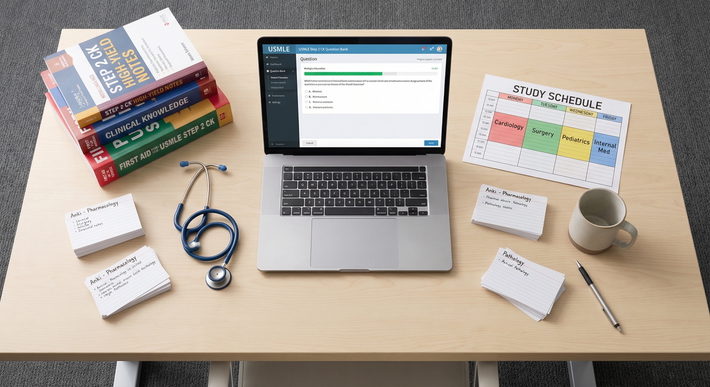
Cover Hook: The Timed-Mode Switch That Backfires Overnight
I watched a third-year medical student turn a solid 242 predicted score into a panicked 218 in three weeks.
His mistake wasn't a lack of effort. He was pulling six-hour Qbank sessions after grueling surgery shifts. His error was strategic and deceptively simple: he flipped his primary Qbank interface from Tutor/Untimed mode to Timed Mode overnight. He assumed that adding time pressure would instantly forge test-day toughness. Instead, it systematically destroyed his clinical reasoning, blew up his confidence, and buried his underlying knowledge gaps under a mountain of anxiety.
Timed practice is a non-negotiable component of USMLE Step 2 CK prep. However, blindly toggling that timer on before your brain is ready doesn't build speed, it cements sloppy habits. Switching modes without a clear plan hides learning failures behind frantic clicking.
If your accuracy takes an unexpected dive every time you run a timed block, stop. You are falling into predictable, score-killing traps. Here are seven high-impact mistakes students make when switching to timed-mode Qbank practice, along with the protective protocols you must use to safeguard your score.
Mistake #1: You Switch to Timed Mode Before You've Built the "First-Pass" Foundation
Don't make this mistake: time pressure acts as an amplifier. If your fundamental understanding of pathophysiology or diagnostic algorithms is shaky, a clock running in the corner won't speed up your recall. It will force you to rely on subconscious pattern matching and wild guesses.
When you guess under time pressure, two dangerous things happen:
- You reinforce false logic: If you guess correctly, your brain falsely codes your flawed reasoning as "success."
- You miss key diagnostic cues: When rushing, your eyes skim past essential modifiers, like "progressive over 6 months" versus "acute onset over 2 hours."
Red Flags to Watch For
- Your overall block accuracy drops consistently below your targeted threshold (e.g., falling under 65% when aiming for a 245+).
- You miss questions on topics you swore you "knew" two days ago.
- You find yourself saying, "I know this disease backward and forward, but timed sets ruin my score." (No, they don't. Timed sets are exposing that you only know the disease when given unlimited time to parse imprecise clues.)
The Avoidance Plan
Never flip to pure timed practice until you've established a stable baseline accuracy in untimed learning mode for a given organ system. Build the foundation first. Process the full differential diagnosis, understand why the wrong answers are wrong, and stabilize your accuracy before bringing in the stopwatch.
Mistake #2: You "Switch Modes" Mid-Topic Without Any Retrieval Plan
I see students do this constantly. They do 20 questions in tutor mode on Endocrinology, read the explanations, feel good, and immediately switch to a 20-question timed set on Endocrinology. They score an 80% and celebrate.
That score is an illusion. You didn't master the material; you're using short-term recognition memory.

Switching modes mid-topic without spaced retrieval converts high-yield study sessions into a warm bath of passive exposure. You read an explanation, recognize the terms on the next screen, click the right button, and mistake familiarity for mastery. On test day, when that endocrinology question is buried inside a 40-question mixed block, your short-term familiarity will be long gone.
Red Flags to Watch For
- You skip re-testing your incorrect answers because you "just read the paragraph."
- You treat timed blocks as a quick check-box exercise rather than an active retrieval tool.
- You perform exceptionally well on targeted single-subject timed blocks, but crash on comprehensive NBME practice exams.
The Avoidance Plan
Enforce an active retrieval loop every time you switch modes. If you review a topic untimed on Monday, do not run a timed block on that same topic until Wednesday. When reviewing your timed block, never just skim the text. Force yourself to re-state the diagnostic trigger (e.g., "Hyponatremia + high urine osmolarity + lung mass = SIADH") without looking at the answer key.
Mistake #3: You Treat Timed Mode Like a Speed Race (Not a Clinical Reasoning Test)
The clock in your Qbank is a boundary condition, not an opponent. Too many students see a 90-second countdown and instantly abandon systematic clinical reasoning. They read like hyperactive children, skipping the patient's age, missing vital sign trends, and jumping straight to the last sentence of the stem.
Step 2 CK does not reward fast reading. It rewards precise diagnostic synthesis. Rushing causes you to fall straight into distractor traps meticulously placed by the NBME writers.
Rushed Approach:
[Skim Stem] ──> [Spot "Chest Pain"] ──> [See ECG image] ──> [Pick Troponin] ──> WRONG (Missed 3-week timeline & friction rub)

Reasoned Approach:
[Read Lead-In] ──> [Identify Risk Profile] ──> [Synthesize Findings] ──> [Eliminate Distractors] ──> RIGHT (Pericarditis)
Red Flags to Watch For
- You select an answer choice before reading all five options.
- You consistently fall for the "most common" trap when the stem clearly presented atypical features.
- You finish 40-question blocks with 12 minutes to spare, but your accuracy is sitting at 58%.
The Avoidance Plan
Institute strict pacing guardrails. Budget approximately 75-85 seconds per question, structured into three distinct steps:
- The Lead-In Read (5 seconds): Read the question stem and answer choices first so you know what clinical data to hunt for.
- The Targeted Read (40 seconds): Read the vignette from top to bottom, highlighting key anchors (age, immune status, acuity, lab anomalies).
- The Systematic Elimination (30 seconds): Rule out options based on hard contradictions in the stem. Never select an answer without actively disproving two others.
Mistake #4: You Ignore Item-Type Differences When Switching Timed Modes
A 70-year-old male with progressive dyspnea requires a completely different processing strategy than a two-by-two biostatistics table or a patient chart review item.
When students hit the "Timed Mode" toggle, they often try to apply a single, rigid reading speed to every single item. That is a recipe for disaster. Treating an abstract/drug-ad question with the same baseline pace as a classic, three-sentence dermatology prompt will destroy your time budget halfway through the block.
Red Flags to Watch For
- Your accuracy on Biostatistics or Drug Ad questions drops off a cliff in timed sets compared to untimed sets.
- You routinely spend 3+ minutes on complex image or table questions, forcing you to blind-guess the last 5 questions of a block.
- You feel a spike of absolute panic whenever a multi-tab chart question appears.
The Avoidance Plan
Recognize item categories and switch tactics instantly:
- Classic Vignettes: Use standard 80-second top-down synthesis.
- Biostats / Calculations: Write formula variables on your scratch paper before solving. If the logic isn't clear within 30 seconds, pick your default letter, flag it, and move on.
- Sequential/Step-wise Guidelines: Skim directly for the timeline and prior interventions. You don't need to read the full past medical history if the question simply asks for the next step in management after a confirmed failed intervention.
Mistake #5: You Don't Do "Failure Analysis" After Timed Sets, So the Switch Teaches Nothing
Finishing a 40-question timed block releases a surge of cortisol. You're exhausted. You click "Submit," see your percentage, feel a wave of relief or self-loathing, and then rapidly click through the explanations just to clear the screen.
The primary goal of timed mode isn't to test your knowledge, it's to collect diagnostic data on your cognitive operational failures. Why did you miss Question 14? Was it because you didn't know the second-line treatment for C. difficile, or was it because you missed the word "except" in the prompt while staring nervously at the timer?
Red Flags to Watch For
- Spending less time reviewing a set than you spent taking it (e.g., a 60-minute block reviewed in 20 minutes).
- Categorizing every mistake as "Ugh, I made a stupid error."
- Repeating the exact same type of reading oversight across multiple consecutive blocks.
The Avoidance Plan
Execute a mandatory 3-Bucket Failure Analysis for every single missed or flagged question in a timed set. Route each mistake into one of three buckets and apply the specific fix.
- Bucket 1: Knowledge Deficit (Pure Ignorance). You didn't know the association or algorithm. Fix: Create a single targeted flashcard or micro-note focused on the missing fact.
- Bucket 2: Reading/Execution Flaw (Misread Stem). You knew the topic, but missed a crucial piece of data. Fix: Adjust your reading speed down by 10% on your next set; physically highlight the patient's age and timing keywords.
- Bucket 3: Decision/Elimination Failure (Overthinking). You had it narrowed down to two options and let an irrelevant detail talk you out of the correct choice. Fix: Re-calibrate your elimination logic. Write down why the correct answer is indisputably right, not just why the wrong answer felt enticing.
Mistake #6: You Keep the Same Timer Settings for Everything (and It Breaks Your Consistency)
Setting your Qbank timer to a strict, unyielding default pace for every single study scenario is rigid and counterproductive.
Early in your dedicated prep, forcing a hard 90-second limit per question on a topic you haven't reviewed in four months produces garbage data. You aren't testing test-taking stamina; you are just stressing your working memory to its breaking point.
Conversely, leaving the timer overly loose late in your dedicated phase leaves you completely unprepared for the brutal pacing of the actual exam.
Red Flags to Watch For
- Timing out on 4 or more questions at the end of every block.
- Experiencing severe anxiety spikes during the first 5 questions of a set.
- Artificial performance swings: scoring 80% on 10-question blocks, but dropping to 55% on 40-question blocks.
The Avoidance Plan
Calibrate your timing settings progressively based on where you are in your study schedule:
- Phase 1 (Foundation Building): Run 10 to 20-question timed sets with a extended time limit (e.g., 2 minutes per question). The goal here is pacing awareness without severe panic.
- Phase 2 (Pacing Refinement): Transition to standard NBME constraints (approx. 90 seconds per question) on 20 to 40-question blocks.
- Phase 3 (Test-Day Simulation): Run full 40-question timed blocks back-to-back under exact exam settings. Focus entirely on stamina and pacing stabilization.
Mistake #7: You Switch to Full Timed Sets Too Early and Overload Your Working Memory
Working memory is a finite resource. When you sit down to tackle a 40-question timed block, your brain is doing heavy lifting: parsing dense narratives, filtering out irrelevant clinical data, suppressing distractor options, and managing the emotional background noise of a ticking clock.
If you jump straight from untimed, single-topic practice into full 40-question mixed timed sets prematurely, you will experience rapid cognitive fatigue.
By question 25, your working memory collapses. Your reading speed stays the same, but your comprehension drops to zero. You start re-reading sentences three times. You pick answers just to end the block. This builds "learned helplessness", a state where your brain associates timed practice with exhaustion and failure.
Red Flags to Watch For
- A steep, obvious drop in accuracy across the second half of a single block (e.g., 85% accuracy on Q1-Q20, dropping to 45% on Q21-Q40).
- Brain fog, headache, or extreme resistance to starting your review session immediately post-block.
- Dreading timed blocks so much that you delay starting them, throwing off your entire daily schedule.
The Avoidance Plan
Use Progressive Overload for timed endurance, just as you would in physical strength training:
- Start with 10-question timed sets. Master the mechanics of pacing and immediate error analysis without fatiguing your brain.
- Step up to 20-question timed sets once your accuracy stabilizes over five consecutive 10-question blocks.
- Scale up to full 40-question blocks only when you can complete 20-question blocks without experiencing cognitive fatigue or late-block accuracy drops.
Summary: Protect Your Score, Switch Modes Strategically, Not Impulsively
Switching your Qbank to timed mode is a powerful tool, but only when executed with absolute intention. If you toggle that switch out of panic, you run the risk of entrenching poor reading habits, destroying your confidence, and masking the exact concept gaps you need to fix.
The Timed-Mode Safety Protocol
- Build foundation first: Achieve stable untimed accuracy on a concept before adding speed pressure.
- Space your retrieval: Never run a timed block on material you studied 5 minutes ago.
- Pace, don't rush: Keep to a structured 75-85 second budget per question. Read systematically.
- Match tactics to item types: Adjust your processing speed for biostats, images, and short vignettes.
- Categorize every mistake: Run every error through the 3-Bucket Failure Analysis framework.
- Scale up progressively: Build from 10 to 20 to 40-question sets as your cognitive stamina improves.
Your Action Item Today
Take your next scheduled Qbank session. Cut the block size in half (do 20 questions instead of 40), run it on timed mode, and commit to spending at least 45 minutes categorizing every single mistake using the 3-Bucket system. Protect your process, refine your mechanics, and let your Step 2 CK score reflect what you actually know.