
Most students know OB emergencies are “high-yield.” Very few know how exam writers actually weaponize them.
Let me be blunt: Step 2 loves obstetric emergencies because they test whether you can recognize a disaster in 10 seconds and pull the one correct intervention out of 10 reasonable-sounding options. This is not about memorizing lists; it is about pattern recognition and ruthless prioritization.
We are going straight through the big ones:
- Shoulder dystocia
- Cord prolapse
- Uterine rupture
- Amniotic fluid embolism
- Postpartum hemorrhage (PPH)
And I will spell out what they actually test: the first move, the do-not-do, and the traps.
Core Mindset for OB Emergencies on Step 2
Before details, fix this in your head: on exam day, the OB emergency questions are algorithm questions disguised as long narratives. You are being asked:
- Is this fetal life in immediate danger, maternal life in immediate danger, or both?
- What is the first actionable step that changes outcome?
- What should you never waste time doing?
USMLE writers love time-wasting options: ordering imaging, getting labs, calling ethics, doing anything except the obvious emergency maneuver.
Quick orienting rule I drill into students:

- Fetal catastrophe, delivery still possible vaginally → positional/manual maneuvers.
- Fetal catastrophe, vaginal route blocked → crash C-section.
- Maternal collapse → ABCs, code-level management, then OB-specific step.
- Massive uterine bleeding → uterotonics + find/correct source.
Keep that foregrounded as we go through each condition.
Shoulder Dystocia: “Turtle Sign” and Zero Time for Subtlety
If you miss shoulder dystocia on Step 2, that is on you. The question stem practically shouts it.
Classic vignette:
- G2P1, macrosomic baby (maternal diabetes, post-dates, or 4+ kg fetus)
- Head delivers, then retracts (“turtle sign”)
- Anterior shoulder impacted on maternal pubic symphysis
- Fetal heart tracing might still be okay early on
The exam does not care about diagnosis. They care about: What do you do in the first 10–60 seconds?
Immediate sequence: what Step 2 wants
The maneuver order can vary by institution, but for exams, remember:
- Call for help – but they rarely list this as an answer.
- McRoberts maneuver – first-line.
- Suprapubic pressure – add to McRoberts.
- If that fails:
- Deliver posterior arm or
- Internal rotational maneuvers (Woods screw, Rubin).
Options you do not pick initially:
- Fundal pressure (never; worsens impaction)
- Forceps or vacuum just to “pull harder”
- Episiotomy as first-line (it enlarges soft tissue, not bony pelvis; may be useful but not priority)
- C-section after the head is already delivered (too late; you must finish vaginally)
So the classic Step 2 answer:
“Next best step in management when head delivers but retracts against the perineum and shoulders do not deliver”?
→ McRoberts maneuver with suprapubic pressure.
Breakdown of maneuvers (exam angles)
You do not need anatomy drawings in your head. You need names mapped to purpose:
- McRoberts: Hyperflex maternal hips (thighs to abdomen) → flattens sacral promontory, increases AP diameter.
- Suprapubic pressure: Downward and lateral pressure over pubic symphysis → dislodges anterior shoulder from behind symphysis.
- Posterior arm delivery: Reach in, flex, and deliver fetal posterior arm → reduces shoulder diameter.
- Woods screw / Rubin: Internal rotation of shoulders into oblique diameter.
If they ask specifically “What maneuver increases pelvic outlet by flexing maternal hips?” — that is McRoberts.
If they ask “What complication is the newborn at highest risk of?” — answer is:
- Brachial plexus injury (Erb palsy)
Sometimes also: - Clavicle fracture
- Humerus fracture
But brachial plexus is the classic.
Maternal complications:
- Postpartum hemorrhage
- 3rd/4th degree perineal lacerations
Common trap: They love giving you a baby with arm adducted, internally rotated, “waiter’s tip” posture and asking what happened. Prior shoulder dystocia, traction on neck → Erb palsy (C5–C6).
Umbilical Cord Prolapse: Fetal First, Everything Else Later
Cord prolapse is a pure reflex question. There is exactly one correct sequence.
Vignette flags:
- Sudden fetal bradycardia after:
- Artificial rupture of membranes (AROM)
- High station or malpresentation
- Premature or small fetus
- On exam or visually: umbilical cord palpable or visible in vagina.
Your brain must fire:
“Relieve pressure on cord + crash C-section.”
Nothing else. Not memos, not dopplers, not waiting.
Step 2 algorithm for prolapsed cord
- Immediate maneuver:
- Manual elevation of presenting part (hand in vagina pushing fetal head up), OR
- Trendelenburg or knee-chest position to reduce cord compression.
- Emergency C-section.
Most test questions phrase it as:
- “Next best step” when cord is felt on exam with decelerations or fetal bradycardia?
→ Manually elevate presenting part and arrange for emergent cesarean delivery.
Options you must ignore:
- Reposition mother alone without manual elevation as final answer
- Tocolytics
- Attempt vaginal delivery with forceps / vacuum
- Oxytocin (would worsen compression scenario)
Key nuance they might test: If the cervix is fully dilated and head is low and you can deliver immediately with forceps/vacuum faster than C-section, that is acceptable in real life. On Step 2, they almost always frame it so the next best step is C-section.
Uterine Rupture: The “Sudden Catastrophe” in a Scarred Uterus
This one is all about recognizing the pattern and not confusing it with placental abruption.
Risk setup:
- Prior classical (vertical) C-section
- Prior myomectomy that entered uterine cavity
- Multiple prior C-sections
- TOLAC (trial of labor after C-section), especially with augmentation/induction
Vignette signals:
- Woman in labor with prior C-section.
- Sudden onset:
- Intense abdominal pain (often “tearing”)
- Loss of fetal station (backup of fetal head from +2 to 0, for example)
- Abnormal fetal heart tracing / bradycardia
- Vaginal bleeding may be present
- On palpation: fetal parts may be felt abdominally; loss of uterine contour; contractions may stop.
That “loss of fetal station” phrase is basically a buzzer word for uterine rupture.
Step 2 management
Immediate management is emergent laparotomy with C-section. Not observation. Not imaging.
If the uterus is unsalvageable or bleeding is severe: hysterectomy.
So the answer stems usually look like:
- “Next best step” → Emergency laparotomy and delivery of the fetus.
Traps:
- Do not pick “perform ultrasound” before going to OR.
- Do not “augment labor with oxytocin.”
- Do not confuse it with:
- Placental abruption (painful bleeding, firm tender uterus, but no loss of station, and usually no prior scar rupture story)
- Normal labor pain (no loss of station, no catastrophic decels + sharp change)
Amniotic Fluid Embolism: The Sudden Collapse Nobody Can Predict
This is the Step 2 version of “obstetric PE + DIC” in one question.
Context:
- Healthy pregnant or postpartum woman, often during labor or immediately after delivery (C-section or vaginal).
- No prior warning signs.
Vignette pattern:
- Sudden respiratory distress / hypoxia
- Hypotension, shock
- Cardiac arrest may follow
- Then rapidly:
- DIC (oozing from IV sites, surgical incision, heavy bleeding)
- Coagulopathy labs: prolonged PT/PTT, low fibrinogen, thrombocytopenia.
This is not about confirming diagnosis. This is about emergency support.
Step 2 management focus
You treat:
- Airway, Breathing, Circulation (intubation, pressors, CPR if needed),
- Deliver fetus if mother arrests and pregnancy is viable, and
- Correct coagulopathy.
They may ask:
- Immediate next step when a woman in labor suddenly collapses, desaturates, and has DIC signs?
→ Supportive care in ICU setting: intubation, vasopressors, blood products including FFP, platelets, cryoprecipitate.
No confirmatory special test is needed on exam. If they ask what labs you will see:
- Low fibrinogen
- High D-dimer
- Prolonged PT/PTT
- Thrombocytopenia
Main trap: confusing this with:
- Massive PE → similar but without obvious DIC early and not so tightly linked to active labor/delivery.
- Septic shock → usually more gradual onset, fever, source of infection.
If they explicitly mention uterine atony, large postpartum blood loss, then DIC → that is secondary DIC from PPH. But the textbook “sudden collapse with DIC during labor” is amniotic fluid embolism.
Postpartum Hemorrhage (PPH): The Favorite OB Emergency on Step 2
This is where the test writers get creative. PPH is not one entity. It is four.
Mnemonic you probably know: “4 T’s” – Tone, Trauma, Tissue, Thrombin.
Let me reframe that clinically, because that is how the exam is structured.
Definition and timing
Primary PPH:
500 mL after vaginal birth
1000 mL after C-section
OR signs of hypovolemia in first 24 hours postpartum.
Most vignettes: “Soaking pads, large clots, hypotension, tachycardia, boggy uterus” etc.
Step 2’s real game: identify the cause from physical exam
, Lacerations, Retained tissue, Coagulopathy](https://cdn.residencyadvisor.com/images/articles_svg/chart-common-causes-of-primary-postpartum-hemorrhage-7444.svg "Common Causes of Primary Postpartum Hemorrhage")
| Category | Value |
|---|---|
| [Uterine atony](https://residencyadvisor.com/resources/usmle-step2-prep/the-high-yield-topics-everyone-overlooks-on-step-2-ck-question-blocks) | 70 |
| Lacerations | 20 |
| Retained tissue | 5 |
| Coagulopathy | 5 |
1. Uterine atony (Tone) – ~70–80%
Vignette:
- Soft, enlarged, boggy uterus.
- Often risk factors: overdistension (multiple gestation, polyhydramnios, macrosomia), prolonged labor, rapid labor, chorioamnionitis, high-dose oxytocin, general anesthesia.
Management sequence (this is exactly what Step 2 wants):
- Fundal massage + bimanual uterine massage.
- Uterotonics:
- First-line: Oxytocin IV or IM.
- If insufficient:
- Methylergonovine (Methergine) — contraindicated in hypertension / preeclampsia.
- Carboprost (15-methyl-PGF2α) — contraindicated in asthma.
- Misoprostol (rectal) — safer but slower; often adjunct.
- If still bleeding:
- Intrauterine tamponade: Bakri balloon, uterine packing.
- If refractory:
- Uterine artery ligation / internal iliac ligation,
- or Hysterectomy as last resort.
Step 2 loves the contraindication questions:
- “Next medication in a hypotensive, bleeding postpartum patient with a history of severe asthma?”
→ Do not choose carboprost. Use methylergonovine (if normotensive) or misoprostol. - “Next step in a woman with severe range BPs and atony not responding to oxytocin?”
→ Avoid methylergonovine. Use carboprost (if no asthma) or misoprostol.
2. Genital tract lacerations (Trauma)
Pattern:
- Uterus: firm, well-contracted, appropriate size.
- Continuous bleeding, bright red.
- Risk factors: operative vaginal delivery (forceps/vacuum), precipitous delivery, macrosomia, episiotomy.
Management:
- Immediate surgical exploration and repair of lacerations (vaginal, cervical, perineal).
The exam trap: They offer you more uterotonics when the uterus is already firm. Wrong. This is mechanical bleeding from a tear.
3. Retained placental tissue (Tissue)
Pattern:
- Boggy uterus, poor contraction, ongoing bleeding.
- Placenta “incomplete” on inspection, or succenturiate lobe, or manual extraction previously attempted.
- Ultrasound might show echogenic material in uterine cavity (but on exam, you can often act without imaging).
Management:
- Manual extraction under adequate anesthesia
- Or suction curettage if manual removal not possible.
- Follow with uterotonics to contract uterus and prevent further bleeding.
Complication they might test: risk for Sheehan syndrome (if severe hemorrhage → pituitary ischemia) later, but that is more for endocrine questions.
4. Coagulopathy (Thrombin)
Pattern:
- Oozing from venipuncture and incision sites, not just uterine.
- History: DIC from abruption, amniotic fluid embolism, severe preeclampsia/HELLP, IUFD, sepsis.
- Lab: low fibrinogen, prolonged PT/PTT, low platelets.
Management:
- Treat underlying cause (e.g., deliver placenta in abruption)
- Blood products: FFP, cryoprecipitate, platelets as needed.
First step vs next step: subtle sequencing
Step questions like to split hairs between:
- “Most appropriate initial step” and
- “Most appropriate next step after X has failed”.
Typical progression for PPH due to atony:
- Initial: Fundal/bimanual massage + IV oxytocin.
- Next if persistent: Add another uterotonic (methergine or carboprost, depending on comorbidities).
- Next if still persistent: Intrauterine balloon tamponade.
- Next if refractory and life-threatening: Surgical ligation or hysterectomy.
If they jump you into the vignette saying “Despite oxytocin and fundal massage, the uterus remains boggy and bleeding is ongoing,” do not pick oxytocin again. Move to second-line drug or tamponade.
How These Emergencies Show Up Across Question Banks
You are not just memorizing names. You are predicting the structure of the question.
| Emergency | Buzzwords / Clues | First Key Action |
|---|---|---|
| Shoulder dystocia | Turtle sign, macrosomia, stuck shoulders | McRoberts + suprapubic pressure |
| Cord prolapse | Sudden decels post-AROM, cord palpated | Elevate presenting part + emergent C/S |
| Uterine rupture | TOLAC, loss of fetal station, severe pain | Emergency laparotomy + delivery |
| Amniotic fluid embol | Sudden collapse, hypoxia, DIC in labor | Supportive ICU care, blood products |
| PPH (atony) | Boggy uterus, heavy bleeding postpartum | Massage + oxytocin |
Recognize that each one hinges on 1–2 “buzzwords” that should immediately narrow your options.
Process Thinking: From Vignette to Answer in 15 Seconds
Let me give you a crude but effective mental flow you can run even under time pressure.

| Step | Description |
|---|---|
| Step 1 | Read stem |
| Step 2 | Support ABCs, resuscitate |
| Step 3 | Amniotic fluid embolism → ICU support + blood products |
| Step 4 | Uterine rupture → emergent laparotomy |
| Step 5 | Prolapsed cord → elevate head + emergent C/S |
| Step 6 | Shoulder dystocia → McRoberts + suprapubic pressure |
| Step 7 | Atony → massage + oxytocin |
| Step 8 | Repair tears |
| Step 9 | Transfuse, treat DIC |
| Step 10 | Maternal collapse? |
| Step 11 | OB cause pattern? |
| Step 12 | Fetal distress or postpartum bleeding? |
| Step 13 | Cord vs shoulder? |
| Step 14 | Uterus boggy or firm? |
| Step 15 | Trauma vs coagulopathy? |
Use something like this mentally. Do not get lost in excess detail.
How to Drill This for Step 2
You do not need a 300-page OB textbook. You need tight repetition of patterns.
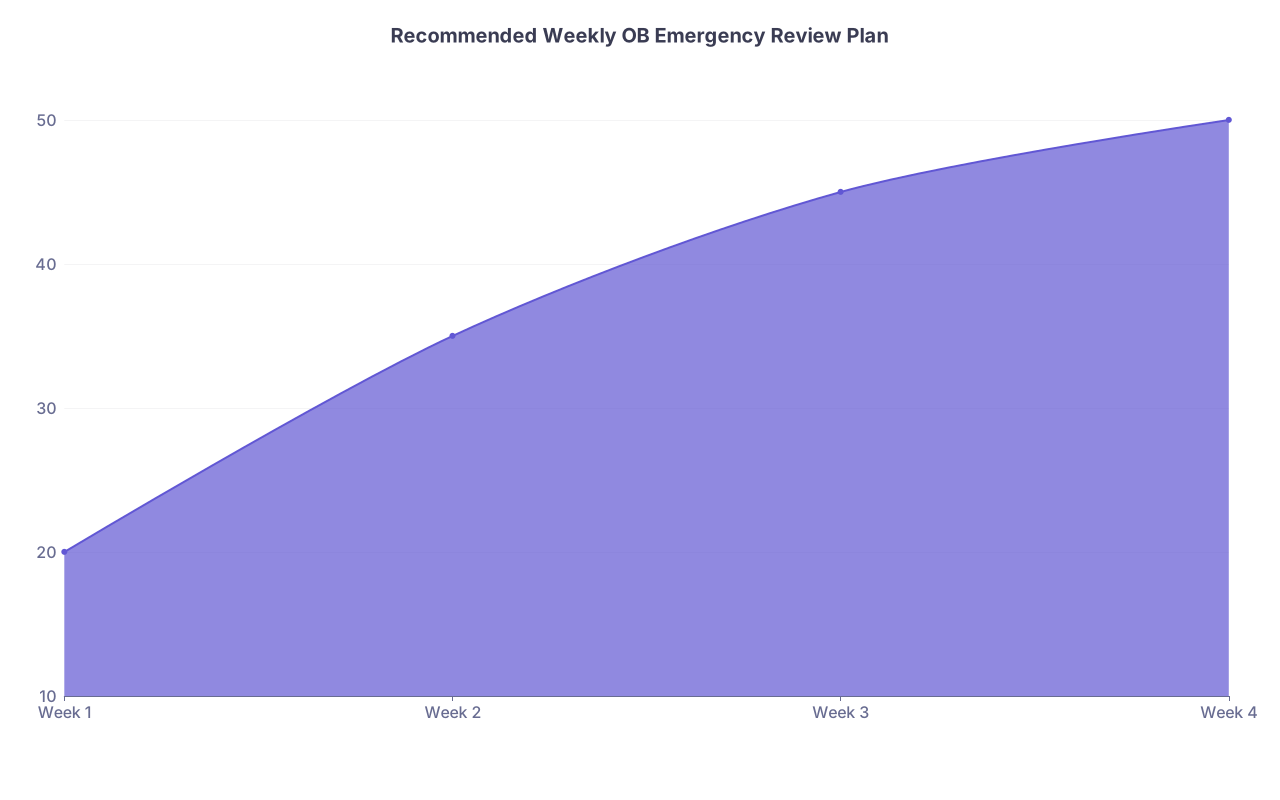
| Category | Value |
|---|---|
| Week 1 | 20 |
| Week 2 | 35 |
| Week 3 | 45 |
| Week 4 | 50 |
What I tell students during dedicated:
Take one evening. Make a one-page sheet:
- Left column: emergency name.
- Middle: buzzwords.
- Right: first-line action + second-line.
Do 10–15 OB emergency questions per week (UWorld, AMBOSS, etc), but do not just check answers. For each miss:
- Identify which clue you ignored.
- Add that phrase to your sheet.
Before the exam, you should be able to answer these questions practically from the first 2 sentences of the stem.
Visual Memory Anchors (Yes, This Helps)
Some people remember text poorly but pictures well. Fine. Use it.

- Shoulder dystocia → Picture legs hyperflexed, assistant pushing above pubic bone, not on the fundus.
- Cord prolapse → Hand in vagina holding the head off a loop of cord, patient head-down.
- Uterine rupture → Baby partly “out of the uterus” into the abdomen, prior scar line.
- Amniotic fluid embolism → Mother collapsing on delivery bed, multiple IVs, monitors, no trauma.
- PPH atony → Boggy, enlarged uterus + provider doing bimanual massage.
If you cannot draw stick-figure versions from memory in 30 seconds for each, you have not encoded them yet.
Common Exam Traps and How to Ignore Them

Doing tests instead of acting.
- Uterine rupture → Do not order ultrasound. Go to OR.
- Cord prolapse → Do not get confirmatory ultrasound. Elevate and C-section.
- Amniotic fluid embolism → Do not order CT angiography first. Stabilize.
Choosing wrong uterotonic because you forgot comorbidities.
- Hypertension/preeclampsia → avoid methylergonovine.
- Asthma → avoid carboprost.
Read comorbidities carefully.
Picking C-section when baby’s head is already delivered.
- Shoulder dystocia after head delivery → cannot C-section now. Use maneuvers.
Confusing a firm uterus with atony.
- If uterus is firm and midline but bleeding continues → think laceration, not atony.
- Uterotonics will not fix a cervical or vaginal tear.
Mislabeling abruption vs rupture.
- Abruption: painful bleeding, hypertonic tender uterus, usually no loss of station, often with hypertension or trauma.
- Rupture: sudden pain, loss of fetal station, decels, prior scar.
FAQs
1. Do I need to memorize exact doses of oxytocin, carboprost, etc., for Step 2?
No. The exam tests which agent and when, not milligram dosing. You must know mechanism-level properties and contraindications:
- Oxytocin first-line.
- Methylergonovine contraindicated in hypertension.
- Carboprost contraindicated in asthma.
- Misoprostol as adjunct, slower onset.
2. How often do OB emergencies actually show up on Step 2 compared to other OB topics?
They show up more than you think. OB is a smaller fraction of the exam than IM, but within OB, emergencies carry disproportionate weight. You will likely see several questions on PPH alone, plus 1–2 across shoulder dystocia, ruptured uterus, or cord prolapse. They are “easy points” if you know the first step cold.
3. For cord prolapse, is maternal repositioning (knee-chest) enough, or do I always need manual elevation?
On the exam, best answer is usually manual elevation of the presenting part plus emergent C-section. Repositioning (Trendelenburg, knee-chest) is helpful adjunct, but if both are in the options, pick the action that directly relieves pressure on the cord with your hand.
4. How do I separate amniotic fluid embolism from massive PE or anaphylaxis on the exam?
Context and DIC. Amniotic fluid embolism:
- Happens during labor or immediately postpartum.
- Has abrupt cardiovascular collapse plus respiratory distress.
- Very quickly followed by DIC and heavy bleeding.
Massive PE can cause sudden collapse and hypoxia but usually without simultaneous DIC and not precisely at the moment of delivery.
5. If uterine atony persists despite multiple uterotonics, do I pick balloon tamponade or go straight to hysterectomy?
Unless the stem tells you she is exsanguinating and unstable with failed tamponade, the next escalation after failed uterotonics is uterine tamponade (e.g., Bakri balloon). Hysterectomy is the final step when all conservative measures (massage, drugs, tamponade, possibly artery ligation) have failed or the bleeding is immediately life-threatening and uncontrolled.
Key takeaways:
- Each OB emergency has 1–2 unmistakable buzzwords and exactly one correct first move. Anchor those pairs.
- Do not “order tests” during a catastrophe. Step 2 rewards immediate, decisive action that preserves maternal and fetal life.
- Postpartum hemorrhage is a mini-algorithm inside the exam: boggy vs firm uterus; asthma vs hypertension; drugs vs knife. Master that, and OB emergencies stop being scary and start being free points.