
The exams are obsessed with neurology localization, and most students are bad at it.
Let me be blunt: if you treat neuro on Step 2 like “random facts and weird syndromes,” you will bleed points. The test writers love classic lesion patterns, brainstem syndromes, spinal cord localizations, and vascular territories. They are not subtle about it. They give you the pattern; your job is to recognize it in under 30 seconds.
I am going to break this down exactly how you should think about it on exam day.
The One-Page Mental Map: How Step 2 Tests Neuro Localization
Before diving into specific syndromes, you need the “framework in your head” that USMLE assumes you have.
On Step 2/CK and shelf exams, neurology localization questions almost always fall into one of these buckets:
| Category | Typical Clue Focus |
|---|---|
| Cortical lesions | Language, neglect, seizures |
| Subcortical (internal capsule, basal ganglia) | Pure motor/pure sensory |
| Brainstem lesions | Crossed signs, cranial nerves |
| Cerebellar lesions | Ataxia, nystagmus, intention tremor |
| Spinal cord lesions | Level-based sensory/motor loss |
You see:
- Pure motor hemiparesis → think internal capsule / lacunar stroke.
- Crossed cranial nerve + long tract finding → brainstem.
- Language disturbance → dominant (usually left) hemisphere.
- Neglect, constructional apraxia → non-dominant (usually right) parietal.
- Saddle anesthesia, urinary retention → conus medullaris / cauda equina.
- Acute severe neck/back pain + rapidly progressive weakness → spinal cord compression.
If you do not instantly attach those patterns to a location, you are working too hard.
Let us go system by system.
Cortical and Subcortical Lesions: The Stroke Patterns
1. Anterior vs Middle vs Posterior Cerebral Artery
The exam loves vascular territories. They will describe an older patient with sudden-onset deficits and expect you to name the vessel and lesion location.
Middle Cerebral Artery (MCA)
This is the workhorse vascular territory on exams.
Key features of MCA stroke (usually due to embolus from carotid or heart):
- Contralateral weakness and sensory loss, face and arm > leg.
- Gaze preference toward the side of the lesion (early).
- Homonymous hemianopia (optic radiations via temporal/parietal).
- Aphasia if dominant (usually left) side.
- Hemineglect if non-dominant (usually right) side.
Split it explicitly:
Left MCA stroke (dominant hemisphere):
- Right hemiparesis/hemisensory loss (face/arm > leg).
- Expressive aphasia (Broca, inferior frontal gyrus): effortful, non-fluent speech, intact comprehension, impaired repetition.
- Receptive aphasia (Wernicke, superior temporal gyrus): fluent, nonsensical speech, impaired comprehension, impaired repetition.
- Global aphasia if large lesion.
- Possible right superior quadrantanopia (“pie in the sky” if temporal optic radiations hit).
Right MCA stroke (non-dominant hemisphere):
- Left hemiparesis/hemisensory loss (face/arm > leg).
- Left hemispatial neglect: ignores left side, does not dress left body, does not acknowledge left environment.
- Constructional and dressing apraxia.
On questions, neglect is basically code for right parietal lesion (often MCA territory).
Anterior Cerebral Artery (ACA)
Think “lower extremity and behavior.”
Classic ACA stroke:
- Contralateral weakness and sensory loss, leg > arm.
- Urinary incontinence.
- Abulia (lack of will), apathy, personality changes.
- Sometimes grasp reflex, primitive reflexes.
If they say: “cannot move right leg, mild arm involvement, flat affect” → left ACA stroke.
Posterior Cerebral Artery (PCA)
PCA territory is mostly visual cortex and some thalamus.
Key PCA findings:
- Contralateral homonymous hemianopia with macular sparing (classic).
- Alexia without agraphia (dominant occipital lesion that disconnects visual input from language areas via splenium of corpus callosum).
- Visual hallucinations or cortical blindness in bilateral lesions.
Visual field cut, preserved macula, otherwise relatively intact strength → PCA.
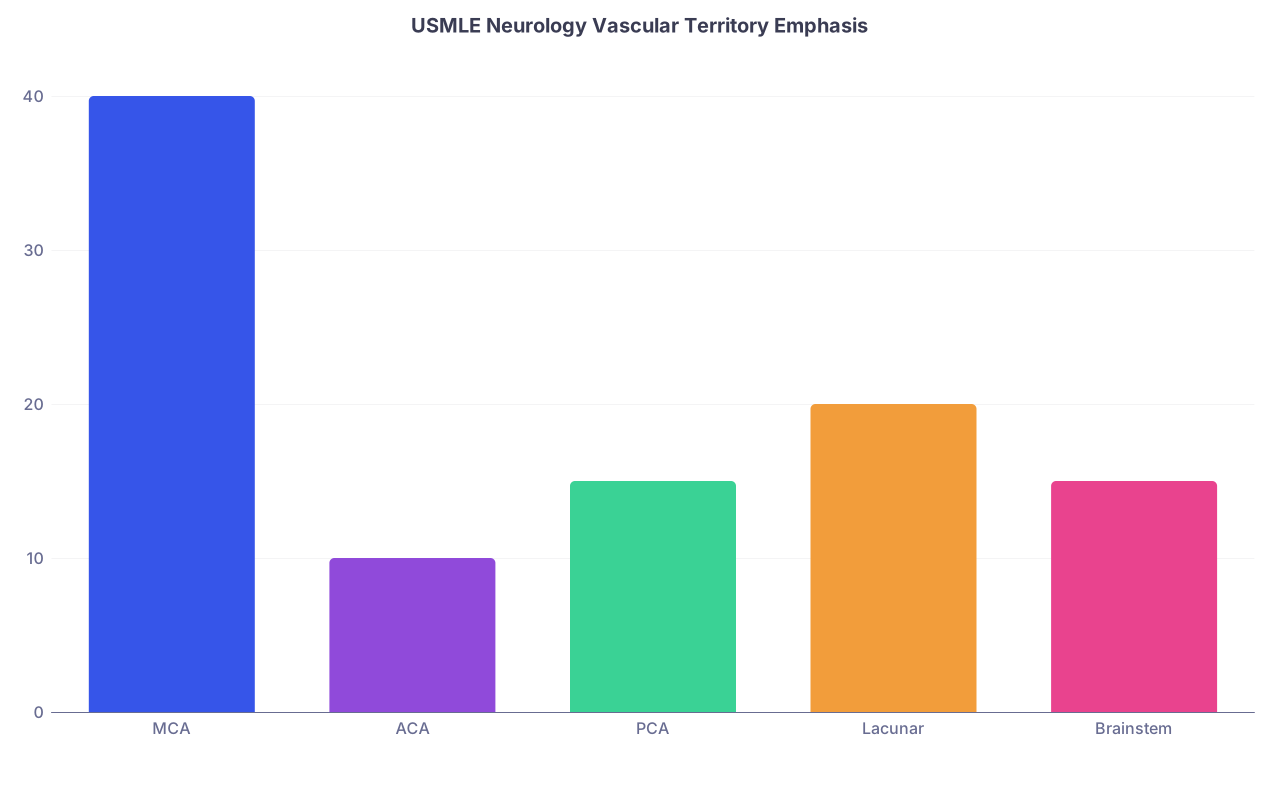
| Category | Value |
|---|---|
| MCA | 40 |
| ACA | 10 |
| PCA | 15 |
| Lacunar | 20 |
| Brainstem | 15 |
2. Lacunar Strokes and Internal Capsule: The “Pure” Syndromes
Lacunar strokes show up constantly. They are small vessel strokes from lipohyalinosis due to chronic hypertension or diabetes, usually in:
- Internal capsule.
- Thalamus.
- Basal ganglia.
- Pons.
High-yield lacunar syndromes:
Pure motor hemiparesis
- Lesion: posterior limb of internal capsule or basis pontis.
- Presentation: sudden contralateral weakness of face, arm, leg. No cortical signs (no aphasia, no neglect, no visual field defect).
Pure sensory stroke
- Lesion: ventral posterior lateral nucleus (VPL) of thalamus.
- Presentation: contralateral sensory loss (all modalities) without motor deficits.
Ataxic hemiparesis
- Lesion: usually at the junction of pons and internal capsule.
- Presentation: contralateral weakness + limb ataxia (more in leg).
Dysarthria–clumsy hand syndrome
- Lesion: basis pontis or genu of internal capsule.
- Presentation: dysarthria + clumsy hand (disproportionately weak).
Exam code word: “long-standing hypertension, sudden onset pure motor deficit, no cortical findings” → lacunar infarct in internal capsule.
CT may be normal initially; MRI diffusion-weighted is more sensitive. Management is the same acute ischemic stroke algorithm (tPA if within window and eligible, antiplatelet, risk factor control).
Brainstem Lesions: Crossed Findings and Cranial Nerves
This is where most students get crushed. The trick: crossed signs.
If you see:
- Ipsilateral cranial nerve deficit(s).
- Contralateral body motor or sensory deficit.
You are in the brainstem. Almost always.
Brainstem Rule of Thumb
- Midbrain lesions: CN III, IV.
- Pons lesions: CN V, VI, VII, VIII.
- Medulla lesions: CN IX, X, XI, XII.
Now, what Step 2 likes: named brainstem syndromes and vertebrobasilar strokes.
1. Medial Medullary Syndrome (Dejerine)
Cause: Anterior spinal artery occlusion (branch of vertebral artery).
Triad:
- Contralateral spastic hemiparesis (corticospinal tract).
- Contralateral loss of vibration and proprioception (medial lemniscus).
- Ipsilateral tongue weakness (hypoglossal nucleus/nerve) → tongue deviates toward lesion.
If the tongue deviates toward the lesion side and opposite side is weak → think medial medulla.
2. Lateral Medullary Syndrome (Wallenberg)
This is heavily tested. Cause: PICA stroke (Posterior Inferior Cerebellar Artery) or vertebral artery.
Findings, by system:
- Vestibular nuclei: vertigo, nystagmus, vomiting.
- Inferior cerebellar peduncle: ipsilateral limb ataxia.
- Nucleus ambiguus (IX, X): dysphagia, dysphonia/hoarseness, diminished gag reflex.
“Nucleus ambiguus effects are unique to PICA lesions” is a phrase exam writers love. - Spinal trigeminal nucleus and tract: ipsilateral loss of pain and temperature from face.
- Spinothalamic tract: contralateral loss of pain and temperature from body.
- Sympathetic fibers: ipsilateral Horner syndrome (ptosis, miosis, anhidrosis).
So: hoarseness, dysphagia, decreased gag + crossed pain-temperature loss + vertigo + ataxia = lateral medulla / PICA.
If the question stem describes severe dysphagia after a stroke, this is almost always the answer they want.

3. Lateral Pontine Syndrome (AICA territory)
Lateral pontine lesions (usually from Anterior Inferior Cerebellar Artery) look similar to lateral medullary, but with facial paralysis and different cranial nerves.
Key features:
- Facial nucleus (CN VII): ipsilateral facial paralysis, loss of corneal reflex (efferent limb), hyperacusis (stapedius paralysis), decreased lacrimation and salivation.
- Vestibular nuclei: vertigo, nystagmus.
- Cochlear nucleus: ipsilateral hearing loss.
- Spinal trigeminal nucleus: ipsilateral facial pain and temperature loss.
- Spinothalamic tract: contralateral body pain and temperature loss.
- Sympathetic fibers: ipsilateral Horner.
- Middle/inferior cerebellar peduncles: ataxia.
Clinically: facial paralysis + loss of pain/temperature in ipsilateral face and contralateral body + ataxia + maybe hearing loss → lateral pontine (AICA).
Mnemonic students use (works on Step 1, still helps in CK):
“Facial droop means AICA’s pooped.”
4. “Locked-in” Syndrome (Basilar Artery)
Lesion: Ventral pons (basilar artery infarction or central pontine myelinolysis).
Presentation:
- Loss of all voluntary motor function in limbs and lower face (bilateral corticospinal and corticobulbar tracts).
- Preserved consciousness and vertical eye movements, blinking (reticular activating system and midbrain vertical gaze centers are intact).
- Patient appears “quadriplegic and mute” but is awake and aware.
Exam loves the scenario: rapid correction of hyponatremia → acute paralysis, can only move eyes vertically → locked-in syndrome.

| Step | Description |
|---|---|
| Step 1 | Crossed CN and body signs? |
| Step 2 | Brainstem |
| Step 3 | Midbrain lesion |
| Step 4 | Pontine lesion |
| Step 5 | Medullary lesion |
| Step 6 | Which CN involved? |
Cerebellar Lesions: Ataxia Patterns They Expect You to Know
Cerebellum questions are straightforward if you remember one sentence:
Ipsilateral deficits, with ataxia and coordination issues, not pure weakness.
Key findings:
- Limb ataxia (dysmetria, intention tremor) → cerebellar hemisphere lesion.
- Truncal ataxia, wide-based gait, inability to sit unsupported → vermis lesion.
- Nystagmus, dysarthria.
Localization specifics:
- Cerebellar hemispheres: affect ipsilateral limb coordination.
Example: right cerebellar hemisphere lesion → right arm past-pointing, right heel-to-shin ataxia. - Vermis: affects truncal stability and gait (alcoholic cerebellar degeneration classic).
Step 2 angles:
- Acute cerebellar hemorrhage or infarct: occipital headache, vomiting, vertigo, inability to walk, wide-based gait, nystagmus. CT or MRI: posterior fossa lesion. Management may require surgical decompression because of risk of brainstem compression and hydrocephalus.
- Alcoholic cerebellar degeneration: gait ataxia, difficulty with tandem walk, relatively preserved limb coordination at first.
If the patient has “ataxia + dysmetria + intention tremor + scanning speech” with no significant weakness or sensory deficit → cerebellar lesion.
Spinal Cord Localizations: Levels, Tracts, and Patterns
Step 2 does not test the microanatomy of every tract, but it absolutely tests spinal cord injury patterns and compressive myelopathy.
1. Complete Cord Transection
Mechanism: trauma, tumor, epidural abscess, severe disk herniation, transverse myelitis.
Findings at and below the level:
- Initially: spinal shock → flaccid paralysis, areflexia, loss of all sensation below lesion.
- Later: UMN signs below level (spasticity, hyperreflexia, Babinski).
- Loss of bowel and bladder control.
Key exam clue: a sensory level. “Loss of pinprick sensation below the umbilicus” → think T10 lesion.
2. Anterior Cord Syndrome
Cause: anterior spinal artery infarct (often due to hypotension, aortic surgery, dissection). Anterior 2/3 of cord involved.
Findings:
- Bilateral loss of pain and temperature below lesion (spinothalamic tract).
- Bilateral motor paralysis below lesion (corticospinal tract).
- Preserved dorsal column (vibration, proprioception, light touch intact).
Classic: patient after thoracic aortic surgery develops acute bilateral leg weakness, loss of pain and temp, but can still feel vibration → anterior spinal artery syndrome.
3. Brown-Séquard Syndrome (Hemisection of Cord)
Often from penetrating trauma, lateral compression, or spinal tumor.
At and below lesion:
- Ipsilateral UMN signs below lesion (corticospinal).
- Ipsilateral loss of vibration and proprioception below lesion (dorsal columns).
- Contralateral loss of pain and temperature starting 1–2 levels below lesion (spinothalamic crosses over a bit above entry).
Plus: LMN signs at level of lesion (anterior horn or root).
They love a trauma case: stab wound to back → ipsilateral leg weakness and loss of vibration, contralateral loss of pain below lesion → Brown-Séquard.
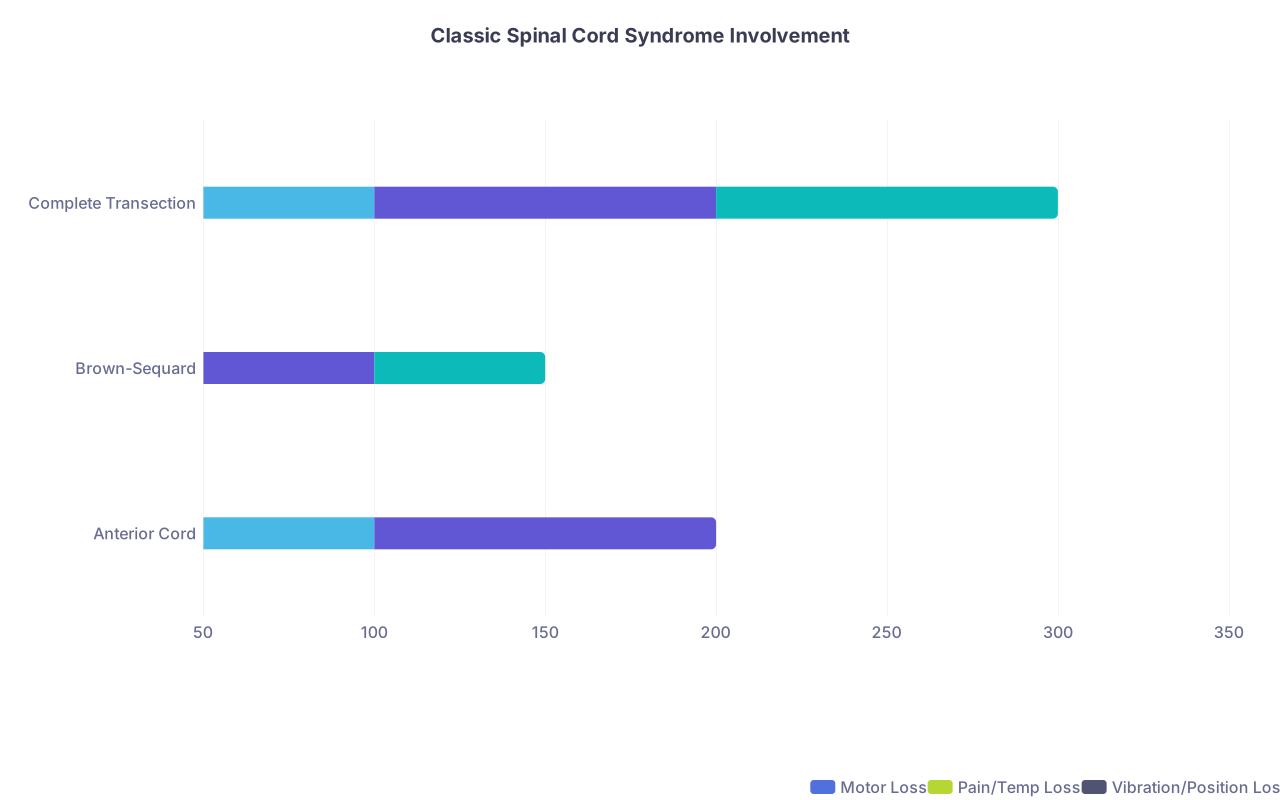
| Category | Motor Loss | Pain/Temp Loss | Vibration/Position Loss |
|---|---|---|---|
| Anterior Cord | 100 | 100 | 0 |
| Brown-Sequard | 50 | 50 | 50 |
| Complete Transection | 100 | 100 | 100 |
4. Central Cord Syndrome
This shows up more in trauma/geriatrics type vignettes.
Mechanism: hyperextension injury in older patients with cervical spondylosis; also syringomyelia.
Findings:
- Greater weakness in upper extremities than lower extremities (because cervical fibers for arms are more central in the corticospinal tract).
- “Cape-like” loss of pain and temperature over shoulders and upper arms if central canal expansion (syrinx) hits crossing spinothalamic fibers.
- Often preserved dorsal column function.
If they describe: old patient, fall with neck hyperextension, now has weak arms but relatively okay legs → central cord syndrome.
5. Conus Medullaris vs Cauda Equina
Examiners adore this pair.
Conus medullaris syndrome (end of spinal cord, around L1):
- Symmetric motor weakness, early sphincter dysfunction (urinary retention, incontinence).
- Perianal (saddle) sensory loss.
- Reflexes in lower limbs may be hyper or hypo depending on involvement.
- Often bilateral, sudden.
Cauda equina syndrome (nerve roots below L1):
- Asymmetric radicular pain.
- Asymmetric weakness, hyporeflexia (LMN signs).
- Saddle anesthesia.
- Urinary retention or bowel/bladder dysfunction but typically later.
- Hypotonia.
Both are neurosurgical emergencies with urgent MRI and decompression. On exams, do not screw around with “order outpatient MRI.” The correct move is emergent MRI spine and surgical evaluation.
Clue words:
- “Saddle anesthesia + urinary retention” → you write cauda equina or conus; then read: if they emphasize asymmetric radicular pain and LMN signs → cauda equina; if symmetrical and sudden with more early sphincter involvement → conus.
Localizing by Symptom Cluster: How to Think on the Exam
Let me give you the decision tree I use mentally when reading a neuro stem.
Step 1: Is this focal or diffuse?
- Focal deficit (one side of body, one limb, specific face/arm pattern) → stroke, mass, cord lesion.
- Diffuse (global confusion, seizures, encephalopathy, length-dependent neuropathy) → metabolic, toxic, degenerative.
Step 2-type vignettes testing localization are almost always focal.
Step 2: Face involved or not?
- Face + arm + leg on same side → lesion above cervical spinal cord (brain).
- Arm + leg only, face spared → could be cortical (ACA/MCA border), internal capsule, brainstem below facial nucleus, or spinal cord.
Then you ask: are there cortical signs?
Step 3: Are there cortical signs?
Cortical signs:
- Aphasia.
- Neglect.
- Visual field defects.
- Seizures.
- Gerstmann features (acalculia, agraphia, finger agnosia, left-right disorientation) → dominant parietal.
- Apraxia.
If yes → cerebral cortex (MCA/ACA/PCA territory).
If no → subcortical (internal capsule, basal ganglia), brainstem, or cord.
Step 4: Any cranial nerve involvement?
- Cranial nerve palsy + contralateral limb weakness or sensory deficit → brainstem.
- Cranial nerve palsy alone without long tract signs → peripheral CN lesion or nucleus lesion; still often brainstem, but not always stroke.
If you see diplopia + contralateral weakness, or facial paralysis + contralateral weakness → you are in pons or midbrain.
Step 5: Sensory Level?
Do you see a “sensory level” described? (e.g., “loss of pinprick sensation below the nipples”)
- Yes → spinal cord at that dermatome (T4 at nipples, T10 at umbilicus).
- No → more likely brain (or peripheral neuropathy if stocking-glove).

Classic Exam Scenarios and How to Pin the Lesion
Let me run through a few “if you miss these, you will be unhappy” patterns.
Scenario 1: Neglect and Construction Apraxia
A 68-year-old right-handed man is brought in. He only shaves the right side of his face, eats food from the right side of the plate, and denies that his left arm belongs to him. Strength is normal.
Localization: Right (non-dominant) parietal cortex, usually MCA territory.
Exam answer: Right MCA stroke.
Scenario 2: “Pure Motor Stroke” in a Hypertensive Patient
55-year-old with long-standing hypertension develops sudden onset left-sided weakness of face, arm, and leg. No aphasia, no neglect, normal visual fields.
Localization: Right internal capsule (posterior limb) → lacunar infarct.
Etiology: Lipohyalinosis of small penetrating arteries.
Scenario 3: Broca vs Wernicke
Broca (expressive) aphasia:
- Non-fluent, effortful speech.
- Good comprehension.
- Poor repetition.
- Patient aware of deficit, frustrated.
- Lesion: Inferior frontal gyrus, dominant hemisphere, often superior division of MCA.
Wernicke (receptive) aphasia:
- Fluent but nonsensical speech.
- Poor comprehension.
- Poor repetition.
- Patient often unaware, cheerful.
- Lesion: Superior temporal gyrus, dominant hemisphere, inferior division of MCA.
Step 2 loves to ask: “Where is the lesion?” or “Which artery is affected?”
Scenario 4: “Crossed” Pain and Temperature Loss
Patient with vertigo, hoarseness, left Horner syndrome, loss of pain and temperature on left face and right body.
Localization: Left lateral medulla (Wallenberg).
Artery: PICA (or vertebral).
Key: ipsilateral face, contralateral body pain-temperature loss + nucleus ambiguus stuff.
Scenario 5: Saddle Anesthesia and Urinary Retention
40-year-old with severe low back pain radiating down both legs, new onset saddle anesthesia, and urinary retention.
Localization: Conus medullaris or cauda equina.
Action: Emergent MRI spine + neurosurgical consult. Do not waste time with outpatient imaging or PT.
On multiple-choice, “cauda equina syndrome” is the phrase they want; but read carefully for symmetric vs asymmetric.
What You Actually Do With This on Test Day
You do not memorize every eponymic syndrome. You memorize:
- The big vascular territories (MCA, ACA, PCA) and what deficits go with each.
- The lacunar “pure” syndromes and associate them with internal capsule/thalamus.
- The brainstem rule: ipsilateral cranial nerve + contralateral body = brainstem lesion.
- The spinal cord patterns: anterior cord, Brown-Séquard, central cord, conus vs cauda.
- Cerebellar = ataxia and coordination, ipsilateral, not primary weakness.
Then, for every neuro question, you force yourself to first answer: Where is the lesion? Only after that do you pick management, imaging, or prognosis.
If you practice that habit on UWorld and NBME forms, your neurology section stops being mysterious and starts feeling like pattern recognition.

FAQ (exactly 4 questions)
1. How much detailed neuroanatomy do I actually need to memorize for Step 2?
You need functional, not microscopic, anatomy. You should know: the basic cortical areas (motor, sensory, Broca, Wernicke, frontal vs parietal roles), the three main cerebral artery territories and their classic syndromes, that internal capsule lesions cause pure motor deficits, that brainstem lesions cause crossed signs, and the named spinal cord syndromes (anterior cord, Brown-Séquard, central cord, conus/cauda). You do not need to memorize cranial nucleus positions by layer. If a fact does not change localization or management, it is probably too low-yield.
2. How do I practice neurology localization efficiently during CK prep?
Do not just read explanations. For every neuro question you do (UWorld, NBME, AMBOSS), pause before seeing the answer and say out loud: “This is a left MCA / right internal capsule / lateral medullary lesion” and why. Then check if you were right. Keep a small notebook or note file where you only write down lesion patterns you missed, in your own words. Review that list weekly. This creates a compact, high-yield neuro packet instead of rereading whole chapters.
3. Are eponym syndromes (Wallenberg, Dejerine, etc.) still tested by name on Step 2?
The names show up less often than the patterns, but you should still know Wallenberg (lateral medullary, PICA) and “locked-in” syndrome (ventral pontine, basilar). For the rest, the exam usually describes the deficits and asks you to localize or choose the vessel. Focus on recognizing the cluster rather than recalling the eponym; if they give the name, it is usually a hint, not the main challenge.
4. How do I differentiate peripheral nerve lesions from central lesions on questions?
Peripheral nerve lesions give you focal, often unilateral deficits that match a specific nerve or root (e.g., wrist drop from radial nerve, foot drop from peroneal nerve) and typically do not involve the face and trunk simultaneously. Reflex changes are localized (one tendon reflex diminished). Central lesions give broader patterns: entire side of body, face and arm together, or a clear level in the cord; often with UMN signs (spasticity, hyperreflexia, Babinski). If there is a sensory level, crossed signs, or cortical features (aphasia, neglect), you are not dealing with a peripheral nerve.
Key takeaways:
- Most Step 2 neuro questions are pattern recognition of a small set of lesion localizations, not random trivia.
- If you can instantly link vascular territories, crossed signs, and spinal cord patterns to anatomic locations, the management questions become easy.
- Train yourself: every neuro stem → first answer “where is the lesion?” before anything else.