
The way most students are taught EKGs is too simplistic for Step 2. The exam is not asking “Is this STEMI or not?” — it is pushing whether you can read subtle patterns under pressure and link them to management.
Let me break down the specific EKG interpretation tricks that keep showing up on Step 2-style questions and shelf exams, especially IM and EM.
1. The “Ischemia Trap”: Localizing MI and Recognizing STEMI Mimics
Step 2 does not just flash obvious tombstones in II, III, aVF and say “Where is the MI?”. It layers in mimics, reciprocal changes, and localization that drives management.
A. MI localization that actually matters on exams
You already know the generic territories. Step 2 pushes a bit further: what you do with that localization.
| Territory | Key Leads | Artery (Most Often) | High-Yield Complications Tested |
|---|---|---|---|
| Inferior | II, III, aVF | RCA | Bradycardia, AV block, RV MI |
| Anterior | V1–V4 | LAD | Cardiogenic shock, VF, VSD |
| Lateral | I, aVL, V5–V6 | LCx or diagonal | LV dysfunction |
| Posterior | V7–V9 (or V1–V3 R/S) | RCA or LCx | Often missed, “NSTEMI” label |
| Right ventricular | V3R–V4R (clinical) | Proximal RCA | Hypotension with clear lungs |
Key Step 2 tricks:
Inferior MI:
- STE in II, III, aVF.
- III > II suggests RCA (vs LCx).
- Look for:
- Sinus bradycardia or AV block (RCA supplies AV node).
- Hypotension that worsens with nitrates = think RV involvement.
- Question stem: patient with inferior MI gets nitro, BP crashes, lungs clear, JVP up. They want “right ventricular infarction” and management: give IV fluids, avoid nitrates, avoid preload reducers.
Posterior MI pattern without posterior leads:
- Classic Step 2 move: “ST depression in V1–V3 with tall R waves and upright T waves.”
- That is not “anterior ischemia”. That is a posterior STEMI mirror image.
- Tall R in V1–V2 + ST depression + upright T = think posterior.
- Exam asks: “Next step?” → Activate cath lab, treat as STEMI, not NSTEMI.
Right ventricular MI:
- Usually inferior MI context.
- Clues in stem, not always on EKG: hypotension, clear lungs, JVD.
- Test trick: They mention “Inferior ST elevation” and also “hypotension after nitrates.”
- Correct answer: fluid bolus, withhold nitrates and diuretics.
“Diffuse ST elevation” vs STEMI:
- Acute pericarditis:
- Diffuse concave (“smiley”) ST elevation in many leads.
- PR depression in multiple leads.
- No reciprocal ST depression except aVR, V1 possibly.
- Pleuritic, positional chest pain.
- STEMI:
- Localized ST elevation (territory based).
- Reciprocal ST depression in opposite leads.
- Step 2 loves: patient with chest pain, “diffuse ST elevations with PR depressions” → answer is pericarditis, not PCI.
- Acute pericarditis:
B. STEMI mimics that test you on not rushing to cath
You will see these patterns:
Early repolarization:
- Healthy young adult, asymptomatic or mild chest discomfort.
- Concave ST elevation, especially in precordial leads.
- Prominent J-point “notching.”
- No reciprocal depression, stable over time.
- Exam angle: do not call it STEMI in a 22-year-old with no risk factors and normal troponin.
LVH with strain:
- Big voltages (S in V1 + R in V5/6 > 35 mm).
- Asymmetric ST depression and T-wave inversion in lateral leads (I, aVL, V5–V6).
- HTN history in stem.
- Wrong choice: acute lateral ischemia. Correct: LVH with strain.
LBBB in chest pain:
- Old rule: “New LBBB = STEMI equivalent.” Step 2 is a bit more nuanced now.
- Still, they might hint that a patient with chest pain and LBBB deserves emergent evaluation if high suspicion.
- But do not overcall every LBBB as acute MI; look for symptoms and hemodynamics in the stem.
2. Axis Tricks, Hypertrophy, and Fascicular Blocks
Most students half-ignore axis. Step 2 writers do not.
A. Rapid axis determination you can do under stress
Forget full hexaxial system in real time. Use this:
- Look at leads I and aVF:
- I positive, aVF positive → Normal axis.
- I positive, aVF negative → Left axis deviation.
- I negative, aVF positive → Right axis deviation.
- Both negative → Extreme axis (northwest).
Now the Step 2 twist: link axis deviation to common causes they like to test.
- Left axis deviation:
- Left anterior fascicular block (LAFB).
- Inferior wall MI.
- LVH.
- Right axis deviation:
- Right ventricular hypertrophy (pulmonary HTN, PE, chronic lung disease).
- Left posterior fascicular block (rare).
- Lateral wall MI.
- Congenital heart disease.
B. Fascicular blocks – high-yield Step 2 patterns
They love these because they are subtle and force pattern recognition.
Left Anterior Fascicular Block (LAFB):
- Left axis deviation (–45° to –90°).
- qR pattern in I, aVL.
- rS pattern in II, III, aVF.
- Normal or slightly prolonged QRS (not full LBBB).
- Seen post-inferior MI, in structural disease.
- Step 2 angle: “Bifascicular block” when combined with RBBB → risk of complete heart block.
Left Posterior Fascicular Block (LPFB):
- Right axis deviation without RVH or other cause.
- rS pattern in I, aVL.
- qR pattern in II, III, aVF.
- Rare; usually ischemic heart disease.
- On exams, they often mention “bifascicular block” (RBBB + LPFB) as indication for pacing if symptomatic or with syncope.
Bifascicular block tested scenarios:
- RBBB + LAFB or RBBB + LPFB.
- Add prolonged PR (first-degree AV block) → “trifascicular.”
- In syncope or presyncope with this pattern: they push you toward permanent pacemaker.
3. AV Blocks and the “Who Gets a Pacemaker?” Questions
Step 2 loves rhythm strips with some form of AV block, then asks you to choose between observation, atropine, temporary pacing, or permanent pacing.
A. Quick recognition patterns
First-degree AV block:
- PR > 200 ms, constant.
- Every P followed by QRS.
- Often asymptomatic, no pacing unless associated with other conduction disease.
Mobitz I (Wenckebach):
- Progressive PR prolongation until a dropped beat (P not followed by QRS).
- Usually at AV node level.
- Often transient (vagal tone, inferior MI, meds).
- Stable, asymptomatic → observation.
Mobitz II:
- Constant PR intervals, then sudden dropped QRS (no warning).
- Usually His–Purkinje disease.
- Considered more dangerous: can progress to complete block.
- Even if asymptomatic on exam, if associated with wide QRS or structural disease, they push you toward pacemaker.
Third-degree (complete) heart block:
- P waves and QRS complexes marching through independently.
- Atrial rate faster than ventricular escape rate.
- Wide, slow QRS = infranodal; narrow QRS = junctional escape.
- Symptomatic → temporary transcutaneous or transvenous pacing, then permanent pacemaker.
B. High-yield Step 2 pacing logic
You should be able to answer these without hesitation:
Symptomatic bradycardia (dizziness, hypotension, altered mental status) from any high-grade AV block:
- First line: Atropine.
- If ineffective or if Mobitz II or complete block: transcutaneous pacing, then transvenous.
Asymptomatic first-degree block:
- No pacemaker, review meds, follow-up.
Mobitz I in an athlete or increased vagal tone:
- Reassurance, no pacing.
Mobitz II or bifascicular block with syncope:
- Permanent pacemaker.
Post-inferior MI with transient AV block that resolves:
- Usually observe, often nodal and reversible.
Post-anterior MI with new high-grade AV block:
- Serious sign of extensive damage → pacing likely.
4. Narrow vs Wide Complex Tachycardias: The Algorithm Step 2 Expects
These questions are bread-and-butter on Step 2 and shelf exams. The EKG is only half the battle; the other half is treatment.
A. Narrow complex tachycardia (QRS < 120 ms)
If patient is unstable (hypotension, chest pain, altered mental status, shock):
- Immediate synchronized cardioversion. Do not overthink.
If stable: look at rhythm.
Regular, narrow tachycardia (rate 150–250):
- Usually SVT (AVNRT) or atrial flutter with 2:1 block.
- Trick: Atrial flutter often ~150 bpm; sawtooth best seen in II, III, aVF or V1.
- Step 2 maneuver:
- First step: Vagal maneuvers (Valsalva, carotid massage).
- If ineffective: Adenosine.
- Very Step 2 detail: Adenosine can “unmask” flutter waves by causing transient AV block.
Irregular, narrow tachycardia:
- Think atrial fibrillation or atrial flutter with variable block.
- No distinct P waves, irregularly irregular → AF.
- Management on Step 2:
- Stable AF with RVR: rate control (IV beta-blocker or diltiazem).
- Consider anticoagulation based on CHA₂DS₂-VASc (but they test concept more than scoring details on Step 2).
- Unstable (hypotension, ischemia, pulmonary edema): synchronized cardioversion.
B. Wide complex tachycardia (QRS ≥ 120 ms)
Test writers love to punish guessing “SVT with aberrancy” when the safer and usually correct exam answer is VT.
Key trick: If you see a wide-complex tachycardia and the patient is older with structural heart disease, default to ventricular tachycardia unless the question explicitly proves otherwise.
Algorithms:
Unstable wide-complex tachy:
- Synchronized cardioversion.
Stable wide-complex tachy:
- If definitely VT → IV amiodarone is common exam answer.
- If monomorphic, uncertain, but patient older with MI history → treat as VT (amiodarone or procainamide, depending on answer choices).
- Polymorphic VT (Torsades de Pointes) → IV magnesium sulfate, and if prolonged QT, stop offending drugs, correct electrolytes.
Classic Step 2 detail: torsades EKG.
- Polymorphic VT with “twisting of the points.”
- Prolonged QT background (hypoMg, hypoK, class IA/III drugs, macrolides, antipsychotics).
- Management:
- Stable: IV magnesium.
- Unstable: immediate defibrillation.
5. Atrial Fibrillation/Atrial Flutter: Nuance Beyond “Rate Control”
AF questions are not just “identify AF.” They test:
- Acute vs chronic.
- Hemodynamic stability.
- Underlying trigger (e.g., hyperthyroidism, PE, post-surgery).
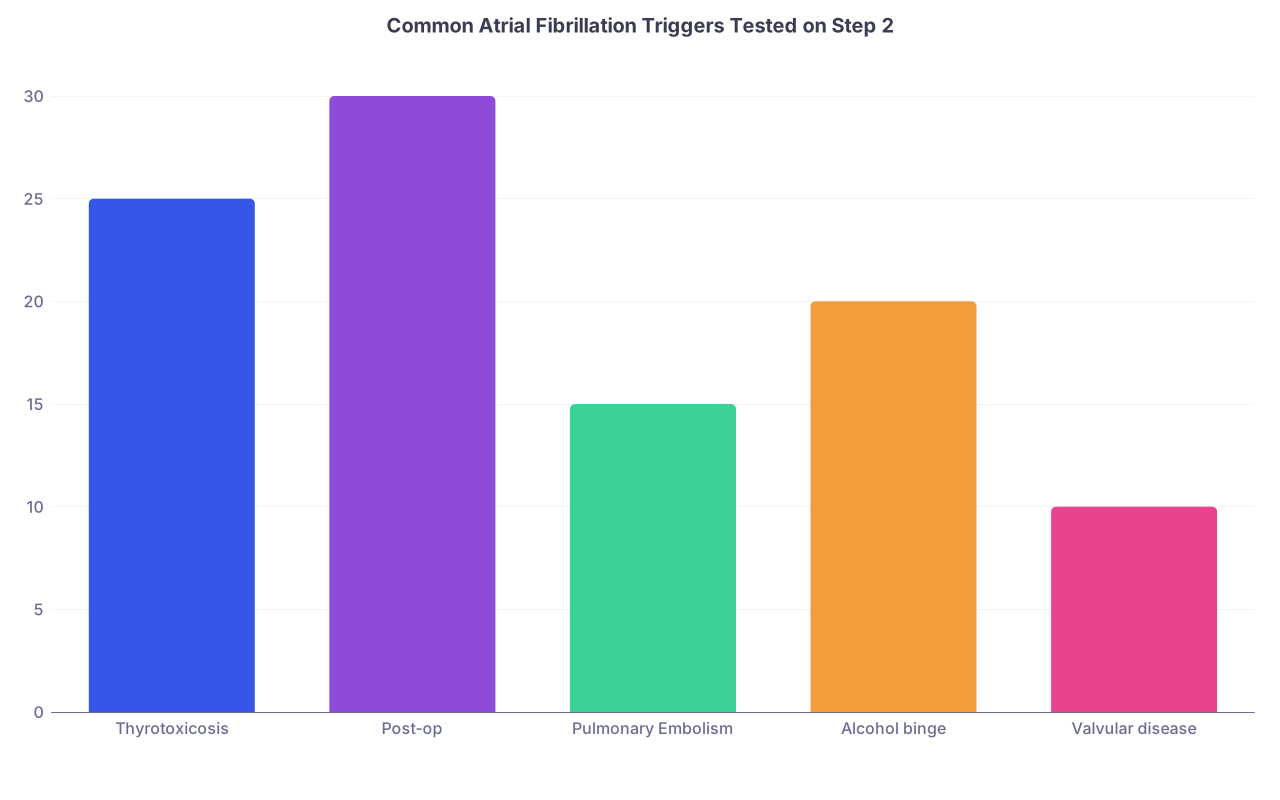
| Category | Value |
|---|---|
| Thyrotoxicosis | 25 |
| Post-op | 30 |
| Pulmonary Embolism | 15 |
| Alcohol binge | 20 |
| Valvular disease | 10 |
Key interpretation trick:
- AF: irregularly irregular ventricular response, no distinct P waves, fibrillatory baseline.
- Flutter: sawtooth F waves, usually in inferior leads.
Exam patterns:
New-onset AF in hyperthyroidism:
- EKG: AF with RVR.
- Stem mentions weight loss, heat intolerance, tremor.
- Correct next step: Beta-blocker first (for both rate control and blocking T4→T3 conversion in some cases), then confirm thyroid disease.
AF in PE:
- EKG: AF with RVR, maybe right heart strain pattern (S1Q3T3).
- Step 2 twist: they want you to think “cause of sudden dyspnea and tachycardia is PE,” not just treat AF in isolation.
Anticoagulation decisions:
- They rarely force full scoring, but pattern:
- Valvular AF (e.g., rheumatic mitral stenosis) → warfarin, not DOAC.
- Non-valvular AF with high stroke risk → DOAC or warfarin.
- AF < 48 hours, hemodynamically unstable → cardioversion without extended anticoagulation delay is often acceptable on exams.
- They rarely force full scoring, but pattern:
6. Electrolyte and Drug Effect Patterns: The “Weird EKG” Vignette
Some of the easiest points on Step 2 come from recognizing classic electrolyte signatures.
A. Hyperkalemia – do not miss this one
They love this.
Progression:
- Mild: peaked, narrow T waves.
- Moderate: PR prolongation, flattening/disappearance of P waves, widened QRS.
- Severe: sine-wave pattern, risk of VF/asystole.
Common vignette:
- CKD patient misses dialysis, comes in with weakness.
- EKG: peaked T waves, widened QRS.
- Question: first step? → Stabilize myocardium with IV calcium gluconate.
- Only then shift potassium (insulin + glucose, beta-agonist, bicarbonate) and remove potassium (dialysis).
B. Hypokalemia
- Flattened T waves.
- Prominent U waves best seen in V2–V3.
- ST depression, prolonged QT (actually QU).
- Predisposes to arrhythmias, especially with digoxin.
Exam trick:
- Patient on diuretics, with ectopy or VT: EKG shows U waves.
- They want potassium and magnesium repletion.
C. Digoxin effect vs digoxin toxicity
Digoxin “effect” on EKG:
- “Scooped” ST depression, especially in lateral leads.
- Shortened QT.
- Looks like Salvador Dali’s moustache.
Digoxin toxicity:
- Any arrhythmia is fair game, but:
- Atrial tachycardia with AV block is classic exam favorite.
- So EKG with atrial tachy + varying AV conduction in a patient on digoxin should scream “digoxin toxicity.”
7. Bundle Branch Blocks and the “Look Within QRS” Detail
You do not need to memorize every subtlety, but Step 2 repeatedly hits:
- RBBB: rsR′ in V1 (bunny ears), wide S in V6.
- LBBB: broad, notched R in I, V5, V6; deep S in V1–V3; discordant ST-T changes.

New LBBB with chest pain:
- Board questions historically treat this as a STEMI equivalent when strongly symptomatic.
- So if they give crushing chest pain, diaphoresis, and new LBBB → emergent reperfusion.
RBBB + LAFB (bifascicular block):
- Wide QRS with RBBB pattern.
- Left axis deviation from LAFB.
- In syncope or presyncope, especially older patient with structural disease → pacemaker answer.
8. QT Interval Prolongation, Torsades, and Drug Lists You Should Actually Remember
You do not need every QT-prolonging drug, but Step 2 repeats the usual suspects.
QT prolonged in:
- Hypokalemia.
- Hypomagnesemia.
- Hypocalcemia.
- Drugs:
- Class IA (quinidine, procainamide, disopyramide).
- Class III (sotalol, dofetilide, amiodarone to lesser extent).
- Macrolides, fluoroquinolones.
- Antipsychotics (haloperidol, ziprasidone).
- Methadone.
They love the combination:
- Patient on an antipsychotic + fluoroquinolone, now has syncope.
- EKG: polymorphic VT with prolonged QT → torsades de pointes.
- First-line treatment: IV magnesium sulfate, NOT amiodarone.
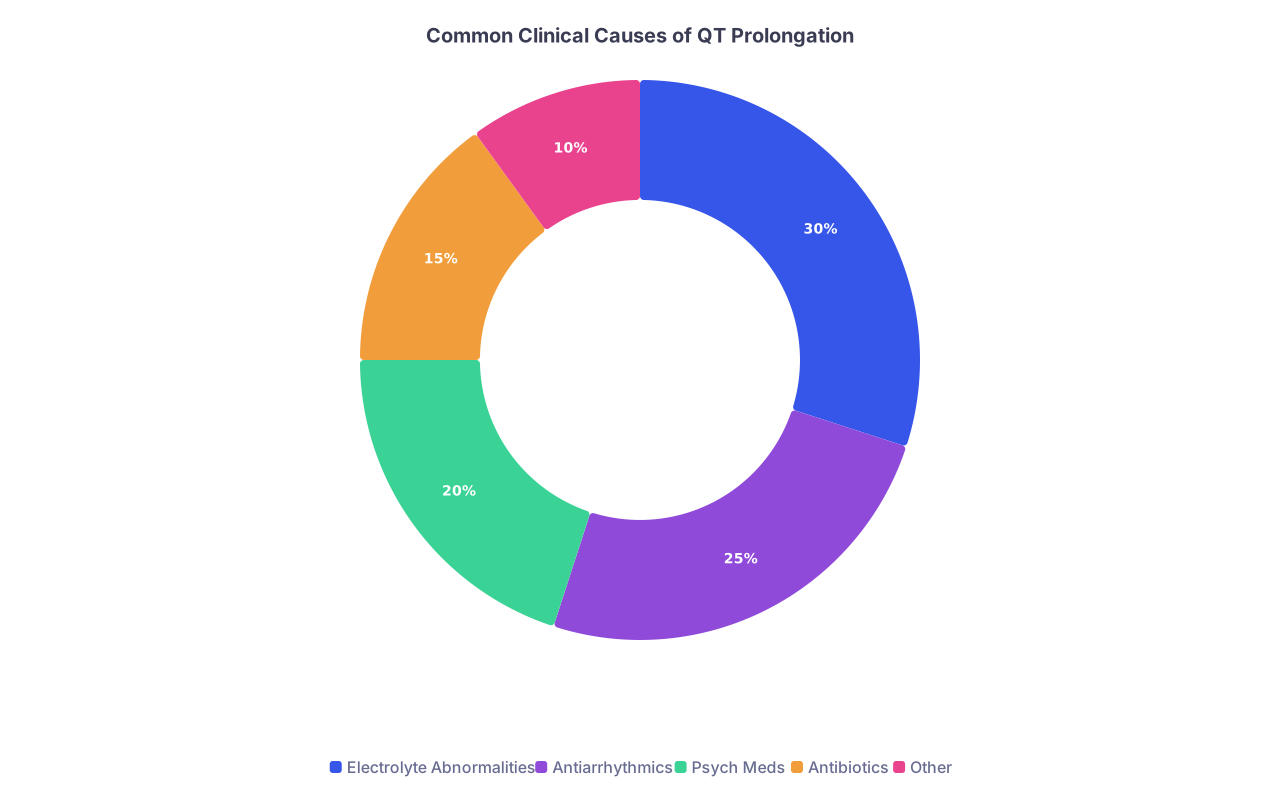
| Category | Value |
|---|---|
| Electrolyte Abnormalities | 30 |
| Antiarrhythmics | 25 |
| Psych Meds | 20 |
| Antibiotics | 15 |
| Other | 10 |
Another detail:
- If they mention congenital long QT (family history of sudden death, syncope with exercise or stress):
- Management: beta-blockers, possibly ICD in high-risk cases.
- Avoid QT-prolonging drugs.
9. PE, Right Heart Strain, and “Non-Cardiac” Uses of EKG
You will see EKGs in vignettes that are not primarily cardiology. Two big non-coronary scenarios:
A. Pulmonary embolism
Classic, but not always present: S1Q3T3 pattern.
- S wave in lead I.
- Q wave and inverted T in lead III.
More common but less specific:
- Sinus tachycardia.
- Right axis deviation.
- RBBB or incomplete RBBB.
- T-wave inversion in V1–V3.
If they show EKG with right heart strain in a patient with acute dyspnea, pleuritic pain, and risk factors → they want you to think PE and choose CT pulmonary angiography, not cardiac cath.
B. COPD and cor pulmonale
Findings:
- Right axis deviation.
- P pulmonale (peaked P waves in II, III, aVF).
- Low-voltage QRS in limb leads (hyperinflated lungs).
- Sometimes multifocal atrial tachycardia (irregular rhythm with 3 or more different P-wave morphologies, rate 100–150).
Multifocal atrial tachycardia (MAT) is a favorite:
- Seen in COPD exacerbations, theophylline toxicity.
- Do NOT treat with cardioversion or antiarrhythmics on exam.
- Treat underlying lung disease and give oxygen; sometimes rate control with verapamil if needed.
10. A Practical Pattern-Recognition Flow You Can Use on Step 2
Let me give you a simple mental checklist. You will not have time to do formal measurements on exam day.

| Step | Description |
|---|---|
| Step 1 | Look at rate & rhythm |
| Step 2 | Think SVT, AF, flutter |
| Step 3 | If unstable: cardiovert |
| Step 4 | If stable: assume VT, treat with amiodarone |
| Step 5 | Check axis & intervals |
| Step 6 | Look for AV block, QT issues |
| Step 7 | Scan ST segments & T waves |
| Step 8 | Localize MI, look for pericarditis, electrolyte patterns |
| Step 9 | Narrow or wide QRS? |
| Step 10 | Regular or irregular? |
| Step 11 | Stable or unstable? |
How to actually use this on exam vignettes:
Rhythm strip fragment?
- Ask: regular vs irregular, narrow vs wide, P-QRS relationship.
- Map quickly to SVT, AF, flutter, AV block, VT, torsades.
12-lead with chest pain?
- First: STEMI yes/no.
- If yes: territory (inferior, anterior, lateral, posterior, RV).
- If no: pericarditis, early repol, LVH strain, LBBB.
Strange waves with electrolyte issues or renal failure in stem?
- Think hyperkalemia or digoxin.
Elderly with syncope and conduction disease?
- Focus on AV blocks, bifascicular/trifascicular patterns.
11. How to Study EKGs Specifically for Step 2 (Not for Cardiology Fellowship)
You do not need to become an EKG wizard. You do need to be pattern-fluent in a limited set of high-yield scenarios. Focus on:
- MI localization and special infarcts:
- Inferior with RV involvement.
- Posterior MI.
- Blocks:
- Mobitz I vs II.
- Complete heart block.
- RBBB/LBBB, bifascicular blocks.
- Tachyarrhythmias:
- SVT, AF, atrial flutter.
- Monomorphic VT vs torsades.
- Electrolytes and drugs:
- Hyperkalemia, hypokalemia, hypocalcemia.
- Digoxin effect/toxicity.
- QT prolongation.

Very practical approach:
- Use a question bank (UWorld, Amboss) and flag every EKG question.
- After each block, print or screenshot those tracings, annotate them with colored pens:
- Circle key leads.
- Write “inferior + RV,” “flutter,” “Mobitz II,” etc.
- After a week, you will start recognizing them the way you recognize faces.
Key Takeaways
Step 2 is testing pattern recognition plus management, not textbook-perfect EKG reading. Focus on a restricted set of repeatable, high-yield patterns: specific MI territories, AV blocks, SVT/VT, torsades, and electrolyte/drug effects.
In wide-complex tachycardias on exams, assume VT unless the question goes out of its way to prove otherwise. In symptomatic or hemodynamically unstable rhythms, cardioversion or defibrillation beats cute pharmacology.
When in doubt with bradyarrhythmias and conduction disease, ask: “Is the patient symptomatic?” and “Is this Mobitz II, bifascicular, or complete block?” Those are your pacemaker patients.