
You: 18 Questions Deep Into UWorld. Stuck On Another “Easy” Ethics Item.
You are on your third block of UWorld for the day. Medicine questions feel fine. OB is annoying but manageable. Then you hit what should be low-hanging fruit: an ethics / consent question.
“14-year-old wants contraception, mother demands to know. What do you do first?”
You pause. You know minors, confidentiality, mature minor doctrine. But there’s parental conflict, plus state law, plus documentation issues. Your brain flips through half-remembered Anki cards and discord debates. You hover between two answers that both sound reasonable.
You pick one. UWorld dings you. “This is a high-yield ethics concept.”
You do not feel reassured.
Let me fix that.
Ethics and consent questions on Step 2 CK are not “soft” content. They are structured logic problems with rules. If you do not have a decision algorithm in your head, you will keep getting trapped by distractors that sound kind, or logical, or “patient-centered,” but are wrong by exam standards.
We are going to build a mental algorithm you can run in under 10 seconds when you see these questions. And I mean algorithm. Stepwise. Branching. Predictable.
The Core Algorithm for Step 2 Ethics Questions
Start here. Every single ethics / consent / confidentiality / capacity question can be forced through this sequence:
- Identify who the “patient” is.
- Assess immediate risk: emergency vs non-emergency.
- Determine decision-maker type:
- Adult with capacity?
- Adult without capacity?
- Minor? (with or without emergency / special category)
- Apply the correct consent / refusal / confidentiality rule set.
- If still unclear, choose the “first best step”:
- Clarify / explore
- Educate / counsel
- Involve surrogate
- Consult ethics / legal
If you cannot answer steps 1–3 clearly, you are guessing.
Let me walk through each with concrete, exam-style detail.
Step 1: Who Is Actually Your Patient?
Sounds obvious. Many people blow it here.
In Step 2 questions, the “patient” is not always the loudest person in the vignette.
Examples:
A father demands to know his 17-year-old daughter’s STI test results.
The patient = the daughter, even if she barely has dialogue in the stem.A husband refuses surgery on behalf of his unconscious wife.
The patient = the wife. The husband is a surrogate, not the primary subject.A mother asks for opioids “for my son’s pain,” but the stem focuses on her misuse.
The patient may effectively be the mother (substance use / drug-seeking), not the child.
Your default: the person whose body or information is at stake is the patient. Their preferences, rights, and capacity are the anchor for everything else.
If the question asks “What is the most appropriate response?” you answer based on duties to the patient, not to family convenience, not to avoiding conflict.
Step 2: Is This an Emergency?
Ethics on the exam is extremely binary about emergencies:
Life-threatening or limb-threatening situation?
→ Stabilize and treat. Do not delay for consent if:- No surrogate is immediately available, or
- The surrogate is refusing clearly life-saving care for non-medical reasons (e.g., religion) and it is a child.
Non-emergent, stable situation?
→ Full rule set: informed consent, capacity, respect for refusal, etc.
You should be mentally tagging words:
- “Hypotensive, tachycardic, confused” → think emergency.
- “GCS 6 after MVC” → emergency, implied consent.
- “Chronic abdominal pain, wants imaging” → non-emergent.
On Step 2, if the stem screams “critical, unstable, time-sensitive,” the correct move is usually:
- Proceed with treatment under implied consent (adult without surrogate available).
- Or, for a child: override parents if they are refusing life-saving treatment (e.g., antibiotics, transfusion, chemotherapy), especially when prognosis is good.
If it is not clearly emergent, you do not shortcut capacity assessment and consent just because you think the treatment is obviously right.
Step 3: Adult vs Minor vs Incapacitated Patient
Once you know there is no immediate emergency, you classify the decision-maker. This is where most mistakes live.
1. Adult with Decision-Making Capacity
Definition on the exam is simple and rigid:
A patient has capacity if they can:
- Understand the information.
- Appreciate how it applies to their situation.
- Reason about options and consequences.
- Communicate a stable choice.
If all four are intact, you respect their decisions. Even “bad” decisions. Even if the family disagrees.
Common exam traps:
Depressed or psych patients.
Depression does not automatically remove capacity. You only remove capacity if they cannot reason, understand, or appreciate consequences.“He is making a terrible choice.”
Bad outcome ≠ no capacity. An informed Jehovah’s Witness refusing transfusion has capacity if they meet the four criteria.“He is intoxicated”
Alcohol or drugs often impair capacity, but the question must give you evidence they cannot understand / reason. If they are severely intoxicated and refusing necessary but non-emergent treatment, you usually wait until sober to reassess capacity.
If an adult has capacity:
- They can refuse any treatment, including life-saving treatment.
- You must maintain their confidentiality, with the usual exceptions (self-harm, harm to others, reportable diseases, impaired drivers in some jurisdictions).
2. Adult Without Capacity
If capacity is impaired and it is non-emergent, you do not simply treat. You:
- Confirm lack of capacity (delirium, advanced dementia, acute psychosis, severe intoxication).
- Look for:
- An advance directive / living will.
- A designated healthcare proxy / durable power of attorney.
- If neither → a next-of-kin surrogate, usually in this order:
- Spouse
- Adult children
- Parents
- Siblings
- Other relatives

On the exam, the highest legal surrogate that is present and competent makes decisions, but they are supposed to use:
- Substituted judgment: What would the patient have wanted?
- If unknown: Best interest standard.
You do not:
- Overrule a valid proxy because you think their choice is dumb (unless it is clear abuse or neglect and harms the patient grossly).
- Follow a sibling if the spouse is available and competent.
- Follow an outdated, verbal “he once said…” over a written living will.
Advance directives and living wills, if clear, beat family preferences. The exam loves this.
3. Minors (Under 18)
Now we go to the messiest bucket: minors.
On Step 2, minors are presumed not to have legal capacity to consent, except in specific, highly testable scenarios.
You need a short internal table for this.
| Scenario | Who Consents? | Confidential From Parents? |
|---|---|---|
| Routine medical care | Parent/guardian | Usually no |
| Emergency, no parent | Implied (treat minor) | N/A |
| STI testing/treatment | Minor can consent | Yes |
| Contraception, pregnancy care | Minor can consent | Yes |
| Substance use treatment | Minor can consent | Yes |
| Abortion | Depends; usually parent or judicial bypass | Usually limited |
Core principles for minors on the exam:
Emergencies: Treat to save life or prevent serious harm. Do not delay for parental consent.
Confidential, protected services where minors can consent on their own:
- STI testing and treatment
- Contraceptive counseling and provision
- Pregnancy care (prenatal, delivery). The pregnant minor makes decisions about her own care.
- Substance use evaluation and treatment (many states; Step 2 uses this principle liberally)
Parents cannot override these protected areas just because they “want to know.”
For example:- 15-year-old requests chlamydia testing and asks you not to tell her parents. You test and treat, maintain confidentiality, and encourage open communication but do not force disclosure.
“Mature minor doctrine” can show up, but the exam usually wraps what they want into the protected categories above. Do not overcomplicate it.
Step 4: The Actual Consent Logic
Now that you know who the decision-maker is and whether it is an emergency, you run the consent logic.
Informed Consent – What Must Be Disclosed?
On Step 2, valid informed consent requires the physician to explain:
- Diagnosis (if known).
- Nature and purpose of the proposed intervention.
- Risks and benefits.
- Reasonable alternatives, including doing nothing.
- Likely outcomes with and without treatment.
The patient must then have a chance to ask questions and voluntarily agree.
Commonly tested omissions:
- Failing to mention alternatives.
- Glossing over significant risks (“small but serious” complications).
- Not explaining “no treatment” as an option.
If a question stem says, “The physician explains the benefits but does not mention the potential complications,” consent is inadequate.
Routine, minor procedures (like drawing blood or checking vitals) are usually covered by general consent for care. Major surgeries, invasive procedures, and risky interventions require explicit informed consent.
Who Must Obtain Consent?
The physician performing the procedure (or the one directing the intervention) should be the one who explains and obtains informed consent.
You do not delegate the core counseling to the nurse or med student on the exam.
So if an option says:
“Ask the nurse to obtain informed consent”
and another says
“Personally explain the procedure, risks, benefits, and alternatives,”
you pick the latter.
Step 5: Capacity vs Competence – Exam Version
You have probably seen debates about these terms. For Step 2:
- Capacity = clinical determination, made by the physician.
- Competence = legal determination, made by a court.
The exam focuses on capacity. When they want you to act, they use “capacity” or give clinical descriptions.
Capacity is task-specific. A patient may:
- Have capacity to accept a low-risk medication.
- Lack capacity to decline a high-risk, life-saving procedure if they cannot understand the stakes.
The workup for capacity questions:
- Address reversible causes first (delirium, hypoxia, intoxication, metabolic issues).
- If still unclear, perform a structured capacity assessment.
- Document reasoning.
If capacity is lacking and it is not an emergency, go to surrogate decision-making.
Step 6: Confidentiality – The Non-Negotiables and Exceptions
Ethics questions love testing when you are allowed or required to break confidentiality.
The default is absolute: you do not share patient information without their consent.
Common Step 2 exceptions where breach is required or allowed:
Threat of serious harm to self or others:
- Active suicidal intent → you ensure safety, may hospitalize involuntarily, inform necessary parties.
- Explicit homicidal intent with identifiable victim → duty to warn (Tarasoff principle), notify law enforcement and possibly victim.
Reportable diseases:
- TB, some STIs depending on state, measles, etc. You notify public health authorities. You do not need patient permission.
Abuse cases:
- Suspected child abuse → mandatory report to Child Protective Services.
- Elder abuse in dependent adult → report to Adult Protective Services.
- Intimate partner violence → more nuanced. Usually you do not report without patient consent unless mandated by state law (e.g., gunshot wounds). On exam, the focus is on ensuring safety and offering resources first.
Impaired drivers / pilots:
- If a patient’s condition (e.g., uncontrolled seizures, narcolepsy, severe dementia, substance abuse) poses a clear public risk, you may have to report to DMV / authority depending on jurisdiction. The exam usually makes this explicit.
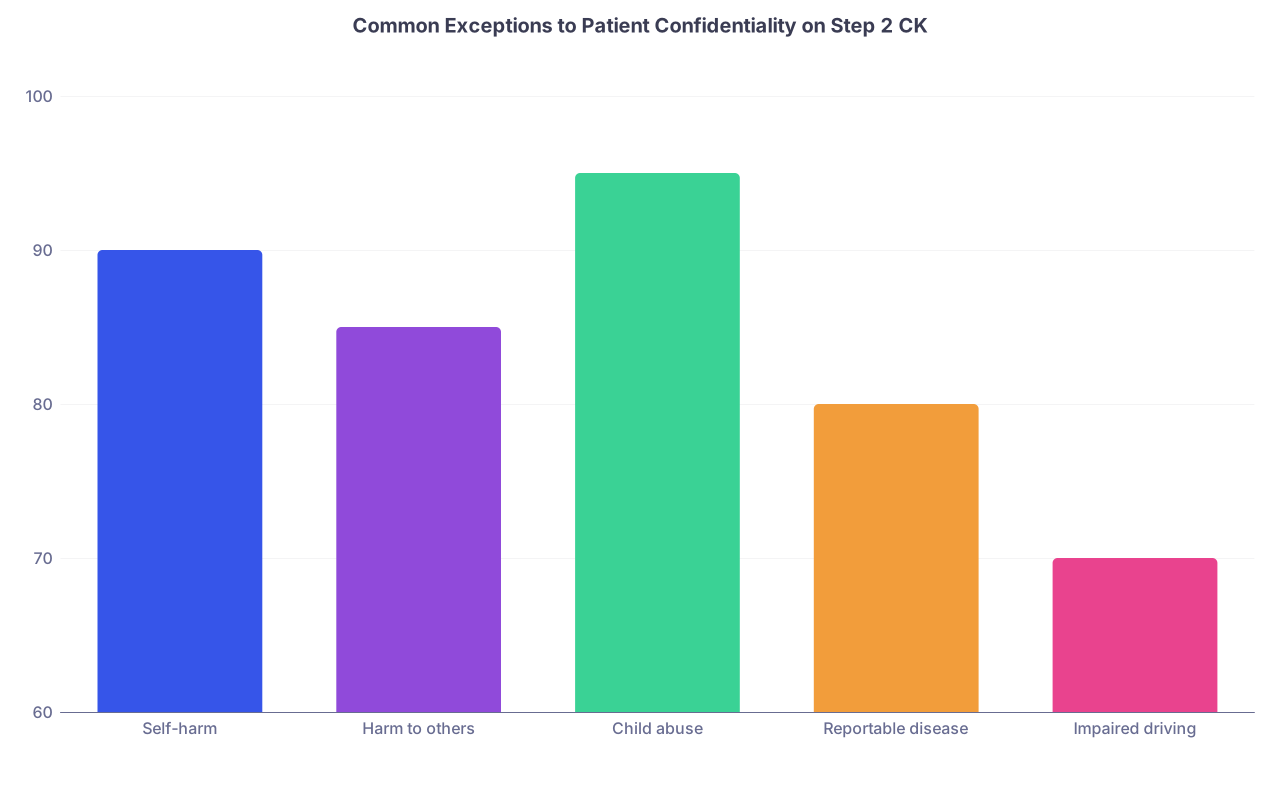
| Category | Value |
|---|---|
| Self-harm | 90 |
| Harm to others | 85 |
| Child abuse | 95 |
| Reportable disease | 80 |
| Impaired driving | 70 |
Confidentiality with minors is trickier. The algorithm:
- For standard medical issues (e.g., headaches, acne): parents are generally involved and have access.
- For protected categories (STI, contraception, pregnancy, substance use): maintain confidentiality, encourage communication, but do not unilaterally disclose.
If a parent directly asks you for those test results and the minor objects, you:
- Explain your confidentiality obligations to the minor.
- Refuse to share without the minor’s permission.
- Offer to help facilitate a joint conversation if the minor agrees.
Step 7: Mandatory Reporting – Abuse and Violence
Abuse questions are a gold mine for Step 2 because many students overthink them.
Hard rules:
Suspected child abuse?
Report. You do not need proof. You do not “wait to gather more evidence.” You do not confront the suspected abuser first. You contact CPS.Elder abuse in a dependent adult?
Report to Adult Protective Services. Ensure safety, involve social work as needed.Intimate partner violence (IPV)?
On Step 2, the basic algorithm:- Ensure immediate safety. Ask if patient feels safe going home.
- Validate and support. Offer resources, shelters, safety planning.
- Do not push for police report unless patient wants it, except in the specific case where the vignette states mandatory reporting by law (e.g., gunshot wound).

| Step | Description |
|---|---|
| Step 1 | Identify possible abuse |
| Step 2 | Mandatory report to CPS/APS |
| Step 3 | Screen for IPV |
| Step 4 | Ensure safety, emergency services |
| Step 5 | Offer resources, support, no forced report |
| Step 6 | Child or Dependent Elder? |
| Step 7 | Immediate danger? |
Mandatory reporting is one of the few areas where you are allowed to override patient autonomy to protect vulnerable people.
Step 8: High-Yield “First Best Step” Patterns
Many ethics questions are not asking “ever” questions; they want what you do first.
So you need a few reflexes:
When you do not understand why a patient wants or refuses something:
First step → Explore their understanding and reasons.
Example: “Can you tell me what you understand about the surgery and what concerns you have?”When a family asks you to withhold the diagnosis from a competent adult:
First step → Clarify the patient’s preferences about how much they wish to know and who should be involved.
Not: “Agree with the family” or “Ignore family and disclose everything immediately” without checking the patient’s own wishes.When a patient gets bad news and is visibly distressed:
First step → Respond with empathy, allow emotions, then discuss next steps.
Not: “Immediately discuss hospice referral” as your first sentence.When there is surrogate disagreement (e.g., two adult children fighting):
First step → Clarify any existing advance directive or past known wishes.
If still unclear, involve ethics committee.When a colleague is impaired (drunk surgeon, high anesthesiologist, etc.):
First step → Remove them from patient care and report to appropriate supervisor / hospital authority.
Not: “Cover for them this once.”
Applying the Algorithm: Concrete Vignette Walkthroughs
Let me run you through a few classic patterns using the algorithm so you see it in motion.
Vignette 1: The 16-Year-Old with STI
A 16-year-old girl presents requesting testing for chlamydia after unprotected sex. She says, “Please don’t tell my parents.” Her mother later calls the office asking for her test results.
Algorithm:
Who is the patient?
The 16-year-old.Emergency?
No.Decision-maker?
Minor, but this is STI testing → protected category. She can consent.Consent/confidentiality rule?
She is allowed confidential STI testing and treatment. Parents do not automatically get access.Best answer:
Do not disclose results to the mother without the patient’s consent. Encourage the girl to talk with her mother, but maintain confidentiality.
Any answer that says “share results with her mother because she is a minor” is wrong.
Vignette 2: The Elderly Man Refusing Surgery
A 78-year-old man with bowel obstruction is recommended for urgent surgery. He is alert, understands the risks, and says, “I would rather die than go through another surgery.” His son insists you “do everything.”
Algorithm:
Patient?
The 78-year-old man.Emergency?
Serious, but not yet described as hemodynamically crashing. We have time for consent.Capacity?
Stem says he understands and consistently refuses. Capacity is intact.Rule?
Competent adults can refuse any treatment, even life-saving.Response?
Respect his decision, document, provide comfort and palliative care options.
You do not obey the son. You do not declare incompetence because you disagree.
Vignette 3: Unconscious Patient, No Family
A 45-year-old man is brought in after a car accident, unconscious, hypotensive, suspected intra-abdominal bleed. No family reachable.
Algorithm:
Patient?
The man.Emergency?
Yes. Life-threatening bleed.Capacity?
None (unconscious).Rule?
Emergency + no surrogate → implied consent. Act to save life.Action?
Take him to the OR for emergent laparotomy.
Any answer that says “wait until family is contacted” fails the emergency rule.
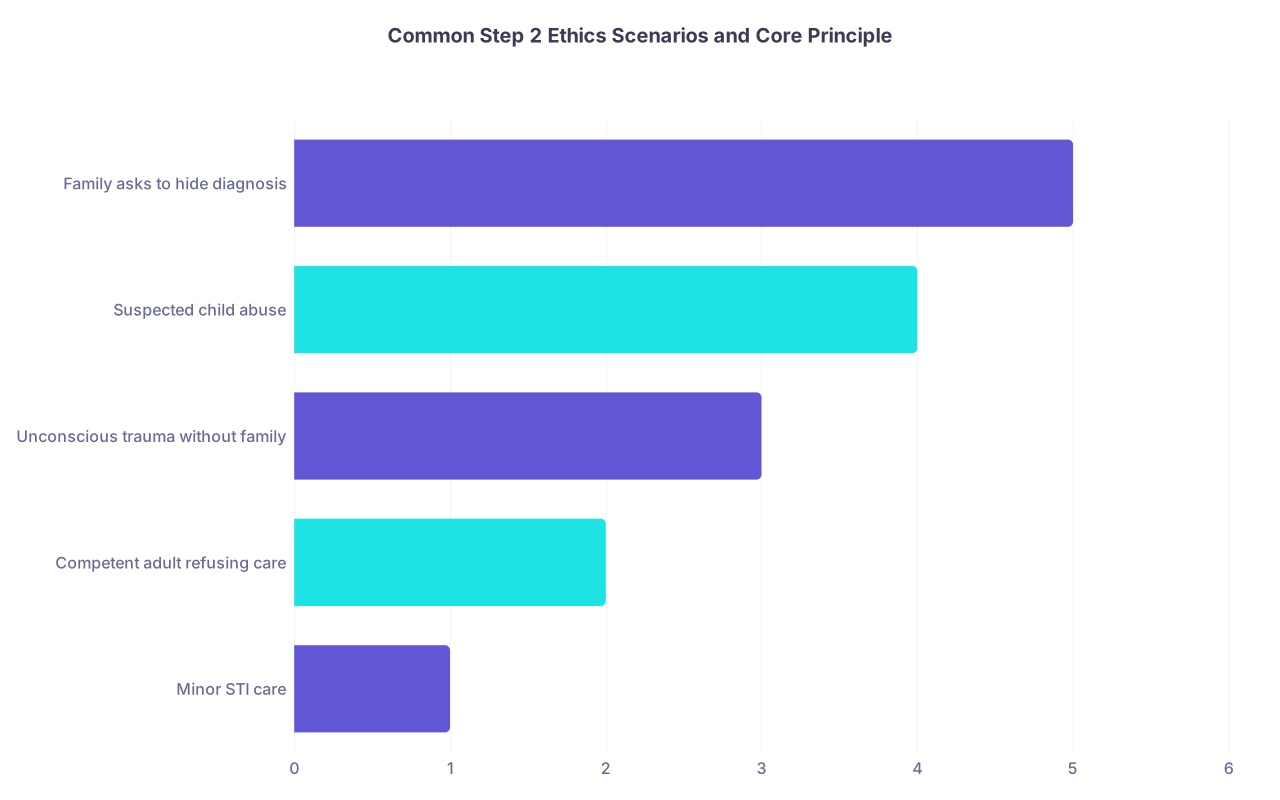
| Category | Value |
|---|---|
| Minor STI care | 1 |
| Competent adult refusing care | 2 |
| Unconscious trauma without family | 3 |
| Suspected child abuse | 4 |
| Family asks to hide diagnosis | 5 |
(The numbers simply mark distinct rule-sets: protected minor care, autonomy, implied consent, mandatory reporting, respect for patient’s information preferences.)
How to Study Ethics & Consent Efficiently for Step 2
You do not need a 300-page ethics textbook. You need:
A clean decision tree in your head for:
- Adult vs minor vs incapacitated.
- Emergency vs non-emergency.
- Confidential vs must-disclose.
Pattern recognition of repeat scenarios:
- Pregnant minors.
- Jehovah’s Witness refusing transfusion.
- Child abuse suspicion.
- IPV.
- Suicidal or homicidal patients.
- Impaired colleagues.
Practice distinguishing:
- What feels “nice” vs what is legally/ethically correct on boards.
One practical method:
- Make a one-page algorithm sheet:
- Top: “Emergency?” → Yes → treat; No → next.
- Then branches for adult capacity, no capacity, minor with protected services, minor without.
- Add a side column with mandatory reporting exceptions.
| Step | Description |
|---|---|
| Step 1 | Identify possible abuse |
| Step 2 | Mandatory report to CPS/APS |
| Step 3 | Screen for IPV |
| Step 4 | Ensure safety, emergency services |
| Step 5 | Offer resources, support, no forced report |
| Step 6 | Child or Dependent Elder? |
| Step 7 | Immediate danger? |
Use UWorld’s ethics questions not just for right/wrong, but to test your algorithm. After every ethics question, literally say to yourself:
- Who was the patient?
- Emergency or not?
- Who was the decision-maker?
- What rule set applied?
If you cannot answer those in under 10 seconds, you need more reps.
Key Takeaways
Run every ethics question through the same core algorithm: identify the patient, check for emergency, classify decision-maker, then apply the relevant rule set on consent, refusal, and confidentiality.
For minors, lock in the protected categories (STI, contraception, pregnancy care, substance use). They can consent for these, and you maintain confidentiality even from parents.
On the exam, competent adult autonomy is king. If capacity is intact, you respect their informed decisions—yes, even bad ones—while using mandatory reporting and emergency exceptions only in the narrow, clearly described scenarios.