It is 10:40 p.m. You just finished a 40‑question UWorld block. You review your stats and there it is, again: you are consistently missing pediatric growth and development questions. Not because you have no idea. Because the scenarios are subtle, the ages blur together, and the exam writers are ruthless about “normal vs. delayed vs. pathologic.”
Let me walk you through how Step 2 CK actually tests this. Not “memorize milestones” in the abstract. But the concrete blueprints of how NBME likes to wrap growth and development into questions that feel clinical, messy, and just ambiguous enough to steal points from unprepared test‑takers.
We will go domain by domain: growth, motor, language, social, and school‑age issues. Along the way I will show you how they like to twist them, which wrong answers they want you to pick, and how to systematically avoid those traps.
1. The Real Blueprint: How Step 2 Uses Growth & Development
Start with the exam’s perspective, not your lecture slides.
Step 2 does not usually present you with: “Which milestone should a 9‑month‑old have?” That is Step 1 / shelf style. By CK, they usually embed milestones and growth into:
- Well‑child visits (“Is this normal?”)
- Work‑up decisions for suspected delay (“What is the next best step?”)
- Counseling questions (“What do you tell the parent?”)
- Underlying pathology (endocrine, genetic, GI, psychosocial) masked as “growth”
You are not just regurgitating a table. You are interpreting a clinical vignette.
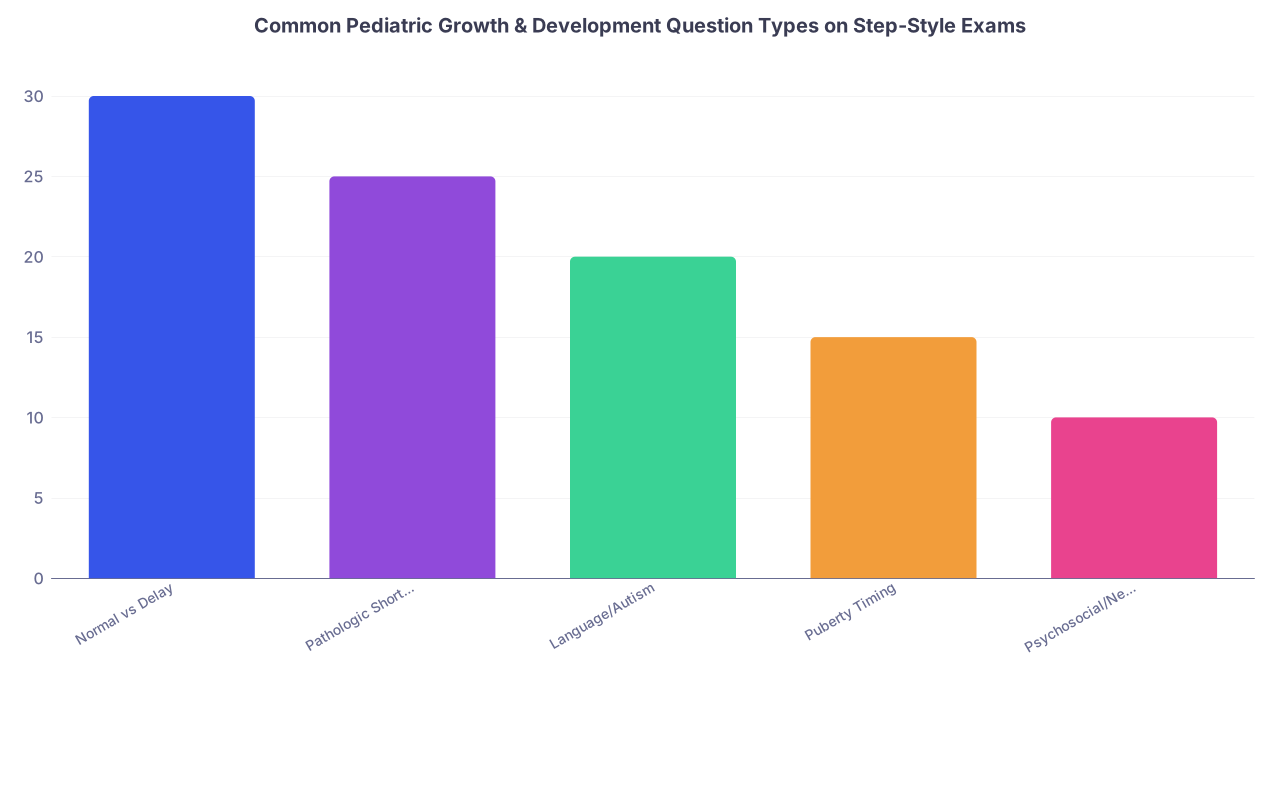
| Category | Value |
|---|---|
| Normal vs Delay | 30 |
| Pathologic Short/Tall | 25 |
| Language/Autism | 20 |
| Puberty Timing | 15 |
| Psychosocial/Neglect | 10 |
Think in those categories every time you see a pediatric age mentioned.
2. Growth: Percentiles, Patterns, and When to Freak Out
Growth questions are extremely pattern‑driven. The exam expects you to see a specific growth chart trend and immediately think: endocrine vs constitutional vs chronic disease vs normal variant.
2.1 The Three‑Line Rule: Weight, Height, Head Circumference
This shows up constantly: they tell you where the child sits on percentiles and how those have changed.
Key patterns you must recognize:
Failure to thrive / systemic disease:
Weight drops first, then height, head circumference last.
Example vignette:- 10‑month‑old with chronic diarrhea, weight <3rd percentile, height 10th, head 25th, “picky eater,” maybe anemia. They want you to think chronic malabsorption or inadequate calories. Next step: detailed diet history, stool studies, or screening for celiac/CF depending on clues.
Endocrine cause (hypothyroidism, GH deficiency, Cushing, etc.):
Height affected more than weight. Weight is normal or high, height dropping across percentiles.
Vignette feel: 8‑year‑old, short, overweight, delayed bone age, constipation/cold intolerance → hypothyroidism. Or obese adolescent with growth deceleration → consider Cushing.Constitutional growth delay vs familial short stature:
- Constitutional: Normal birth size → drop to low percentiles early → then parallel curve; delayed bone age; delayed puberty; parental history of “late bloomers.”
- Familial short stature: Short parents, child tracks low but parallel curves; normal bone age; normal puberty timing.

You must be able to pick up:
- “Crossing two major percentile lines downward” = not just variation; evaluate.
- Parallel low line with short parents = probably normal.
2.2 Question Blueprints Around Growth
Typical stems you will see:
“Is this normal?” type:
- A 4‑month‑old dropped from 50th to 10th percentile for weight after the mother returned to work and formula feeds became inconsistent. Development normal. No systemic signs.
They are fishing for: inadequate caloric intake, early FTT, address feeding schedule, not immediate endocrine work‑up.
- A 4‑month‑old dropped from 50th to 10th percentile for weight after the mother returned to work and formula feeds became inconsistent. Development normal. No systemic signs.
“Next best step in management”:
- 7‑year‑old short stature, BMI normal, height <3rd percentile, bone age 5 years, dad says he hit puberty late.
Answer: reassure, monitor growth, repeat height in 6–12 months. Maybe endocrine referral, but they often want: constitutional delay, no massive work‑up.
- 7‑year‑old short stature, BMI normal, height <3rd percentile, bone age 5 years, dad says he hit puberty late.
“Which test?” for suspected endocrine issue:
- 12‑year‑old girl, no breast development, normal weight, short stature, bone age 9 years.
They may push you toward: measure serum FSH/LH, TSH, IGF‑1 depending on the context. High FSH/LH at age >13 with no thelarche = primary gonadal failure. Low FSH/LH = constitutional or central.
- 12‑year‑old girl, no breast development, normal weight, short stature, bone age 9 years.
2.3 Growth Tables to Internalize
You do not need thousands of numbers. Just anchor points.
| Age | Normal Doubling/Tripling | Red Flag If… | Think About |
|---|---|---|---|
| 4–5 mo | Birth weight doubled | Not doubled by 5–6 mo | Caloric intake, FTT |
| 12 mo | Birth weight tripled; height +50% | Not doubled weight by 12 mo | Chronic disease, malnutrition |
| 2 yrs | Height ~50% adult height | Crossing down percentiles | Endocrine vs chronic disease |
| Any | Head circumference steady | HC crossing down sharply | CNS insult, microcephaly |
On exam questions, percentiles + tempo of change + systemic signs → your diagnosis.
3. Developmental Milestones: The “Age + Task” Framework
You already know you should memorize milestones. But that is not enough. You need to be able to reverse‑engineer age from described tasks and decide: reassuring, watchful waiting, or full evaluation.
I prefer to group them by functional domain and anchor ages.
3.1 Four Core Domains
- Gross motor
- Fine motor / adaptive
- Language
- Social / cognitive
Most questions mix at least two of these.
Here is how I anchor them.
| Age | Gross Motor | Fine/Adaptive | Language | Social/Cognitive |
|---|---|---|---|---|
| 2 mo | Lifts head prone | Tracks past midline | Coos | Social smile |
| 4 mo | Rolls front to back | Grasps objects | Laughs, squeals | Enjoys looking around |
| 6 mo | Sits with support, rolls both ways | Transfers objects hand to hand | Babbles | Stranger anxiety begins |
| 9 mo | Pulls to stand, crawls | Pincer grasp starts | "Mama/dada" nonspecific | Waves bye-bye, plays pat-a-cake |
| 12 mo | Walks with support/independent | Mature pincer, points | 1–3 words, follows simple commands | Separation anxiety, imitates |
| 18 mo | Runs, climbs stairs with hand held | Builds 3–4 block tower | ~10–25 words, names body parts | "Mine", pretend play starts |
| 2 yrs | Walks up/down stairs 2 feet/step | Tower of 6 blocks, copies line | 2-word phrases, ~50+ words, 50% intelligible | Parallel play |
| 3 yrs | Tricycle, stairs alternating feet | Circle copy, uses utensils well | 3-word sentences, 75% intelligible | Knows age/gender, group play |
| 4 yrs | Hops on one foot | Square copy, buttons | 100% intelligible, tells stories | Cooperative play, imaginative |
You do not need every detail. You need pattern recognition:
- 2 → smile + head control
- 4 → roll and laugh
- 6 → sit and transfer
- 9 → crawl, pull to stand, pincer emerging
- 12 → walk, words, point
- 18–24 → run, stairs, 2‑word phrases
- 3–4 → tricycle, clear speech, shapes
3.2 How CK Wraps Milestones into Questions
They will not always state the age directly. Sometimes you must infer it.
Example style:
“A child is brought in for a well‑child visit. She can walk up and down stairs with both feet on each step, can build a tower of 6 cubes, and uses two‑word phrases like ‘mommy up.’ She does not yet know her age or gender. Which of the following is the most appropriate recommendation?”
That is a 2‑year‑old with appropriate skills. They will list answers like:
- Refer to early‑intervention program
- Schedule follow‑up in 3 months for possible speech delay
- Reassure parents and continue routine care
They want: reassurance.
Another:
“A 15‑month‑old boy is not yet walking independently. He cruises around furniture, stands with support, crawls well, has 2–3 words, and points to objects he wants. Family history: father ‘walked late.’ Examination normal.”
This is borderline but usually still within normal. The answer is often: watchful waiting with repeat evaluation in 3 months, unless there are concerning factors (prematurity, abnormal tone, no progress at all).
4. Specific High-Yield Scenarios NBME Loves
Now we get more concrete. Here are the scenarios that show up repeatedly, across NBME forms, UWorld, and institutional exams.
4.1 Autism vs Normal Language Delay vs Hearing Loss
Step 2 is obsessed with developmental and behavioral pediatrics. Autism spectrum disorder (ASD) vs hearing loss vs benign delay is a classic.
Key patterns:
Autism spectrum disorder:
- Social communication deficits: no joint attention, not pointing to share interest, poor eye contact
- Language may be delayed, but the core issue is social reciprocity
- Restrictive, repetitive behaviors, insistence on routines
- Usually present by age 2, but symptoms may be recognized around 18 months
Hearing loss:
- Language delay with relatively preserved social interest (smiles, gestures, points, plays peek‑a‑boo)
- Child may respond to visual cues but not to name, does not startle to loud sounds
- May have history of recurrent otitis media or NICU stay with ototoxic meds
Simple expressive language delay:
- Normal social interaction, joint attention, eye contact, gestures
- May use single words late, but comprehension often intact
- Normal hearing screen
Typical exam stem:
“An 18‑month‑old boy does not respond when called by name, does not point to show things, does not bring toys to show his parents, and prefers to play alone, lining up cars. He babbles occasionally but has no meaningful words. Physical exam is normal.”
They will offer:
- Normal for age, reassure
- Refer for speech therapy only
- Order hearing test
- Refer for early intervention for autism spectrum disorder
Correct: early evaluation for ASD + hearing test is fine, but the key concept: do not “wait and see.” Early intervention.
Another:
“A 2‑year‑old girl has only 10 single words, does not combine words, but uses gestures and brings toys to show parents. She follows 2‑step commands, points to body parts, and plays with other children. She was born at term, passed newborn hearing screen, and responds to environmental sounds.”
This is likely isolated expressive language delay. Next step: speech and language evaluation, but not ASD labeling.
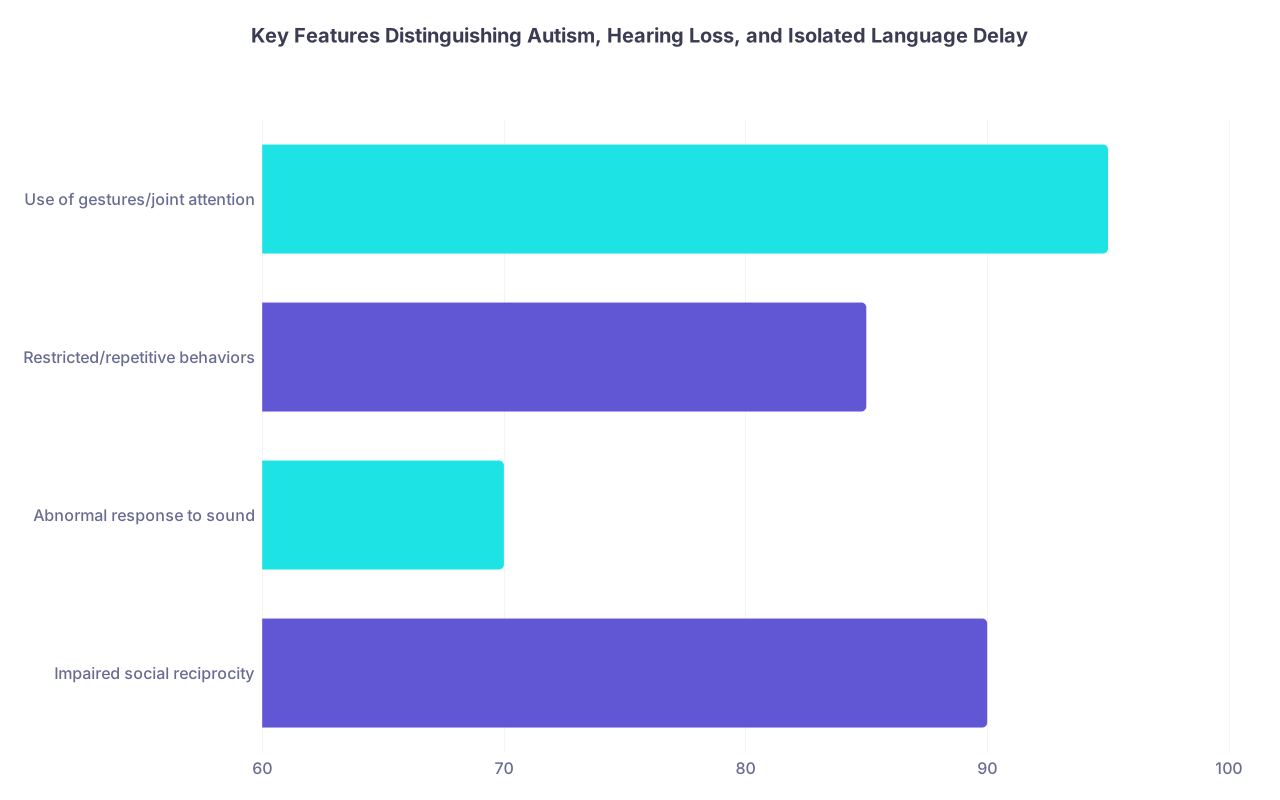
| Category | Value |
|---|---|
| Impaired social reciprocity | 90 |
| Abnormal response to sound | 70 |
| Restricted/repetitive behaviors | 85 |
| Use of gestures/joint attention | 95 |
(Interpretation: ASD – high impaired reciprocity/repetitive behaviors; hearing loss – abnormal sound response; language delay – intact gestures/joint attention.)
4.2 “Is This Behavior Normal for a Toddler?”
Family medicine and pediatrics questions love to show you a 3‑year‑old melting down and ask if you pathologize it.
Normal (developmentally appropriate) behaviors on exams:
- Temper tantrums in toddlers (especially 1–3 years)
- Separation anxiety around 9–18 months
- Oppositional behavior peaks in preschool years
- Imaginary friends around 3–5 years
- Transient stuttering in early childhood when vocabulary jumps
Abnormal red flags:
- Cruelty to animals, fire‑setting → conduct disorder territory (older kids)
- Persistent enuresis after age 5–7 with no progress
- Regression of milestones (especially language/social) after previously normal development
Vignette example:
“A 2‑year‑old throws multiple daily tantrums, screams when denied candy, and sometimes hits his mother. Otherwise he eats well, sleeps well, and plays with other children. Growth and development are normal. Which is the best next step?”
Correct: structured discipline, consistent routines, ignore minor tantrums, avoid corporal punishment. Not psychiatric referral.
5. Puberty, Tanner Staging, and Growth Spurts
Puberty questions combine growth, development, and endocrinology. Step 2 expects you to know who is “too early,” who is “too late,” and when you watch vs work‑up.
5.1 Age Cutoffs You Must Know Cold
Girls:
- Breast development (thelarche): 8–13 years
- Menarche: ~2–2.5 years after thelarche, usually 10–15 years
- Precocious puberty: secondary sexual characteristics before age 8
- Delayed puberty: no breast development by age 13 or no menarche by age 15
Boys:
- Testicular enlargement: 9–14 years
- Precocious puberty: testicular enlargement before age 9
- Delayed puberty: no testicular enlargement by age 14
| Sex | Precocious Puberty | Delayed Puberty | Initial Work-up |
|---|---|---|---|
| Girls | <8 years | No breasts by 13 or no menarche by 15 | Bone age, LH/FSH, estradiol, MRI if central |
| Boys | <9 years | No testes enlargement by 14 | Bone age, LH/FSH, testosterone, MRI if central |
Step style:
“A 7‑year‑old girl has Tanner stage II breast development, no pubic hair, and normal growth velocity. Bone age is 8 years. No neurological symptoms.”
This is early but can be normal variant (premature thelarche) if stable. They may ask for: observation and follow‑up, not immediate GnRH analog therapy, unless progression is clear.
Another:
“A 6‑year‑old boy with pubic hair, acne, and advanced bone age but prepubertal testicular volume.”
Think: premature adrenarche, usually benign, due to early adrenal androgen production. Manage with observation unless rapid progression or virilization.

| Step | Description |
|---|---|
| Step 1 | Child with early/late puberty |
| Step 2 | Reassure and monitor |
| Step 3 | Assess growth velocity & Tanner stage |
| Step 4 | Order bone age |
| Step 5 | Check LH/FSH, sex steroids |
| Step 6 | Check LH/FSH, thyroid, IGF-1 |
| Step 7 | Central cause → Brain MRI |
| Step 8 | Peripheral cause → Adrenal/gonadal studies |
| Step 9 | Age within normal range? |
| Step 10 | Bone age advanced/delayed? |
| Step 11 | LH/FSH high or low? |
Know how to read that pattern on the fly.
6. Cognitive, School-Age, and Psychosocial Growth
By school age, CK questions broaden. They stop asking about crawling and start asking about reading, attention, and behavior.
6.1 ADHD vs Normal Activity vs Learning Disorder
Classic trap: 6‑year‑old boy, “cannot sit still,” disrupts preschool, but development otherwise normal. They will list: ADHD, normal development, oppositional defiant disorder, conduct disorder.
ADHD features:
- Inattention, hyperactivity, impulsivity in more than one setting (home and school)
- Symptoms present before age 12 and impair functioning
- Difficulty sustaining attention, following instructions, finishing tasks
- Poor academic performance not due to lack of instruction
Learning disorder:
- Specific deficits in reading, writing, or math
- Effort is present, but achievement markedly below expected for age and IQ
- Behavior may be secondary (acting out) but the primary problem is academic performance
Normal high activity:
- Child is active but can follow rules when structured
- No significant functional impairment (grades ok, relationships OK)
On test questions, look for: teacher complaints, poor grades, and impairment across settings → ADHD or learning issue, not “normal.”
6.2 Intellectual Disability and Adaptive Function
You will get at least a question or two where a school‑age child has IQ/cognitive concerns:
- Global delays since early childhood
- Late walking, late talking
- Difficulty with activities of daily living and academic tasks
If developmental delay in multiple domains is clear, the next step is often:
- Formal developmental evaluation
- Hearing and vision assessment
- Consider genetic testing (Fragile X, microdeletion, etc.) if dysmorphic features or family history
Autism vs intellectual disability: ASD has prominent social communication deficits and restricted interests; ID is more global but social reciprocity can be relatively appropriate for mental age.
7. Strategy: How to Train for These Questions
You do not fix growth and development weakness by rereading one table. You need an active system.
7.1 Build a Minimal, High-Yield Milestone Sheet
One double‑sided page. Only the milestones that distinguish one age from the next. Review it daily for a week. Later, spaced once or twice per week.
| Category | Value |
|---|---|
| Impaired social reciprocity | 90 |
| Abnormal response to sound | 70 |
| Restricted/repetitive behaviors | 85 |
| Use of gestures/joint attention | 95 |
7.2 Do Themed Question Blocks
Do 10–15 question sets filtered to pediatrics / growth & development from UWorld or another Qbank. After each block:
For every missed question, categorize:
- Misread age?
- Didn’t know if behavior was normal?
- Confused endocrine vs constitutional growth pattern?
- Misclassified autism vs hearing vs language delay?
Then on your one‑page sheet, add 1–2 bullet reminders that would have saved you. This is how you internalize patterns, not trivia.
7.3 Learn to “Age-Read” Vignettes Fast
When you see:
- Points → ~12 months
- 2‑word phrases → ~2 years
- Tricycle → 3 years
- Hops on one foot → 4 years
Train your brain to immediately see: “Ok, 2‑year‑old, what is expected?” That turns vague stems into structured checklists in your head.
FAQ (Exactly 6 Questions)
1. How many developmental milestones do I actually need to memorize for Step 2 CK?
You do not need to memorize a 5‑page milestone chart. You need to know a tight set of anchor ages (2, 4, 6, 9, 12, 18, 24, 36, 48 months) with 2–3 key milestones per age in each domain: gross motor, fine motor, language, social. If you can correctly place about 30–40 “big” milestones, you can handle almost every exam scenario. Anything beyond that is diminishing returns.
2. How do I differentiate constitutional growth delay from pathologic short stature on questions?
Look at three things: growth curve pattern, bone age, and family history. Constitutional delay: early drop then stable low‑percentile tracking, delayed bone age, normal weight, and often parents who “grew late.” Pathologic: recent deceleration after normal growth, height much worse than weight, symptoms of chronic disease or endocrine dysfunction, and often a markedly abnormal lab or exam finding. If the question emphasizes chronic fatigue, GI complaints, or CNS symptoms, that is not benign.
3. What are the absolute red‑flag signs for autism spectrum disorder on Step 2?
No pointing to share interest, lack of joint attention, poor or absent eye contact, failure to respond to name, lack of pretend play, and restricted repetitive behaviors (lining things up, fixated interests, intense distress with change in routine). A toddler with these plus language delay needs early ASD evaluation, not “wait and see.” If language is limited but social reciprocity is normal, think isolated language delay or hearing loss instead.
4. When should I order a hearing test in a developmental delay vignette?
Any child with speech or language delay without a clearly normal or recent hearing evaluation should get a formal audiologic assessment. On exams, clues are: does not respond to name, had recurrent otitis media, NICU stay, or exposure to ototoxic meds. Even if you suspect autism or simple language delay, a hearing test is still appropriate early in the work‑up.
5. What are the most testable puberty timing facts I must know?
Four numbers: girls precocious <8, boys precocious <9; girls delayed = no breasts by 13 or no menarche by 15; boys delayed = no testicular enlargement by 14. Add that menarche typically follows thelarche by about 2 years, and that growth spurt in girls usually occurs early in puberty, in boys later. Then remember: advanced bone age suggests true precocious puberty; delayed bone age suggests constitutional delay or chronic disease.
6. How often should I review growth and development during Step 2 prep?
At least weekly. This content is high‑yield and easy to lose if you “learned it in M1.” Do a short, focused review (10–15 minutes) of your milestone sheet once a week, plus pediatric blocks that include growth and behavior questions. The combination of spaced review and repeated question exposure is what turns this content from vague recall into quick, confident recognition on test day.
Key takeaways:
- Do not memorize milestones in isolation; tie them to ages, patterns, and common exam scenarios (normal vs delay vs pathology).
- Recognize growth chart patterns (weight vs height vs head circumference) and puberty timing; they anchor a lot of differential diagnosis questions.
- Train with focused pediatric question sets and keep a lean, high‑yield milestone sheet that you actually revisit, not just file away.