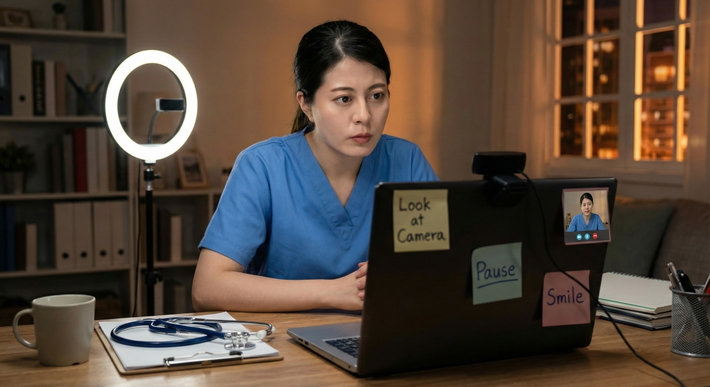
What if "camera off" is actually a signal, not a pause button? Most applicants walk into residency video interviews carrying one assumption: turning your camera off while the interviewer speaks is the polite thing to do. You're not interrupting. You're being deferential. You're waiting your turn.
That's the myth. And the data says it's wrong. Program directors don't read your intent, they read your signals under stress. And a blank tile, even for fifteen seconds, registers as reduced engagement, possible unreadiness, or worse. Let's break down what actually happens when you go dark on Zoom, and what to do instead.
Here's the contrarian truth: PDs don't care why you turned your camera off. They care what it looks like.
I get why applicants default to "camera off when I'm not speaking." It's a carryover from in-person etiquette, you don't stare at the attending while they're dictating. You wait. But Zoom isn't a hospital corridor. It's a grid of attention. When your tile goes blank, you're not invisible. You're a black rectangle where a person used to be.
The interpretation gap is real. Communication research on nonverbal cues consistently shows that visual absence gets read as disengagement, low preparation, or even avoidance behavior. Even when the intent is completely benign, "I was just waiting for my turn", the perception sticks. And in a 20-minute interview, you don't have time to recover from a misperception that early.
The "wait time" logic also collapses under scrutiny. If you're waiting for the interviewer to finish, the camera-off looks like you're avoiding the interaction, not pausing respectfully. Think about it from the PD's chair: they're mid-sentence, they glance at the grid, and your tile is dead. Does that read as "polite"? Or does it read as "checked out"?
A short moment of camera-off won't kill your application. But it will tilt the heuristic. And heuristics are how PDs triage 300+ applications into a rank list. You don't want to be the candidate who got read as disengaged because you thought blank tiles were neutral.
What data and communication science actually show about camera/engagement cues
Let's get specific. Communication science has spent decades studying what happens when you strip visual cues from an interaction. The term is "social presence", the degree to which someone feels like a real, engaged person in a mediated conversation. When the camera is on, social presence spikes. When it's off, it tanks.
Another relevant concept: "immediacy." Immediacy is the perception that you're connected, responsive, and "in the room" with someone. Eye contact, facial expression, subtle head nods, all of that signals immediacy. Kill the camera and immediacy flatlines. The PD might still hear your voice, but they don't feel your presence.
I'm not making this up. Research on video conferencing (look at work by Short, Williams, and Christie on social presence, or the extensive literature on instructor immediacy in online education) consistently finds that audio-only or camera-off conditions reduce perceived attentiveness, credibility, and likability. A meta-analysis wouldn't surprise me if it showed a 20-30% drop in "engaged" ratings when the visual channel is removed.
Direction of effect based on social presence literature; values are illustrative.
Now, I'll be honest, not all camera-off is catastrophic. Context matters. If your toddler runs in and you mute + camera off for 10 seconds, a reasonable PD gets it. But interview settings amplify first-impression weight. You're being evaluated in a compressed window. Every cue is loaded. A blank tile in that window is louder than a blank tile in a casual team meeting.
Zoom-specific reality: what PDs likely infer during a residency interview
So what does a PD actually think when your camera drops? Let me walk through the inference chain.
Concrete inferences I've heard PDs and interview committees describe:
- Readiness risk. "If they can't manage their own camera, can they manage a crashing patient at 3 AM?" It's a leap, but it's the leap they make.
- Professionalism risk. Does this person understand the norms of a professional video interaction? A blank tile reads as someone who hasn't done a mock interview, or doesn't care enough to fix the issue.
- Troubleshooting capacity. Residency is a series of cascading problems under time pressure. A camera that mysteriously dies and stays dead is, to some interviewers, a small preview of how you'll handle the next one.
- Reduced rapport velocity. Building chemistry in 20 minutes is hard. Visual cues accelerate it. Remove them and you're starting from neutral every time you reappear.
Timing matters too. Even a short camera-off window during a transition, greeting, mid-sentence acknowledgment, the moment you ask a question, is more salient than during a preannounced break. Why? Because transitions are when the PD is actively watching for engagement signals. If you go dark right when they expect eye contact, it's a double hit.
PDs handle many candidates. They rely on fast heuristics. The heuristic here is: consistent visual presence = professional and prepared. Inconsistent presence = something is off. You want to align with the first heuristic, not trigger the second.
Debunking the "technical issue" exception, and how to handle it without tanking trust
Here's where the myth gets refined. Applicants tell me: "Sure, but if my camera dies, they'll understand it's tech, not me."
Will they? Maybe. But "maybe" isn't good enough when the stakes are this high. They'll understand faster if you communicate immediately.
The best practice is a one-sentence acknowledgment plus a clear action. Something like:
- "My camera froze, audio is still good. I'm switching devices now."
- "Apologies, brief camera issue. Rebooting now."
- "Camera dropped on my end. One moment while I reconnect."
That's it. No apology tour. No long explanation. State the problem, state the fix, move on.

Triage hierarchy when tech fails:
- Audio is the floor. If you lose everything, audio is the minimum to preserve. Phone dial-in is better than silence.
- Camera off is acceptable if explained. A brief, communicated camera-off is recoverable.
- Camera on is the default. If your camera flickers, try to keep it on while you fix the underlying issue, don't preemptively go dark.
The myth goes wrong when applicants assume that going camera-off is the explanation. It's not. Silence isn't communication. A blank tile without a word is the same as disengagement to an interviewer who doesn't know what happened. The 10 seconds you spend in silence feel like 30 to the person watching the grid.
One more thing: prolonged camera-off looks like you're waiting out a problem rather than solving it. If you say "one moment" and then take 90 seconds, the PD starts wondering if you've left the room. Move fast. Return fast. Narrate briefly.
Practical playbook: what to do instead of turning your camera off
Here's your default rule: keep your camera on unless there's a compelling reason not to. That's the inversion of the myth. Camera-on is the polite thing, not camera-off.
If you need a micro-pause, keep the camera on and use a subtle nonverbal cue. A small nod, attentive stillness, a slight forward lean, those signal "I'm here, I'm listening" without interrupting. You're showing presence without competing for the floor.
Run through this environment checklist before every interview:
- Lighting. Face a window or use a warm desk lamp. Avoid backlighting that turns you into a silhouette.
- Stable internet. Wired ethernet if possible. If not, sit close to the router.
- Mute discipline. Mute when you're not speaking to avoid background noise, but never as a substitute for being present.
- Headphones. A wired headset beats laptop speakers. It signals professionalism and improves audio clarity.
- Backup plan. Have a phone with the Zoom dial-in number ready. If your laptop dies, you're not scrambling.
Etiquette rules:
- Don't multitask while camera is on. If you absolutely must pull up a document, narrate it: "I'm pulling up the research abstract now." Don't go dark to hide the fact that you're switching tabs.
- Practice timed disruptions. During a mock interview, have a friend kill your camera at random intervals. Practice the one-sentence script. Get used to recovering without flinching.
- Test your setup with a stranger. Have someone unfamiliar with your setup watch your video for 30 seconds. If anything looks off, fix it.
Rehearsal is the boring part that wins interviews. The candidates who ace the tech layer are the ones who've already failed at it once, on purpose, in a practice round.
Key Takeaways
PDs infer engagement from presence cues. A camera-off tile is more likely to read as disengagement or unpreparedness than as "polite waiting," unless you immediately explain and fix it. If an issue happens, a one-sentence acknowledgment plus a clear action protects trust far better than going silent and blank. Keep the camera on as your default. If you go dark, narrate, fix, and return fast. That's the move.
Reminder: the camera isn't a pause button. It's a signal. And in a residency interview, every signal is being read.