Everybody has heard the same advice: grab the earliest virtual interview slot you can, because programs remember the first people they meet and fill their mental rank list fast.
Sounds neat. Also too neat.
Here’s the myth I’m busting: there is no universal rule that early interview slots are better, smarter, or safer for residency applicants. I’ve watched applicants spiral because they got a January slot instead of a November one, as if the calendar itself had judged them. That’s not how this works. Not reliably. Not across specialties. Not even across programs in the same city.
“Early” and “late” aren’t fixed concepts anyway. In some specialties, “early” means the first two weeks after invitations drop. In others, it means any date before the holiday slowdown. One program may finish interviews by mid-December; another may still be going in late January. And for applicants, timing gets even messier because strategy interferes with everything. A student juggling 14 interviews may intentionally take a later date at a top-choice program to get more practice first. Another takes the first available slot because they’re terrified it signals interest. Same calendar. Completely different meaning.
That’s the real point of this article. Timing can matter at the margins, but the data does not support a blanket rule that early is always better or late is always worse. Sometimes an early slot helps. Sometimes a late slot helps. Often it means almost nothing beyond scheduling mechanics.
And in the virtual era, some of the old assumptions got even shakier. No airport delays. No sprinting from hotel shuttle to pre-interview dinner. No dragging yourself through your fourth city in six days while trying to sound “energetic.” Those details used to create real differences. Online, a lot of that noise drops out.
What the Data Actually Shows About Interview Timing
Let’s separate vibes from evidence.
Most of what interview timing reflects is logistics, not applicant quality. Programs release invitations in batches, faculty calendars shift, chiefs get pulled into service needs, and interview days are built around available people and technology. If you got a later slot, the most boring explanation is usually the correct one: that’s what was open when you scheduled. Not destiny. Not a secret downgrade.
There is a reason this myth survives, though. Early interviewers can create an impression of momentum. Programs may feel excited at the start of the season. Faculty are fresher. There’s less comparison fatigue. Applicants also tend to assume that being invited early means they were reviewed early, and being reviewed early means they were wanted more. Sometimes that chain is partly true. But partly true is not the same as broadly predictive.
Correlation is not causation. Basic, but people forget it the second ERAS anxiety kicks in.
An applicant with a strong file may get an earlier invite, schedule earlier, and ultimately match well. That can make it look like the timing helped, when really the applicant was just strong from the start. Once you control for applicant competitiveness, specialty patterns, and program workflow, the clean “early is better” story usually falls apart or at least gets very weak.
The published literature on interview timing and ranking outcomes isn’t robust enough to support sweeping claims, and match-season observations across programs are mixed. Some studies in medical selection contexts have suggested minor order effects. Others show little to no durable advantage once structured scoring is used. In residency specifically, program practices vary so much that trying to generalize one timing effect across the whole system is sloppy thinking.
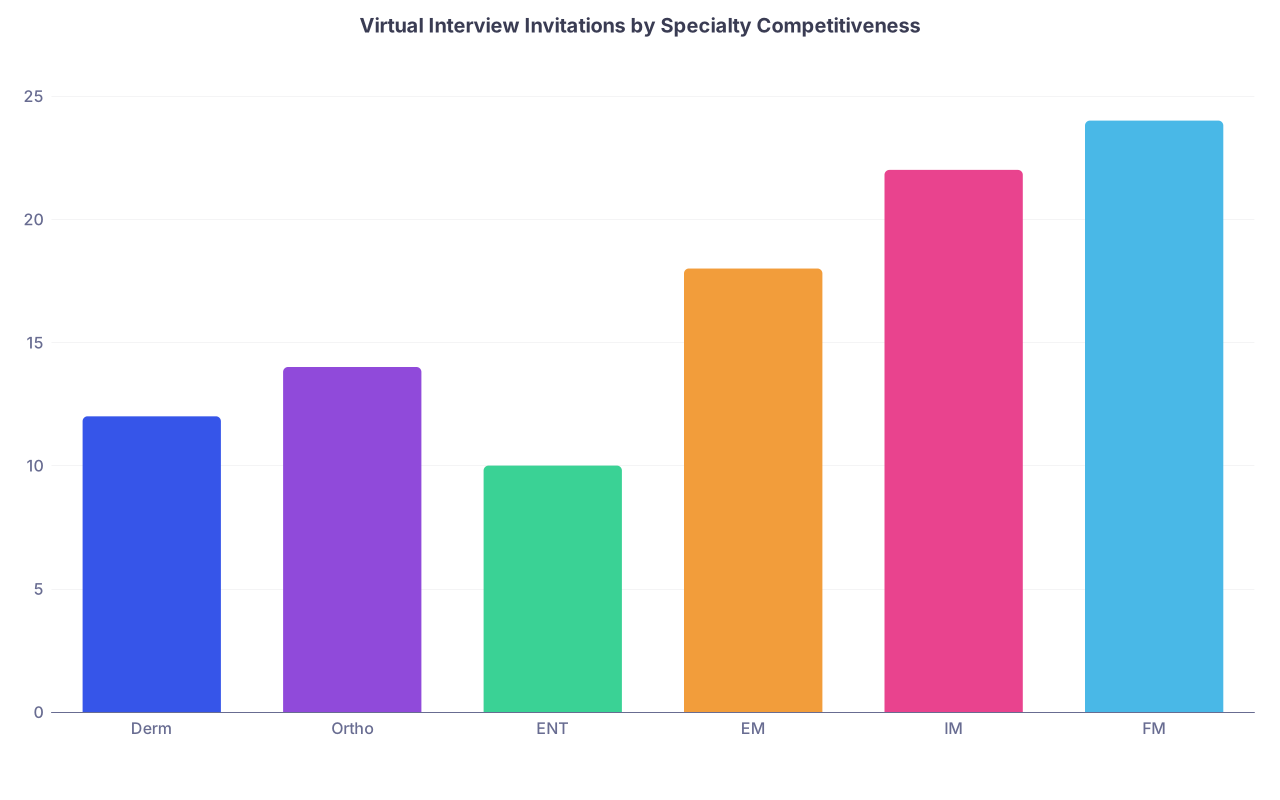
That chart is the honest version. Not sexy. Just honest. Early slots may carry a slight edge in perceived signal or memorability in some settings. But the evidence for a consistent match advantage? Weak. Mixed. Often absent.
And virtual interviews changed the equation further.
Back in the in-person era, timing could interact with travel fatigue in ugly ways. I’ve seen applicants crush their first two interviews, then look half-dead by trip number eight. Late-season performance sometimes suffered because people were broke, exhausted, and rehearsed to death. Interviewers noticed. Programs noticed. Even little things—weather delays, arriving flustered, awkward social dinners—created timing-related noise.
Virtual interviewing strips out a lot of that chaos. You’re in the same room, with the same lighting, the same chair, the same coffee, and ideally the same internet backup plan. That standardization blunts some timing effects that used to matter. A January virtual interview is less likely than a January in-person interview to be sabotaged by travel wear and tear. Likewise, an early virtual interview doesn’t automatically benefit from the novelty and adrenaline bump that used to come with the first site visits.
That doesn’t mean date bias is gone. Human beings still compare candidates imperfectly. Recency bias is real. First-impression bias is real. Memory is messy. But the virtual format tends to compress applicant experience, making slot timing less determinative than people think.
In plain English: if your interview goes well, it usually goes well because you performed well and fit the program, not because your Zoom tile appeared on screen in week two instead of week seven.
Why Programs Schedule Early and Late Slots Differently
Applicants love conspiracy theories about scheduling. Most of them are nonsense.
Programs distribute interview slots for operational reasons. Faculty clinic schedules. inpatient coverage. committee meetings. holiday breaks. file review speed. backup days for cancellations. chief resident availability. IT support. The unglamorous machinery of academic medicine. That’s what’s behind a lot of “why did they put me in January?” questions.
And no, late interviews are not automatically “leftovers.” That idea refuses to die, even though many programs deliberately mix applicant strength across the season. They don’t want one superstar day and one weak day. They want balance, comparability, and enough flexibility to handle cancellations and late file movement.
Some programs do track sequence internally. They may discuss whether a candidate interviewed before or after a major review meeting, or whether someone came from an initial invitation wave versus a waitlist wave. Fine. But many also use structured rubrics, standardized interviewer forms, and rank meetings designed specifically to minimize date bias. They know order effects exist. They try, imperfectly, to suppress them.
Also, specialties have quirks. Some front-load interviews because they want decisions made early. Others back-load because faculty can’t review applications quickly enough, or because away rotation timing and service demands distort the calendar. So using the date itself as a proxy for “how much they like me” is usually reading tea leaves from a spreadsheet.
How Applicants Should Actually Use Interview Timing
Here’s the strategy that actually holds up: stop overinterpreting the date and start optimizing your performance.
If you get an interview, the invitation matters far more than whether the slot is early or late. That’s the signal. The rest is mostly noise.
Take a workable date when it’s offered. If you have choices, use common sense. If it’s a dream program and you know you interview better after a few reps, a slightly later date may help you. If your schedule is packed and you want to lock in one of your stronger programs before burnout sets in, take the earlier slot. That’s not gaming the system. That’s managing yourself like an adult.
What should you chase instead of timing mythology? Preparation. Program-specific answers. Consistent energy on camera. A clean setup. Real knowledge of why the program fits your goals. Those things move rank positions. Not your fantasy theory that “third Thursday in November” is somehow optimal.

There are a few nuances. Competitive applicants may have more flexibility and can sometimes choose dates strategically after weighing other interviews. Signaling and geographic preference may influence when invitations arrive. Waitlist movement can produce late interviews that are still very real opportunities. I’ve seen applicants assume a late add-on interview was tokenism, then match there. Bad assumption. Programs don’t waste many interview spots for fun.
And yes, if you have two equivalent options at the same program, picking a date that lets you be rested and prepared is smart. Picking a date because Reddit told you early always wins? Dumb.
Your rank list quality matters more. Your interview execution matters more. Your ability to articulate fit matters more. The calendar is not the main character here. You are.
Bottom Line: Timing Matters Less Than People Think
Here’s the clean summary.
Interview slot timing can shape perception at the margins. Sure. Early might help in a few settings. Late might benefit applicants who perform better with practice. But the evidence does not support the lazy claim that early automatically beats late in virtual residency interviews.
What drives outcomes is still the boring, powerful stuff: the strength of your application, how well you interview, and whether a program sees you as a fit. That’s what survives rank meetings. That’s what matters on Match Day.
So don’t turn a calendar date into a superstition. That’s anxiety pretending to be strategy.
The myth says timing is everything.
The data says otherwise.