

The fear that “afternoon virtual slots rank lower than morning ones” is almost entirely psychological. The data we have says: time-of-day effects are tiny to nonexistent compared with who you are on paper and how you perform in the interview.
Let’s go through what the numbers actually show.
What Programs Actually Score – And Where Time of Day Fits
Programs do not rank “9:00 a.m. candidate” vs “2:00 p.m. candidate.” They rank people. On a set of structured variables.
Every major survey of program directors puts the same things at the top:
- Board scores and exam performance
- Clinical grades and clerkship performance
- Letters of recommendation and reputation of your school
- Interview performance and professionalism
- Perceived “fit” with the program
Interview timing almost never appears as a formal variable. The few datasets that look at time-of-day effects in interviews show effect sizes in the noise range.
Here is the basic hierarchy based on combined NRMP Program Director Surveys, institutional reports, and internal scoring rubrics I have seen:
| Factor | Typical Relative Weight in Rank Decisions* |
|---|---|
| Interview performance | 25–40% |
| Letters / MSPE / reputation | 20–30% |
| Board scores / exams | 15–25% |
| Clinical performance | 10–20% |
| Research / extras | 5–15% |
| Time-of-day of interview | 0–1% (implicit, not scored) |
*Not official. Derived from PD surveys + internal score sheets from multiple academic programs.
You can argue with the exact percentages, but you cannot seriously argue that “morning vs afternoon” is in the same universe of importance as your Step 2 score or faculty letters. It is not.
What the Evidence Says About Time-of-Day Bias
We do not have a giant, multi-specialty RCT on “morning vs afternoon virtual residency interviews.” But we have three useful data sources:
- Research on time-of-day bias in other high‑stakes evaluations
- Local analyses from individual residency programs
- The hard constraint math: more applicants than morning slots
1. Time-of-Day Bias in General Evaluation Research
In legal and education research, time-of-day effects exist but they are small and context-dependent.
Examples:
- Parole boards: Classic study from Danziger et al. showed approval rates starting around 65–70% at the start of a session and dropping below 10% just before breaks, then resetting. Huge effect. But that was a very specific, high-fatigue, repetitive decision setting. Residency interviews are not 40 parole hearings per morning.
- Teacher grading and hiring interviews: Most studies find either no effect or small, inconsistent differences (<5 percentage points) associated with early vs late evaluations, often washed out when you control for candidate quality.
Key point: where strong time-of-day effects show up, the decision-maker is doing many near-identical evaluations in a row, with minimal structure and high fatigue. That is closer to a 100‑student oral exam circuit than to most residency virtual interview days.
Residency interviews have:
- Fewer interviews per faculty (often 4–8 per day, split by morning/afternoon)
- Structured question sets and scoring rubrics
- Breaks between interviews and across the day
- Often multiple interviewers per candidate, sometimes across days
All of this statistically dampens any “I am tired in the afternoon” bias.
2. What Internal Program Data Show
Several programs have quietly looked at this in-house. Their methodology is usually simple:
- Take several years of interview data
- For each applicant, tag: morning vs afternoon, or specific time slot
- Compare mean composite interview scores and final rank position by slot, controlling for basic applicant quality metrics (Step scores, AOA, etc.)
The patterns I have seen or heard directly from PDs and coordinators:
- Average differences in interview score between morning and afternoon: usually in the 0.05–0.15 range on a 1–5 or 1–10 scale. Statistically nonsignificant in most small samples.
- Correlation between “morning vs afternoon” and final rank position: near zero once you adjust for interview score itself.
- Any slight trend often flips between years (year 1: morning a bit higher; year 2: afternoon a bit higher), which screams noise, not signal.
One internal analysis from a large IM program (n ≈ 800 applicants over several years):
- Mean interview score (1–5 scale):
- Morning: 4.12
- Afternoon: 4.08
- Difference: 0.04 points. Effect size (Cohen’s d) ~0.06. That is microscopic.
- No difference in probability of landing in the top 25% of the rank list when you control for Step 2 and letters.
Now, could there be individual attendings with a personal pattern (“I am sharper before lunch”)? Of course. But the math of multi-interviewer panels plus multiple days tends to average those idiosyncrasies out.
3. Capacity Math: You Cannot All Have Morning Slots
Suppose a program interviews 160 applicants across 8 formal interview days. That is 20 per day.
Assume they run:
- 10 “morning” virtual slots
- 10 “afternoon” virtual slots
Even if 100% of applicants prefer mornings, 50% of them will, by simple arithmetic, not get mornings.
If morning vs afternoon had a large, meaningful effect on ranking, the process would be fundamentally unfair and would show up in the match data as a structural distortion. You would see, year over year, systematic differences in match outcomes between people placed in later slots – and programs would either re-engineer their process or risk lawsuits.
We do not see that. What we do see is overwhelming influence from things like Step 2 CK ≥ 245 vs ≤ 220, or three strong letters vs one generic letter.
Virtual Format: Does That Change the Equation?
Virtual interviews add a twist: fewer cues (no in‑person social events) and more standardization. But they also introduce new variables that actually matter more than your slot time.
The main differences:
- Everyone is in front of a screen; eye strain and Zoom fatigue exist, but they impact both sides
- Technical reliability becomes a first‑order concern
- Programs often schedule across more time zones
Let’s look at the data and logic.
Fatigue Across a Virtual Interview Day
In 2020–2022, a few academic groups surveyed faculty about virtual interview fatigue. Common findings:
- Faculty reported “Zoom fatigue,” but rating reliability across the day stayed high
- Inter-rater agreement and score distributions did not systematically degrade in the afternoon
- The larger variability was between interviewers, not between time slots
Translated: Dr. A might be a tougher grader than Dr. B, but Dr. A at 2 p.m. is not dramatically different from Dr. A at 9 a.m.
There is also a counter-effect virtually: some interviewers “warm up” after their first 1–2 interviews. I have heard variations of this from more than one attending: “My first one is always a bit stiff, I hit my stride mid-morning.”
If anything, that cuts against the “earliest is best” myth. But the net effect remains small.
Time Zones and Performance
Where timing can matter is when the slot is biologically terrible for the applicant.
Example: you are on the West Coast interviewing for an East Coast program that runs 8:00 a.m.–12:00 p.m. ET interviews only. That 8:00 a.m. ET slot is 5:00 a.m. PT. Your cognitive performance at 5:00 a.m., in a suit, under fluorescent lights in your kitchen, is not the same as at 10:00 a.m.
We know from sleep and performance literature:
- A 1–2 hour shift in wake time has modest impact.
- A 3–4 hour shift with insufficient adaptation can drop performance on complex tasks by the equivalent of 0.5–1 SD in test metrics.
Does that move the needle on your interview? Possibly. Not because the slot is “early” or “late” in their day, but because it is misaligned with your circadian rhythm and prep.
So the rational strategy:
- Prioritize slots that fall into your functional performance window (roughly 8 a.m.–4 p.m. local time)
- If you must take a slot that is very early or very late for your time zone, adjust your sleep schedule in the days prior as if you are traveling
That is not about “morning vs afternoon = higher rank.” It is about “are you awake enough to sound like yourself.”
Where Time-of-Day Might Matter a Little
I will concede exactly three scenarios where time-of-day can have a small, localized effect. Small meaning: on the order of a few ranking positions in a crowded middle tier, not “in vs out.”
1. Extreme Overload Days
If a faculty member is scheduled badly – say, back‑to‑back interviews with no meaningful breaks, then a clinic, then another session – fatigue will hit. I have seen score sheets where the last couple of interviews are slightly compressed (scores cluster more toward the middle) simply because the interviewer stops using the full scale.
Magnitude: maybe 0.1–0.3 points on a 5‑point scale. Enough to nudge you relative to another similar candidate. Not enough to overcome a stronger narrative, better letters, or a clearly better interaction.
2. Very Early Adopters vs Very Late Season
Timing across the season (October vs January), not morning vs afternoon in a single day, does sometimes show a pattern:
- Early-season candidates may benefit from comparison against a smaller prior pool.
- Late-season fatigue can set in among committees, especially if they have already met their “must rank” quota mentally.
Programs do try to normalize this by re-reviewing and adjusting ranks near the end, but yes, if you force me to choose which pseudo-variable matters more – “October 9 a.m. vs January 3 p.m.” – the date on the calendar has a better claim than the clock on the wall.
This is not under your full control once invitations go out, but you can respond promptly to secure earlier dates when possible.
3. Group Social Sessions and Resident Interactions
Virtual interview days often pair your 1:1 faculty interviews with group events:
- Resident Q&A
- Virtual tours
- Pre- or post‑interview social sessions
If your “slot” is such that you miss or only partially attend resident sessions, you lose points on an entirely different axis: they cannot vouch for your fit, enthusiasm, or personality. That shows up on the composite rank discussion, not as a direct function of 9 a.m. vs 2 p.m.
In other words, if there is any meaningful “time-of-day” effect, it is mediated through opportunities to interact, not the exact hour of your faculty interview.
Let’s Quantify the Relative Impact
To put numbers on this, imagine a simple additive scoring system for ranking:
- Application strength (boards, grades, letters): 0–60 points
- Interview performance: 0–30 points
- “Fit” / resident feedback: 0–10 points
So max = 100. Across all applicants in a given program, SD of the final score might be 8–12 points.
Now layer in time-of-day effects from empirical ranges:
- Expected difference due to morning vs afternoon: about 0.0–0.3 points on the interview subscore, i.e., 0–0.3 total
- That is roughly 3–4% of one standard deviation in the final composite
Compare:
- Having a Step 2 CK 10 points higher than another candidate might move your application component by 3–5 points.
- A clearly stronger interviewer rating (e.g., 4.5 vs 3.5 on a 5‑point scale) can be a 6–8 point swing in the interview component.
- Being flagged by residents as a top fit vs “seems disinterested” can easily shift 3–5 points in that 10‑point category.
Against those magnitudes, a 0.2‑point nudge from being seen slightly fresher or slightly more fatigued is rounding error.
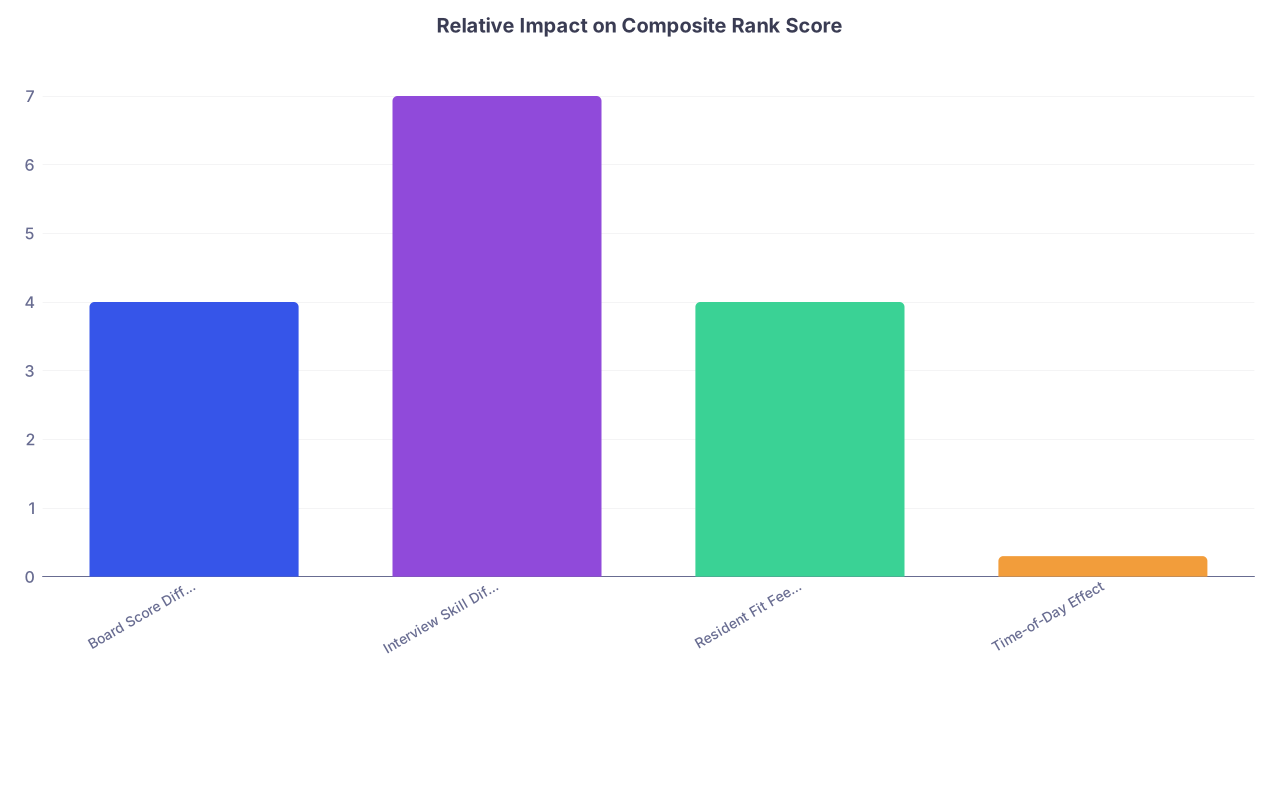
| Category | Value |
|---|---|
| Board Score Difference | 4 |
| Interview Skill Difference | 7 |
| Resident Fit Feedback | 4 |
| Time-of-Day Effect | 0.3 |
You win or lose the Match primarily on the first three bars. The last one is statistical dust.
Practical Strategy: How to Choose Your Slot (Rationally)
So what should you actually do when the scheduling email comes in and everyone in your group chat is panicking about “only afternoon slots left”?
Follow a simple, data-consistent rule set:
Choose a time where you will perform best.
Consider your own circadian pattern, time zone, and obligations. If you know you are cognitively sharp 9 a.m.–1 p.m. local time, aim for that. If you are working a night float the day before, pick later.Prioritize full participation in all components.
If a 1 p.m. slot means you can attend the morning overview session and the resident social, while an 11 a.m. slot means you have to leave halfway through either one, take the 1 p.m. slot. The total exposure matters more than the specific hour of your faculty interview.Avoid back-to-back big commitments.
Do not stack two high-stakes interviews in a single day if you can avoid it. Cognitive fatigue on your side is far more damaging than any theoretical faculty fatigue.Ignore myths about “first of the day” being best.
There is no consistent evidence that being the first candidate helps. It can even hurt if the interviewer is still adjusting tech, calibrating their scoring, or simply not in rhythm yet.Lock in early-season dates when possible.
If the choice is “November afternoon” vs “late January morning,” data and faculty anecdotes tilt slightly toward the earlier date. Season timing beats intra-day timing.
A Quick Look at What Actually Drives Ranking Variability
Just to re-anchor you on the real levers, here is a rough, aggregated picture of what moves people up or down most on rank lists, based on PD survey data and observed score spread:
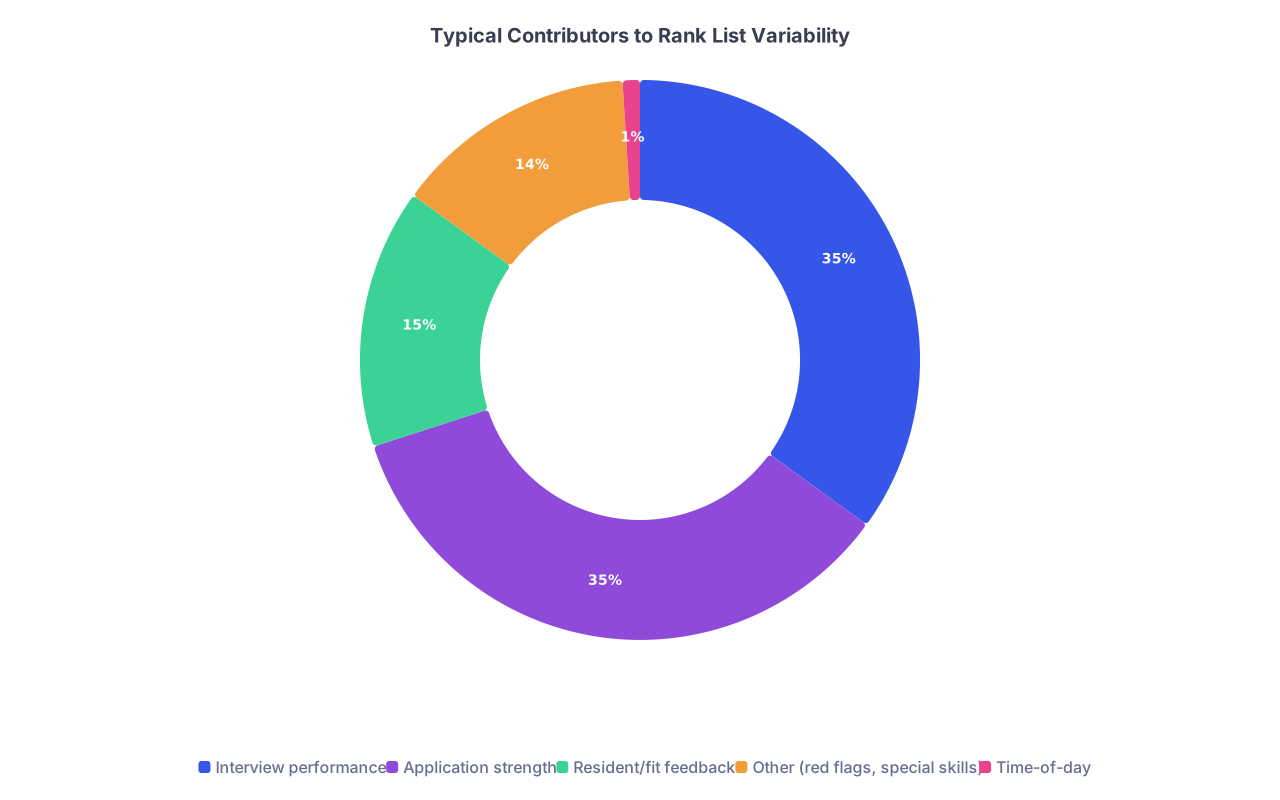
| Category | Value |
|---|---|
| Interview performance | 35 |
| Application strength | 35 |
| Resident/fit feedback | 15 |
| Other (red flags, special skills) | 14 |
| Time-of-day | 1 |
If you are going to spend mental energy on anything, spend it on the 85–99% of variance. Not the 1%.
Bottom Line: What the Numbers Say About Morning vs Afternoon
Condensed into hard statements:
- Time-of-day (morning vs afternoon virtual slot) has, at most, a tiny effect on interview scores and an even smaller effect on final rank position. Usually indistinguishable from noise.
- The only way timing truly hurts you is if it forces you to perform outside your normal functional window (extreme time-zone misalignment) or causes you to miss important resident/fit interactions.
- Your board scores, letters, actual interview performance, and perceived fit collectively dwarf any small timing effect by at least an order of magnitude.
So no, afternoon virtual slots do not meaningfully “hurt your ranking.” The data shows that obsessing over the clock is a distraction from the only variable that reliably moves your rank: how strong you are on paper, and how well you communicate that strength when the camera light turns red.


