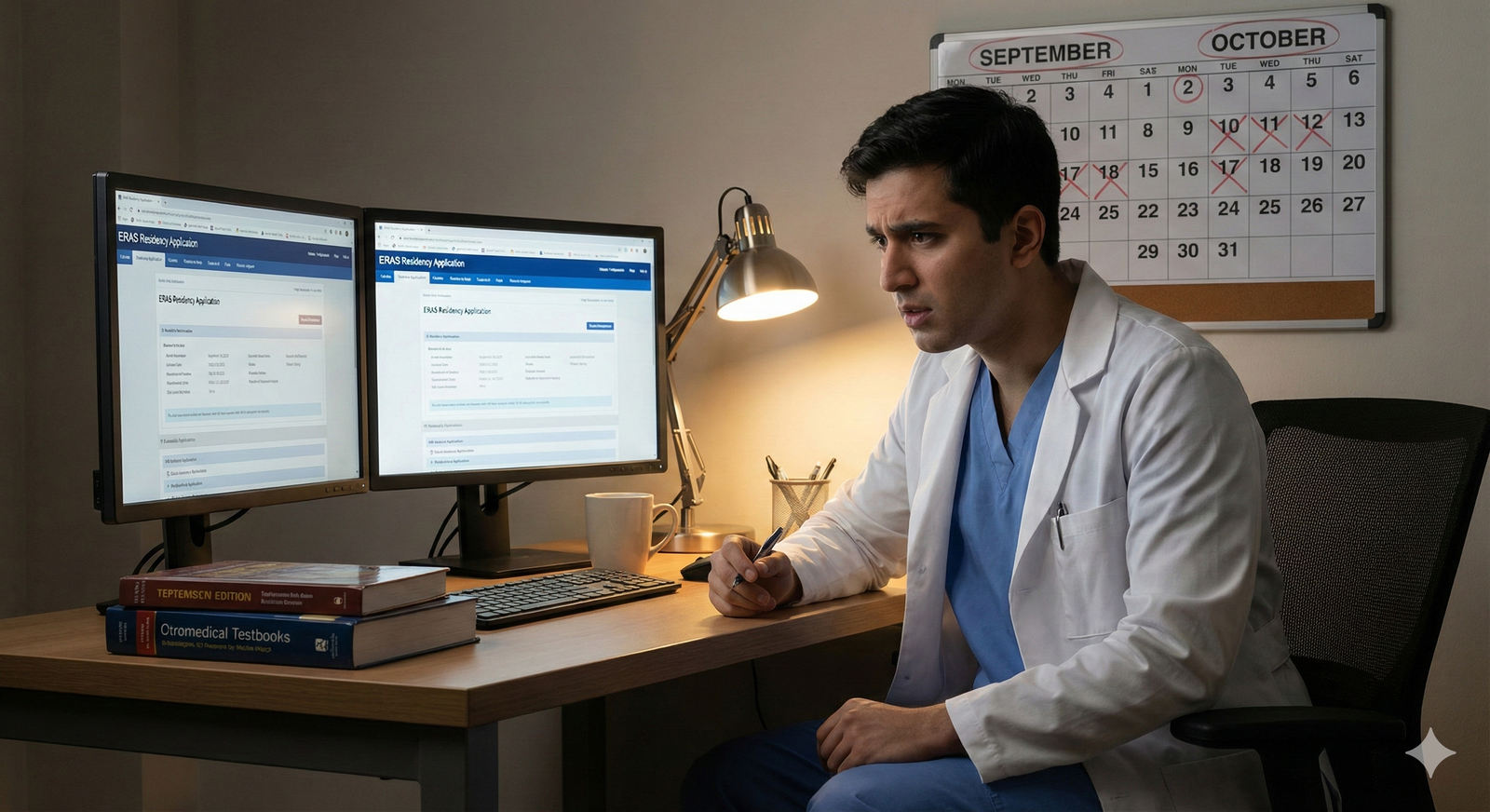
Stop. Read that headline again. If you're sitting at your laptop at 11:47 PM on a Friday with ERAS open in another tab and three unverified letters pending, this article is for you. And I mean that as a warning, not a pep talk. I've watched too many qualified applicants sabotage themselves with bad timing. Don't be the next one I warn a future medical student about.
Submitting your ERAS application at the wrong time isn't a minor scheduling preference. It's a strategic decision that determines whether a program director actually reads your file or scrolls past it in a Monday morning avalanche. The difference between matching and not matching can literally come down to the day of the week you click "Submit." Let me show you exactly where the danger zones are, and more importantly, where the safe ground lives.

Stop. Do Not Submit on a Friday Night.
I get it. You've been working on this for months. The deadline is technically not until next week, but there's a voice in your head telling you to just get it done. Close the laptop, hit submit, and recover over the weekend. That voice is lying to you. Here's what's actually happening when you submit late Friday:
- The rush mindset is your enemy. Fatigue plus deadline pressure equals sloppy work. You will miss a typo. You will attach the wrong personal statement to the wrong program. You will check the wrong box on a checkbox that locks you out of an entire specialty. I have seen all of these happen to real applicants in real match cycles.
- Program coordinators are not reviewing files at 11 PM on a Friday. Even if your application is technically "in," nobody is reading it. Your file sits in a queue over the weekend and gets picked up Monday morning, when it's already competing with a fresh batch.
- You cannot review what you cannot see. The verification process takes time. A Friday night submit means your file is unlikely to be verified until early the following week. You've gained nothing.
- It signals disorganization. This is the part most applicants don't think about. Program directors and coordinators talk. A submission timestamped 11:58 PM on a Friday looks like a panic submit, not a strategic one. First impressions start with the file metadata, not your personal statement.
Walk away from the computer. Close the laptop. Sleep on it. The deadline isn't actually for several more days, and you'll thank yourself on Sunday when you read your personal statement with fresh eyes and catch the sentence that would have buried you.
The Monday Morning Trap: Why You Are Being Buried
So you stayed disciplined and didn't submit Friday night. Congratulations. Now you wake up Monday morning, refreshed, and think, "Perfect, I'll submit first thing." Wrong. You're about to walk into the single worst submission window of the week.
Here's the ugly truth about Monday mornings in residency program offices:
- Administrative backlog. Program coordinators spent Friday wrapping up the week, then came in Monday to hundreds of new files that landed over the weekend. Yours is now file #247 in a stack of 400.
- Massive influx from other applicants. Thousands of medical students across the country have the same brilliant idea you do: "I'll do it Monday." You're not special. You're in the herd.
- Time pressure on the coordinator. Monday is the day coordinators triage the pile, send out interview invites for the week, and respond to the emails that piled up. Your application gets a 90-second skim at best.
- Lower ranking priority. This is the one that actually costs you the match. If a program has 800 applications to review before a Wednesday meeting, and yours is timestamped Monday morning among 500 others, you're not getting a deep read. Period.
Look at that chart. Tuesday and Wednesday aren't just slightly better than Monday. They are categorically, demonstrably, strategically superior. Anyone who tells you "the day doesn't matter" hasn't talked to a program coordinator after a brutal Monday inbox.
The Golden Window: Tuesday Through Thursday
Here's the part you came for: when to actually hit submit. The data, the conversations with program directors, and the patterns from successful matches all point to the same window. Tuesday through Thursday. Mid-week. Not Monday morning. Not Friday evening. The middle of the week.
Why does this work?
- Tuesday morning: The Monday backlog is cleared. Coordinators are caught up, caffeinated, and actively opening new files. Yours lands at the top of a manageable queue, not the bottom of a pile.
- Wednesday: Peak review energy. Program committees are often mid-week in their planning meetings. Submitting Wednesday gives you the best shot at being discussed in a Thursday or Friday review session.
- Thursday afternoon: Still solid. Coordinators have time to verify your file before the weekend, and your application is fresh in their minds when they return Monday.
- Buffer time for problems: If a LOR didn't upload, if a transcript has a mismatch, if your photo is the wrong file format, you have days to fix it. Not hours. Not minutes. Days.
Let me show you the safe submission sequence:
The flowchart isn't complicated because the process shouldn't be complicated. Most applicants sabotage this with overthinking, last-minute edits, and "let me just tweak one more thing" syndrome. Set your submit window. Trust your preparation. Click the button.
The Letter of Recommendation (LOR) Bottleneck
This is the timing mistake that ruins more applications than any other. I cannot stress this enough: do not submit your ERAS application until every single Letter of Recommendation is uploaded, verified, and attached to your file.
Why is this so critical?
- Incomplete applications get skipped. Programs are not going to email you asking, "Hey, when's Dr. Smith's letter coming?" They have 800 other applications. They'll simply move on to the candidate who is fully complete.
- You become invisible. Your file may be visible to the program, but if three out of four letters are there, the system often flags it as incomplete. Some programs filter these out automatically. You never even appear in the review queue.
- Forced Friday night submits. Here's the trap. You wait on a mentor. The mentor is slow. Suddenly it's Thursday afternoon, only two letters are in, and you panic. You submit Friday night with two letters and promise yourself you'll add the rest later. You can't add them later in a way that re-prompts a review. The first impression is the only impression.
How do you avoid this bottleneck?
- Ask for letters at least 6 to 8 weeks before the deadline. Not 6 days. Not 6 hours. Weeks.
- Send your letter writers a clear deadline that is one week before the actual ERAS deadline. Build in a buffer. Mentors are busy. They will be late. Account for it.
- Provide your writers with everything they need in one email. Your CV, your personal statement draft, the letter request form, the upload link, and a friendly reminder of your deadline.
- Follow up politely two weeks out, one week out, and three days out. This is not annoying. This is professional. Your letter writers expect it.
- Verify upload status daily in the last week. Do not assume. Log in. Look. Confirm.
That image is what your application should look like on submission day: complete, organized, and ready. Not a chaotic stack with pieces missing.
Don't Wait Until the Deadline: The Last-Minute Danger
Even with a perfect mid-week submit, you still need to leave yourself a 24-hour buffer. The ERAS system is not bulletproof, and assuming it will work flawlessly at 11:59 PM on deadline night is a gamble you cannot afford.
Real talk about what happens in the final hours:
- Server crashes happen. They happen every cycle. AAMC's servers get hammered. Some applicants lose connectivity mid-submit. Some applications don't fully upload. Some get timestamped incorrectly.
- Payment processing fails. Your application may be "submitted" but if the payment doesn't go through, it doesn't process. Check your email for confirmation.
- System glitches mark files as late. Even if you clicked submit at 11:58 PM, a server hiccup can push your timestamp past midnight. The system doesn't care about your intentions.
- No support available. If something breaks at 11:50 PM, there's no one to call. The help desk closed hours ago. You're on your own.
The rule is simple: submit at least 24 hours before the deadline. If the deadline is Friday at 5 PM, submit Thursday morning. If the deadline is Wednesday at midnight, submit Tuesday morning. You lose nothing by being early. You risk everything by being late.
Key Takeaways
Let me make this brutally simple. These are the only four things you need to remember:
- Never submit your ERAS application on a Friday night or Monday morning. These are the danger zones. Avoid them like you'd avoid a missed ECG finding on a patient.
- The Golden Window is Tuesday through Thursday. This is when coordinators are caught up, committees are reviewing, and your application gets the attention it deserves.
- Do not submit until every LOR is verified and attached. An incomplete file is an invisible file. Coordinate with your mentors early and follow up professionally.
- Submit at least 24 hours before the deadline. Server crashes, payment failures, and system glitches are real. Buffer your time. Confirm the verification email. Then walk away.
Your Next Move
The application cycle rewards preparation, not panic. Every single mistake I've outlined here is avoidable if you start now. If your deadline is two weeks away, you have time. Use it. Build your LOR buffer. Polish your personal statement. Schedule your submit for a Tuesday or Wednesday morning, confirm verification, and then close the laptop and go do something that isn't ERAS for the rest of the day.
I've seen too many brilliant students with great boards scores, compelling personal stories, and strong clinical experiences get passed over because they submitted at the wrong time on the wrong day. Don't let timing be the reason you don't match. The Match is competitive enough without shooting yourself in the foot. Be strategic. Be early. Be a Tuesday morning applicant.
Your future self, holding that match letter, will thank you.