You know the drill. Refresh email. Refresh ERAS. Refresh the program portal. Put your phone down. Pick it back up 90 seconds later because what if the invite came in and somehow only stayed visible for a minute, as if residency programs are running a sadistic flash sale. Then nothing. Silence. And your brain does what anxious applicant brains do best: That's it. I'm done. They reviewed my file, hated it, and now I'm being quietly eliminated everywhere.
I'm going to say this plainly because applicants need someone to say it plainly: that thought spiral is understandable, but it's usually wrong.
"Quiet weeks" are real. Very real. I've watched applicants panic during a dead stretch on a Tuesday, only to get two invites on Thursday and another the following Monday. I've seen entire friend groups decide they were cooked because a spreadsheet looked flat for five days. Dumb. Not because the fear is dumb, but because the conclusion is. Silence often reflects operations, not judgment. Committee timing. Faculty schedules. Batch processing. Portal lag. Administrative bottlenecks. All the boring machinery behind the curtain.
And yes, "interview invite data" can help a little, but only if you define it correctly. A data point isn't just the email timestamp that sends you into cardiac arrest. It's also a portal status change, a batch of invites released by one program on the same day, a cluster of movement across several programs, or a period of no news that later breaks all at once. If you only watch your empty inbox, you'll mistake missing information for bad information. That's how people spiral.
Quiet Weeks & the "Invite Gap": Why Your Brain Thinks the Worst
The worst part of interview season isn't always rejection. Sometimes it's ambiguity. Rejection is painful, but at least it's clear. Silence is where your brain starts writing horror stories.
A quiet week feels personal because residency applications are personal. You wrote the statements, begged for the letters, polished the CV, submitted the app, and now your entire emotional stability is somehow tied to whether a portal button changes color. So when nothing happens, your brain turns operational silence into a verdict on your worth. Brutal. Also inaccurate.
A true "invite gap" is simply a period where you're not seeing new movement. That can mean no emails, no portal updates, no interview scheduler openings, no obvious signs that your application changed status. But that gap does not automatically mean programs have made a final decision and excluded you. A lot of applicants act like every day without an invite is a tiny rejection. It isn't.
What counts as meaningful data? Email timestamps matter, but they're messy. Portal status changes matter, but they can lag. Batch release patterns matter, especially if multiple applicants report movement around the same time. Even no-news periods matter, if you understand them correctly: they're often pauses in processing, not evidence that your file vanished into a black hole.
How Interview Invites Get Released: The Scheduling, Committee, and Batch-Processing Reality
Programs do not operate like anxious applicants. They're not sitting there making one neat decision at a time and instantly notifying you. Most are juggling service demands, faculty schedules, committee review structures, interview calendars, and plain old administrative chaos. That's why invite release patterns look lumpy instead of smooth.
Here's the usual reality. A committee reviews applications on a certain schedule. Maybe once a week. Maybe in larger bursts. Maybe one subgroup reviews a geographic region or a subset of applicants, then the full committee signs off later. After that, a rank list or preliminary selection list is built. Then the program has to figure out interview capacity. How many spots are open? Which days? Which faculty are available? Are they protecting subspecialty clinic? Did someone go on leave? Did the coordinator just get buried under 900 emails? All of that matters.
Then invites go out in batches. Not because programs enjoy torturing you, but because batch sending is efficient. One release wave now, another after cancellations, another after the program sees acceptance rates from the first group. This is common. Very common.
And those timestamps everyone obsesses over? They're not gospel. A committee decision made Monday may not hit your portal until Wednesday. An email can be delayed, filtered, or buried. A portal can cache old information. One program may release all at once at 6 p.m.; another may trickle invites after every committee meeting; another may hold back a wave while waiting to see how many initial invites are accepted.
This is why "quiet" doesn't equal "rejected." Some programs are methodical and slow. Some are disorganized. Some intentionally throttle invites because they don't want to overbook interview slots. Some are waiting to fill remaining seats after seeing declines. That silence you're taking as doom may just be administrative pacing. Not sexy. But true.
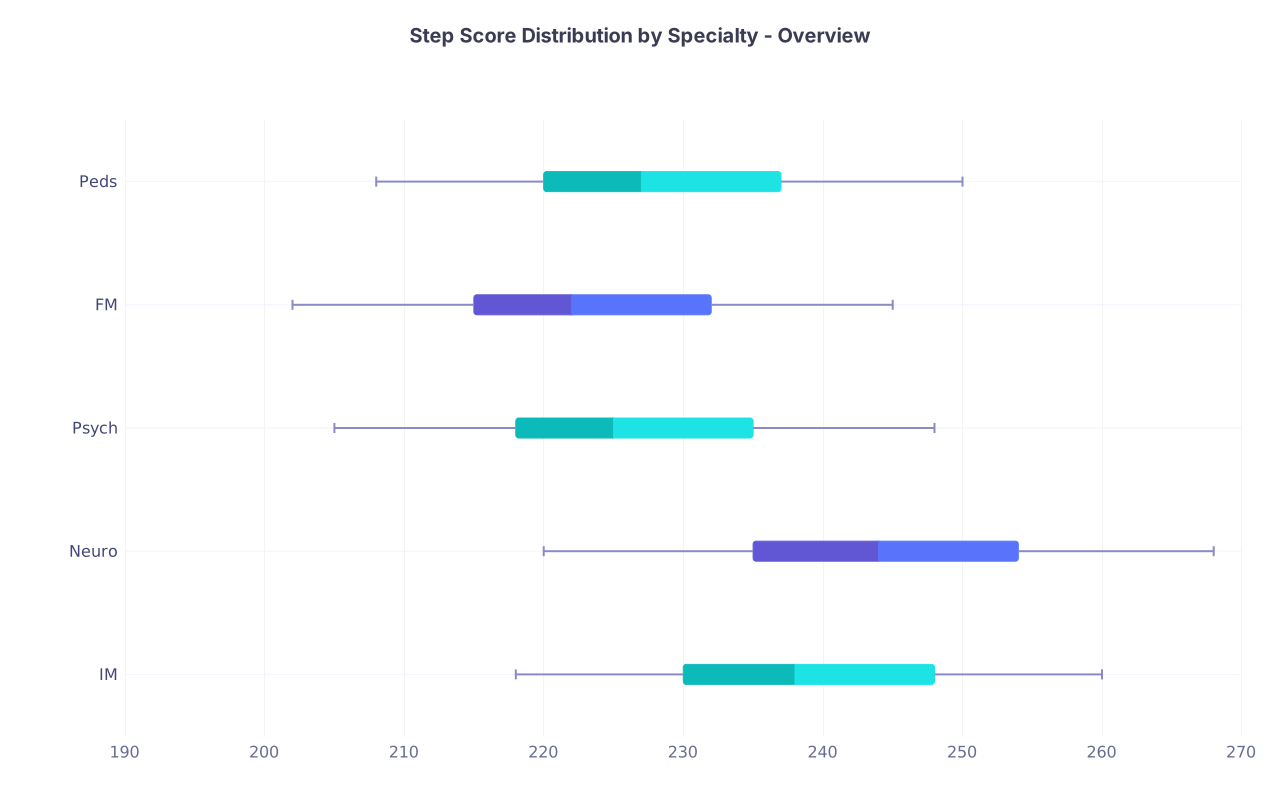
IM vs Psych vs Neuro: Specialty-Specific Reasons "Quiet Weeks" Look Different
Here's where applicants really get themselves into trouble: they assume all specialties behave the same. They don't. Internal Medicine, Psychiatry, and Neurology can all have very different invite rhythms, and if you compare one to another too literally, you'll scare yourself for no reason.
Internal Medicine is often the noisiest. Big applicant volume. Big program volume. Multiple tracks at some institutions, categorical, prelim, primary care, research pathways, sometimes separate review streams. That creates movement, but not always clean movement. One IM program may send a giant first wave, then a smaller clean-up wave, then another after cancellations. Another may review regionally or by academic filters. Another may process prelims and categoricals on different timetables. So IM can look active overall while still leaving you personally in a miserable waiting pocket. That pocket doesn't prove anything by itself.
Psychiatry often feels different. Fewer but sometimes more distinct waves. Programs may be more deliberate about interview distribution, especially when they're balancing mission fit, geographic interest, and class composition. Applicants panic because they don't see daily invite chatter the way they might in high-volume IM spaces. But Psych silence between waves is normal. I've seen applicants assume they were done after an early quiet stretch, then get multiple Psych invites in a later batch when committees regrouped or when initial invitees released spots.
Neurology is its own animal. Often smaller cohorts, smaller departments, and sometimes more deliberate communication. That can mean fewer visible data points and longer stretches where nothing seems to happen. Which is awful if you're the kind of person who needs constant proof that the universe hasn't abandoned you. Neuro programs may also have more tightly constrained faculty schedules or subspecialty input that slows review. So yes, the quiet can feel louder in Neuro simply because there are fewer total releases and less noise on the applicant side.

The downstream constraints differ too. IM may have more interview slots but also more tracks and more volume to process. Psych may have committee cultures that prioritize broader discussion and larger release waves. Neuro may run smaller interview cohorts and communicate more selectively. Faculty availability matters. Class size matters. Interview-to-match strategy matters. A program that interviews aggressively early looks different from one that protects later-wave flexibility.
So if you're applying IM, Psych, and Neuro and trying to use silence in one lane to predict silence in another, stop. That's how anxiety turns into fake pattern recognition. A quiet week in IM doesn't mean the same thing as a quiet week in Psych. A slow Neuro cycle doesn't mean your file was forgotten. Different cadence. Different machinery. Different noise level.
And yes, I know the worst-case thought: What if mine is the one file that got left behind? Possible in theory. Rare in reality. Much more often, you're sitting inside a specialty-specific release pattern that doesn't match the one you expected.
What the Data Can (and Can't) Tell You: Interpreting Quiet Weeks Without Spiraling
Invite data is useful. It's just not magical. The problem is that anxious applicants treat weak signals like final diagnoses.
A quiet week is not a stable predictor at the individual level. Read that again. Even if overall reported invites dip, that doesn't tell you what any one specific program is doing with your application. Correlation is not causation. A flat week across crowdsourced reports might reflect committee timing, a holiday, interview date planning, or applicants simply posting less. If your conclusion from sparse data is "my application is being rejected everywhere," you're not analyzing. You're catastrophizing.
The useful signals are broader. Are multiple programs in the same specialty showing movement? Are there consistent updates across your list, or just isolated noise? Do invites seem to resume after a lull? Are your documents complete everywhere? Has a portal changed even if no email came through yet? Those are better questions.
What you should not do is build a grand theory from one or two silent weeks. That's classic confirmation bias. You're scared, so you start collecting only the evidence that supports the scary story. "No invite today, therefore they passed on me." "My friend got one, I didn't, therefore I'm done." "The spreadsheet slowed down, therefore the season is over." No. That's not data literacy. That's fear wearing a lab coat.
Use the whole timeline. Compare carefully. And be honest about sample bias: the loudest applicants online are not a representative dataset. People post when they get invites. They post when they panic. They do not post every boring administrative delay. So the public "data stream" is already emotionally distorted before you ever see it.
Risk Management: Your Next Steps During a Quiet Week (So It Doesn't Control You)
This is the part people skip because it's less dramatic than spiraling. But it's the part that actually helps.
During a quiet week, do the boring checks first. Confirm your documents are complete. Letters uploaded? Transcript there? MSPE processed? Any program-specific requirements missing? Is your contact information correct? Have you checked the actual program portal instead of assuming the email would be enough? You'd be shocked how often applicants burn energy on panic while ignoring fixable logistical stuff.
Then get your rapid-response materials ready. If it becomes appropriate to send an update, don't write it in a frenzy at 11:48 p.m. Have a clean template ready. One paragraph. Value-add only. New publication, meaningful rotation update, significant accomplishment, genuine letter of interest if appropriate and allowed. Not "Hi, just checking status." Status-check emails are usually pointless and sometimes just annoying. Programs are busy. They know you want an interview. You do not need to remind them that oxygen exists.
Communication boundaries matter. If you have no new information and the program doesn't invite updates, don't send one. This is where anxious applicants convince themselves that more contact equals more control. Usually it just equals more noise. If you do write, be concise, respectful, and selective. One good update is professional. Repeated pokes are not.
The biggest sanity saver, though, is a check schedule. Non-negotiable. Pick two or three times a day. Morning, early afternoon, evening. That's it. Constant refreshing is gasoline on anxiety. I know because I've watched people turn a manageable season into a full-time cortisol hobby. Every refresh teaches your brain that the threat is active and immediate. It's a terrible system.
Build an evidence log instead. Simple notes. Date, program, portal change, invite received, document completed, update sent. Facts only. No interpretation. No "probably rejected." No "this feels bad." Just evidence. The point is to stop your brain from filling empty space with invented disaster. When your mind says, nothing is happening anywhere, your log may show that two programs updated documents, one portal changed status, and last week a specialty wave resumed after four quiet days. That's grounding. Not glamorous. Effective.
And do something useful with the rest of your time. Practice interview answers. Review your application. Read about programs. Get your setup ready. Sleep. Eat like a person who deserves stable blood sugar. Quiet weeks become much less terrifying when they aren't empty.
How to Set Expectations for Each Specialty: Timelines, Patterns, and Planning Your "If/Then"
You need a plan that respects specialty differences instead of flattening them into one anxiety blob.
For IM, expect more visible movement overall, but don't assume that means your invites must come early or they won't come at all. There's volume, there are multiple tracks, and there are often additional waves. For Psych, expect wave-like behavior and don't overreact to pauses between releases. For Neuro, expect fewer data points and potentially more deliberate pacing. Smaller cohorts can feel terrifyingly quiet, but quiet isn't the same as dead.
That means your planning should be specialty-specific too. Financially and logistically, leave room for delayed invites. Keep your calendar flexible enough that later-wave scheduling won't wreck you. Don't spend all your emotional reserves in the first lull.
Then build "if/then" scenarios before panic writes them for you. If invites lag for two weeks, then I will verify documents, check portals on schedule, and keep preparing. If I receive a later-wave invite, then I will respond quickly and stay ready with scheduling preferences. If I end up with fewer invites than hoped, then I will meet with an advisor, assess strategy honestly, and plan next steps early rather than hiding from the numbers. That's what real control looks like. Not refreshing. Planning.

Preparedness is power. I know that sounds a little cheesy, but it's true. One quiet week does not decide your match. One weird gap does not erase a solid application. What wrecks applicants is not silence itself. It's what they let silence convince them of.
If you remember one thing, make it this: your brain is allowed to be scared, but it is not allowed to be the statistician.