The silent email inbox in November is one of the most brutal parts of this entire process.
You start counting days since ERAS submission. Then weeks. Then…suddenly it’s November, your classmates are comparing interview schedules, and you’re trying not to cry in the hospital bathroom between patients because you still have…nothing.
Let’s talk about that exact nightmare. No sugarcoating. But also, no doom prophecy either.
You are not automatically doomed in November. But you are officially in “I need to be proactive and strategic” territory.
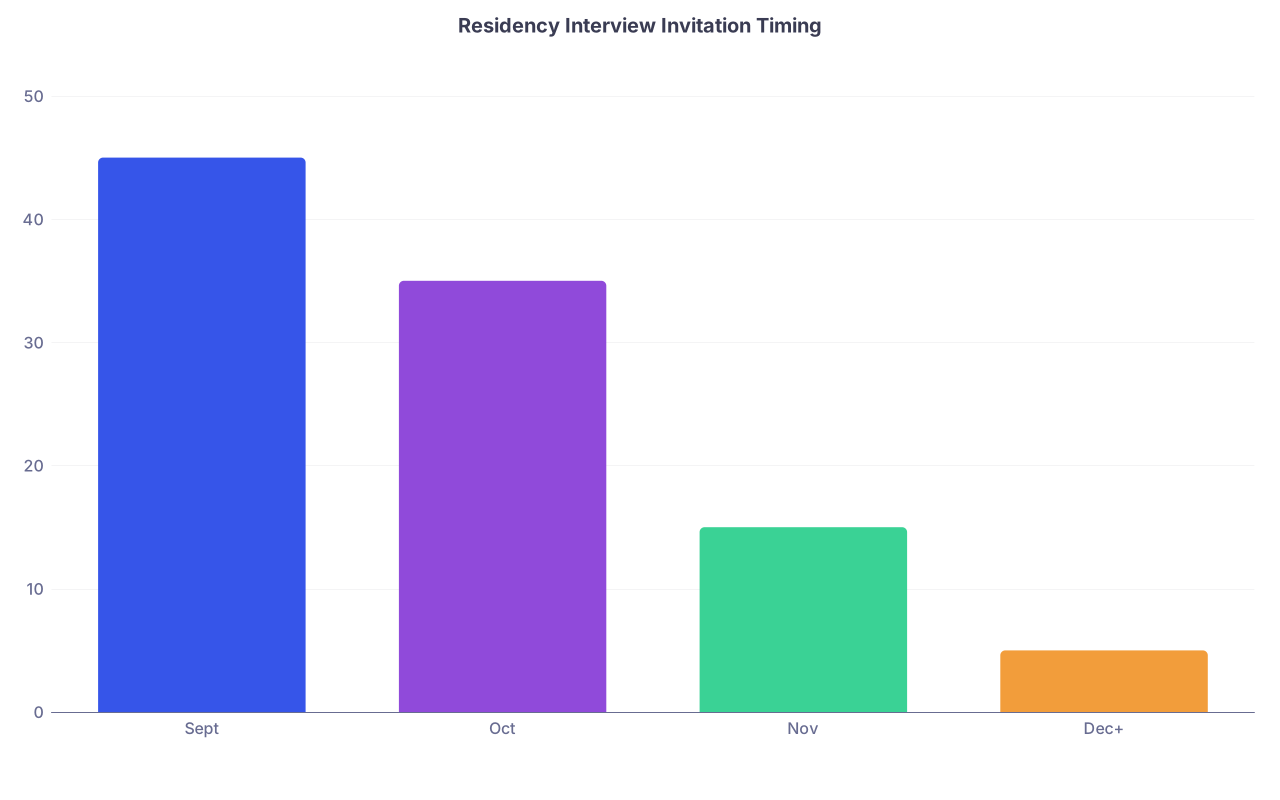
| Category | Value |
|---|---|
| Sept | 45 |
| Oct | 35 |
| Nov | 15 |
| Dec+ | 5 |
First: Is November Actually “Late” For Interviews?
Short answer: kind of, but not in the way your brain is telling you at 2 a.m.
Most programs send a big first wave of invites in September and October. By the time it’s mid–late November:
- A lot of interview spots are already booked.
- Some programs still have unfilled slots.
- Others will get cancellations and send second or third waves.
- Some programs are literally just slow or dysfunctional with their admin.
I’ve seen applicants get their first invite:
- November 20–30 for IM, Psych, FM
- Early December for less competitive community programs
- Even January after cancellations for things like Pediatrics or Pathology
Is that ideal? No. Is it “game over”? Also no.
But if it’s November and you have zero invites, you cannot just “wait and see.” That’s how people silently fail a cycle without ever really fighting for it.

| Step | Description |
|---|---|
| Step 1 | No Interviews by Nov |
| Step 2 | Get advisor to review app |
| Step 3 | Expand program list |
| Step 4 | Email PDs/PCs thoughtfully |
| Step 5 | Monitor for Dec/Jan invites |
| Step 6 | Plan for reapplication |
| Step 7 | Maximize interviews |
| Step 8 | Any red flags? |
| Step 9 | Still 0 by Jan? |
Step 1: Calmly Audit Where You Actually Stand
Your anxiety is screaming “I’m the only one without interviews.” That’s just not true.
What matters is some basic reality checking:
- How many programs did you apply to in your specialty?
- Which specialty is it? (Derm vs FM is a different universe.)
- Are you AMG or IMG? Visa needs?
- Any obvious red flags: fails, gap years, professionalism issue, late Step 2, no LORs in specialty?
Let’s be blunt: if you’re an average US MD applying categorical Internal Medicine with 60–80 apps and you have zero invites by mid-November, that’s concerning but not hopeless.
If you’re an IMG with Step 2 barely passed, applying to Derm at 25 top programs only? That’s not a “be patient” situation. That’s “this cycle was structurally flawed” and you need a backup plan.
Here’s a rough sanity-check snapshot:
| Profile | By Nov With 0 Invites Likely Means |
|---|---|
| US MD, mid-tier, IM/FM/Peds | Weak app or overly competitive list, but salvageable |
| US MD, Step fail, competitive field | Very high risk; need backup/reapp plan |
| US DO, applying IM/FM | Tough but not impossible; must expand list |
| IMG with strong scores, IM | Need aggressive outreach, broader list |
| IMG with low scores, any field | This cycle likely low-yield |
Is this oversimplified? Of course. But you need some framework that isn’t just “I suck.”
Step 2: Fix What You Can Now (Not In April)
By November, the application is what it is. But there are still levers you can pull.
1. Get a brutally honest application review
Not your friend. Not your mom. Someone who actually knows how PDs think:
- Home program PD or APD (if safe)
- A trusted faculty mentor in your specialty
- School’s career advising / dean’s office
- Someone who’s sat on a rank committee before
Ask them to look specifically at:
- Personal statement – Is it generic, cliché, or oddly off-putting? (This happens more than people realize.)
- Experiences section – Does it look scattered? Too research-heavy for a primary care field? Or the opposite?
- LORs – Do you actually have strong specialty-specific letters, or just “nice student, showed up” fluff?
- Step scores / COMLEX – Any silent cutoff issues that mean half your programs never truly considered you?
You want them to answer one question: If I were a program director, what reason would I have to not invite this person?
You cannot fix everything mid-cycle. But you can at least understand what went wrong and stop blaming the wrong thing.
2. Expand and re-target your program list (yes, even in November)
Everyone hates this advice. Because it costs more money and feels like “giving up on your dream tier.”
But if you have 0 interviews, the “dream” is already not happening the way you planned. You have to pick: ego or options.
Things you can still do in November:
- Add more community programs (especially in less desirable locations).
- Add lower-tier academic programs you skipped earlier.
- If you’re DO/IMG, add DO-heavy or IMG-friendly places with known track records.
- Consider programs in states people avoid: rural Midwest, certain Southern states, etc.
I’ve watched people go from 0 to 3–4 interviews in December solely by widening their net to places they originally thought were “beneath them.” Those 3–4 interviews matched them.
You only need one residency. Not one prestige brand.

Step 3: Thoughtful Outreach (Without Becoming That Desperate Email Bomb)
This is where everyone panics and wants to email 60 program directors a sob story. Don’t.
But strategic, respectful outreach can sometimes (not always) help.
Who to contact
Focus on programs where:
- You have a genuine connection (rotated there, from the area, alma mater links).
- You’re a borderline applicant, not completely out of range.
- Your school/mentor knows someone there who can send a warm email first.
The best-case scenario: your advisor emails the PD or APD saying, “We have a very solid student who hasn’t gotten many interviews yet and would be a fantastic fit for your program.” Then you send your email.
What to say (and not say)
Things to communicate:
- Specific interest in their program (not “I love your reputation for excellence” nonsense).
- One or two concrete reasons you fit there.
- A brief mention that you’re very interested and would be grateful for consideration if spots open.
Things to avoid:
- Begging. “Please please give me a chance” vibes.
- Trauma dumping. Your life story won’t override their criteria.
- Guilt trips. “I’ll disappoint my family if I don’t match” is not a selection factor.
You’re not trying to emotionally manipulate them. You’re trying to get on the “if we get cancellations, maybe invite this person” radar.
Does it always work? Absolutely not. But I’ve seen it lead to a handful of late December/January invites. Without trying, that number is guaranteed to be zero.
Step 4: Decide If/When to Pivot to A Backup or Reapplication Plan
Here’s the part your brain doesn’t want to touch: what if this cycle really doesn’t work?
Ignoring that possibility until Match Week is how people end up stunned, unprepared, and scrambling into weird gap-year limbo with no plan.
There are a couple of paths you may need to consider if by December/early January you still have zero or almost zero interviews.
Option A: Pivot to a less competitive specialty (if realistic)
This only works if:
- ERAS is still open to add programs/specialties (varies by year and system).
- You have some connection to that field: a rotation, a letter, at least a plausible story.
- You’re not trying to switch from Derm → Neurosurgery, but like, Ortho → PM&R or EM → IM or IM → FM.
This isn’t always possible. But when it is, it can save a cycle.
Option B: Accept that reapplication is likely and plan a strong gap year
This sounds like the absolute end of the world right now. It isn’t. It just feels like it because you’re watching classmates move on.
A “salvage” year has to be targeted, not random:
- If scores are your issue: improve Step 2 if possible, or add strong shelf/COMLEX 2 performance.
- If clinical exposure is thin: find a research year with clinical component, a prelim year, or a strong sub-I/externship plan.
- If letters are weak: strategically place yourself where you’ll work closely with faculty who actually write good LORs.
I’ve seen people do:
- A dedicated IM research year → match IM the next cycle.
- A prelim medicine or transitional year → match advanced field later.
- A year as a hospitalist scribe + targeted audition rotations → match FM or Psych.
The cycle you don’t match in hurts like hell. The cycle you do match in matters more. But you need to build that bridge now, not in March.
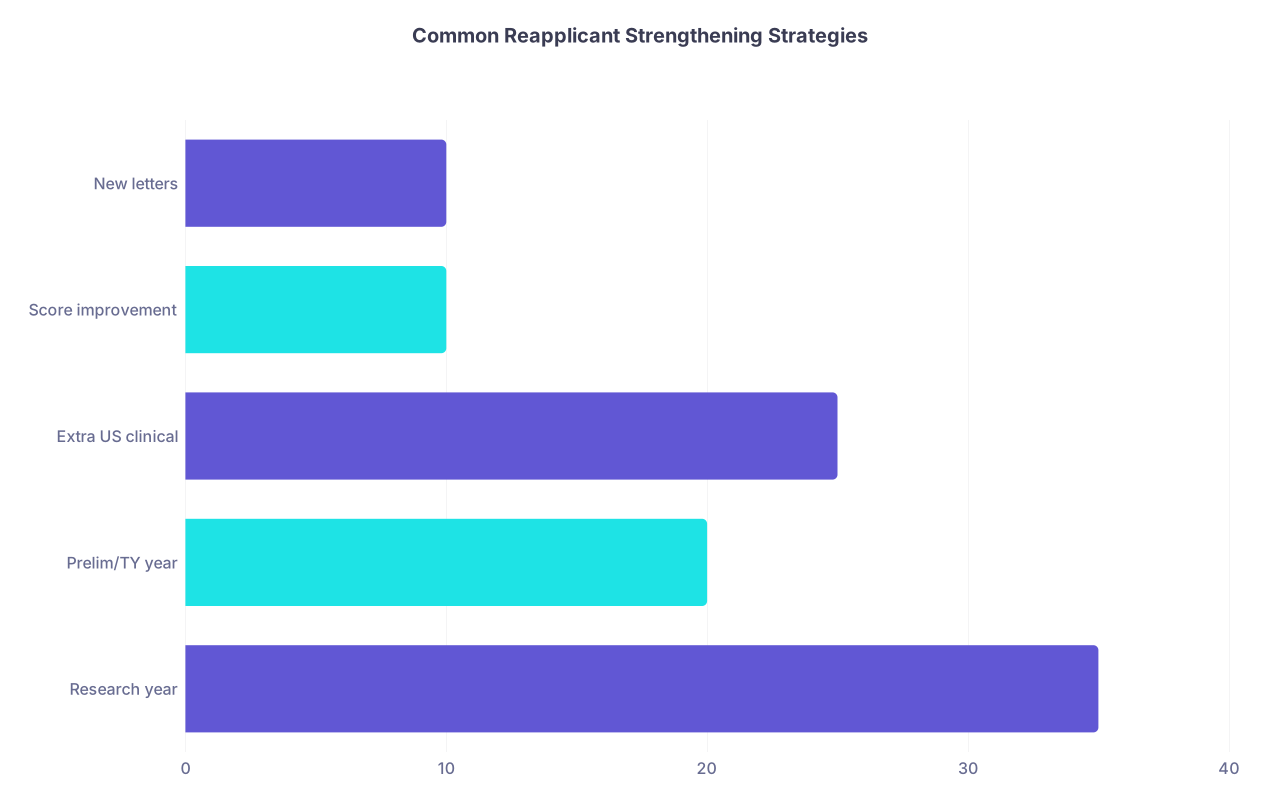
| Category | Value |
|---|---|
| Research year | 35 |
| Prelim/TY year | 20 |
| Extra US clinical | 25 |
| Score improvement | 10 |
| New letters | 10 |
Step 5: Protect Your Sanity While Everything Feels Like It’s Falling Apart
There’s the strategy side. Then there’s the part where you’re waking up at 4 a.m. checking email and doom-scrolling SDN/Reddit until you feel physically sick.
You can’t brute-force your way out of this mentally. You have to put some guardrails in place.
Stuff I’ve actually seen help people in your shoes:
- Set email checking rules. Example: once at 7 a.m., noon, 5 p.m. That’s it. Not every 6 minutes like a slot machine.
- Mute the group chats where everyone is flexing their interview counts and complaining that “18 is not enough.”
- Have 1–2 people you vent to who get it. Not your aunt who keeps asking “Heard anything yet?” at every family dinner.
- Give your brain alternative problems to solve: studying for current rotations, a small project, anything that isn’t just “wait and refresh.”
And yeah, if this is tipping you into panic attacks, constant crying, or not functioning, talk to someone professional. This process is legitimately brutal. You’re not weak for cracking under it.

What This Actually Means For Your Chances
The question you really want answered is: “If I have zero interviews by November, am I done?”
Here’s the hard truth:
- You cannot match into a categorical residency with zero interviews. That’s mathematically impossible.
- You still have a non-zero chance of getting late interviews in November–January, especially if you:
- Expand your list
- Get your app reviewed
- Do polite, targeted outreach
- If by January you still have zero invites, you should assume your chance this cycle is extremely low and fully pivot to reapplication planning.
Is it unfair that some mediocre applicants glide to 20+ interviews while strong ones get ghosted? Yes. The system is messy and biased and sometimes random.
But you’re not a failure because a chaotic, overloaded, imperfect system didn’t see you this year. It just means your path is going to be less linear than you pictured.
You’re allowed to be devastated. You’re also allowed to keep going.
FAQs
1. Is it normal to have zero interview invites by November?
It’s not “normal” in the sense of typical, but it’s also not rare. Every cycle, there are plenty of students in exactly your shoes. Especially in more competitive specialties, for DOs/IMGs, or for people who under-applied or had red flags. It’s a warning sign, not a final verdict.
2. Should I email every program I applied to and ask for an interview?
No. That screams desperation and clutter. Focus on a smaller subset where you have a genuine angle: places you rotated, your home institution, programs where you have a connection, or places your advisor can vouch for you. A few thoughtful, specific emails beat 80 copy-paste “consider me” messages that get ignored.
3. Is it worth adding more programs this late in the season?
If you have zero or almost zero interviews, yes. Especially community programs, less popular geographic locations, and places known to be IMG/DO-friendly if that applies to you. Late applications are not ideal, but a late app is still better than no app when you’re sitting at zero interviews.
4. Does not getting any interviews mean something is “wrong” with me as a person?
No. It means something about your application profile this year didn’t align with what programs were looking for or what their filters allowed through. That can be scores, numbers of programs, timing, letters, specialty choice, or just bad luck. It’s about the app, not your worth as a future physician or a human being.
5. If I end up reapplying, will programs hold this failed cycle against me?
Not automatically. What does hurt is reapplying with essentially the same application. Programs like seeing growth: stronger letters, clearer specialty focus, extra clinical or research work, improved scores, or a mature explanation of what changed. A good reapplicant story is “I understood what went wrong, fixed it, and I’m better now,” not “I tried the same thing again and prayed.”
6. What should I do today if I’m sitting here in November with no invites?
Three concrete things:
(1) Email or message a trusted advisor/mentor and schedule a full application review within the next week.
(2) Open your ERAS list and identify 15–30 realistic additional programs you could add, especially community/less competitive ones.
(3) Write a draft of a concise, respectful outreach email you could customize for a few key programs, then have your mentor critique it.
Open your ERAS application tonight and make a list of 10 specific things you can change this week—programs to add, faculty to contact, mentors to meet, emails to send. Don’t stare at your inbox waiting for a miracle. Build yourself a few new chances.