
The biggest lie people tell reapplicants is that “programs don’t really remember.” They do. But that’s not the whole story.
You’re not crazy for spiraling about being a reapplicant. Your brain jumps straight to: “They’ll see I failed once. I’m marked. I’ll be filtered out. Everyone else is shiny and new and I’m… damaged inventory.”
Let’s unpack how close to the truth that actually is—and where your anxiety is straight-up lying to you.
How Programs Actually See Reapplicants (Not the Horror-Movie Version in Your Head)
Here’s the blunt version: being a reapplicant is a yellow flag, not an automatic red one.
Programs basically group reapplicants into three mental buckets:
- “Same applicant, same problems, different year” → Usually a no.
- “Same applicant, but clearly improved” → Actually interesting.
- “Train wreck last year, still a train wreck this year” → Immediate no.
You’re terrified you’re always #3. Most people are actually stuck in #1. And your whole goal this cycle is to become unmistakably #2.
What PDs (program directors) and selection committees actually care about with reapplicants:
- Did you clearly understand why you didn’t match?
- Did you actually do something meaningful about it?
- Can you explain that story without sounding defensive, bitter, or clueless?
If the answer to those is yes, being a reapplicant is survivable. Sometimes even a bit of a plus—because you can show resilience, insight, and growth. I know that sounds like an inspirational poster, but I’ve seen it play out.
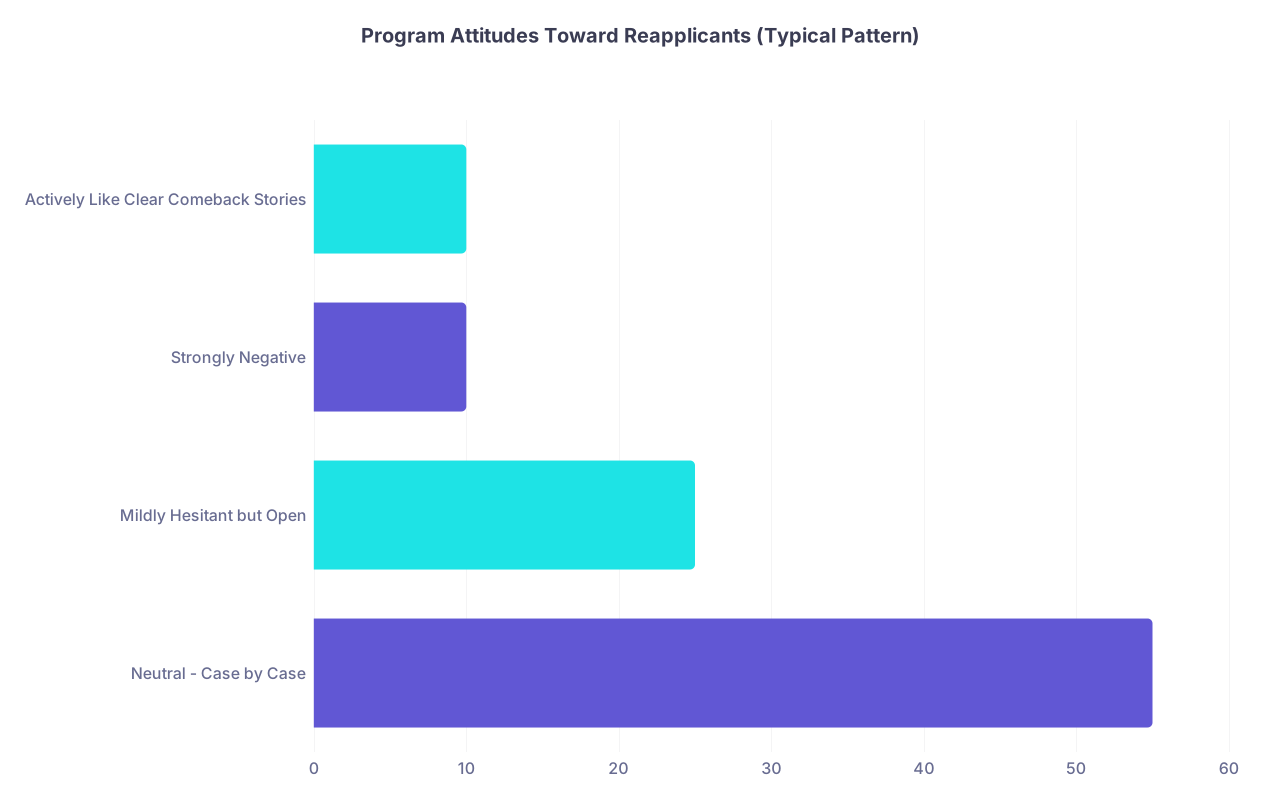
| Category | Value |
|---|---|
| Neutral - Case by Case | 55 |
| Mildly Hesitant but Open | 25 |
| Strongly Negative | 10 |
| Actively Like Clear Comeback Stories | 10 |
Is that exact data from some giant NRMP report? No. It’s pulled from what PDs say on panels, in webinars, and in the side comments they make once the official recording is off.
Most are neutral but cautious. They’re not hunting for reapplicants to reject. They’re hunting for evidence you learned something and aren’t going to flame out under pressure.
The Part Everyone Avoids Saying: Why Reapplicants Scare Programs
Let me say the quiet part out loud: programs are risk‑averse.
They’re not thinking, “How do we punish this person for not matching the first time?”
They’re thinking, “If we rank this person high, will they struggle again? Are we inheriting someone else’s problem?”
Common fears programs have about reapplicants:
- “Were they passed over because of professionalism issues?”
- “Did they have failed exams or weak clinical performance?”
- “Are they applying way above their competitiveness again?”
- “Will they struggle with resilience when things get hard in residency?”
Your application needs to preempt those fears. You don’t get to pretend you’re not a reapplicant. They see the “prior application” box. Some even remember your name or PS.
Here’s the rough truth: if your new ERAS looks like a lightly edited version of last year’s—same personal statement vibe, same LORs, similar weak Step/COMLEX narrative, same too‑competitive specialty list—they assume you’ve learned nothing. And they’re done.
If, instead, they see:
- New experiences that actually look substantial (not just “I did some shadowing and a few CME modules”).
- New or updated letters that speak to growth.
- A personal statement that clearly shows insight and ownership.
Then the “reapplicant” label becomes more of a context, not a sentence.
Do Reapplicants Match? Yes. But Not If They Pretend Nothing Happened.
Let me be clinical here for a second and rough‑cut it into scenarios.
| Scenario | Reapplicant Outlook |
|---|---|
| Same specialty, no real improvements | Very poor |
| Same specialty, clear improvement + strong backup | Mixed but realistic |
| Switch to less competitive specialty with solid gap year | Often decent |
| Multiple past failures, minimal changes, still aiming high | Almost zero |
You already know this intellectually. But your brain keeps asking: “Will they blacklist me just for being a reapplicant?”
No. There is no national blacklist.
But there is an invisible list in PDs’ minds that goes like this:
- People who applied wildly above their stats last year, did nothing serious to change, and are back again = Not learning.
- People who bombed Step 1/2 and pretend it never happened = Not safe.
- People who underestimate how competitive their chosen specialty is = Unrealistic.
You don’t want to be in any of those categories.
Where reapplicants actually win:
- They switch specialties to something that fits their record better (e.g., from Derm → IM or from Ortho → FM).
- They do a meaningful research year or a prelim/transitional year and don’t mess it up.
- They collect glowing fresh letters that say some version of: “This person is the best student I’ve worked with this year, and I’d take them in my program.”
What PDs Look For in a “Good” Reapplicant Story
Honestly, PDs like a clean narrative. They don’t have time for puzzles.
Here’s the kind of story that plays well:
“I applied to X last year with Y weaknesses. I didn’t match. I took a hard look at those weaknesses, and in the past year I have done A, B, and C. I’m now applying to X/Y with a much clearer understanding of the specialty, stronger clinical performance, and a better support system.”
That’s the 30‑second version they want to see reflected in your whole file.

| Step | Description |
|---|---|
| Step 1 | Reapplicant |
| Step 2 | Likely Screened Out |
| Step 3 | Hesitation / Low Rank |
| Step 4 | Consider for Interview |
| Step 5 | Did they improve? |
| Step 6 | Is story coherent? |
What “improvement” actually looks like (not the fluff version):
A new clinical experience with strong documented performance
Example: A year as a medicine prelim intern with solid evals and a PD letter.A meaningful research or fellowship year that ties logically to your specialty
Example: One‑year cardiology research with publications/posters for an IM applicant.A Step 2/Level 2 improvement if Step 1/Level 1 was weak, or at least strong explanation and consistent performance elsewhere.
Activities that show you can show up consistently: teaching, longitudinal volunteering, working as a hospitalist scribe/MA with strong supervisor feedback.
If your “improvement” is just: “I rewrote my personal statement and did some observerships” – programs feel that. And not in a good way.
Being a Reapplicant in Competitive vs. Non‑Competitive Specialties
Here's the part that makes everybody’s stomach drop: it’s not the same if you’re reapplying to Derm vs. Family Med.
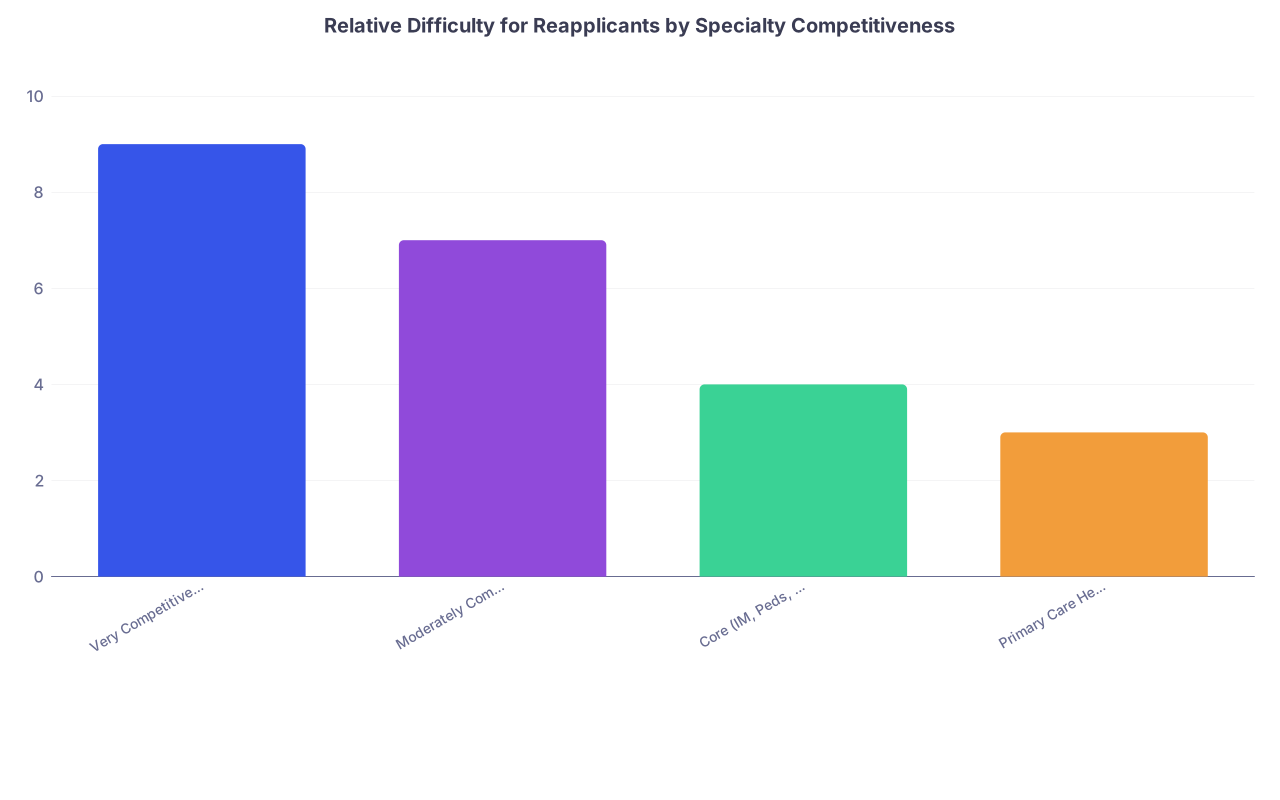
| Category | Value |
|---|---|
| Very Competitive (Derm, Ortho, ENT) | 9 |
| Moderately Competitive (EM, Anesthesia) | 7 |
| Core (IM, Peds, FM) | 4 |
| Primary Care Heavy Programs | 3 |
Scale here is 1 (easier for reapplicants) to 10 (borderline brutal).
Very competitive fields (Derm, Ortho, ENT, Plastics, Neurosurg):
- If you struck out once with an average or below‑average application and did not massively level‑up (publications, strong mentorship, extra degrees, strong research years at name‑brand places), the honest answer:
A second try in the same field is often dead on arrival. - Some people absolutely do make it on the second or third try—but they usually have a very specific rescue path (e.g., strong prelim year + major connections + serious new research).
Moderate fields (EM, Anesthesia, OB/GYN, some surgical subspecialties):
- Reapplicants can be OK if:
- They fix major issues (late application, weak Step 2, no home support).
- They apply more broadly and realistically.
- They don’t treat EM at top‑10 academic places like it’s the same as community EM.
Core specialties (IM, Peds, FM, Psych):
- Programs see reapplicants more often.
- They’re used to people switching into these specialties after trying something else.
- Here, being a reapplicant with a clear pivot story can actually look mature: “I realized what kind of doctor I actually am” plays well if it’s not obviously desperation.
Are there programs that flat‑out don’t want reapplicants? Yes. Some literally say things like “We prefer first‑time applicants” behind closed doors. But that’s their internal bias, not residency law.
How Honest Do You Have to Be About Being a Reapplicant?
You don’t need a sob story. You do need a coherent one.
Where this usually shows up:
- Personal statement
- Interviews (“So, tell me about your journey here” = code for “Let’s talk about the gap/failed match.”)
- LoRs from your gap year or prelim year
Bad answers sound like:
- “The match was really unfair last year.”
- “I don’t really know why I didn’t match.”
- “I had some personal things going on, but it’s better now.” (Vague = red flag)
Better answers sound like:
“Last cycle, I applied late and over‑concentrated my applications in highly competitive academic programs. I also hadn’t yet taken Step 2. After not matching, I took a structured research year in X, worked closely with attendings in this specialty, and strengthened my clinical and scholarly skills. I also applied more broadly and earlier this year.”
“Initially I applied to a different specialty. While I enjoyed parts of it, my strengths and interests—especially continuity of care and patient communication—fit better with FM, which I’ve now confirmed through X, Y, Z experiences this year.”
You don’t have to bleed all over the page, but you also can’t gaslight the committee into thinking nothing happened.
The One Thing That Quietly Kills Reapplicants: Applying the Same Way Again
Let me be blunt: if you hit “resubmit” on basically the same strategy, you’re not a reapplicant. You’re a repeat.
Common self‑sabotage patterns:
Same too‑competitive programs.
You apply to the same top‑tier university places that already passed on you, with no serious new leverage.Same number of programs.
You applied to 40 last year, matched nowhere, and now you’re thinking 45 is “casting a wider net.” It’s not.Same weak letters.
You cling to an old famous‑name attending who barely knew you instead of getting a new, strong letter from someone who watched you grind every day this year.No early Step 2/Level 2 if that was previously a problem.
You push it late again, then wonder why programs hesitate.

| Step | Description |
|---|---|
| Step 1 | Last Match Unsuccessful |
| Step 2 | Analyze Weaknesses |
| Step 3 | Change Specialty? |
| Step 4 | Build New Specialty Experiences |
| Step 5 | Strengthen Same Specialty Profile |
| Step 6 | New Letters + Broader Apps |
| Step 7 | Reapply with Clear Improvements |
If you’re going to go through the pain, the money, the emotional free‑fall of reapplying—you owe yourself visible, undeniable change.
Let’s Be Honest About the Emotional Part
You’re not just filling out ERAS again. You’re re‑opening a wound.
Every “past application” checkbox is a reminder. Every program you re‑add is: “Hi, remember when you rejected me?”
Here’s what people almost never say out loud: being a reapplicant can mess with your confidence so much that it leaks into your writing, your interviews, your letters.
It shows up as:
- Over‑defensiveness in your personal statement.
- Trying too hard to sound “humble” and instead sounding apologetic.
- Under‑selling yourself because you feel like you have to prove you’re not a loser.
You are not your match result. PDs don’t respect self‑pity, but they do respect someone who took a hit, did the work, and can talk about it without collapsing.
Is it fair you have to be both devastated and composed at the same time? No. But that’s the game.
Quick Reality Check: Should You Even Reapply to the Same Specialty?
Here’s where I’ll be a little harsh—because false hope is worse than an uncomfortable truth.
Use this table as a sanity check:
| Situation | Same Specialty Again? |
|---|---|
| Failed to match competitive specialty, no big changes, average/low scores | Probably not wise |
| Failed to match competitive specialty, now have strong gap year + big improvements | Maybe, with backup |
| Failed to match core specialty with red flags (fails, professionalism) not fixed | Very risky |
| Failed to match core specialty due to late apps, poor strategy, now corrected | Reasonable to try |
If you’re reapplying into the same field, your file should make a clear case that you’re a different applicant now. Not by vibes. By evidence.
FAQ (Exactly the Things You’re Probably Afraid to Ask)
1. Will programs hold it against me that I didn’t match the first time?
Some will. Most won’t automatically. They’ll hold it against you if they can’t see what changed. If your story is, “I didn’t match and then kind of drifted and now I’m back,” that’s a problem. If your story is, “I took a hit, rebuilt, and here’s how I’m stronger,” they’ll at least give you a real look.
2. Do I need to directly say I was a reapplicant in my personal statement?
You don’t need to write “I am a reapplicant” in the first line, but you can’t pretend the gap doesn’t exist. If there’s a missing year or a prelim year, they’ll ask. It’s usually better to have a short, honest, confident explanation in your materials than to let people invent worse stories in their heads.
3. Are there programs that will never interview a reapplicant?
Yes. Some PDs have a “no second looks” policy, especially in smaller or highly competitive programs. You can’t control that. What you can do is apply broadly enough that those programs don’t make or break your season, and focus your energy where you’re actually being considered.
4. If I did a prelim year and had a rough start, am I doomed as a reapplicant?
Not automatically. What matters is the trajectory. If your preliminary evals started rough but clearly improved, and your prelim PD is willing to write a strong letter that emphasizes growth, that can actually be a powerful story. If your prelim year added new concerns (ongoing professionalism issues, consistently poor evaluations), that’s a much steeper hill.
Bottom line:
- Being a reapplicant is a yellow flag, not a death sentence—if your application looks clearly different and stronger.
- Programs don’t hate reapplicants; they hate repeated mistakes and vague, unexamined stories.
- If you’re going to reapply, do it as a new version of yourself with a real plan, not as the same person hoping for better luck.