
Two nights ago, a friend called me from her car, parked in a grocery store lot. She’d just gotten her Step score: “Fail.” She kept saying the same sentence over and over: “I just ended my career. It’s over. I’m done.”
If you’re reading this, I’m guessing your brain is doing something similar. You’re refreshing your email, replaying test day in your head, and quietly Googling: “Does one failed Step exam ruin my match chances?” while trying not to throw up.
Let me answer that first, bluntly:
No. One failed Step exam does not automatically ruin your match chances.
But it does change your risk, your strategy, and the story you have to tell.
Let’s walk through that without sugarcoating it, but also without the drama spiral your brain is probably stuck in right now.
What One Failed Step Actually Means (Versus What Your Brain Thinks It Means)
Your brain: “I’m incompetent. Programs will think I’m stupid. No one will rank me. I’ll never match. I’ve wasted 10 years of my life.”
Reality: Programs see this all the time. Not ideal. But not career-ending by default.
Here’s the thing most students don’t realize:
Program directors do not sit around a table cackling over people who failed Step once. They’re busy. They’re trying to figure out:
- Can this person pass boards on the next try?
- Is this failure an outlier or a pattern?
- Are they going to be safe with patients at 3 a.m.?
- Are they going to be a headache for us when it comes to board pass rates?
They’re not thinking about you in the catastrophic, personal way you’re thinking about yourself.
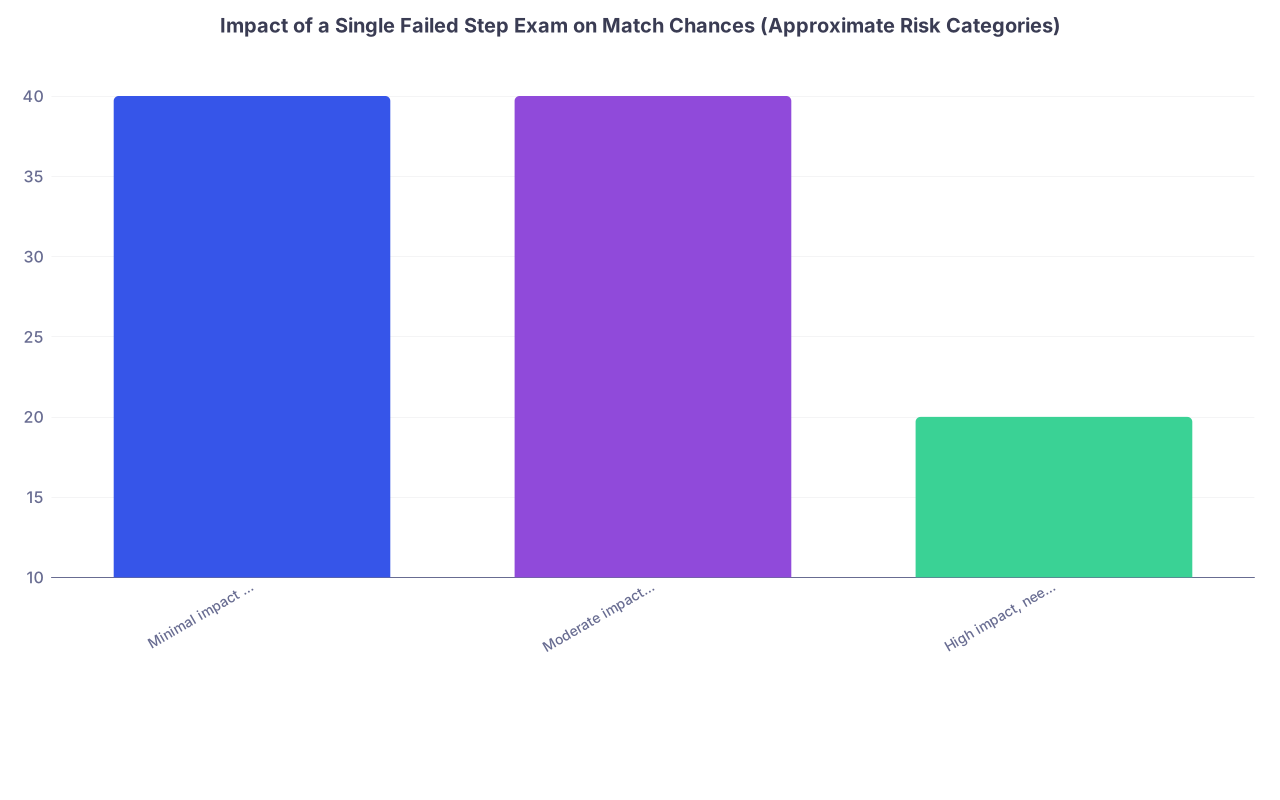
| Category | Value |
|---|---|
| Minimal impact with strong retake | 40 |
| Moderate impact, needs strategy | 40 |
| High impact, needs major adjustment | 20 |
That’s not real data from NRMP, obviously—nobody publishes “exact penalty for failing Step once.” But in practice, most applicants I’ve seen with:
- One failure + solid pass on retake + reasonable application
end up in the “still very possible with strategy” category.
It’s the pattern that kills people. Two fails. Fail plus multiple course remediations. Fail plus vague explanations. Those are riskier.
One failure? Painful, but survivable.
Step 1 vs Step 2 Failure: How Bad Is It, Really?
Let me be specific, because the risk isn’t the same.

If you failed Step 1 (especially now that it’s Pass/Fail)
Old world: Step 1 was numeric, and a fail looked brutal.
New world: It’s pass/fail, and a fail is still bad—but less mathematically weaponized.
Programs will think:
- Did they fix it on Step 2?
- Did they pass Step 2 comfortably, not barely scraping by?
- Does the rest of the application scream “solid, reliable, safe”?
If you failed Step 1 but then:
- Passed Step 2 on the first attempt, ideally with a solid score if still reported
- Showed normal progression in clerkships
- Got strong letters that say you’re clinically competent
You’re definitely still in the game—especially for less competitive specialties and home/state programs.
If you failed Step 2
This one stings more. Step 2 is closer to clinical readiness, and some programs really care.
But again, nuance:
- One Step 2 fail + strong retake with clear improvement → concerning but explainable
- Step 2 fail + Step 1 issues + weak clinical evals → more serious red flag
The main question they’re asking is:
“Will this person pass their specialty boards, or will they tank our board pass rate stats?”
If your retake looks good, your clerkship comments are strong, and you can own and explain what happened, there's a path. Harder. Narrower. But it exists.
How Programs Actually Think About Risk (Not the Fantasy Horror Movie in Your Head)
You’re probably imagining some PD saying: “Fail? Trash. Next.”
That’s lazy and not accurate.
Do some programs auto-screen any fail? Yes. Especially the most competitive ones.
Will you get filtered out from some places you might’ve liked? Also yes.
But many programs—especially mid-tier university, community, and less competitive specialties—go a layer deeper.
They’re considering things like:
| Factor | Good Sign | Bad Sign |
|---|---|---|
| Retake performance | Strong pass, clear improvement | Barely passed, no upward trend |
| Timing | Early fail, long record of improvement | Recent fail close to application |
| Pattern | Isolated issue | Multiple exams or course failures |
| Explanation | Clear, specific, takes responsibility | Vague, defensive, blames others |
| Overall file | Strong letters, solid rotations | Mediocre evals, weak narrative |
You’re not a score in a vacuum. You’re a risk calculation.
If the rest of your file says, loudly, “This was an outlier, I fixed it, here’s the proof,” many PDs are willing to move past it.
If your file whispers “I struggle, and I’m not sure why,” that’s when it gets scary.
Specialty Choice: Where a Failed Step Hurts More (And Less)
Let me say the thing you’re probably afraid of:
Yes, one failed Step exam can close some doors. Not forever, but for this match cycle? Very possibly.
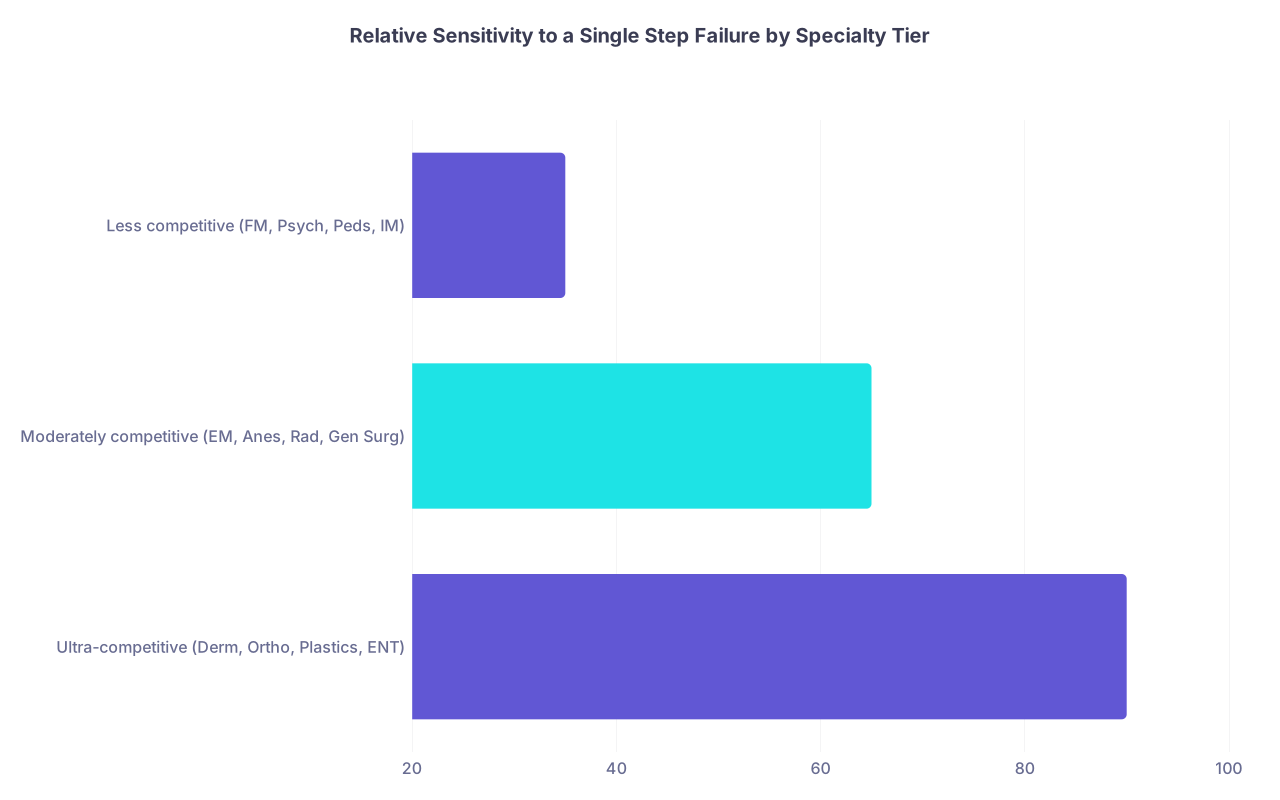
| Category | Value |
|---|---|
| Ultra-competitive (Derm, Ortho, Plastics, ENT) | 90 |
| Moderately competitive (EM, Anes, Rad, Gen Surg) | 65 |
| Less competitive (FM, Psych, Peds, IM) | 35 |
Here’s the rough reality:
Ultra-competitive specialties: derm, ortho, plastics, ENT, neurosurg, etc.
With a failure, especially Step 2, your chances drop sharply unless you have insane research, connections, or some unicorn-level story. Even then, you’re fighting uphill.Moderately competitive: EM (depending on region), anesthesia, radiology, gen surg in desirable locations.
You’re not out, but you’re now a “borderline” applicant. Strategy and connections matter a lot.Less competitive / more forgiving: FM, psych (depending on location), peds, IM (esp. community programs), path, PM&R in some places.
Much more willing to consider someone with a single stumble if the rest of the file is reassuring.
This doesn’t mean “give up on what you love.” But it does mean you can’t fantasize your way out of this. You need a Plan A, Plan B, and sometimes a Plan C.
How to Think About Risk Without Losing Your Mind
Right now your brain is doing black‑and‑white thinking:
Pass everything = I match.
Fail anything = I’m done.
That’s not how this works. The match is not binary; it’s probabilistic.
Think of it like this:
- Before the failure, maybe (if you were average-ish) you had, say, a 70–80% shot at matching somewhere in a reasonable specialty.
- After the failure, depending on specialty and your response, maybe it’s 40–70%.
- With a strong retake, good mentoring, smart list-building, and realistic choices—you push that back up.
Your job now isn’t to guarantee an outcome. You can’t.
Your job is to shift the odds as far in your favor as they’ll go.
That means:
- Maximize controllable variables
- Stop pretending the uncontrollable ones are under your command
- Accept that there’s risk—but also that there’s still a path
Concrete Damage Control: What You Should Actually Do Next
Let’s get out of your head and into an action plan. No fluff.

| Step | Description |
|---|---|
| Step 1 | Receive Failing Score |
| Step 2 | Feel Awful, Process |
| Step 3 | Tell Dean/Advisor |
| Step 4 | Plan Retake Timeline |
| Step 5 | Fix Study Strategy |
| Step 6 | Retake and Pass |
| Step 7 | Adjust Specialty Target |
| Step 8 | Craft Explanation for Application |
| Step 9 | Apply Strategically |
1. Tell your school. Yes, even if you’re ashamed.
They’ve seen it before. Seriously. They expect a handful of fails every year.
Why it matters:
- They may have formal remediation policies that protect you
- They might help with adjusted rotations, dedicated time, or tutoring
- They can warn you about any timing pitfalls (like needing a pass before ranking)
If you try to white‑knuckle this alone, you’re more likely to repeat the same mistakes.
2. Be brutally honest about why you failed
Most people say: “I just had a bad day.”
That almost never explains a failure.
The actual reasons I hear when people finally get honest:
- “I did tons of Anki but barely any full-length practice tests.”
- “I was depressed and couldn’t focus, but I pretended I was fine.”
- “I worked part‑time and tried to study like I didn’t.”
- “My baseline NBME scores were too low, but I took the exam anyway because I was scared to delay.”
You must figure out what actually happened. Otherwise, you’re just rolling the dice again.
3. Fix the method, not just the hours
More hours of the same broken strategy won’t save you.
Things that actually help:
- Doing multiple full‑length practice exams and taking them seriously
- Reviewing questions thoroughly, not just counting them
- Getting outside eyes on your approach (tutor, good advisor, upperclassman who improved dramatically)
If you were consistently scoring near or above passing and still failed, that’s a different problem (test anxiety, sleep, mental health, misreading questions). That also needs a specific intervention, not vague “I’ll try harder.”
How to Talk About a Failed Step on Your Application
This part freaks people out. How do you write about it in ERAS? What do you say if someone asks in an interview?
You do not:
- Write a dramatic confessional essay about your darkest days
- Blame your school, Prometric, or “trick questions”
- Pretend it’s not a big deal
You do:
- State it briefly, clearly, and then pivot to growth
Something like:
“I failed Step 1 on my first attempt. Looking back, I underestimated how much my unrecognized anxiety and inefficient study methods affected my performance. I worked with my school to restructure my approach, added regular self-assessments, and addressed my mental health with a counselor. On my second attempt, I passed comfortably, and that new system carried into my clerkships, where I’ve consistently performed at a high level.”
Short. Honest. Specific. And most importantly: it shows you changed something concrete.
In interviews, same idea. Own it. Don’t turn it into a 10‑minute monologue about your suffering. They’re not evaluating your pain; they’re evaluating your reliability.
Building a Safer Application Strategy After a Failure
This is the part everyone tries to skip. Don’t.
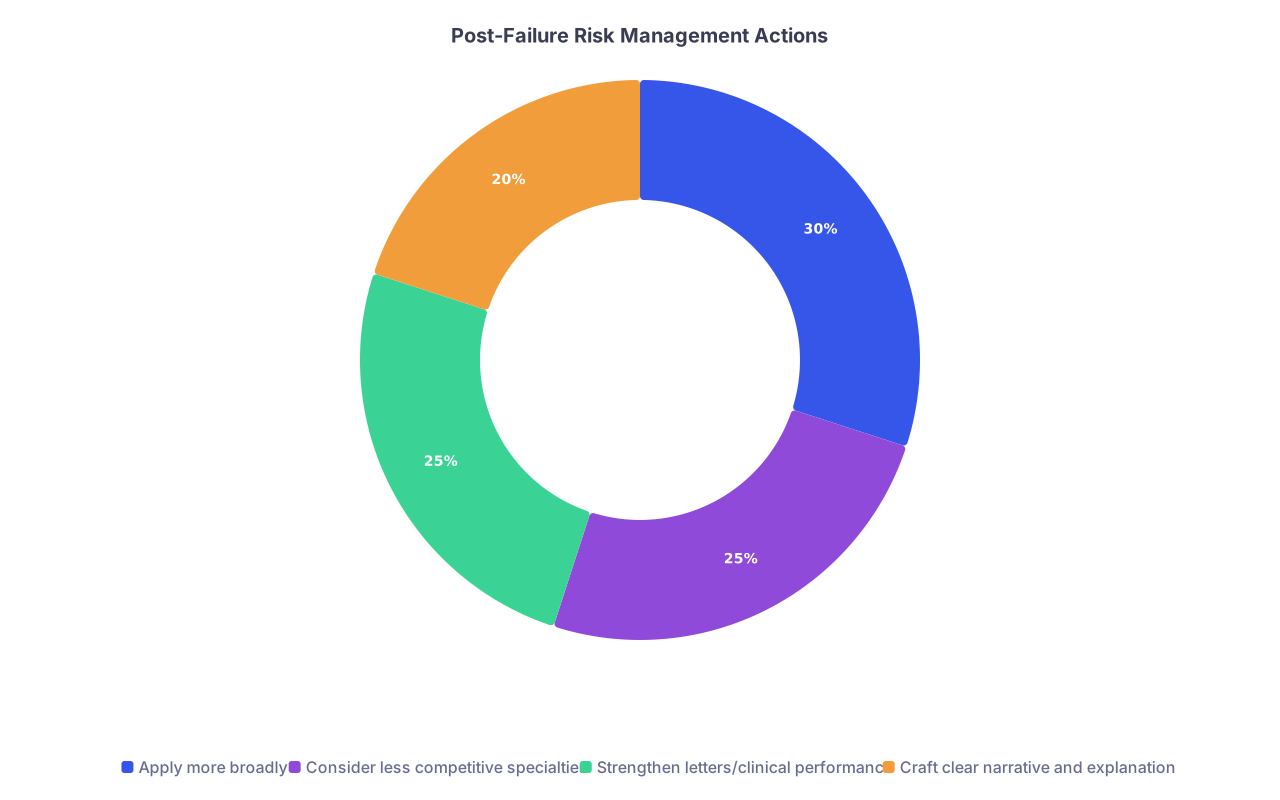
| Category | Value |
|---|---|
| Apply more broadly | 30 |
| Consider less competitive specialties | 25 |
| Strengthen letters/clinical performance | 25 |
| Craft clear narrative and explanation | 20 |
If you want to stay in the game, you can’t apply like a “clean” applicant and hope for the best.
You probably need to:
- Apply to more programs than you originally planned
- Include a wider range of program types (community, smaller cities, non-coastal)
- Seriously consider whether a slightly less competitive specialty you still like gives you better odds and a safer career path
- Double down on clinical performance and letters—because if your evals are also just “fine,” that’s not enough to overcome the failure
None of this is fun. It feels like you’re admitting you’re not as good as everyone else. But you’re not building a fantasy; you’re trying to get a job. A good one. That fits who you are now, not who you were before the score report.
The Part Your Brain Keeps Ignoring: People With Fails Do Match
I’ve watched:
- A student who failed Step 1, then crushed Step 2 and matched IM at a solid university program.
- Someone who failed Step 2, passed on retake, pivoted from gen surg to anesthesia, and matched at a community program where they’re now thriving.
- An IMG with a Step 1 failure, multiple attempts, and a rocky path who eventually matched FM after two cycles—and is now genuinely happy in practice.
Do some people never recover from a failure? Yes. Usually because:
- They never fix the root cause
- They stay in denial about their competitiveness
- They apply like nothing is wrong and then are shocked in March
You’re not doomed. But you are on a thinner tightrope than before. The sooner you admit that, the safer you can make it.
FAQ: The Questions You’re Afraid to Ask Out Loud
1. “Should I even bother applying this cycle after a fail?”
It depends on timing and your retake. If your retake result will be back before most programs seriously review apps, it can be okay to apply. If you’re rushing a retake and likely to barely pass—or worse, fail again—waiting a cycle and doing this properly is sometimes the less risky path, even though it feels like social death when your classmates move on. Talk to someone who’s actually matched applicants before, not just your equally panicked friends.
2. “Will programs automatically reject me just for the word ‘Fail’?”
Some will. Especially the top-tier and hyper‑competitive ones. They have enough applicants with clean records that they don’t need to take on extra risk. But that’s not all programs. Many will look at the whole picture—fail + retake + clinical record + letters + specialty choice. The question isn’t “Will anyone reject me?” (yes) but “Will enough reasonable programs still consider me if I apply smart?” That answer is often yes.
3. “Is it dishonest not to explain every detail of why I failed?”
No. You’re not writing a memoir; you’re applying for a job. You should own the failure, take responsibility, and briefly mention contributing factors if relevant (illness, family crisis, mental health), but you do not owe the entire story to everyone who reads your file. The key is that your explanation makes sense, doesn’t sound like blame‑shifting, and is paired with evidence that you fixed the issue.
4. “What if I fail again? Is that actually the end?”
Two fails is a much steeper hill. Some programs will be completely out of reach. Some specialties basically become fantasy. But “end” is a big word. I’ve seen people with multiple fails still carve out paths—different specialties, different countries, different timelines. It’s brutally hard, and you don’t want to be in that position. That’s why your focus right now has to be on doing everything you can to avoid a repeat: new strategy, real support, honest assessment, no more magical thinking.
Open your score report right now and write down, in one sentence, why you think you failed. Then cross out the excuse version and rewrite it as a cause you can actually act on. That rewritten sentence is your starting point.