
What actually happens if you admit you burned out, saw a therapist, or took meds… and a residency PD reads it? Do you get quietly filtered into the “too risky” pile?
You’re not the only one spiraling on this. Every year, I watch applicants whisper the same thing in hallway corners and group chats: “I really struggled mentally in med school. Can I say that? Or is that like career suicide?”
Let me be blunt: this is a minefield. You can talk about burnout and mental health. People do. Some do it well and it helps them. Others overshare, sound unstable, or raise big red flags, and it hurts them.
The problem is no one tells you where that line is until after you’ve crossed it.
Let’s talk about the actual risks, where that invisible line really is, and how to be truthful without handing a program a reason to screen you out.
The ugly truth: programs are not neutral about this
Residency programs are run by humans. Some genuinely care about wellness. Some say they care about wellness and then brag about their “malignant but we make great surgeons” culture. Both types read your application.
Here’s the part that keeps you up at night:
Programs are quietly asking themselves, “Is this applicant going to need extra monitoring? Extra coverage? Extra paperwork? Could they fail out? Take a leave? Trigger a hospital legal/HR nightmare?”
They aren’t supposed to discriminate based on mental health. Reality is messier.
So you’re asking two different questions:
- Can I be honest?
- Will being fully honest hurt my chances?
Those are not the same. And pretending they are is how people get burned.
What’s “safe” to mention vs what makes committees nervous
Let’s separate mental health content into rough buckets. This is over-simplified, but you need a practical mental model right now, not a legal ethics seminar.

Generally “safer” territory
These are things I’ve seen applicants include without torpedoing their cycle, when framed well:
Burnout / exhaustion without formal diagnosis
Example: “During third year I overextended myself, ignored my limits, and burned out. I sought mentorship, changed my study and work habits, and learned to ask for help.”Stress, anxiety, imposter syndrome that you managed and grew from
Not chronic, disabling anxiety. More like: “I was overwhelmed at first, but learned X, Y, Z coping strategies.”Therapy / coaching mentioned briefly and functionally
“I started counseling to improve my coping skills and communication. It’s helped me maintain balance during demanding rotations.”
Not a five-paragraph deep dive into your trauma.Short-term academic dip with clear recovery
Low shelf, one bad semester, failed an exam once — followed by stronger performance and concrete changes.
The key thing: these stories have a clear arc. Struggle → insight → action → stable improvement.
Programs don’t mind that arc. They actually like it. It reads as resilience, self-awareness, and a lower chance you’ll implode silently later.
High‑risk territory (the stuff that sets off alarm bells)
This is the part nobody says out loud in advising meetings, but you’re worried about it anyway, so I’ll say it.
Programs get nervous when they see:
Specific diagnoses with functional impairment
Major depression with multiple leaves. Bipolar with hospitalizations. OCD that made it hard to complete tasks. They’re picturing call nights, patient safety, remediation, legal liability.
Fair? Debatable. Real? Yes.Suicidal ideation or attempt described in detail
This is the big one. If you admit you seriously considered or attempted suicide during training, some PDs will immediately worry you’re high-risk under stress. That doesn’t mean you should be ashamed. But it does mean you have to be strategic about how and where you disclose.Recent or unresolved crisis
If something serious happened last year and there’s no clear time and track record of stability afterward, programs get anxious about what will happen when residency stress hits.Leaves of absence for mental health without a very strong “I’m stable now” story
LOAs are not an automatic death sentence. But if you mention one and your explanation is vague, chaotic, or defensive, committees will absolutely worry.Any narrative that sounds like: “I’m still barely hanging on”
If your essay reads like a cry for help instead of a reflection, it will hurt you.
And this is where the internal war starts.
Because you think: “If I hide this, I’m lying.”
And: “If I say it, they’ll reject me.”
Both can feel true at the same time.
Where you can talk about it (and how much)
You don’t have to pick “tell everything” or “tell nothing.” You can control what, where, and how you share.
Personal statement: use a dimmer switch, not a spotlight
Your personal statement is not your therapy note.
It’s a place to:
- Acknowledge struggle in broad, professional language
- Focus 80–90% on what changed, what you learned, and who you are now
So instead of:
“I was severely depressed, crying daily, couldn’t get out of bed, and thought about ending my life in M2…”
Something more like:
“In my second year I hit a point of profound exhaustion and hopelessness. I was overwhelmed and not coping well. I sought professional help, opened up to mentors and friends, and rebuilt my routines. That period forced me to develop sustainable habits and honest communication that I carry into my clinical work now.”
You’re not lying. You’re choosing professional, contained disclosure. You’re not giving them material to catastrophize with.
MSPE / Dean’s letter and leaves of absence
If you had:
- A leave of absence
- Remediation
- A repeat year
There’s a decent chance it’s already referenced in your MSPE or transcript in some bland phrase like “student took a personal leave” or “delayed progression.”
Programs may ask. You can’t just shrug.
Rule of thumb:
Explain in one or two sentences, then shift to proof of stability.
Example:
“I took a leave during M2 for health reasons, including mental health. During that time I worked closely with my physicians and therapist, made concrete changes, and have had stable performance since returning. I haven’t needed additional leaves and have handled full clinical responsibilities reliably.”
You don’t owe them your entire psych history. You owe them evidence that you can do the job safely and consistently now.
Interviews: expect at least one awkward question
The nightmare scenario you’re imagining?
You’re not totally wrong. PDs and faculty sometimes ask terrible, borderline-illegal questions:
- “So what really happened during your leave?”
- “Are you going to get depressed again when you’re on nights?”
- “Are you still on meds?”
You’re sitting there thinking: “If I say yes, I’m done. If I lie, I’ll hate myself.”
Here’s how I’d handle it in a way that protects you and doesn’t sound evasive:
“I went through a difficult period that affected my functioning, and I addressed it with appropriate professional care and changes in how I manage my workload and stress. Since then I’ve completed [X years/rotations] without needing any further leave, and my evaluations reflect that I’m reliable and perform well even under pressure.”
Firm, calm, focused on current functioning, not diagnosis details.
If they push (rare but it happens), you can say:
“I’m happy to discuss my current ability to meet the demands of residency, but I’d prefer to keep specific medical details private.”
That’s not you being “difficult.” That’s you having boundaries. And any decent program will respect that.
How much honesty is “enough” without self-sabotage?
Here’s the line I use with anxious applicants:
Be honest about impact. Be selective about detail. Be concrete about recovery.
You do not owe:
- Your exact diagnosis
- Your meds
- Your therapist’s name
- The number of sessions
- Graphic description of your lowest moments
You should be honest about:
- Whether it impaired your performance to the point it’s on your record
- The fact you took real steps to get help
- What your performance and functioning look like now
You’re not faking wellness. You’re summarizing your story at a professional level, like a physician would present a case: relevant, concise, focused on current status and prognosis.
What programs actually care about more than your diagnosis
You’re convinced they’re fixated on your depression/anxiety/burnout history. Reality check: they’re obsessed with something else.
They care about:
- Will you show up?
- Will you do safe work?
- Will you pass boards?
- Will you need constant hand-holding or extra coverage?
- Will you destroy the team dynamic?
Your mental health story either calms those fears or inflames them.
A helpful version sounds like:
- “I had a tough stretch. I learned from it. I built systems. My record since then shows I can handle serious responsibility.”
A scary version sounds like:
- “I am still actively drowning and using this essay to process it.”
Same underlying struggle. Very different signal.
When you probably should not disclose details in the application
I’m going to say the thing you’re afraid to say out loud:
If your mental health struggles:
- Are ongoing
- Are not well-managed
- You just came off an LOA
- You don’t yet have a track record of stable performance
Then your primary job right now isn’t “how do I perfectly explain this to PDs.”
It’s: “Am I actually ready for residency?”
And if the honest answer is “not quite,” you might be better off:
- Delaying your application a year
- Getting fully stable and building a strong clinical track record
- Then disclosing less detail and letting your performance speak for itself
Is that unfair? Yes.
Is it how the system works? Also yes.
Quick reality check: what applicants actually do
Here’s roughly how different people approach this:
| Approach | Level of Detail | Risk | When It Can Work |
|---|---|---|---|
| Say nothing | None | Low–Moderate | If no LOA and record is clean |
| Vague “burnout” mention | Minimal | Low | If framed as growth, with strong recent performance |
| Specific but brief | Moderate | Moderate | If enough time and stability since the episode |
| Full graphic disclosure | Very high | High | Rarely helps; usually harms |
| Off-application only (in person if needed) | Low | Low–Moderate | If forced to explain LOA or transcript issue |
Most applicants with serious past struggles who match well either:
- Don’t go into detail in writing
- Or only hint at it and focus on growth, not diagnosis
Is that ideal from a stigma perspective? No.
Is it the current survival strategy? Yes.
A simple framework to decide what to share
Here’s one way to check yourself before you send that personal statement with your soul poured across it.

| Step | Description |
|---|---|
| Step 1 | Did it appear on transcript/MSPE? |
| Step 2 | Optional to mention |
| Step 3 | Needs brief explanation |
| Step 4 | Dont include |
| Step 5 | Include briefly, focus on growth |
| Step 6 | Consider delaying or keeping details minimal |
| Step 7 | Provide 1-3 sentences, emphasize stability |
| Step 8 | Will this help PDs understand growth or commitment? |
| Step 9 | Is there clear stability since the episode? |
If it’s not on your record, ask yourself brutally:
Is this for them, or is this for me?
If it’s mostly for you (you want to feel honest, seen, fully “known”), that’s valid as a human. But residency applications are not a safe emotional container. They’re a high-stakes professional filter.
You can be 100% honest in therapy. With close friends. With your future co-residents once you’re in the door.
You don’t owe that level of vulnerability to strangers scanning PDFs at 11:30 pm.
One thing you can do today
Open your personal statement draft and find every sentence about your mental health. For each one, ask:
- Does this help them trust my current stability and reliability?
- Or does it just give them more to worry about?
Then cut or rewrite anything that’s more catharsis than reassurance.
You’re not erasing your story. You’re choosing when, where, and how to tell it so you still get to have a career.
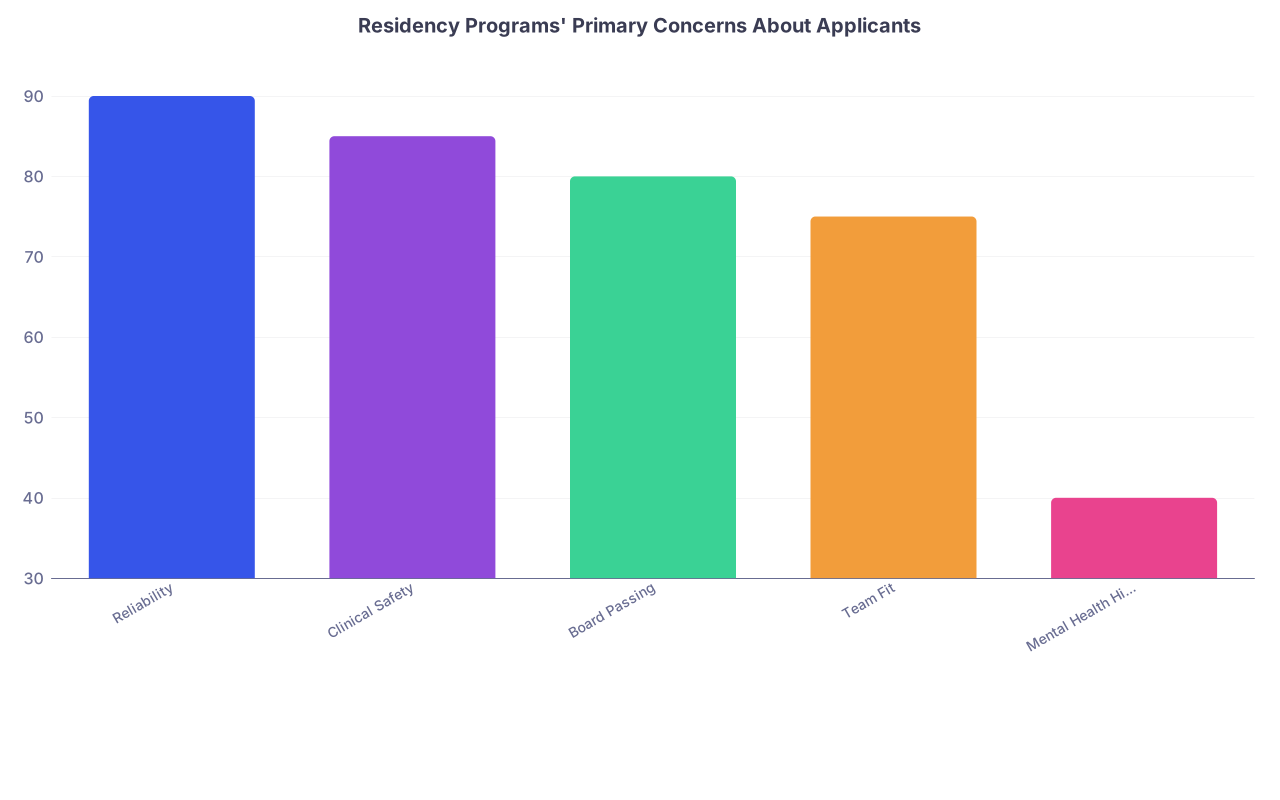
| Category | Value |
|---|---|
| Reliability | 90 |
| Clinical Safety | 85 |
| Board Passing | 80 |
| Team Fit | 75 |
| Mental Health History | 40 |
FAQ: Burnout & Mental Health in Residency Applications
1. If I don’t mention my depression or anxiety, am I being dishonest?
Not automatically. Honesty doesn’t mean giving your entire psychiatric chart to every program. If your condition didn’t lead to leaves, major performance issues, or formal disciplinary action, you’re allowed to keep that private. You only really owe an explanation when there’s something on your record they have to interpret (LOA, repeat year, big gap). You can still be honest about who you are without sharing every diagnosis.
2. I had a mental health leave of absence. Will that ruin my chances?
No, but it will absolutely raise questions. The damage isn’t the LOA itself; it’s how recent it was, how you performed afterward, and how you explain it. If you have at least a year or more of solid, stable performance post-LOA, you can frame it as: “I hit a wall, got appropriate help, and my record since shows I’m reliable.” If your LOA was very recent and you don’t have much post-leave data, that’s trickier – sometimes waiting a year to build that track record is the smarter move.
3. Is it ever a good idea to talk openly about being suicidal in my application?
In 99% of cases: no, not in detail. Programs get very anxious about prior suicidality, especially during training. You can absolutely acknowledge you hit a very dark point and needed serious help, but you don’t need to use the word “suicidal” in an application that’s being read by strangers. That level of detail belongs in a therapeutic space or with people you trust, not in a mass-circulated PDF.
4. Can I mention that I see a therapist or take meds?
You can, but ask yourself what it accomplishes. Saying “I sought counseling and made lasting changes” is usually enough. The fact that you’re on an SSRI is not their business and doesn’t prove anything to them. Programs care about functioning, not pharmacology. If you mention therapy, do it as a sign of maturity and proactive self-care, then move quickly to how that translates into being a better, more stable resident.
5. What if a PD directly asks about my mental health diagnosis in an interview?
You’re allowed to have boundaries. You can pivot to functioning: “I’ve had health challenges, including mental health, that I addressed with professional care. Right now I’m stable and able to meet the demands of residency, as reflected in my recent performance.” If they push hard for specifics, that’s already a red flag about the program. You don’t have to disclose your diagnosis to prove you can do the job.
6. I really want to reduce stigma. Isn’t hiding this just feeding the problem?
You’re not responsible for single-handedly fixing stigma while you’re in one of the most vulnerable, high-stakes phases of your career. You’re allowed to prioritize your survival and future. Once you’re in a program, with some power and stability, you can decide how open you want to be and how you want to advocate. Right now, your job is to get there. That means telling enough of your story to show growth and resilience without giving biased people ammunition to exclude you.
Now: open your personal statement, scroll to the part where you talk about burnout or mental health, and see if every sentence actually helps programs trust your current readiness — if it doesn’t, rewrite it today.