
Most people are lying about how “average” they really are in this process.
You’re not crazy for thinking, “My application is just… fine. Not terrible, not amazing. Am I doomed?” That thought is practically the soundtrack of fourth year. You hear classmates say they’re “nothing special” and then find out they’ve got three publications, a 260+, and their chair calling programs for them. Meanwhile you’re staring at your ERAS PDF thinking:
Is this it? Is this enough? Or am I headed straight for SOAP?
Let’s strip the fantasy away. You want one thing: odds. What happens to people who aren’t rockstars, who have gaps, average scores, normal evals, maybe a lukewarm dean’s letter? Do they actually match, and how often?
First: What Does “Average” Even Mean? (And Why You’re Probably Underestimating Yourself)
Most of us use “average” as code for “I’m embarrassed to say my real stats out loud.”
Average in residency-land usually looks like some mix of this:
- Step 2 in the low 220s–240s depending on specialty
- Around class middle, maybe slightly below or above
- No insane research record – maybe a poster or two, maybe nothing
- Some solid but not glowing comments: “hardworking,” “pleasant to work with,” “reliable”
- Normal extracurriculars – student interest group, maybe some leadership that no one outside your school cares about
In other words: a regular human, not a machine.
Here’s what people forget: the match is mostly built on regular humans. The 260+/AOA people are loud, not common. Programs literally cannot fill their classes with only the top 10%. Even in competitive specialties, there aren’t enough unicorns to go around.
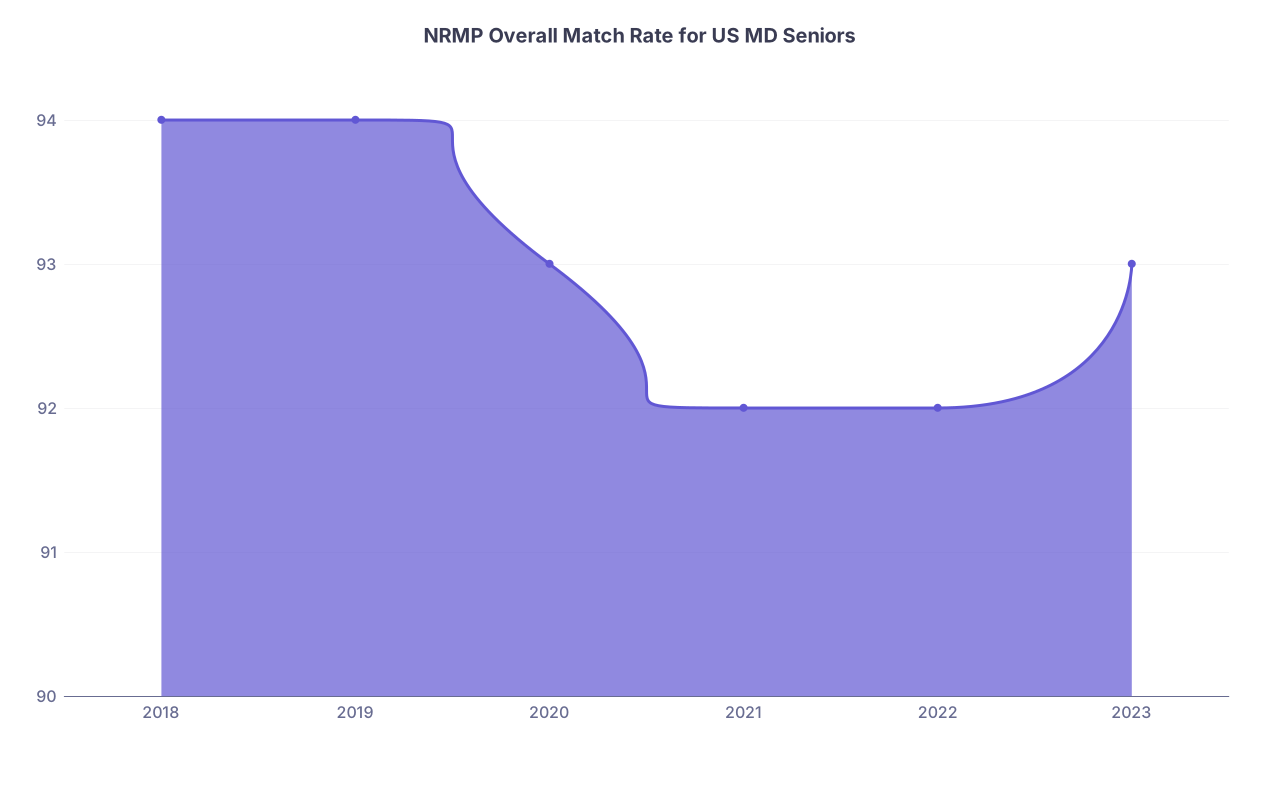
| Category | Value |
|---|---|
| 2018 | 94 |
| 2019 | 94 |
| 2020 | 93 |
| 2021 | 92 |
| 2022 | 92 |
| 2023 | 93 |
Those numbers you see every year? >90% match rate for US MD seniors. That’s not just the stars. That includes the “average” kids, the people who barely scraped passes on some clerkships, the ones who did zero research because they were drowning just staying afloat.
So if the match rate is that high, why does it feel like you will somehow be the rare disaster? Because you know your flaws in excruciating detail and you see everyone else’s highlight reel.
How Often Do “Average” Students Actually Match?
Let me be blunt: if we’re talking about a US MD student aiming for a reasonable specialty (IM, FM, peds, psych, neuro, OB, anesthesia, EM in some regions), with:
- A Step 2 comfortably above their specialty’s deadly-red-flag area
- No catastrophic professionalism issues
- A normal number of programs applied to
They usually match.
Not always. Not all in their #1 city or dream program. But they match somewhere at rates much closer to the overall NRMP numbers than your anxiety is telling you.
Here’s the thing people never say quietly in the library but everyone knows in the dean’s office:
Most unmatched US MDs are not “average.” They usually have one or more serious issues:
- Way too few applications or too competitive a list for their stats
- Very low Step 2 relative to the field
- Visa/IMG status in a tight specialty without a backup
- Failed Step attempt(s) with no strategic adjustment
- Massive red flag: professionalism, failed courses, big unexplained gap
Are there heartbreaking edge cases? Yeah. I’ve watched people with truly solid apps still end up in SOAP because of bad luck plus poor strategy. But “average-good” applicants who cast a sane net? The majority end up matching.
The Silent Killer: Strategy, Not Your CV
This is the part people gloss over when they ask “Will I match?” They want a yes/no answer based on their Step score and number of pubs.
Reality is nastier than that and also kinder: your strategy can save a middle-of-the-road app or tank a pretty strong one.
Let me give you an example I’ve literally seen:
Applicant A:
- Step 2: 234
- Middle of the class
- 1 poster, no big-name research
- Applying IM, no red flags
- Applied to 80 IM programs, good geographic spread, a mix of academic and community
- Matched at a solid mid-tier academic program
Applicant B:
- Step 2: 246
- Top third, nice evals
- 2 publications
- Also applying IM
- Applied to 25 programs, almost all coastal, big-name only
- Didn’t match, scrambled into prelim, then took a brutal extra year to try again
Who’s “stronger” on paper? Obviously B. Who actually matched categorical IM? A.
Not because the universe is unfair (though it kind of is), but because strategy matters more than anyone wants to admit. You can’t control your past exams anymore. You can absolutely control your list, your timing, your breadth.

| Step | Description |
|---|---|
| Step 1 | Average Applicant |
| Step 2 | High Unmatch Risk |
| Step 3 | Moderate Risk, Likely Match |
| Step 4 | Increased Risk |
| Step 5 | Realistic Specialty? |
| Step 6 | Apply Broadly? |
| Step 7 | Backup Plan? |
If you feel “average,” you can’t afford arrogant strategy. You can’t be picky with program tier or geography the way a 260+/5‑pubs candidate can. That doesn’t mean you won’t end up somewhere good. It means you have to play probabilities, not pride.
What Being “Average” Looks Like Specialty by Specialty
I know you probably want a table, so here’s a rough reality check. This is not exact NRMP gospel, but close enough to orient you.
| Specialty | Average-ish Chances If Strategic | Danger Level If You're Truly Average |
|---|---|---|
| Family Med | Very good | Low |
| Internal Med | Good | Low–Moderate |
| Pediatrics | Good | Low–Moderate |
| Psychiatry | Good but tightening | Moderate |
| Neurology | Generally good | Moderate |
| EM | Getting tougher | Moderate–High |
| Anesthesia | Tightening | Moderate–High |
Derm, ortho, plastics, ENT, urology, neurosurgery, ophtho, rad onc? Let’s not pretend. If you’re truly “average” there, especially as US MD without major networking or home-advantage, your risk climbs fast. People do still match with “average” numbers into these, but that’s not the typical outcome. It’s usually coupled with something strong: killer letters, home program backing them hard, unique story, or just obnoxiously good away rotations.
So if you’re “average” and also in love with a hyper-competitive field, the smartest thing you can do for your future self is brutally honest backup planning. Dual apply. Build a parallel path that you can live with. That’s not “giving up.” That’s protecting yourself.
How Many Interviews Do “Average” Applicants Need To Feel Safe?
Here’s where your brain probably spirals at 3 a.m.: “I only have X invites. Is that enough? Am I dead?”
There’s no magic number, but we do actually have data trends:
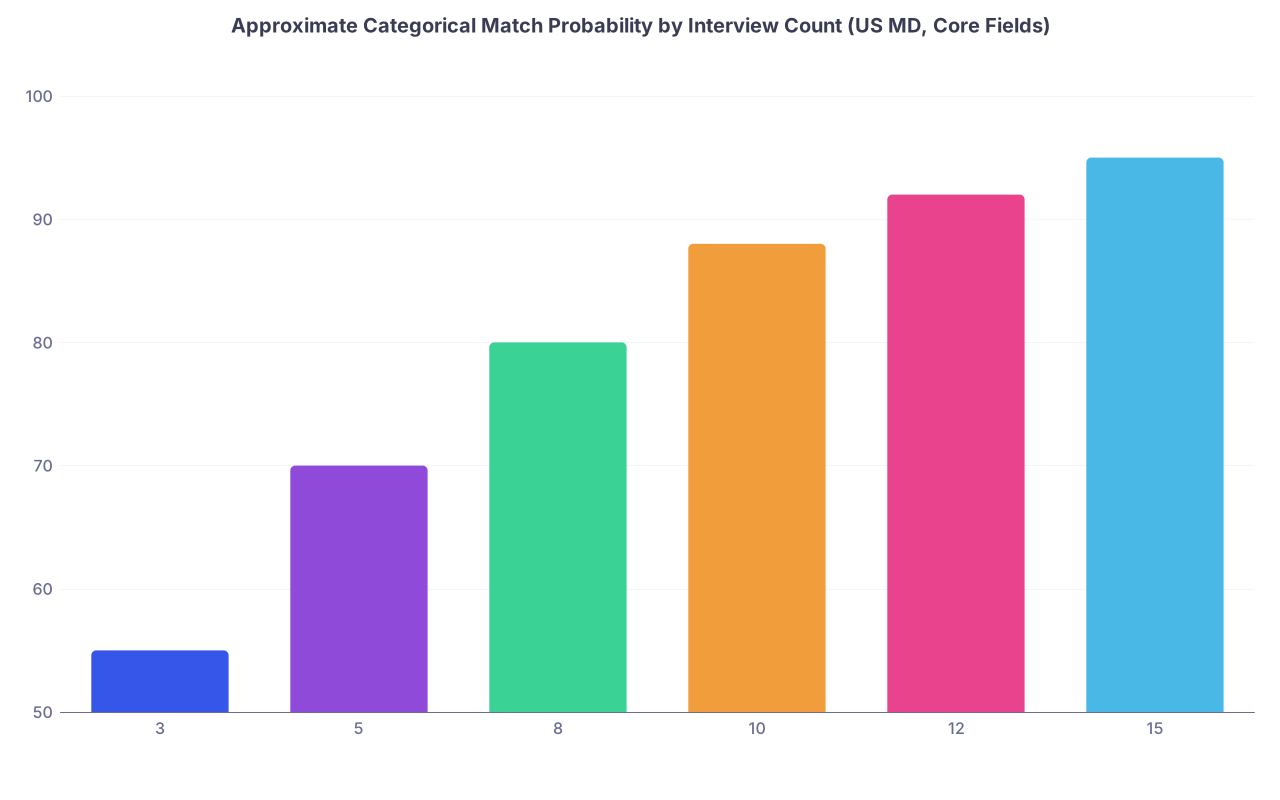
| Category | Value |
|---|---|
| 3 | 55 |
| 5 | 70 |
| 8 | 80 |
| 10 | 88 |
| 12 | 92 |
| 15 | 95 |
Those are broad, rough estimates from years of NRMP charting outcomes, mostly for core specialties like IM, FM, peds, psych. Translation in human terms:
- Around 8–10 solid interviews in a reasonable specialty? Most average US MD applicants match somewhere.
- Under 5? That’s when the real anxiety is justified, and you start thinking seriously about SOAP and contingencies.
And “solid interview” means not outright malignant, not complete disaster fit-wise, and categorical spots, not a stack of prelims when you don’t have an advanced position locked.
So when your classmate with 18 anesthesia interviews says they’re “so nervous they won’t match,” you’re allowed to silently roll your eyes.
The Ugly Truth: Why Average Applicants End Up in SOAP
This is what you’re actually afraid of, right? Not just “not matching my #1,” but being publicly humiliated, watching your name not pop up on Monday and pretending you’re “at the dentist.”
Here’s the pattern I’ve seen for “average” students who SOAP:
They aimed too high and too narrow.
Example: mid-220s Step 2, no research, applied anesthesia to 35 programs all in major cities, little geographic diversity.They didn’t dual apply when they should have.
EM when things got tighter. Anesthesia in a bad year. Certain surgical subs with shaky stats.They had a hidden red flag they didn’t emotionally process as a real problem.
Professionalism comments, that one really bad evaluation, a failure that wasn’t well-explained.They overestimated the power of “vibes” from away rotations.
“But the PD loved me!” Maybe. But also maybe they loved three other students more.
SOAP, for many, is not the result of being “average” but of mismatched expectations and strategy. That doesn’t make it less brutal emotionally, but it does mean it’s not a random lightning strike you can’t prepare for.

| Step | Description |
|---|---|
| Step 1 | Average Stats |
| Step 2 | Narrow Application List |
| Step 3 | Reasonable Specialty |
| Step 4 | Few Interviews |
| Step 5 | Moderate Interview Count |
| Step 6 | High SOAP Risk |
| Step 7 | Lower SOAP Risk |
| Step 8 | Competitive Specialty? |
| Step 9 | Too Few Programs? |
If you’re reading this early in the season, the takeaway is harsh but useful: don’t build a SOAP story for yourself. Build a boring, statistically safe story now.
What You Can Actually Still Control (That Matters More Than You Think)
You can’t retroactively become AOA. You can’t time-travel and not bomb that OB shelf. But even late in the game, there are levers you can pull that help “average” applicants a lot more than they admit.
Letters:
One brutally good letter can change how your application feels to a committee. If there’s an attending who clearly liked working with you, ask them for a strong, detailed letter. Not just a generic one. Sometimes your self-perceived “average” performance reads totally differently when someone describes you as “the most reliable student on our team this year.”
Communication with programs:
I’m not saying spam PDs. But:
- Thank-you emails that sound like a real human wrote them
- One or two genuine, targeted “this program is a top choice for me because X, Y, Z” messages
- Updating programs (appropriately) if something substantial changes: new publication, award, step score
That moves the needle more for “on-the-fence” candidates than for the obvious rockstars.
Rank list strategy:
Here’s where average applicants self-sabotage hard. They try to “guess” who will rank them and then tank their own chances.
Do not play 3D chess with your rank list.
You rank programs in your real preference order, from “I’d be happiest here” down to “I can live with this and not be miserable.” You don’t omit a place just because you “felt awkward” for five minutes on interview day if you’d still attend. Average or not, the math of the algorithm is actually on your side if you’re honest.
The Psychological Side: Why You Feel More Doomed Than You Are
You’re not just asking, “How often do average students match?” You’re asking, “Why does every story I hear make me feel like I’m the one outlier who’s going to crash and burn?”
Two things are happening:
First, survivorship bias. The most dramatic stories travel the fastest: the unmatched US MD with “great stats,” the person who SOAPed into a specialty they hate, the derm applicant with 20 publications who didn’t match. Those are rare, which is exactly why people talk about them like gossip currency.
Second, impostor amplification. Average applicants tend to assume anything good in their application “doesn’t count” (home program? oh that doesn’t matter; good letter? well they were just being nice). While every flaw is highlighted in neon.
Your brain is curating a horror anthology, not a balanced dataset.
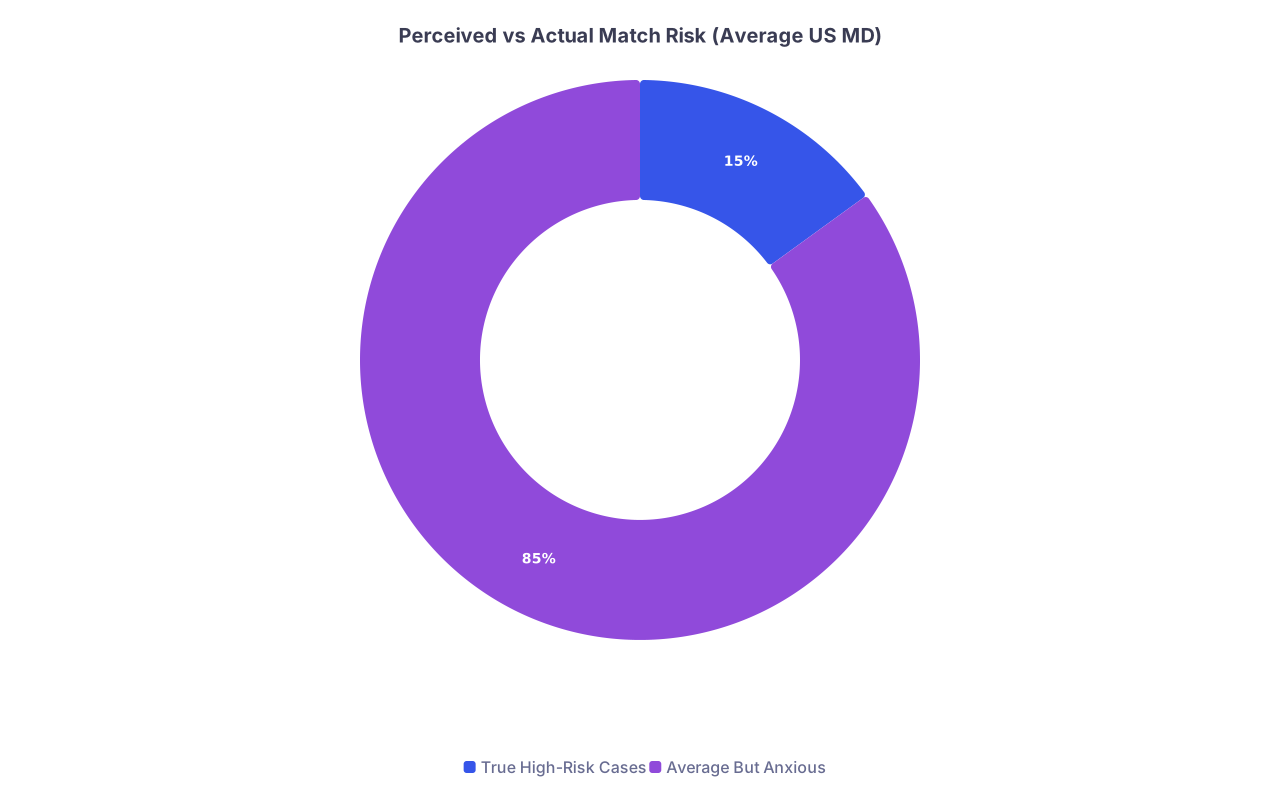
| Category | Value |
|---|---|
| True High-Risk Cases | 15 |
| Average But Anxious | 85 |
In reality, most average US MD applicants with sane planning end up in the “Average But Anxious, Still Matches” bucket. It doesn’t feel that way because you don’t see all the people who quietly match to normal programs and just move on with their lives. They’re not on Reddit writing 2,000-word posts about their trauma. They’re buying scrubs.
How to Know If You’re Actually in Trouble vs Just Anxious
Let’s be uncomfortably honest. If you recognize yourself in most of these, you’re probably more anxious than truly doomed:
- You applied to a reasonable specialty for your stats
- You applied broadly across program tiers and geography
- You don’t have a major professionalism or exam red flag
- You have at least a handful of interviews (ideally 8+ in a core field)
- Faculty who know you reasonably well are not shocked by your plans
On the other hand, your worry is more justified if:
- You’re in a very competitive field and didn’t dual apply
- You have <5 interviews in any field by the time most invites are out
- You quietly have a failed Step attempt or major gap that no one helped you strategically account for
- You massively restricted your list by region or “prestige”
If you’re in that second group, you’re not hopeless. But now it’s time for active damage control: talking to your dean, revisiting backup options, tightening your communication with the places that have shown interest, preparing mentally and tactically for SOAP instead of just catastrophizing it.
Because here’s the hard thing: anxiety feels like doing something. It’s not. It’s mental pacing. At some point you have to swap spiraling for strategy.
FAQ (Exactly 5 Questions)
1. I feel totally average and only have 7 interviews for a core specialty. Am I screwed?
No, but you’re not fully in the comfort zone either. Seven is borderline-but-okay territory for a US MD in things like IM, FM, peds, psych, especially if the programs are a reasonable mix and you’re prepared to rank them all. Focus now on showing up sharp, asking smart questions, and not self-sabotaging interviews. Also talk to your advisor about whether there’s any late outreach they can do for you, but don’t panic-quit the process in your head.
2. My classmates all seem stronger than me. Does that mean programs will see me as weak too?
Your classmates are not the comparison group programs use. They’re looking at thousands of applicants from all over the country. At your school you might be middle of the pack; in the national pool, you might be solidly above average, or exactly normal, which is fine. Stop using the one derm-bound gunner in your small group as your mental baseline.
3. Can a really strong letter make up for average scores?
It can’t magically turn a 215 into a 260, but yes, a powerful, specific letter can absolutely pull you out of the “meh” pile. Programs lean heavily on narrative: if someone trusted and respected says, “This student is outstanding and I’d be thrilled to have them as a resident,” that matters more than you think, especially when your numbers are in a big undifferentiated blob with everyone else’s.
4. Is it better to apply to fewer ‘good’ programs or more including ‘lower-tier’ ones?
If you feel average, volume and breadth beat pride. Better to be choosing between a so-called “lower-tier” program and SOAP than between SOAP and nothing because you only applied to shiny-name places. The match doesn’t reward ego. It rewards probability and flexibility. You can become an excellent doctor from a completely unsexy program.
5. How do I stop obsessing that I’ll be the one average person who doesn’t match?
You probably won’t fully stop, and that’s honest. But you can blunt it. Ground yourself in actual numbers (US MD match rates, your interview count), get a frank read from someone who’s seen many cycles, and then build a worst-case plan you can live with (SOAP targets, potential research year, dual-apply next cycle if needed). Once you’ve sketched out a “if it all blows up, here’s what I do,” your brain has less incentive to keep running disaster scenarios on loop.
Key points: your “average” application is not automatically doomed; strategy and breadth matter more than you want to admit; and the vast majority of average, slightly-anxious-but-reasonable US applicants end up exactly where they need to be—matched, training, and moving on with their lives while next year’s class starts freaking out in your place.