
What if you completely blanked in one residency interview… and that was your only real shot at your dream program?
Because that’s the loop in my head: “That was my chance. I blew it. They think I’m an idiot. I’m done.”
Let’s talk about that. Not in the fake, “you’ll be fine, don’t worry” way. In the real “how much damage did I actually do and what happens now?” way.
What “Blanking Out” Usually Actually Looks Like
I don’t mean you passed out in the chair and woke up on the floor. Blanking out in residency interviews is usually messier and more subtle, and your brain will absolutely exaggerate how bad it was.
Typical versions:
You get asked: “Tell me about a time you handled a conflict on the team.”
And suddenly every story you’ve ever lived disappears. You stare. You say “that’s a good question” way too many times. Your mind is just… static.
Or they ask: “Why our program?” and even though you literally rehearsed this answer in the hotel 30 minutes earlier, it evaporates. You babble some generic thing about “strong clinical training” and “collaborative environment” and internally you’re screaming: say literally any detail about this program, you idiot.
Or the worst one: you get a red-flag question.
“Tell me about that leave of absence.” “What happened with that failed Step attempt?” “Walk me through that low clerkship grade.”
And your brain just slams the panic button. You either say too much, or too little, or you start apologizing, or you sound defensive. Then you walk out convinced you just confirmed every fear they had about you.
Here’s the part that feels unfair: you might’ve done fine on 90% of the interview. But your mind will zoom in on the 10% you botched, loop it on repeat, and call the entire day a disaster.
So the real question isn’t “did I mess up?” You probably did, at least a little. Everyone does. The question is: how much does that actually change your odds?
How Programs Really Weigh One Bad Interview
Let me be blunt: yes, a truly awful interview can tank your odds at that specific program.
But it’s a lot more nuanced than the “one bad answer = no match anywhere” nightmare script your brain is running.
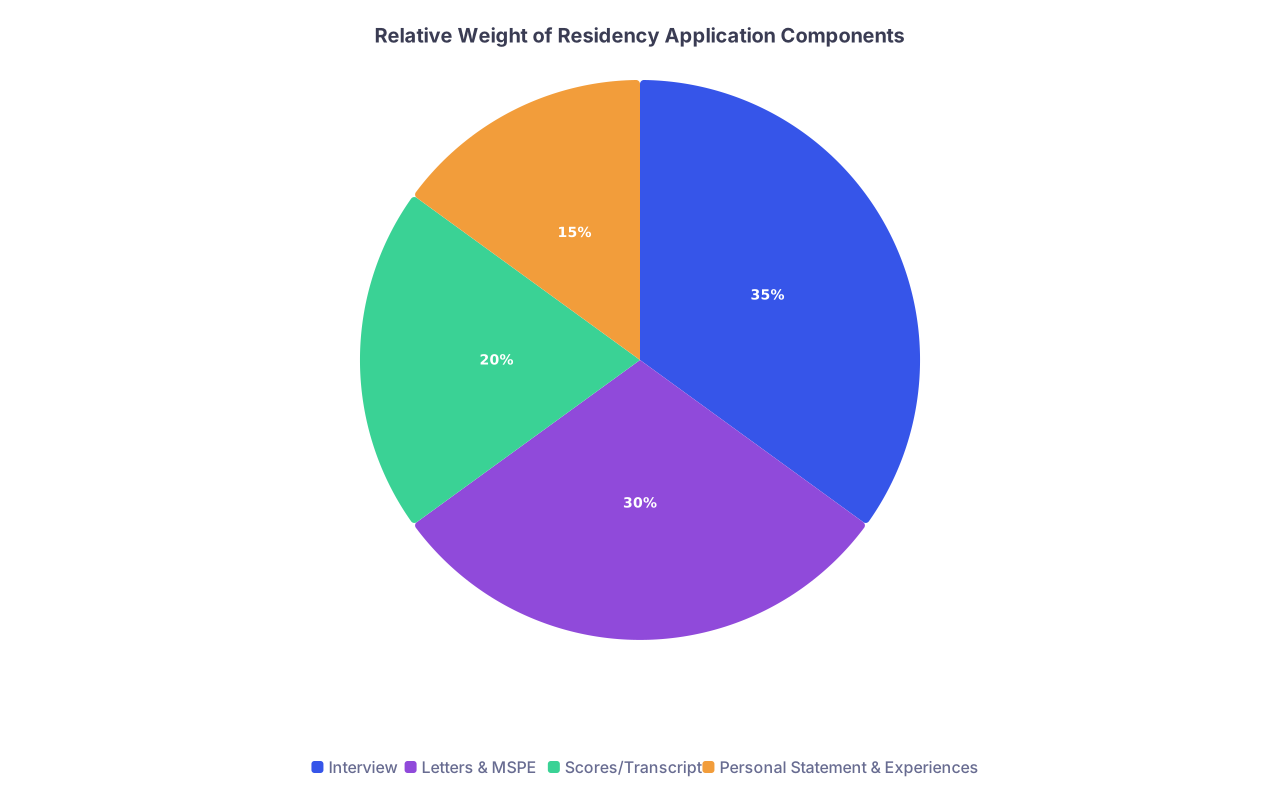
Here’s roughly how interview weight fits into the bigger picture:
| Category | Value |
|---|---|
| Interview | 35 |
| Letters & MSPE | 30 |
| Scores/Transcript | 20 |
| Personal Statement & Experiences | 15 |
Those numbers aren’t exact, but they’re close to how a lot of programs talk behind closed doors. Once you’re at the interview stage:
You’re already “good enough” on paper for that program. They don’t invite people just to reject them for fun (despite how it feels). The interview is mostly: do we want to work with you at 3 a.m. for the next three years?
So what does a “bad” interview actually do?
If you were already borderline and you came off flat or disconnected, it can definitely bump you down the list there. If you were a strong on-paper candidate and clearly kind and not a jerk, one clumsy answer usually doesn’t completely obliterate you.
Most programs don’t tank someone for one awkward moment. They worry about big patterns:
- Weirdly hostile or arrogant vibe
- Can’t communicate clearly at all
- No insight into mistakes
- Zero basic professionalism
Blanking for a question? Losing your train of thought? Rambling once or twice? That’s “normal human under stress,” not “do not rank.”
I’ve heard attendings say after interviews:
“He was nervous, but you could tell he cared.”
“She didn’t answer that question perfectly, but I liked her.”
Human. Not robots. That can work in your favor.
Worst-Case vs Realistic Impact of One Bad Day
Let’s separate your anxiety story from reality.
Worst-case story in your head
- You blanked →
- They hated you →
- They’ll rank you last / not at all →
- Every program will know you’re trash →
- You won’t match →
- Your career is over →
- Med school was a waste and your loans will ruin your life
This is catastrophizing 101. Your brain is trying to protect you by pre-grieving everything.
Now what’s actually on the table?

Realistic range of outcomes
The interview wasn’t as bad as you think
You noticed every stumble. They didn’t. They saw “slightly nervous but fine.”The interview was clearly below your best, but not catastrophic
You might get ranked, but lower than you hoped. Still in the game.The interview truly went poorly
You could fall off the rank list there. It happens. To lots of people.
That’s painful for that one program… but does not automatically doom your entire match.
Here’s the key: each program’s decision is siloed. There is no secret national Slack channel where PDs say:
“Hey everyone, we had Alex Smith today, total disaster, don’t rank them.”
They’re too busy and frankly don’t care enough to do that.
Your bad day at Program X does not poison Programs Y and Z.
Does One Bad Interview Matter If You Did Great Everywhere Else?
Short answer: it matters… at that one place. That’s usually it.
The match is a numbers and probabilities game. Think about it roughly like this:
| Applicant Type | Overall Profile | Effect of 1 Bad Interview |
|---|---|---|
| Strong | Great scores, strong letters, mostly good interviews | Hurts mainly at that one program; match odds still high |
| Middle | Decent scores, mixed interviews | Might lose one realistic option; still many paths to match |
| Risky | Low scores, red flags, few interviews | One bad day can matter more; backup planning is key |
If you’re a strong or even middle-of-the-pack candidate with, say, 10–14 interviews, one disaster day just isn’t the end of the world statistically. People match every year with a mix of “amazing,” “meh,” and “please erase that from memory” interviews.
Where it really stings is if:
- You only had a handful of interviews
- That program was one of your few realistic “fit” places
- Or it was your home or absolute dream program
Then yes, that one bad day feels gigantic. It can absolutely change which specific program you end up at.
But here’s the uncomfortable truth people don’t say out loud: you can have a mediocre or bad day at a dream program and still end up in a solid, even better-fitting place you never expected. I’ve watched that happen.
It doesn’t feel comforting right now because your brain is latched onto loss, not possibility.
How Programs Talk About “Nervous” vs “Red Flag”
If I could stick a microphone in a rank meeting so you could hear how they actually talk about you, I would.
It’s more like this:
- “She was clearly nervous, but she was kind and thoughtful. I liked her.”
- “He took a second to think, but his answers were good once he got going.”
- “She blanked on one question, but otherwise she was solid.”
Versus:
- “He couldn’t answer basic questions about his own application.”
- “She got defensive when we asked about the failed Step.”
- “I’m not sure he actually wants to be here. Vibes were off.”
They can tell the difference between: “this person was anxious” and “this person might be difficult, disinterested, or unsafe.”
Anxiety doesn’t freak them out. Actually, they expect it.
What they need to see is:
- You’re safe
- You’re trainable
- You’re not going to be a nightmare at 4 a.m.
If you blanked, but then regrouped, answered other questions reasonably, didn’t snap or shut down, and showed some insight anywhere in the conversation — you’re probably not a red flag.
Specific Scenarios: How Bad Is Your Bad?
Let’s walk through some specific nightmare moments and how ugly they actually are in program eyes.
Scenario 1: You blank on a behavioral question
They say: “Tell me about a time you failed.”
Your brain: “Never failed. I am both flawless and unemployable. Great.”
You stall. You say “that’s a great question” (again). You stutter through some half-story that doesn’t really answer the question.
How bad is that? Annoying? Yes. Fatal? Almost never.
What they prefer: clear STAR-style story.
What they accept: human trying their best under pressure.
Scenario 2: You choke on “Why our program?”
This one hurts. You know they care about this. You rehearsed it. And you still defaulted to some generic “strong training, diverse patient population” nonsense.
Bad? It’s not great, especially at more competitive places. But unless you also seemed disengaged the whole time, they might just interpret it as nerves or poor prep, not “doesn’t want to be here at all.”
Scenario 3: You mishandled a red-flag question
This is the one that matters most.
If you:
- Sounded defensive
- Blamed everyone else
- Offered zero insight or growth
Then yes, that can seriously damage your chances at that specific place. They worry that the pattern will repeat.
But if you stumbled at first and then eventually got to something like:
“I struggled. I’m not proud of it. Here’s what I changed. Here’s how I know it’s different now.”
That’s not death. That can actually be redeeming.
What You Should Do Right After a Bad Interview (And What Not To)
You walk out. You sit in your car or the hotel lobby. Your stomach is in your throat. You’re replaying every word.
You will be very tempted to do a few things that do not help.
Don’t:
- Email the program immediately trying to “fix” an answer. That usually just shines a brighter light on the thing you’re obsessed with.
- Write a 1,000-word apology in your thank-you note about how anxious you were.
- Ask multiple attendings/friends to dissect every second of it like game tape. It will make you feel worse, not better.
Do:
- Jot down what actually happened. Brief. Factual. Not “I was terrible,” but “I froze on X question; stumbled on Y; everything else ok.” Your memory will distort it over time.
- Rate the day honestly: “overall 6/10” or “overall 3/10” instead of just calling it “disaster.”
- Move your energy to the next interview. Practice the specific questions that tripped you, not the entire universe of possible questions.

| Step | Description |
|---|---|
| Step 1 | Leave Interview |
| Step 2 | Write brief factual notes |
| Step 3 | Identify 1-2 weak question types |
| Step 4 | Targeted practice for next interview |
| Step 5 | Still write notes |
| Step 6 | Felt Bad? |
If the program is truly one of your top choices, you can still send a normal, professional thank-you note. Brief. Grateful. Maybe one sentence of clarification if you genuinely mis-spoke factually — but not a 3-paragraph self-flagellation.
Zooming Out: Will This One Day Decide Your Whole Career?
No. It might decide one line on your rank list. That’s different.
People end up in great, fulfilling careers after:
- Not matching their “dream” program
- Switching specialties
- Doing a prelim year then re-applying
- Matching at a place that wasn’t even top 5 on their list
You’re stuck in the part of the movie where the main character thinks it’s all over. The audience already knows they’re wrong.
| Category | Value |
|---|---|
| 3 | 45 |
| 5 | 65 |
| 8 | 80 |
| 10 | 88 |
| 12 | 92 |
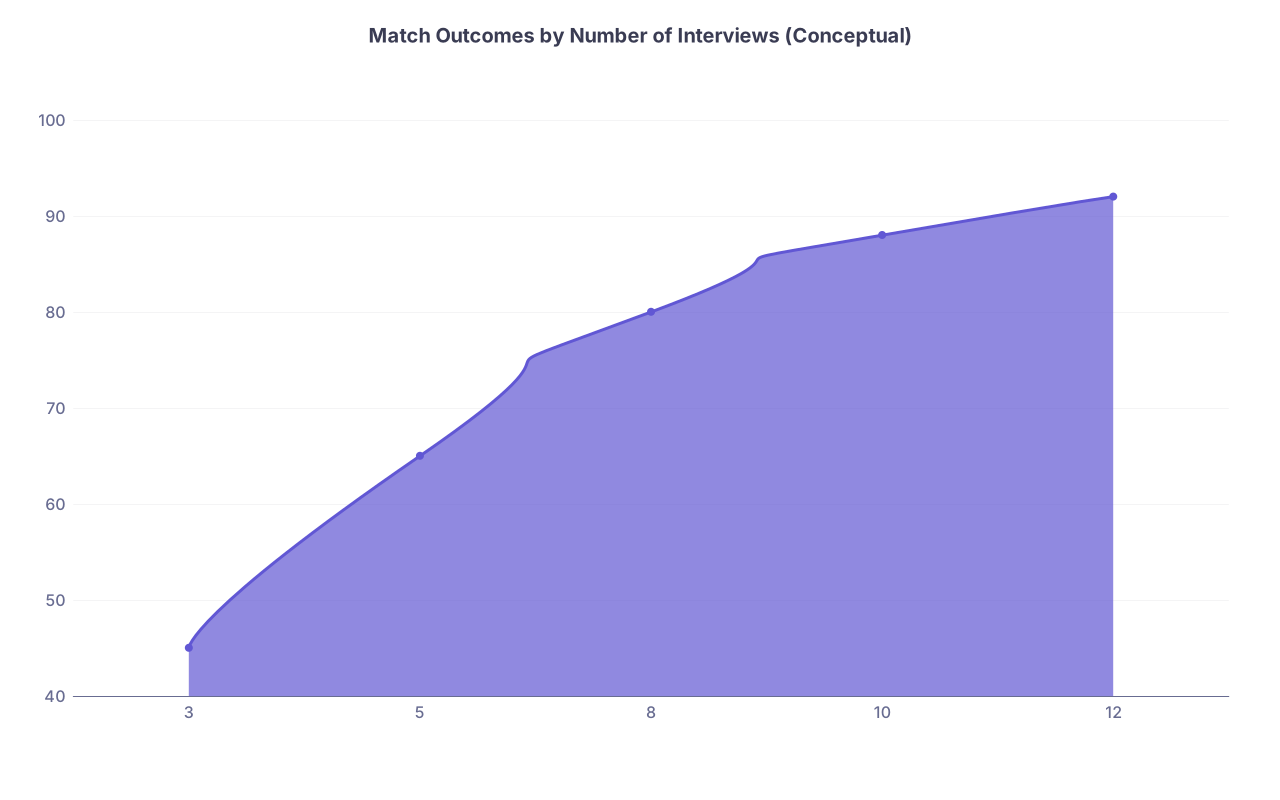
With somewhere around 8–12 interviews in most core specialties, match probability is still high. That doesn’t mean guaranteed. It does mean one program’s opinion of you is not all-powerful.
I know the voice in your head is saying: “Yeah, but I’m the exception. I’m the one who will slip through the cracks.”
Everyone feels like that. Almost all of them still match somewhere.
What Actually Matters Most Now
You can’t resuscitate that interview. It’s gone.
What you can affect:
- How you show up to the next one
- Whether you let this spiral wreck the rest of your season
- Whether you learn anything behind the anxiety
Obsessing over “do they hate me?” doesn’t change the rank list. Improving one weak answer type? That actually might.
If you keep blanking out repeatedly, that’s different. Then we’re not talking about one bad day. We’re talking about a pattern, and you might need to change strategy:
- Practice out loud with real people, not just in your head
- Get a friend or advisor to ask you worst-case questions until they’re boring
- Script and rehearse red-flag explanations until you can say them calmly, even when your heart is racing

Anxiety doesn’t vanish. You just get better at functioning while it screams in the back seat.
When the Fear Is Really About More Than the Interview
Sometimes the panic about one bad interview is actually covering a bigger fear:
“I’m not actually good enough for this field.”
“I tricked everyone into thinking I belong in medicine.”
“If they really saw me, they’d all say no.”
If that’s what’s underneath, no number of “you’ll be fine” comments will calm you down.
Residency interviews are brutal because they feel like a referendum on your worth after years of sacrificing everything. But they’re not. They’re one noisy, human, imperfect data point in a huge, messy process.
You’re allowed to have a bad day. You’re allowed to stutter. You’re allowed to freeze and then recover. That’s not proof you shouldn’t be a doctor. It’s proof you’re a human being in a high-stress situation.
The Short Version
One bad residency interview can absolutely hurt you at that specific program, especially if it was truly rough. But it almost never destroys your entire match chances, and your brain is probably exaggerating how bad it was.
If you got through the day without being rude, unsafe, or completely checked out, you’re probably not the disaster story you think you are.
Key things to remember:
- Programs care much more about patterns and overall vibe than one frozen moment.
- A bad day at one program does not broadcast to every other program.
- Your energy is better spent preparing for the next interview than replaying the last one.
You’re not the only one who’s walked out of an interview thinking, “That’s it, I’m done.” And most of those people are residents now.