
It’s 11:48 p.m. You’ve refreshed your email so many times Gmail is practically begging you to go to bed. Your phone is on 100% volume, screen face-up, notifications allowed from everything even remotely related to ERAS.
You interviewed at your dream program two weeks ago. They said “We’ll be in touch.” They smiled. They seemed excited. One faculty member even said, “I think you’d be a great fit here.”
And now? Silence.
Your brain is filling in the blank with the worst possible answer:
“They hated me. I misread everything. I’m already rejected and they’re just being polite.”
Let’s talk about what’s actually going on. And what this specific kind of quiet usually means—and does not mean.
First: What Silence Usually Means (And What It Almost Never Means)
Let me be blunt:
Most programs are chaotic behind the scenes.
You’re picturing some super-organized PD sitting at a perfectly sorted spreadsheet, calmly ranking candidates and sending thoughtful, personalized emails.
Reality: half the faculty hasn’t submitted their evaluations on time, the PD is covering service, the coordinator is drowning in logistics, and your email follow-up is somewhere under 40 unread messages from vendors, students, and GME.
Here’s the annoying truth:
Silence after the interview, especially from a top program, usually means one of three things:
- They don’t routinely send post-interview communication.
- They can’t say anything meaningful because of NRMP rules and institutional policies.
- They’re still sorting out their rank list, and no one wants to commit to anything in writing.
What it almost never means:
“You’re definitely ranked low” or “We decided we don’t like you.”
Most programs don’t send “we loved you” emails to everyone they’re ranking highly. They don’t have the time, and they’re also terrified of NRMP violations. A lot of PDs have literally been told in meetings: “Do not say anything that can be construed as a commitment.”
So they say nothing.
And you sit there and suffer.
How Much Does Post-Interview Silence Actually Predict Match Chances?
Here’s where you’re probably going to roll your eyes at me, but I’m still going to say it:
Post-interview emails are a terrible predictor of where you’ll actually match.
I’ve seen people get:
- Zero love from a place → still matched there.
- Warm fuzzy “you’re ranked highly” language → didn’t match there.
- Direct “we’ll rank you to match” → still didn’t match there, because the student ranked somewhere else higher and matched there.
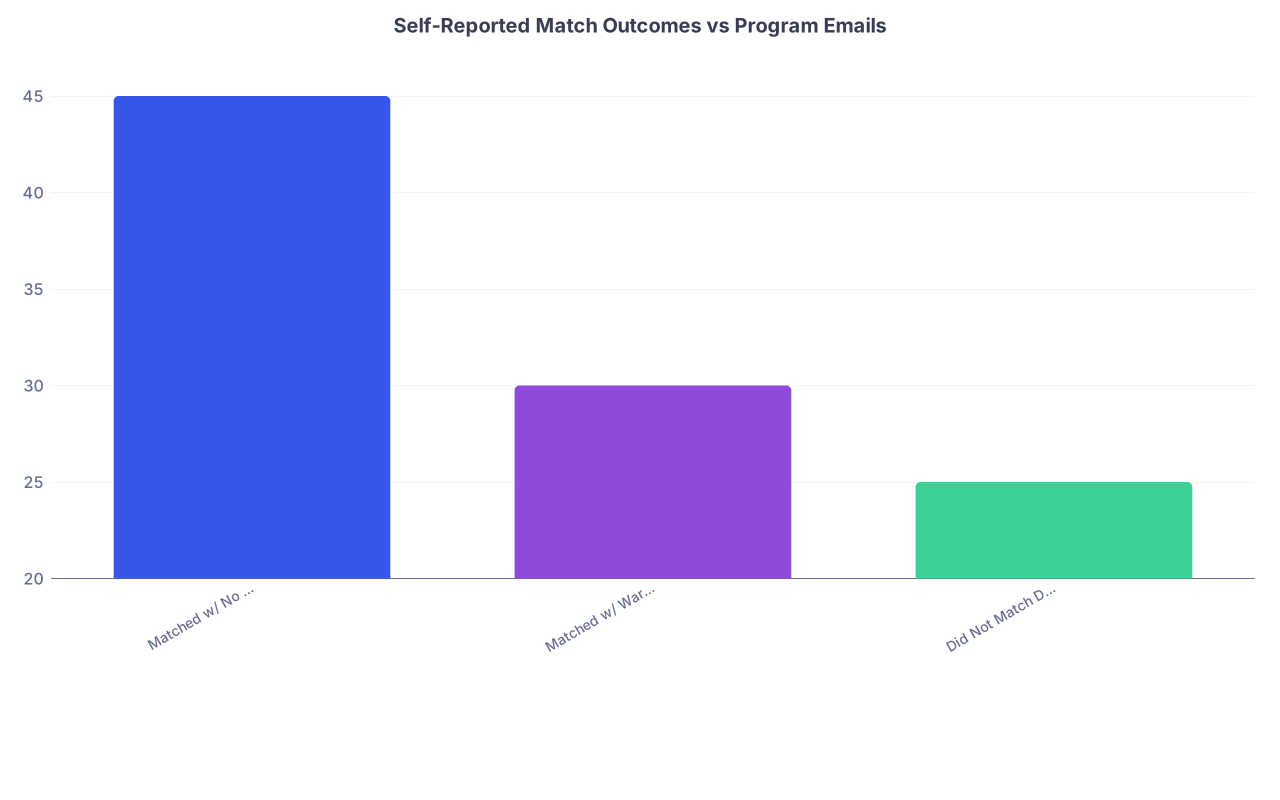
| Category | Value |
|---|---|
| Matched w/ No Email | 45 |
| Matched w/ Warm Email | 30 |
| Did Not Match Despite Email | 25 |
This isn’t perfect data, obviously, but it matches what I’ve heard from countless residents and applicants:
- They matched at a place that never contacted them again.
- They got ghosted by a program that ended up being their number one.
- The place that sent them the most attention? Sometimes not even in the top three of their final rank list.
You know why?
Because the part that matters is your interview day performance + your application + the program’s needs. The email politics are just…noise.
(See also: I Blank Out in Interviews for tips on handling interview-day anxiety.)
The Ugly Head Game: Why This Silence Hurts So Much
The silence itself isn’t the problem.
It’s what your brain does with it.
You replay tiny moments:
- That one awkward laugh.
- The time you interrupted accidentally.
- The question where you rambled.
- The answer where you were too honest.
You compare:
- “My friend got a ‘we really enjoyed meeting you’ email from XYZ. I got nothing.”
- “My other friend heard from that same program and they said ‘we hope to work with you.’ That has to mean something, right?”
Now it feels like a scoreboard. You vs. everyone else.
Except you don’t even know the rules, and the refs aren’t talking.
Here’s the harsh reality: programs are inconsistent. One interviewer might send a nice note to one applicant because they happened to click. Another might send nothing to anyone. Different coordinators may send generic follow-ups randomly. It’s not standardized. At all.
So your anxiety is trying to find meaning in something that’s just…a mess.
Should You Email Them? Or Will You Annoy Them?
This is the big fear, right?
“If I email them, I’ll look desperate.”
“If I don’t email them, they’ll think I’m not interested.”
Here’s the sanity check:
1. Post-interview thank-you emails
If it’s been a few days after the interview and you haven’t sent any thank-you notes, send them. Brief. Professional. Done.
Something like:
Dear Dr. X,
Thank you again for the opportunity to interview at [Program Name]. I really enjoyed learning more about [specific thing] and appreciated your perspective on [specific thing]. The interview confirmed my strong interest in [Program Name].
Best regards,
[Your Name]
You’re not going to tank your chances by sending that. No one on a rank committee is saying, “Well, they wrote a polite thank-you email, so clearly they’re unhinged.”
2. “You’re my top choice” / “Letter of intent” messages
These are trickier. And your anxiety is right to hesitate here.
General rule I’ve seen work:
- If you’re going to send a true “you are my number one” message, send it to one program, late in the season, only if you mean it, and only once.
- Don’t send “you’re my top choice” to multiple programs. That’s gross and, yes, people do get burned when PDs talk.
But also: you are not obligated to send any letter of intent at all. Plenty of people match at their top choice having never sent anything more than a thank-you note.
3. “Just checking in, haven’t heard back”
I almost never recommend this. Programs hate being put in a spot where they feel like they have to respond with something they’re not allowed to say.
If you absolutely must, keep it minimal:
Dear Dr. X,
I hope you’re doing well. I remain very interested in [Program Name] after my interview on [date] and wanted to express my continued enthusiasm about the possibility of training there.
Best,
[Your Name]
No “Have you decided about my application?” No “Where do I stand?” That puts them in a corner and helps exactly no one.
NRMP Rules, Game-Playing, and Why Everything Feels So Manipulative
Part of why this whole thing feels so psychologically abusive is that the rules are vague, and the behavior is inconsistent.
Programs can say things like:
- “You’re a strong candidate.”
- “We really enjoyed meeting you.”
- “You’d be a great fit here.”
They shouldn’t say:
- “We will rank you to match.”
- “You are our top choice.”
- “If you rank us first, you will match here.”
Some do it anyway. Some flirt with the line. Some never say a word.
And then you, sitting alone at 11:48 p.m., read deep meaning into who emailed what and how fast.
But here’s the piece nobody tells you in a way that sinks in:
Your rank list and their rank list are built independently. The algorithm doesn’t reward emailing, flattery, or drama. It rewards mutual interest in the ranking, not in the inbox.

| Step | Description |
|---|---|
| Step 1 | You Submit Rank List |
| Step 2 | NRMP Algorithm |
| Step 3 | Programs Submit Rank Lists |
| Step 4 | Try to Match You to Highest Ranked Program That Ranked You |
| Step 5 | Final Match Outcome |
Whether they emailed you or not doesn’t change where they actually place you on that list.
And that’s the maddening part. Your anxiety wants the email to mean something concrete. But it just…doesn’t.
Real Scenarios I’ve Seen (So You Know You’re Not the Only One)
I’ve seen:
- An applicant who got no post-interview communication from their top three programs. Convinced they were out. Matched at their number one.
- Someone who got a very warm “we were impressed” email from a program. Didn’t even rank it in their top five. Matched somewhere else higher.
- A student who was sure radio silence meant doom. They matched at that silent program. They’re literally a chief resident there now.
- Another person who got a borderline “we’ll rank you to match” email. They ranked that program number one. Did not match there. Matched at their number two. PD later admitted: “We liked you a lot, but a couple of other candidates were slightly higher on our list.”
The pattern is simple:
The story in your head about what silence means is almost always harsher than reality.
What You Can Actually Control Right Now
You can’t force them to email you.
You can’t peek at their rank meeting.
You can’t make the algorithm tell you early.
So what’s left?
- Send any remaining thank-you notes (if within a reasonable window).
- Decide if you truly want to send a single, honest “top choice” email later in the season.
- Build your rank list based on where you’d actually want to train, not who emailed you prettily.
- Limit your email checking. I know, I know. But maybe set certain times: once every few hours, not every 90 seconds.
- Talk to someone who’s been through this. Preferably someone honest, not the “I got 30 interviews and matched derm at Harvard” person who thinks their experience is universal.
(See also: Inside the Rank Meeting for more about what happens in selection meetings.)

Your brain wants action. Anything. Some lever to pull so you don’t feel helpless. But the truth is, after interviews, the most powerful thing you can do is build a thoughtful, honest rank list and then protect your mental health hard.
How to Build Your Rank List When You’re Haunted by the Silence
Here’s the trap:
You start to think, “Well, they never emailed me, so clearly I should bump them down.”
No. Rank on where you’d actually want to wake up at 4:30 a.m. to go work for the next 3–7 years.
Ignore:
- Who emailed first.
- Who sounded flirty.
- Who was “so sure they’d love to have you.”
Focus on:
- Where you felt like a human, not a number.
- How the residents looked at 3 p.m. on a random weekday—exhausted but okay, or absolutely wrecked.
- Whether you can realistically see yourself in that city, in that hospital, with those people, when everything is hard.
The match algorithm protects you if you’re honest.
It doesn’t protect you from playing games with yourself because a program stayed silent.

Quick Reality Check: Are You Actually Ghosted?
Sometimes what feels like “they never emailed me” is actually just…normal.
| Program Type | Post-Interview Contact Pattern |
|---|---|
| Big academic IM | Often minimal or no individual emails |
| Competitive surgical | Mixed: some love-bomb, some go totally silent |
| Community programs | Sometimes more warm, sometimes generic |
| Highly regulated systems | Often strictly no post-interview signals |
| Smaller specialties | More variable, depends heavily on PD |
Plenty of very good, very humane programs simply don’t engage in post-interview back-and-forth. They think they’re being fair. Or they’re just avoiding trouble. Or they literally don’t have time.
You interpret it as rejection.
They think they’re being neutral.
That disconnect is brutal. But it does not mean you’re out.
FAQ: The 5 Questions Your Brain Won’t Stop Asking
1. Does “no email” mean I’m ranked low or not at all?
No. It means you have no clue where you stand. That’s it.
I’ve seen applicants with zero contact get ranked to match. I’ve also seen people getting multiple warm emails from a program and still not match there. There is no reliable correlation. Silence is absence of data, not negative data.
2. My friend got a “we really enjoyed meeting you” email and I didn’t. Am I doomed?
No. Different interviewers send different things to different people. One faculty might email only one or two people they personally vibed with. Another might send a mass thank-you to everyone. Another sends nothing ever. You’re comparing your inbox to a completely different communication style, not necessarily your standing.
3. If I tell a program they’re my top choice, will it help?
Sometimes a little. Sometimes not at all.
If they’re already ranking you very highly, it may nudge them to keep you there. If you’re borderline, it might bump you slightly. If they’re not ranking you at all, it changes nothing.
It can be worth doing once, honestly, and only if you mean it. But it’s not a magic unlock. And it’s definitely not required to match at your top choice.
4. Can I hurt my chances by sending too many emails?
Yes. You can come off as anxious, demanding, or not understanding boundaries if you keep “checking in” or asking for feedback or “just wondering where I stand.” One thoughtful thank-you and, optionally, one genuine “top choice” email is fine. A string of “just following up again” messages is not.
5. What if I hear nothing from every program? Am I going to go unmatched?
No. Lots of people hear almost nothing between interviews and Match Day. They still match, often at programs they thought had forgotten about them. The silence feels like an omen, but it’s really just how the system is built: opaque, inconsistent, and emotionally punishing.
You’re sitting there, exhausted, refreshing an inbox that may never give you the reassurance you’re begging for.
Years from now, you won’t remember which programs emailed you back. You’ll remember where you actually trained, who you became there, and how you handled this stretch of uncertainty when nothing made you feel safe—but you still kept going.