
It’s late January. You just finished a residency interview, you’re exhausted, and your brain feels like mashed potatoes. You log into your email in the parking lot “just to check,” and there it is:
“Thank you for interviewing with us. We’d love to know where you’re planning to rank our program on your list.”
Your stomach drops.
You’re replaying the interview in your head, that moment when the PD or APD casually said, “So… where do you think we’ll fall on your rank list?” And you froze. Or you babbled something weird. Or you lied. Or you told the truth and now you’re convinced you broke some unspoken rule and sabotaged everything.
Welcome to one of the worst head games of residency season.
Let’s walk through this like two people on the same sinking ship, because I promise: you are not the only one panicking about this.
First: Are They Even Allowed To Ask About My Rank List?
Short version: They shouldn’t ask. But some still do.
NRMP rules are actually clear about this stuff, but programs either ignore it, conveniently “forget,” or try to dance around it.
They’re not supposed to:
- Ask you to disclose your rank order list
- Ask for a commitment about how you’ll rank them
- Pressure you for “number 1” declarations
- Suggest you’ll be ranked higher if you rank them higher
They can:
- Express strong interest in you
- Say things like “You would fit well here”
- Ask what you’re looking for in a program
- Ask which geographical region you’re focusing on
But here’s the problem: what they’re “supposed” to do doesn’t change the fact that you’re sitting there, in real time, with a PD looking at you and saying:
“So, are we near the top of your list?”
And you’re thinking:
If I say yes and it’s not true, am I lying?
If I say no, am I sunk?
If I dodge, do I look shady?
You feel trapped. That’s exactly why this feels so awful.
The Moment It Happens: What Do You Say In the Room?
Let’s imagine you’re back in the interview. You’re on Zoom or sitting in some conference room, and they hit you with it point blank.
“Where will you rank us?”
Your heart rate spikes. You have 1.5 seconds to decide if you’re going to be ethical, strategic, or both.
Here’s the reassuring part: you don’t have to answer directly, and you won’t ruin your chances by politely refusing to disclose.
I’ve seen people handle this well with variations of:
- “I’m still in the process of finalizing my list, but I can say I’m very interested in [specific features of the program].”
- “I’ve really liked a few programs for different reasons; I plan to submit a fair and honest rank list after I reflect on everything.”
- “I’m not sharing my specific rank order with any programs, but I can say this interview has definitely kept you in serious consideration.”
Notice what’s happening in those answers:
- You’re not giving a number.
- You’re not committing.
- You are expressing genuine interest.
You’re allowed to have boundaries. You can basically say “I’m not telling you my exact rank, but I do like you,” in more polite language.
The anxiety brain says: “If I don’t say I’ll rank them #1, they’ll drop me.”
Reality: Good programs know the Match works when both sides make honest lists. They’re not supposed to be ranking you based on how obediently you answer rule-breaking questions.
Will there be some insecure, toxic programs that don’t like you dodging the question? Maybe. Do you want to train there for 3–7 years? That’s a separate, ugly question.
But What If I Already Told a Program They’re #1… and They’re Not?
Yeah. This is the one that keeps people up at night.
Maybe on your second interview in October, you were excited, caught off guard, and said something like, “You’re definitely my top choice right now.”
Then you interviewed at your actual dream program in December and now your stomach sinks every time you think about it.
Two scenarios here:
You said: “You’re my top choice” when you genuinely felt it at that time.
You didn’t lie. Feelings changed. New data came in. That’s life.You sent: “I will be ranking you #1” in a post-interview email when you had no intention of doing that.
That’s closer to an outright lie. Not the worst sin in human history, but yeah, it feels gross.
Reality check:
Programs know applicants say this to multiple places. They’re not naive. Every PD has seen “You’re my #1” emails from people who didn’t match there. They complain about it over coffee. It’s a thing.
Is it great to over-promise? No.
Is your career over? Also no.
You don’t need to send a follow-up confession email saying, “Actually you’re #3 now.” That helps no one and just makes everything more awkward.
What you can do:
- Stop promising specific rank positions to programs you’re not sure about
- Going forward, use language like “I will be ranking your program high on my list” if you’re genuinely enthusiastic but not ready to commit to #1
Once the rank list is submitted, let it go. There’s nothing to fix retroactively. The guilt is just anxiety chewing on itself.
Can Being Honest Hurt My Chances?
Here’s the nightmare thought: If I say “I don’t know yet” or “I’m not comfortable sharing my exact rank,” they’ll immediately move me to the bottom of their list.
Let me be blunt: any program that punishes you for not disclosing your rank list is waving a big red flag about their culture.
Healthy programs care more about:
- Your fit
- Your work ethic
- Your communication skills
- How you treat other people
…than about you playing some pre-Match loyalty game.
Also, the Match algorithm is designed so your optimal move is to rank programs in your true order of preference. Not to game it. Not to tell programs what they want to hear.
So what’s the actual worst-case scenario if you politely don’t say?
- Maybe a paranoid program interprets your non-answer as “They’re not into us”
- Maybe they drop you a few slots
- You still might match there if other people rank them lower or match elsewhere
But here’s the really fun part: you will never know. You’ll never see their rank list. You’ll never know if your answer “cost” you anything. So torturing yourself over this hypothetical is just… self-harm for no payoff.
You’re allowed to protect your own integrity and privacy. The algorithm actually works better when everyone does.
Post-Interview Emails and “Where Will You Rank Us?” Messages
Sometimes the horror doesn’t happen live. It shows up in your inbox.
“Dear Applicant, following your interview, we remain very interested in you. We’d love to know if you’re considering ranking our program highly.”
You stare at it like it’s a bomb.
Options you’ll want to choose (but probably shouldn’t):
- Ignore it entirely and then feel guilty
- Break down and say “You are absolutely my #1” when they’re not
- Write some weird 4-paragraph essay justifying your entire thought process
Better approach: short, polite, noncommittal, but appreciative.
Something like:
“Thank you so much for the follow-up. I really enjoyed meeting the residents and faculty and was impressed by [specific detail]. I’m still in the process of finalizing my rank list, but your program will definitely be under strong consideration. I appreciate your time and the warm welcome.”
You gave them:
- Gratitude
- Specific praise
- A clear signal of interest
You did not:
- Reveal your exact rank
- Make a promise you might regret
That’s enough. You don’t owe them more transparency than that.
What If I Panicked and Said Something Dumb in the Interview?
You said, “Yes, you’re my top choice” when you didn’t mean it. Or you blurted, “I think you’ll be in my top 3,” and now you’re obsessively rearranging your rank list trying to match that comment.
Or you did the opposite:
They asked, “Where will we fall?” and you said, “I don’t know, I’m still thinking,” and now you’re convinced you looked disinterested, cold, or ungrateful.
Here’s the ugly truth: every applicant says something awkward on at least one interview day. Every. Single. Person.
How much do programs weigh that one answer, out of the whole interview? Not as much as your brain thinks.
They care more about:
- Did you seem like someone they can stand at 3 a.m.?
- Did you ask thoughtful questions?
- Did you seem to understand the specialty and the program?
- Did you treat staff, coordinators, and residents kindly?
This rank-list question is one tiny piece of a much bigger puzzle.
If you’re really spiraling, you can send a brief follow-up:
“Thank you again for the interview. I realized I may have sounded uncertain when asked about my rank list. I’m still processing all my interviews, but I wanted to reiterate that I’m very interested in your program because of [specific reasons].”
And that’s it. No apology essay. No emotional confession. One normal human email.
Then you let it die. Obsessing over that one moment won’t change anything now.
The Truth About Programs Fishing for Rank Info
Let me be a bit cynical for a second.
Some programs ask where they’ll be ranked because:
- They’re insecure about filling
- They’re trying to game the Match (even though it doesn’t really help them that much)
- Someone on their team hasn’t internalized NRMP rules
- It’s “just how they’ve always done it”
It’s not about you personally. You didn’t do something wrong to “deserve” this awkwardness. You just walked into a system that’s half-regulated and half vibes.
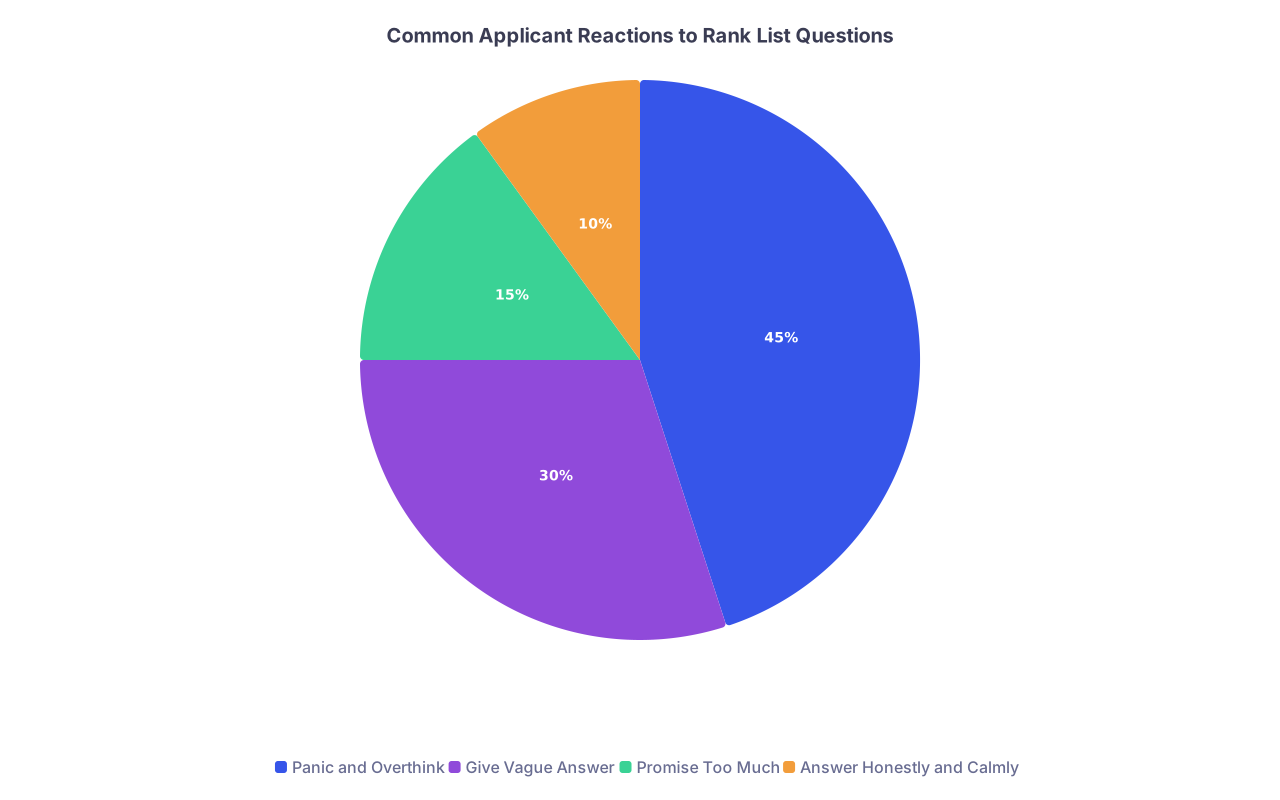
| Category | Value |
|---|---|
| Panic and Overthink | 45 |
| Give Vague Answer | 30 |
| Promise Too Much | 15 |
| Answer Honestly and Calmly | 10 |
Most people panic. Most people overpromise at least once. Most people say something they wouldn’t say if they had more time to think. The system almost guarantees it.
None of that disqualifies you from being a good resident.
How to Decide What You’re Willing To Say (Before It Happens)
The best way to not choke in the moment is to decide your boundaries ahead of time. Like an internal script.
Here’s a simple mental rule set you can adopt:
- “I will not tell any program my exact numeric rank position.”
- “I will express enthusiasm honestly when I feel it.”
- “I won’t promise #1 unless I’m 100% sure and prepared to stand by it.”
- “If cornered, I’ll say I’m still finalizing my list but I’m strongly interested.”
You don’t have to say this out loud. Just commit to it privately. Then when somebody ambushes you, you’re not inventing your ethics policy on the fly.
If you’re worried you’ll freeze, literally write out a sentence or two and practice saying it out loud. Sounds stupid, but it works. You don’t want the first time the words come out of your mouth to be in front of a PD on Zoom.

| Step | Description |
|---|---|
| Step 1 | Asked about rank list |
| Step 2 | Give polite non-answer |
| Step 3 | Express strong interest only |
| Step 4 | State clearly and honestly |
| Step 5 | Reaffirm fit and enthusiasm |
| Step 6 | Want to disclose? |
Quick Reality Check on Match Outcomes
Your brain is probably doing that thing where it takes this one awkward question and expands it into “I’m not going to match anywhere.”
That’s not how this works.
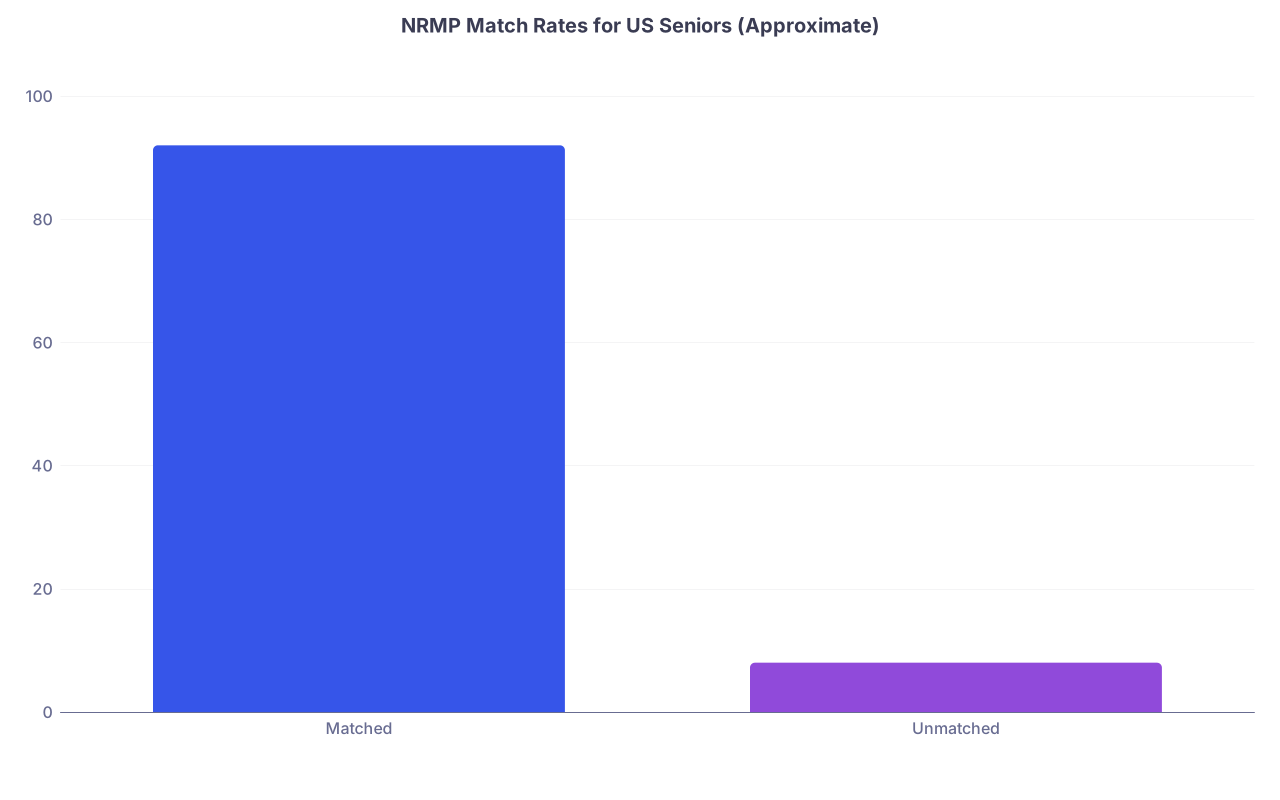
| Category | Value |
|---|---|
| Matched | 92 |
| Unmatched | 8 |
The overwhelming majority of US MD seniors match somewhere. DO seniors and IMGs have more variability, yeah, but even there, this one question isn’t the pivot point for your whole career.
You’re not going to blow up your entire match outcome because you refused to say, “You’re my number one.”
Rank the programs in the order you actually want them. Not the order you think will make PDs happy. The algorithm favors your preferences if you’re honest.
Tiny Scripts You Can Actually Use
Here’s a little cheat sheet you can mentally carry into your next interview.
If they ask:
“So… will we be near the top of your list?”
You:
“I’ve really liked what I’ve seen here today. I’m still finalizing my list after all my interviews, but I can say I’m very interested in your program.”
If they push harder:
“Are we your number one?”
You:
“I’m not sharing my exact rank order with any program, but you’re absolutely a program I could see myself at, and I’ll be giving serious thought to ranking you highly.”
If this comes in an email and you like them:
“Thank you for reaching out. I really appreciated [specific thing]. I’m still organizing my final rank list, but your program will definitely be under strong consideration.”
If this comes in an email and you don’t like them:
“Thank you again for the opportunity to interview. I enjoyed learning more about your program and appreciated meeting the team.”
You’re not obligated to say more than that.
| Situation | Example Response Brief |
|---|---|
| Live question, you like program | "Still finalizing, but very interested." |
| Live question, you’re unsure | "Considering several, you’re in the mix." |
| Email from program you like | "Strong consideration, really enjoyed visit." |
| Email from program you don’t love | "Thank you, appreciated the opportunity." |
| You already overpromised | "Stop promising, don’t send correction email." |

FAQ – Exactly 5 Things You’re Probably Still Worried About
1. Will a program rank me lower if I refuse to say where I’ll rank them?
Some might. Many won’t. The ones who punish you for having boundaries are usually not the healthiest environments anyway. You cannot and should not sacrifice honesty or your comfort just to appease a program that’s already ignoring NRMP spirit.
Rank them where you want them. That’s your only rational move.
2. Is it “lying” if I said “you’re my top choice” early in the season and then changed my mind?
No, not if it was true at that time. People change their minds based on new information. That’s normal. If you sent explicit “You’re my #1” emails to multiple programs knowingly, yeah, that’s more misleading. Still not career-ending, just a lesson learned. Don’t spiral forever over it.
3. Should I email a program to “correct” myself if I told them they were #1 but now they’re not?
No. That doesn’t help you or them. It creates awkwardness and adds nothing to your match outcome. Your submitted rank list is what matters. Quietly submit the honest list you want, and move on.
4. Do programs actually care about those “You’re my #1” emails?
Some do, some don’t, but almost all know applicants send them to multiple places. They’ve been burned before. They take it with a grain of salt. A thoughtful, specific “I really liked your program because of X, Y, Z and will be ranking you highly” usually comes across as more genuine than “You’re my #1.”
5. What if I froze and said something awkward or contradictory in one interview?
Then you’re human. They’ve seen worse. One awkward answer, even about rank lists, almost never decides your fate. If the rest of the day went well, you asked good questions, and seemed like someone they can work with, that matters more. Send a brief, normal thank-you email, reassure yourself you’re not the first person to fumble this, and get back to building an honest rank list.

Final Takeaways
- You don’t have to disclose your rank list. You’re allowed to give polite, vague answers and still be a strong candidate.
- Don’t promise #1 lightly. If you’re not sure, stick to “rank you highly” or “strong consideration.”
- The Match algorithm protects you when you’re honest. Rank programs in the order you actually want them, not in the order you think they want to hear.
You’re anxious because you care. That’s not a flaw. Just don’t let that anxiety talk you into doing things that make you feel gross or trapped.