
What if you wake up on Match Day and realize you literally never had a chance because you applied to way too few programs?
Reality check: Did you actually under-apply?
Let me be blunt: almost everyone thinks they applied to too few programs at some point in this process. But some of us… are right.
So first, you need to figure out which group you’re in:
- Normal applicant anxiety
- Or genuinely under-applied and at higher risk
Here’s the uncomfortable truth: the “right” number of applications depends on your specialty and your stats and your red flags. There is no universal safe number.
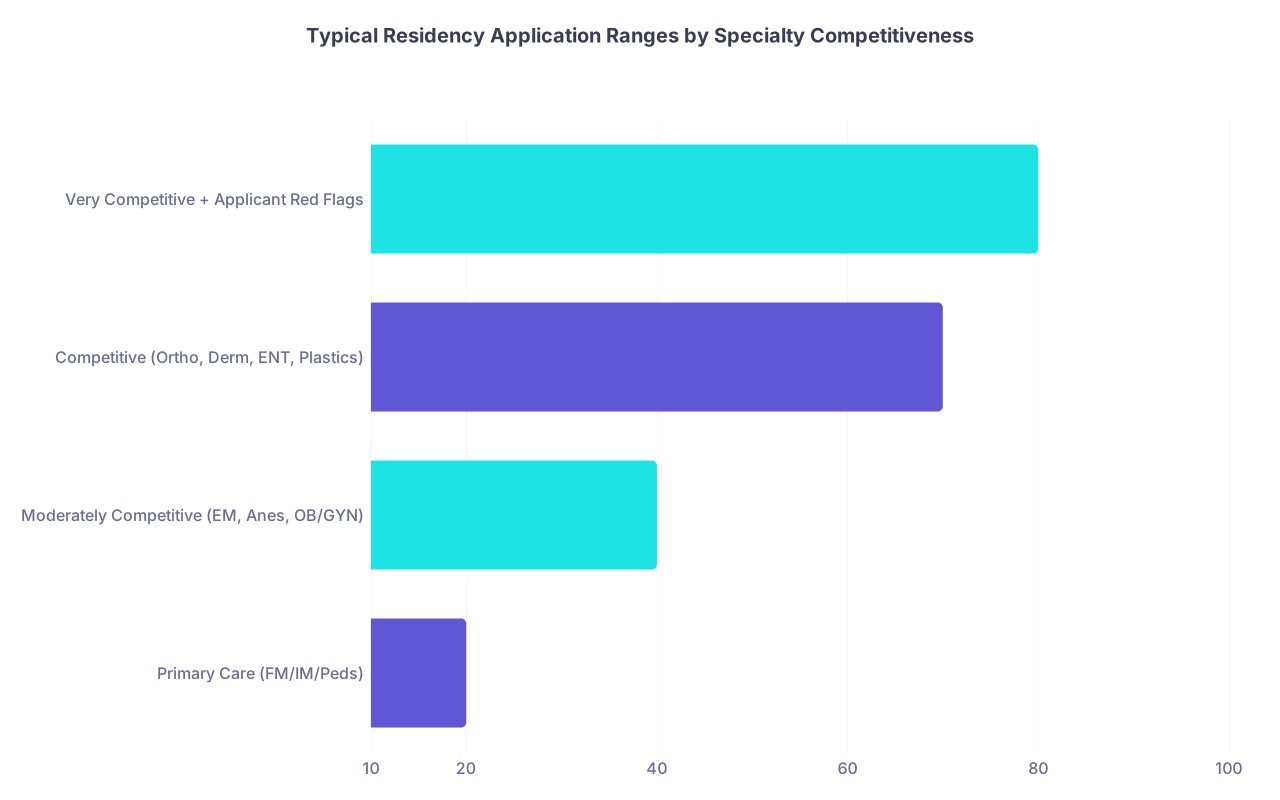
| Category | Value |
|---|---|
| Primary Care (FM/IM/Peds) | 20 |
| Moderately Competitive (EM, Anes, OB/GYN) | 40 |
| Competitive (Ortho, Derm, ENT, Plastics) | 70 |
| Very Competitive + Applicant Red Flags | 80 |
Those are rough ballparks, not rules. I’ve seen:
- Someone match EM after applying to 35 programs.
- Someone go unmatched in IM after applying to 15 with mediocre scores and no home program.
- A derm applicant match with 40 apps and another not even come close with 80.
So before you spiral, ask yourself three hard questions:
What specialty am I applying to?
Applying to FM with 25 apps is not the same as applying to ortho with 25 apps.Where do I actually fall compared to average applicants?
Not “how my friends make me feel,” but actual data: Step scores, class rank, research, home program support.Do I have any red flags?
Step failure, leaves of absence, mediocre letters, no away rotations in competitive fields, big specialty switch late in the game.
If your numbers are average or above for a less competitive specialty (FM, IM, Peds, Psych) and you applied to 25–30+ reasonably chosen programs, you’re probably more anxious than doomed.
If you’re in a competitive specialty and applied fewer than, say, 50–60 programs with no obvious advantage (top school, insane research, strong connections) — yeah, you might’ve under-applied.
And if you have red flags and applied near the low end of recommended ranges for your specialty? Your worry is not irrational.
Signs you actually under-applied vs just spiraling
There’s the voice in your head, and then there are actual warning signs.
Here’s how I’d separate them.
Mostly anxiety (common, painful, but not catastrophic)
You’re probably just spiraling if:
- You’re in FM/IM/Peds/Psych and applied to 30–40+ programs.
- Your Step 2 is at or above the program mean.
- You don’t have fails or repeated years.
- You applied mostly in your region or where you have ties.
- You’re still early in the interview season and haven’t heard much yet.
This is the “I saw someone on Reddit who applied to 70 and I only did 35” panic. That doesn’t automatically mean you’re screwed. It means you’re comparing yourself to the most anxious people on the internet.
Legit concerns (where I’d say: okay, let’s act)
You may have a real under-application problem if:
You’re in a competitive specialty (Derm, Ortho, Plastics, ENT, Urology, Ophtho, Neurosurgery, some EM markets now) and:
- Applied fewer than 40–50 programs
- Or you mostly targeted reach programs (university, top names)
You’re in a moderately competitive specialty (Anesthesia, EM, OB/GYN, sometimes Gen Surg) and:
- Applied fewer than 30–35 programs
- And your application is average or below average
You’re in IM/FM/Peds/Psych and:
- Applied under ~20 programs
- Or limited yourself tightly (e.g., “only in one expensive coastal city”)
You have red flags AND:
- Applied at or below the average number of programs people without red flags use
This is where your worry is actually your brain trying to protect you — and you should listen.
When to panic based on the calendar (and when not to)
Your stress level probably spikes every time you check your email. The timeline actually matters here.
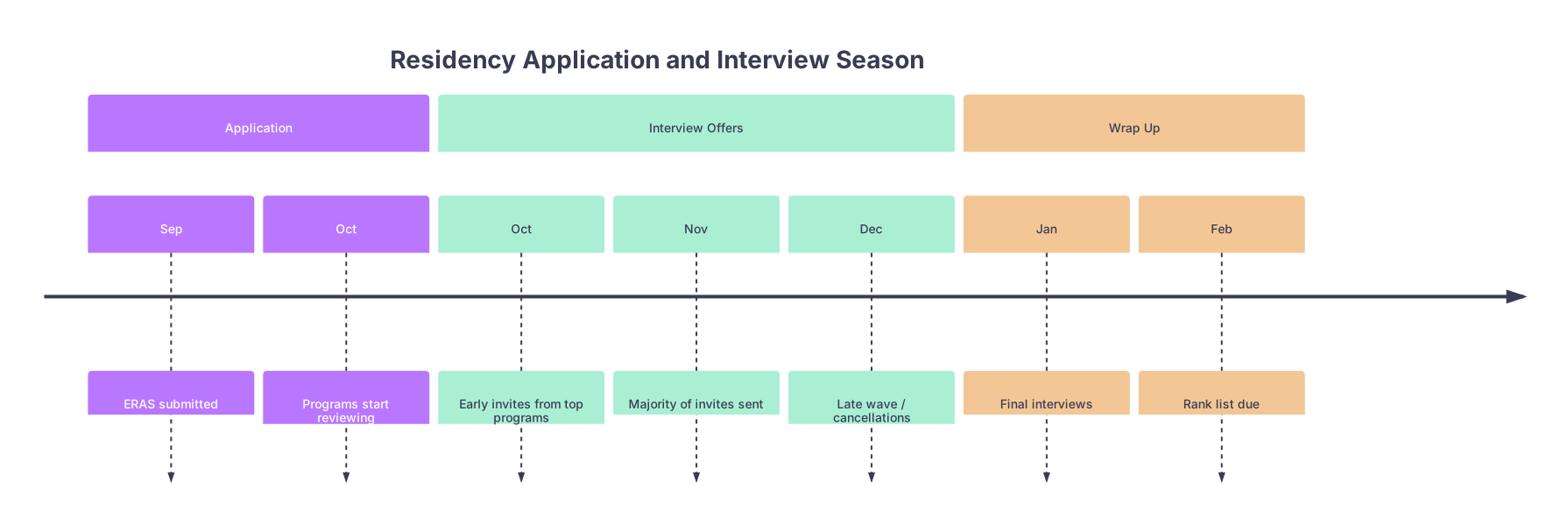
| Period | Event |
|---|---|
| Application - Sep | ERAS submitted |
| Application - Oct | Programs start reviewing |
| Interview Offers - Oct | Early invites from top programs |
| Interview Offers - Nov | Majority of invites sent |
| Interview Offers - Dec | Late wave / cancellations |
| Wrap Up - Jan | Final interviews |
| Wrap Up - Feb | Rank list due |
Rough guide:
October
Silence is terrifying but not definitive. Early invites tend to go to superstar applicants or internal candidates. Lack of invites here = anxiety, not necessarily disaster.Mid–Late November
This is where the signal gets real. By then:- Many programs have already sent most of their invites.
- You should have some interviews in most specialties if things are going okay.
December
You’ll see:- Cancellations from others opening up a few spots.
- A random sprinkling of late invites.
But you cannot rely on December to save an application that was under-applied and underperforming to begin with.
January
Mostly finishing interviews and final cleanup. New invites here are exception, not expectation.
So when to "panic"? I’d rephrase it to: when to acknowledge there’s a problem.
- If by mid–November you have:
- 0–1 interviews in a competitive specialty → red alert.
- 0–2 interviews in a less competitive specialty → very concerning.
- If by early December your total interview number is:
- Competitive field: fewer than ~5
- Less competitive field: fewer than ~7–8
Then ignoring that would be denial.
Panic itself doesn’t help. But recognizing you might’ve under-applied gives you time to actually do something.
What you can still do if you think you under-applied
This is the part that matters. You can’t go back and submit ERAS to more ACGME programs now that deadlines have passed. But you’re not completely powerless.
Let’s talk options, even the ones no one wants to say out loud.
1. Get brutal feedback on your application — now, not later
Most people avoid this because it’s painful. Don’t.
Ask:
- A trusted attending who’s on an admissions or residency committee.
- Your dean’s office / career advising.
- A resident from the specialty you’re aiming for, ideally at your home program.
Send:
- Your full ERAS PDF
- Personal statement
- List of programs you applied to
- Current interview count
Tell them clearly:
“I’m worried I applied to too few programs and may go unmatched. Can you please be brutally honest about whether my list and my application were realistic, and what I can still do now?”
If they say, “On paper, you should be getting more interviews than this” — that’s important.
If they say, “You under-applied and your list was too reach-heavy” — that’s also important.
You need the truth, not comfort.
2. Consider SOAP now, not as a last-second surprise
Everyone treats SOAP like the Voldemort of residency: you’re not supposed to say its name until Monday of Match Week.
That’s… stupid.
You should know, now, how SOAP works and whether you’d use it if you go unmatched. That includes:
Talking to your dean’s office about:
- How they support SOAP applicants
- How many SOAP positions your specialty usually has
- Whether they think you’re SOAP-competitive
Being mentally prepared for:
- Expanding your specialty list (e.g., IM instead of GI dream, FM if IM fails, etc.)
- Geographic flexibility
- Lifestyle trade-offs
Knowing your worst-case scenario and having a game plan doesn’t jinx you. It lets you sleep more than 3 hours a night.

| Step | Description |
|---|---|
| Step 1 | Low Interview Count |
| Step 2 | Consider SOAP in nearby specialties |
| Step 3 | Prepare plan to reapply stronger |
| Step 4 | Meet with Deans Office |
| Step 5 | Specialty Flexible? |
3. Quietly explore backup specialties or reapplication
If you realize you under-applied and chose an ultra-competitive specialty without a strong application, you have three realistic paths:
- Hope this cycle surprises you
- Be ready to SOAP into something else
- Plan to reapply stronger next year — maybe in a different field
Yes, reapplying sounds like failure. But you know what’s worse? Matching into a specialty you hate, or ending up in a toxic program just because it was the only option in SOAP.
Talk to mentors about:
- Whether you’d be a strong applicant in a different field (IM, FM, Psych, etc.)
- If extra research, a prelim year, or a dedicated research year could help.
- Where your actual strengths lie — not just what you decided in MS2 because your friend loved that rotation.
4. Fix what you can this year (even if it doesn’t change this cycle much)
You can’t change how many programs you applied to now. But you can change how your file looks if:
- Programs reassess you for late invites
- You reapply next year
- You end up in SOAP and PDs are skimming your app fast
Concrete moves:
- Crush any rotations you’re currently on. Ask for strong, specific letters if they go well.
- Update ERAS if allowed with new publications, abstracts, or significant achievements.
- Stay in good standing academically — no new red flags.
- If you have Step 2 pending, do everything in your power not to bomb it.
These don’t erase a small program list. But they do keep doors from slamming harder.
How many interviews is “enough” to feel okay?
No number feels “enough” when you’re anxious. But there are rough thresholds where most advisors start to breathe a little easier.
| Specialty Type | Risky Zone (Approx) | More Comfortable Zone |
|---|---|---|
| Primary Care (FM, IM, Peds) | 0–6 | 8–12+ |
| Psych | 0–5 | 7–10+ |
| Anes, OB/GYN, EM, Gen Surg | 0–5 | 7–11+ |
| Competitive (Derm, Ortho, etc.) | 0–4 | 6–10+ |
These are not guarantees. People match with fewer. People fail to match with more. But if you’re way below these numbers by early December, your worry is valid.
And yes, one very real possibility is:
You applied to too few programs for your specific profile.
That doesn’t mean you’re doomed. It means you may need to mentally prepare for a more bumpy road.
How to cope mentally while your brain screams “You messed this up”
You’re probably doing that thing where you:
- Re-open ERAS.
- Count your programs for the 20th time.
- Think, “Why didn’t I just add 15 more when I could?”
- Then go re-read match horror stories at 1 a.m.
I’ve seen that cycle. I’ve lived some version of it.
Here’s the uncomfortable reality: you can’t change the number now. Obsessing over the past choice is just self-punishment.
What you can do:
Decide, in advance, how far you’re willing to flex:
- Would you SOAP into a different specialty?
- Would you take a research year if you don’t match?
- Would you move across the country for a program?
Put boundaries on your anxiety rituals:
- Check email at scheduled times, not every 2 minutes.
- Limit Reddit/SDN deep dives. Skimming 500 panic posts doesn’t protect you from anything.
Have 1–2 people you’re honest with: “I’m scared I applied to too few programs and I might not match.”
Saying that out loud to a real human is better than screaming it silently into your pillow.

And if someone tries to dismiss your worry with "You’ll be fine, don’t stress" and nothing else? Ignore that. You deserve actual information and planning, not toxic positivity.
Hard truth: You might’ve under-applied. That’s not the end of the story.
There’s a version of this where you did everything “right” and still come up short. There’s another where you under-applied, got burned, and then matched beautifully the second time with a better plan.
Both happen every year.
Your job now is not to rewrite what you did. It’s to:
- Be honest about where you stand.
- Take every realistic step that’s still available.
- Prepare for the worst-case practically instead of just mentally torturing yourself with it.
You’re allowed to be scared. But you’re not completely stuck.