
The idea that you have to love your specialty after one sub-I is a lie.
That “Oh no… did I pick the wrong specialty?” moment
You’re standing in the call room at 2 a.m., staring at the wall, thinking: “I hate this. Did I just ruin my life?”
Everyone around you seems so sure. The resident who says, “I knew I wanted surgery since I was 8.” The attending who says, “Welcome to the best field in medicine.” Your classmates who are already “ride or die” for EM or ortho or derm and have the Instagram bios to prove it.
Meanwhile you just finished your sub-I and all you can think is:
“I don’t like this. At all. But… I already told people this is my specialty. I have a letter. I did the rotation. I’m supposed to commit now… right?”
Let me be blunt: No, you don’t have to commit now. You do have to be strategic. But you’re not trapped.
You’re just feeling what a ton of people feel and don’t say out loud.
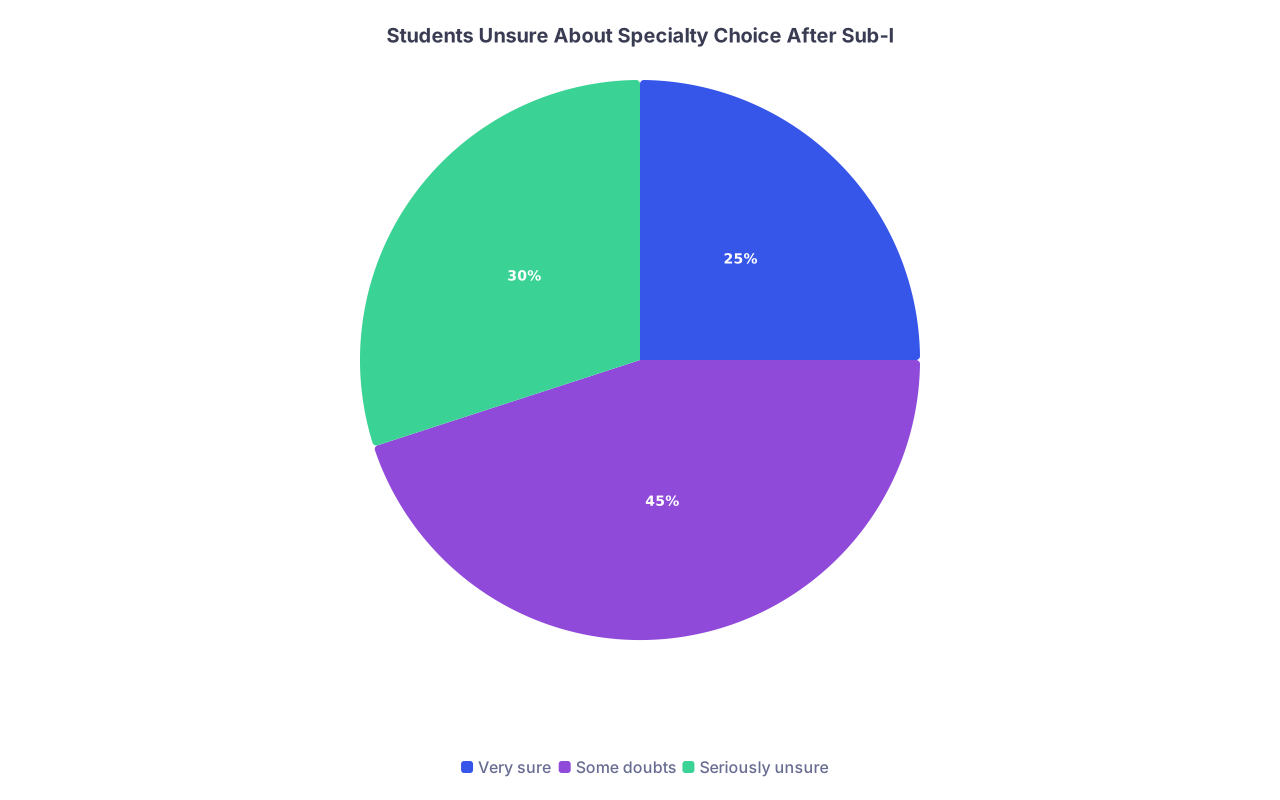
| Category | Value |
|---|---|
| Very sure | 25 |
| Some doubts | 45 |
| Seriously unsure | 30 |
What your regret after a sub-I actually means (and what it doesn’t)
The brain loves worst‑case scenarios, so it goes straight to:
“I hate this → I chose wrong → I’m stuck forever → I’ll be a miserable attending → I ruined everything.”
But that reaction after a sub-I usually means something more specific, and way less permanent.
It does not automatically mean:
- You picked the wrong specialty forever
- You can’t apply in that specialty anymore
- You must switch immediately or you’re doomed
- Programs will “find out” you were unsure and blacklist you
What it usually means is something like:
- You experienced the specialty in its most intense, least balanced form
- You got unlucky with a toxic team or a poorly organized rotation
- Your expectations were fantasy-level and reality hit hard
- Parts of the work are genuinely misaligned with your personality/values… but you haven’t sorted out which parts yet
- You’re exhausted, burnt out, and your brain is interpreting that as “I hate this specialty”
I’ve watched students hate their IM sub-I, then love a different IM service with a different team. I’ve seen people certain they were surgeons, then do a surgery sub-I and realize, “I actually like medicine more than the OR.” Both are real. Both are valid. Neither means your career is over.
The sub-I is a snapshot. Not a lifelong contract.
Timeline reality check: Are you actually out of time?
Your anxiety is screaming: “I HAVE TO DECIDE RIGHT NOW.”
You really don’t. But you also can’t kick the can for another 8 months and hope clarity magically appears.
Here’s what the rough reality looks like for a typical fourth-year timeline (US, ERAS):
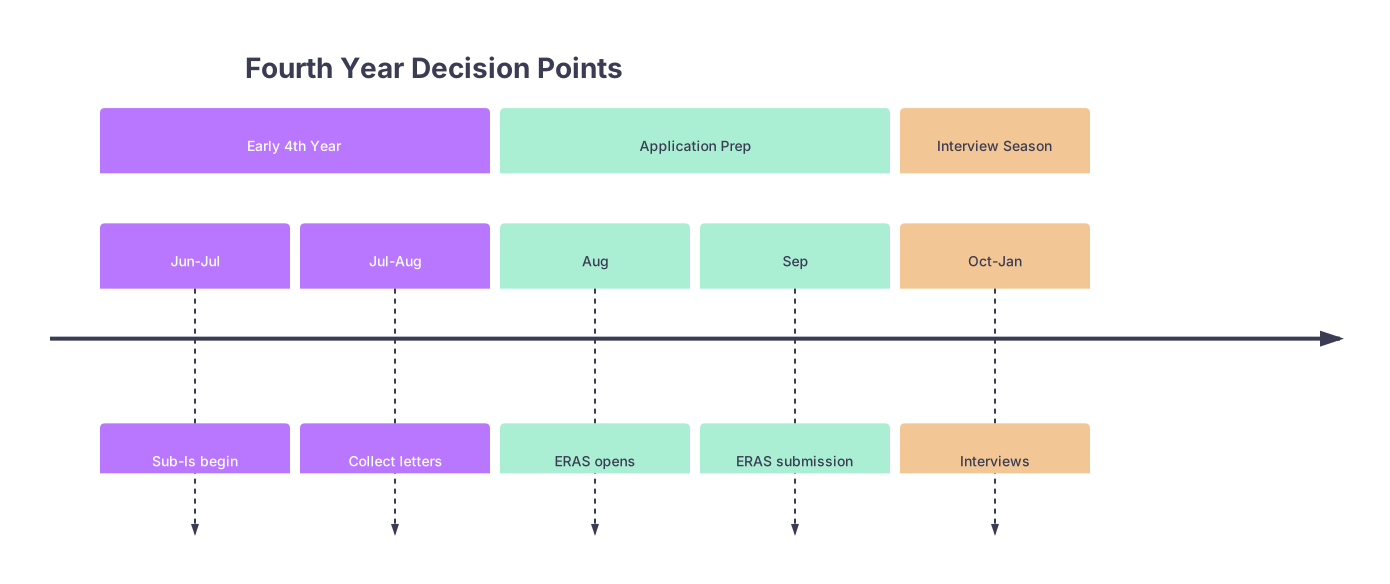
| Period | Event |
|---|---|
| Early 4th Year - Jun-Jul | Sub-Is begin |
| Early 4th Year - Jul-Aug | Collect letters |
| Application Prep - Aug | ERAS opens |
| Application Prep - Sep | ERAS submission |
| Interview Season - Oct-Jan | Interviews |
So where are you in this?
If you just did your first sub-I in July/August:
You still have wiggle room to explore or pivot. Not tons. But some.If it’s late August/early September:
You’re in decision and damage‑control territory, but people do switch this late. It just takes more planning.If you’re mid‑interview season and realizing this:
That’s a different flavor of panic. Still not hopeless, but the strategy changes (we’ll talk about that).
Point is: you’re not “too late” just because your first sub-I didn’t feel like a movie montage of “finding your calling.”
Do you actually hate the specialty… or the rotation?
This is the part everyone skips because it’s uncomfortable: you have to dissect what, exactly, you’re regretting.
Take a breath and be uncomfortably honest:
- Was it the content of the work? (e.g., “I don’t care about these problems. I’m bored by these patients. The procedures terrify me and not in a good way.”)
- Or was it the context? (“My resident was malignant. The hours were brutal. The pager never stopped.”)
Because those aren’t the same thing.
I’ve seen people walk away from IM because their sub-I was a 3-resident-1-attending nightmare with 20 patients each and constant cross-cover. They later did a subspecialty elective and said, “Oh. I actually like the medicine. I hated the chaos.”
Flip side: I’ve seen people in OB who loved the team and the babies and the camaraderie… and still admitted, “The pace, the nights, the constant emergencies—it’s not sustainable for me.”
Ask yourself some very blunt questions:
- On your best day of the sub-I, did you feel even a flash of: “I could see myself doing this”?
- When you imagine your future life, outside of training, does this work feel at least tolerable, maybe even meaningful?
- If the team had been kind and reasonable, would you feel differently?
If the answer is “No, I felt dead inside the entire time, even when people were nice,” that’s real data. Not drama.
If the answer is “I was miserable but I can’t separate it from being exhausted and scared all the time,” that’s uncertainty. And uncertainty doesn’t require a nuclear decision tomorrow morning.
Okay, but do I have to commit to this specialty now for residency?
Short answer: you have to commit to something before you submit ERAS. You don’t have to blindly commit to the specialty you just had a bad experience with.
Here’s the uncomfortable but honest framework:
| Option | Risk Level | Flexibility Later |
|---|---|---|
| Stick with specialty | Moderate | Depends on field |
| Pivot to related field | Moderate-High | Often decent |
| Switch to very different field | Higher | Some cross-over |
| Dual-apply strategically | Highest workload | Most options |
You essentially have four paths:
- Stay with the specialty despite the doubts
- Pivot to a related specialty
- Switch to a very different specialty
- Dual-apply (two specialties at once)
None of these are “wrong.” They each have trade-offs.
1. Staying with the specialty despite the regret
This is not as ridiculous as it sounds, if your regret is mostly about environment, not content.
Worth considering if:
- You like the patient population and problems, even if training is miserable
- You have decent letters already and a reasonable application
- Your doubts feel more like “this is hard and I’m tired” than “this is fundamentally not me”
What I’d do if I were in that position:
- Talk to 1–2 attendings or senior residents you trust and literally say, “I’m worried I chose wrong after this sub-I—can I be honest about what I did and didn’t like?”
- Ask what life looks like 5–10 years out, post‑training. Many people hate residency but like the job.
- Use your personal statement to focus on the parts of the specialty that did resonate, not fake passion 24/7
It’s okay to not be obsessed with your field. You just need “I can live with this and find meaning here,” not “I would die for this specialty.”
2. Pivoting to a related specialty
Classic examples:
OB to family med/women’s health.
Gen surg to anesthesiology.
Peds to family med.
IM to neurology, or vice versa.
This works when there’s overlap in your letters, story, and skill set.
It’s more believable to say, “I realized I’m more drawn to continuity primary care than inpatient general medicine” than, “I did a psych sub-I and now I want ortho.”
Things to think about:
- Can your current letters still be used or reframed? (An IM letter for FM? A surgery letter for anesthesia? Often yes.)
- Do you have time to do a short elective in the new field before ERAS submission? Even 2 weeks helps a lot.
- Can you quickly get at least one letter from the new field, even if it’s from a brief but strong performance?
3. Switching to a totally different specialty
This is the “I did an OB sub-I and realized I want psych” scenario.
Not impossible. Just more work and more explaining.
You’ll need:
- A coherent story: not fake, but also not “I panicked and randomly chose something else.”
- At least one letter in the new field. Preferably two, but one strong one is better than two lukewarm.
- Somebody in your advising world who isn’t useless. (Yes, some school advisors are terrible. But you need at least one person on the inside who knows the match.)
The biggest mistake people make here is trying to hide the switch, acting like they always wanted the new specialty. You don’t have to overshare your existential crisis, but you can say something like:
“I initially explored X seriously, including a sub-internship. What I learned from that experience is that while I respect the field, the aspects of care that resonated most with me were Y and Z, which I’ve found more fully in [new specialty].”
That’s honest. That’s mature. That’s way better than pretending you woke up in MS1 already obsessed with your final choice.
4. Dual-applying: the anxiety special
This is the nuclear option of “I’m terrified to commit.” And sometimes it’s correct.
Reasonable dual-apply combos:
IM + neurology
IM + FM
Gen surg + prelim surgery or prelim medicine
OB + FM
Psych + neurology
Riskier but done:
EM + IM
Anesthesia + IM
Surg + anesthesia
Dual-applying is brutal. Twice the personal statements, letters arranged strategically, twice the interviews, lots of explaining why your application is floating in two pools.
Use it if:
- Your stats are marginal for your original specialty and
- You’re genuinely torn or fearful you won’t match
Don’t use it as a reflex because your sub-I just felt bad. It’ll explode your stress and not always improve your chances.
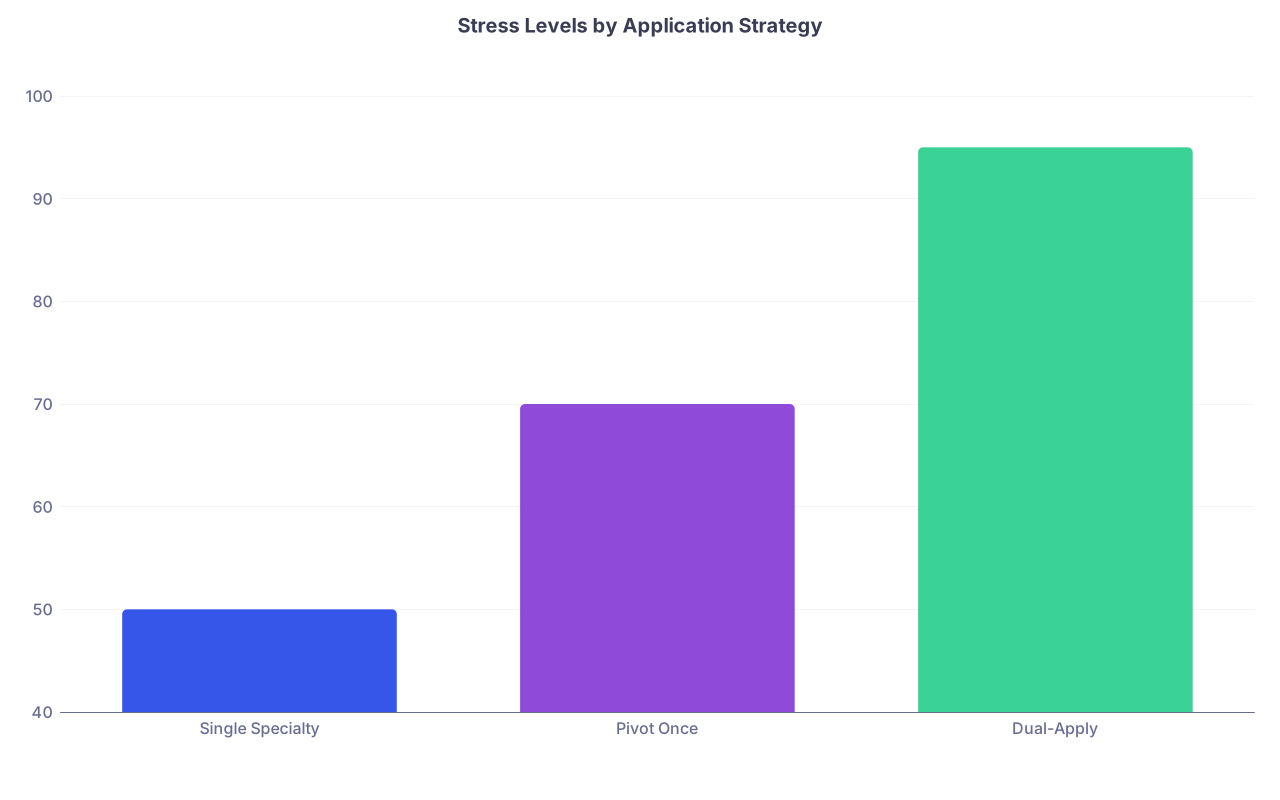
| Category | Value |
|---|---|
| Single Specialty | 50 |
| Pivot Once | 70 |
| Dual-Apply | 95 |
How honest can I be with programs about my regret?
You’re probably worrying: “If I admit I was unsure, won’t they rank me lower or reject me?”
Here’s the harsh truth: programs care less about your tortured decision process and more about:
- Are you going to show up and work?
- Are you likely to finish the program?
- Do your letters say you can function?
- Do you seem reasonably aligned with the specialty’s demands?
You don’t need to disclose your full specialty crisis saga in your personal statement or interviews. You do need a coherent story that doesn’t sound like you threw darts at a list.
In your materials, focus on:
- What you like about the specialty you’re applying to now
- How your prior experiences, even regretful ones, clarified what you want
- Evidence you’ve thought about the lifestyle and realities, not just the cool parts
What you don’t need to say:
“I hated my sub-I and questioned my entire identity and now I’m here, please don’t reject me.”
You can keep that part for your therapist and your closest friends.
But what if I commit and still end up hating it?
This is the fear under all the fears, right? That you’ll pick, match, start intern year, and then realize you completely screwed up.
Here are a few not‑talked‑about facts:
- People do switch residencies. It’s not common, but it happens every year, in every specialty.
- People do finish a residency in a field they don’t love and then craft an attending job that’s more tolerable or aligned.
- People do discover that what they hated was residency, not the field itself. (And sometimes it’s the opposite.)
You’re not signing a blood oath that you’ll be a generalist in your field for 40 years. You’re choosing a training path that will give you a skill set. There are doors both inside and outside that specialty later.
None of this means “don’t think carefully.” It means the pressure you’re feeling—“I must get this PERFECT right now or life is ruined”—is way out of proportion to reality.

Practical steps for the next 2–4 weeks
Let’s get concrete. You’re spiraling, and vague reassurance doesn’t actually help. So here’s what you do now:
- Write down, in one sitting, everything you hated and everything you liked (even a little) about your sub-I. Don’t censor, don’t make it pretty. Just get it on paper.
- Circle what’s intrinsic to the specialty (e.g., “hours are skewed to nights,” “high volume of procedures,” “lots of end-of-life conversations”) vs what’s rotation‑specific (“my senior ignored me,” “the schedule was unsafe,” “we were chronically understaffed”).
- Book a meeting with someone who actually knows the match landscape for your field at your school. If your assigned advisor is useless, ask classmates who they talk to. There’s usually that one attending who’s “the person” for a field.
- If you’re seriously considering a pivot, see if you can get even a 1–2 week elective in the alternative specialty ASAP. Even observational time is better than nothing.
- Start drafting two versions of your narrative: one where you stick with your original specialty, and one where you pivot. You’ll feel less trapped if you see both are possible.
This isn’t about perfection. It’s about not letting pure panic make a permanent decision for you.
The part nobody tells you: most people are not 100% sure
One last thing you need to hear: the loudest, most confident people are not the majority. They’re just the loudest.
A lot of your classmates are doing exactly what you’re doing:
- Nodding along when someone says, “So you’re going into X, right?”
- Smiling like they’re sure
- Then going home and googling “I regret my specialty choice” at 1 a.m.
You are not the weird outlier. You’re just saying the quiet part out loud.
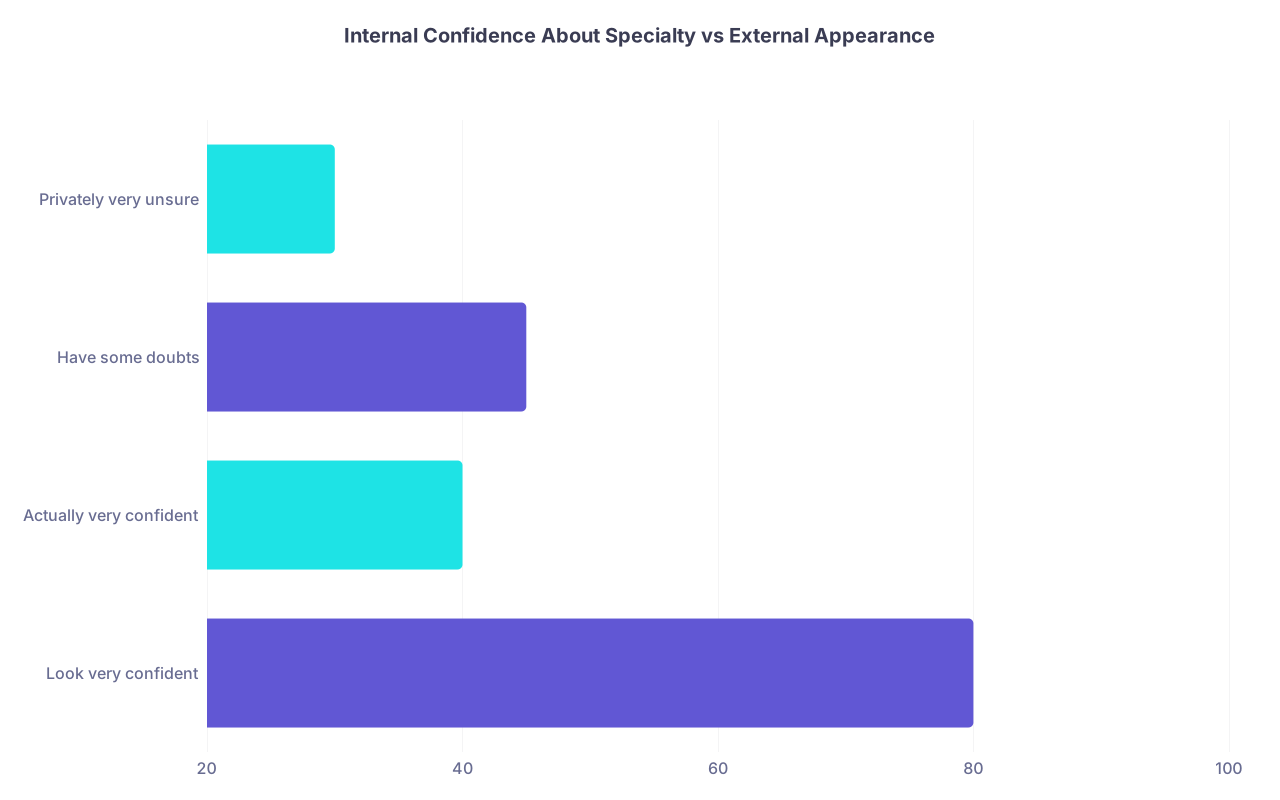
| Category | Value |
|---|---|
| Look very confident | 80 |
| Actually very confident | 40 |
| Have some doubts | 45 |
| Privately very unsure | 30 |
You don’t have to be 100% sure. You probably won’t be. You just need to be sure enough that the field is:
- Livable for you
- Aligned enough with your strengths and interests
- Not fundamentally incompatible with the life you want
That’s it. Not soulmate-level fate. Just a good enough fit that you can build something decent from it.