

I have met this resident a hundred times.
She likes medicine. She likes patients. She does not hate complexity, and she is not lazy. What she hates is the machinery of inpatient life: 5 a.m. prerounds, admissions at 6:45 p.m., cross-cover pages about potassium, weekend rounding that erases half of Saturday, and that peculiar hospital time warp where one "quick consult" mutates into a four-hour detour. She wants a career that still feels like medicine without being swallowed by the hospital.
That is not an unserious question. It is one of the smartest specialty questions a medical student can ask.
The real version of the question is more precise: which specialties actually let you build a mostly outpatient career, and which ones only look outpatient from a distance? Because plenty of fields market themselves as clinic-based while quietly stapling on inpatient consults, hospital call, post-op rounds, weekend coverage, and credentialing obligations that drag you right back into hospital life.
My position is simple. Yes, you absolutely can bias your career heavily toward outpatient medicine. In some specialties, that is the default. In others, it is possible but only with very careful fellowship and job selection. And in a few, believing you can "mostly avoid inpatient" is fantasy.
The mistake students make is treating specialty names as lifestyle guarantees. They are not. "Cardiology" tells me far less than "noninvasive cardiology in a large outpatient-heavy private group with separate hospital coverage." "Psychiatry" tells me less than "outpatient adult psych with no inpatient unit duties and shared light call." The fine print matters. A lot.
This article is for educational purposes only. It is not financial advice, not legal advice, and not tax advice. Figures vary by individual circumstances, so consult a qualified professional before acting.
First, Define What "Mostly Outpatient" Actually Means
"Outpatient" is one of those words people use sloppily. That causes problems fast.
There are really three buckets:
- Fully outpatient: You work in clinic, office, ambulatory procedure spaces, or telehealth, with little to no hospital responsibility.
- Primarily outpatient: Most of your work is clinic-based, but you may still take call, see occasional inpatient consults, round in limited settings, or supervise post-procedure issues.
- Outpatient-heavy hybrid: Your calendar looks clinic-dominant from the outside, but hospital work remains a real chunk of your professional life.
That distinction matters because students often imagine outpatient medicine as nine-to-five clinic with evenings free and zero admissions. Sometimes that exists. Dermatology can look very close to that. Allergy/immunology often can too. But "outpatient" can also mean endoscopy center days plus hospital call, or office visits plus newborn rounds, or clinic all day followed by inbox cleanup and phone call coverage all night. Outpatient is not automatically easy. It is just different.
And residency muddies the picture even more. Training life is often far more inpatient than attending life. Internal medicine residency is a perfect example. You can become an outpatient endocrinologist or rheumatologist eventually, but first you are still doing wards, ICU, nights, and all the rest. If you are trying to avoid inpatient medicine because you merely dislike it, that may be tolerable. If you cannot stand the hospital at all, training realities may kill the plan before you ever reach the promised land.
So ask two separate questions:
- What does training look like?
- What does the eventual job look like?
People who blur those together make bad decisions.
Specialties That Are the Best Fit for a Largely Outpatient Career
If your goal is to minimize inpatient exposure, some specialties are simply better bets. Not maybe. Better.
1. Dermatology
This is one of the cleanest outpatient lifestyles in medicine. Typical day: clinic visits, biopsies, excisions, acne, psoriasis, rashes, skin cancer surveillance, procedural blocks, documentation, repeat. Inpatient work exists, but it is limited in many jobs. Some academic dermatologists do inpatient consults. Some private dermatologists never step into the hospital.
Hidden fine print:
- Mohs or procedural derm may have a more intense schedule, but still usually not inpatient-heavy
- Academic jobs may include consult weeks
- Call can involve urgent rashes, drug eruptions, inpatient consult advice, but it is usually not medicine-ward chaos
This is a true clinic-first specialty.
2. Allergy and Immunology
Often underrated by students. It is one of the most outpatient-centered careers available. Typical day: asthma follow-up, allergic rhinitis, food allergy evaluation, urticaria, immunodeficiency workups, skin testing, challenge procedures, biologic management.
Inpatient burden is often minimal. Many allergists have no meaningful admitting responsibilities. Hospital consults may exist in academic or large referral centers, but private practice allergy can be almost entirely office-based.
Hidden fine print:
- You usually get there through internal medicine or pediatrics first, so training may still include inpatient years
- Severe asthma and immunology patients can create after-hours issues, but the field is still strongly outpatient
3. Ophthalmology
This one sits in an excellent outpatient niche, with one caveat: surgery changes the texture of the work. Typical day may include clinic, laser procedures, injections, cataract evaluations, post-op checks, and OR time.
Most ophthalmologists are not living the IM resident nightmare. But they are not all pure clinic either. Retina, glaucoma, cornea, and comprehensive ophthalmology jobs can still include emergency eye call, trauma coverage, and occasional hospital consults.
Still, as a whole, ophthalmology is very outpatient-friendly. Clinic and ambulatory surgery center life dominate. For many people, this is an ideal "procedure-heavy but not hospital-ward-heavy" compromise.
4. Psychiatry
Psychiatry is broad enough that students need to stop speaking about it as if it were one job. It is not.
If you choose outpatient adult psychiatry, child outpatient psychiatry, collaborative care, or telepsychiatry, you can build a very clinic-centered life. Typical day: med management, psychotherapy depending on practice, intake evaluations, follow-up visits, care coordination.
But here is the trap: training is not purely outpatient, and some jobs still mix in consult-liaison, inpatient unit coverage, emergency psychiatry, or weekend call. The difference between an outpatient private practice psychiatrist and an academic psychiatrist staffing an inpatient service is enormous.
Psychiatry can absolutely be one of the safest choices for avoiding inpatient life. You just need to choose the actual job, not the fantasy label.
5. PM&R
Physical medicine and rehabilitation is frequently misunderstood. Many PM&R careers are outpatient-heavy: musculoskeletal clinic, spine, EMG, sports medicine, interventional pain depending on training, rehab follow-up, botulinum toxin clinics, prosthetics, and functional medicine-style longitudinal care.
The caveat is obvious. There is also inpatient rehab. A lot of it. During residency you will almost certainly spend major time managing rehab inpatients, strokes, spinal cord injury, brain injury, debility, and consult services. Some attending jobs are heavily inpatient. Others are almost all outpatient musculoskeletal medicine.
So PM&R is a good option if you want outpatient life eventually, but it is not a zero-hospital pathway.
6. Preventive Medicine / Occupational Medicine
These are among the least discussed outpatient-friendly paths. Many jobs involve employee health, occupational injury evaluation, public health administration, use review, wellness, population health, or clinical preventive care. Inpatient burden is often very low.
This path is not for someone who wants dramatic bedside medicine. It is for someone who likes systems, longitudinal prevention, policy, and structured schedules. Very different flavor. Often very controllable lifestyle.
7. Endocrinology and Rheumatology
These are strong examples of mostly outpatient after inpatient-heavy training. As attendings, many endocrinologists and rheumatologists live largely in clinic. Diabetes, thyroid disease, osteoporosis, pituitary issues, lupus, RA, vasculitis follow-up, infusion management, bone health, and autoimmune disease dominate their weeks.
Hidden inpatient obligations:
- Academic consult services can be significant
- Some groups rotate hospital consults
- Infusion center and complex biologic management can add administrative weight
- Internal medicine residency comes first, so you earn this lifestyle the hard way
These are excellent options for people who like cognitive medicine and continuity but dislike constant admissions.
8. Pathology-adjacent and low-patient-contact careers
If your dislike of inpatient life overlaps with dislike of bedside clinical chaos, pathology deserves honest attention. Not every medical student should force themselves into traditional patient-facing medicine. I have seen students do that, and it ends badly.
Pathology is not outpatient clinic, strictly speaking. But it is one of the most hospital-detached physician careers in daily workflow. Likewise, some informatics, lab medicine, and population-health-oriented careers create enormous distance from inpatient ward life.
If your core goal is "I want medicine without floor work," this belongs on the table.
9. Certain limited-admission procedural niches
A few subspecialty jobs are built around ambulatory procedures with relatively little admitting. Think some pain practices, some vein practices, some office-based ENT or urology niches, some breast imaging or women's imaging roles, and selected ambulatory GI models with separate hospitalists covering admissions. These can be excellent. They can also be misleading.
The lesson: specialty title is not enough. You want clinic-first fields if minimizing inpatient life is your priority. Dermatology, allergy/immunology, outpatient psychiatry, many ophthalmology jobs, and selected PM&R or cognitive subspecialty practices are the safest bets.
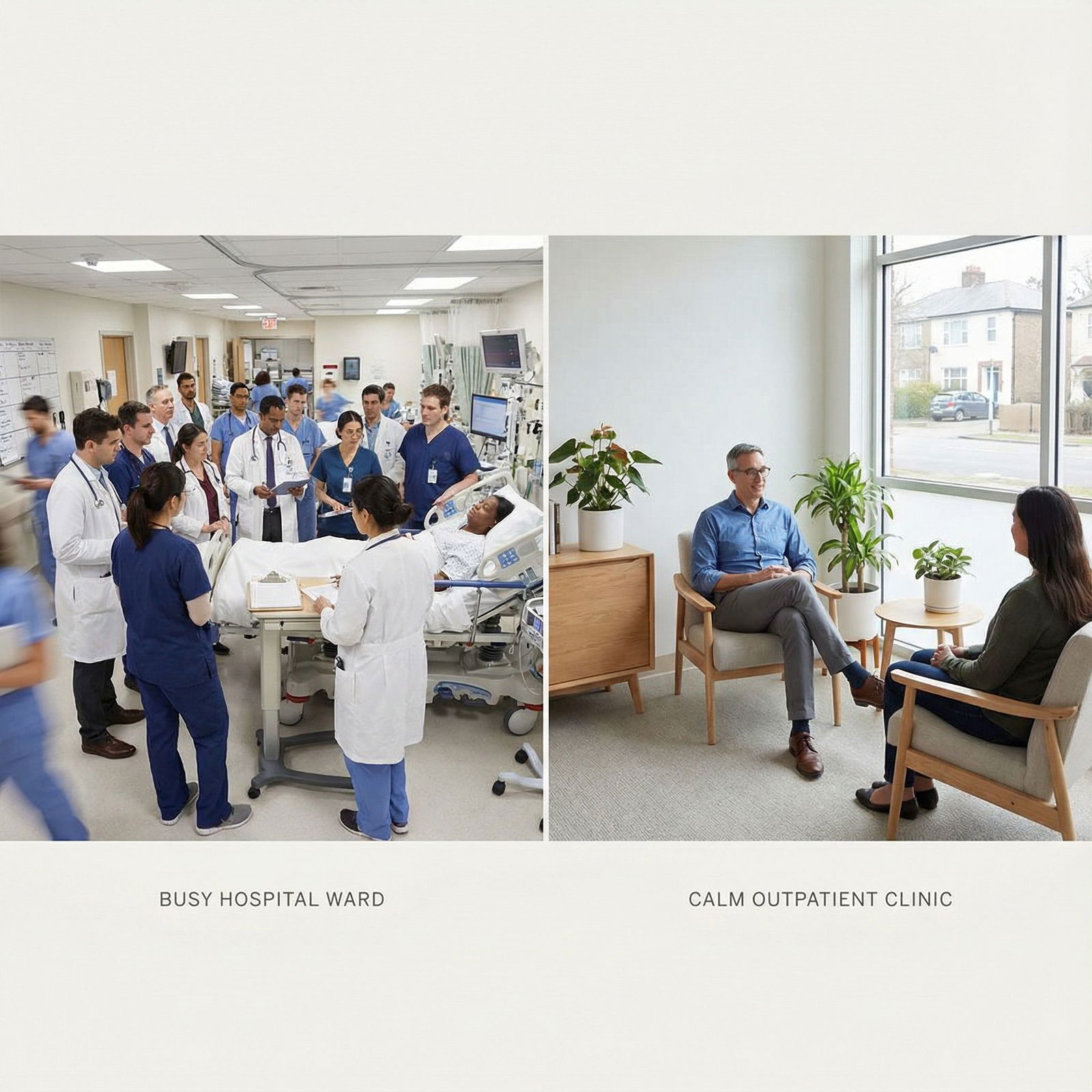
Specialties That Sound Outpatient-Friendly but Still Bring Inpatient Realities
Now for the gotchas. These are the fields students routinely misread.
Cardiology
Students see office visits, stress tests, echoes, and clinic follow-up, then imagine an outpatient specialty. Wrong. Many cardiology jobs still involve hospital consults, STEMI call, inpatient rounding, readmissions, device issues, and weekends. Noninvasive cardiology can be more clinic-centered, yes. But the average cardiology career remains tethered to hospitals far more than people admit.
Gastroenterology
GI has outpatient procedures and clinic, which looks attractive. Then reality arrives: hospital consults, bleeds, urgent scopes, admissions orbit, weekend call, and procedural emergencies. Some GI jobs are beautifully structured around ambulatory endoscopy centers with separate inpatient coverage. Others own your life. Huge difference.
Neurology
Outpatient neurology exists and can be great: headache, movement disorders, sleep in some pathways, cognitive clinics, epilepsy follow-up. But many neurologists still cover strokes, inpatient consults, EEG call, and hospital service weeks. If you choose neurology, understand exactly how much acute hospital work remains in the model.
OB/GYN
This one is not even subtle. Students sometimes tell themselves they will "mostly do clinic." Then they remember labor and delivery exists. OB/GYN has clinic, yes. It also has deliveries at night, urgent surgery, postpartum rounding, triage, and call that can wreck any illusion of predictability. Pure outpatient gyn jobs do exist, but they are not the default.
Surgical subspecialties
Aesthetic plastics, hand, ENT niches, outpatient ortho subspecialties, and ambulatory-focused urology can reduce inpatient burden. But surgery never fully stops being surgery. Post-op issues, add-ons, hospital privileges, and call can creep back in quickly. Private elective practice is very different from trauma-affiliated or hospital-employed practice.
This is where employment model matters almost as much as specialty:
- Academic jobs often bring consult services and hospital responsibilities.
- Hospital-employed jobs may tie you to service line coverage.
- Private practice may offer cleaner outpatient separation, or may dump call on a small group and make life worse.
- Large groups can dilute call.
- Small groups can trap you in every-third-night nonsense.
Training Pathway Matters: Residency and Fellowship Can Change the Reality
This is where a lot of students fool themselves.
You may want an outpatient endocrine career. Fine. You still need to survive internal medicine residency. You may want outpatient sports PM&R. Fine. Residency still includes inpatient rehab and hospital consults. You may want child psychiatry clinic life. Residency still includes inpatient, emergency, and consult-liaison exposure.
So do not choose a pathway whose training structure you cannot tolerate. Future attending life matters, but residency is not a minor inconvenience. It is several years of your actual life.
Fellowship can either rescue your lifestyle or intensify the hospital bond. Rheumatology and endocrinology often move internists toward clinic. Interventional cardiology moves in the opposite direction. Pain can shift PM&R or anesthesiology into more ambulatory procedural life. Sleep medicine can create a much more outpatient, scheduled career for people coming from internal medicine, psychiatry, neurology, or pediatrics.
Program structure matters too:
- Community vs academic
- Size of the residency
- Night-float model vs 24-hour call
- Presence of fellows who absorb inpatient burden
- Moonlighting culture
- Geographic referral patterns
I have seen two residents in the same specialty have completely different lives because one program had q4 call and endless tertiary consult volume, while another had better staffing and cleaner outpatient blocks. Same specialty name. Totally different existence.
How to Vet a Specialty and a Job if You Want to Avoid Inpatient Life
Do not ask vague questions and expect useful answers. "Is this specialty lifestyle-friendly?" is a bad question. It invites salesmanship.
Ask sharp questions instead:
- How many days per month are spent in clinic versus hospital?
- Do attendings round on inpatients?
- Are there dedicated inpatient consult weeks?
- Is there overnight call from home, in-house call, or no call?
- How often are weekends affected?
- Who covers hospital consults?
- Are you expected to maintain hospital privileges?
- Are post-op admissions part of the practice?
- Does the group own or staff an ambulatory procedure center?
- Is there separation between outpatient physicians and inpatient coverage physicians?
- In a private group, how is call divided?
- In an academic group, what percentage of effort goes to inpatient service?
Ask residents what actually happens at 7 p.m. Ask junior attendings whether they still get dragged into the hospital unexpectedly. Ask who covers when someone is on vacation. Ask whether inbox burden and refill work are replacing the time you think you are saving by avoiding the hospital. That is a real trap in outpatient medicine. No admissions, but 200 portal messages.
Also, look at geography and group size. Rural jobs often demand broader coverage. Smaller groups often mean heavier call. Highly specialized urban markets can allow cleaner outpatient niches.
The same specialty can produce radically different lives. A four-physician GI group tied tightly to one hospital is not the same as a large multisite GI practice with dedicated inpatient partners. An academic psychiatrist covering the consult service is not the same as an outpatient telepsychiatrist. Details decide everything.
The Tradeoffs: What You Gain, What You Give Up
The upsides of outpatient-focused careers are obvious and real.
More predictable schedules. Fewer overnight disruptions. Less exposure to crashing patients at 2 a.m. Better control over family life, sleep, travel, and basic human routines. For many physicians, that control is not a luxury. It is the difference between sustainability and burnout.
But there are tradeoffs.
Some outpatient fields have less acute drama and less procedural intensity. If you live for emergencies, rescue medicine, or high-stakes interventions, pure clinic life may feel flat after a while. Some outpatient-heavy careers also bring lower compensation than their more hospital-entangled counterparts, though that varies a lot. And some "lifestyle" jobs compensate for the lack of admissions with endless documentation, inbox management, prior auth fights, and administrative nonsense. Different pain. Still pain.
The right question is not "How do I avoid inpatient medicine at all costs?" The right question is "What kind of work do I actually want to do every day, and what kind of disruption am I willing to tolerate for it?"
That is a better filter. And a more honest one.
Summary: Yes, You Can Strongly Bias Toward Outpatient Life, If You Choose Carefully
Yes. You can absolutely build a career that is mostly outpatient and keeps you far from the classic inpatient grind. But you need to stop thinking in specialty labels and start thinking in workflows.
The safest outpatient-oriented options are fields like dermatology, allergy/immunology, many outpatient psychiatry roles, ophthalmology, selected PM&R tracks, preventive or occupational medicine, and clinic-heavy cognitive subspecialties such as endocrinology or rheumatology. The common traps are cardiology, GI, neurology, OB/GYN, and surgical fields that look clinic-friendly until call, consults, rounds, and emergencies reclaim your calendar.
My blunt advice: evaluate three things separately.
- The specialty
- The training path
- The actual job
If you do that well, you can get very close to the life you want. If you do not, you can match into something that sounded outpatient on paper and discover too late that you signed up for a hospital life with nicer clinic furniture.
That mistake is common. And completely avoidable.


