
Choosing the Right Clinical Volunteering Experience for Your Medical Career
Clinical Volunteering is one of the most powerful ways to test your interest in medicine, gain Hands-On Experience, and demonstrate your commitment to serving patients. With a growing number of Healthcare Opportunities available—from hospital programs to free clinics and global health trips—many premeds and medical students struggle with a key question: Which experiences are actually right for me and my future medical career?
This guide walks you through how to strategically choose, evaluate, and maximize clinical volunteering so it truly supports your long-term goals in medicine, rather than becoming just another line on your CV.
Why Clinical Volunteering Matters for Medical Careers
Clinical volunteering is more than just “checking the box.” When chosen thoughtfully and pursued consistently, it becomes a formative part of your development as a future physician.
Bridging Classroom Learning and Real Patient Care
Textbooks and lectures can teach you pathophysiology and pharmacology, but they can’t fully prepare you for:
- A nervous parent asking if their child will be okay
- A patient with limited English struggling to understand discharge instructions
- A busy nurse juggling tasks in the ED while still showing kindness to every patient
Clinical volunteering pulls you out of the theoretical and immerses you in the real work of healthcare. You start to see how systems function (or fail), how interdisciplinary teams collaborate, and how social determinants of health affect patients’ lives.
Building Genuine Hands-On Experience (Within Your Scope)
As a student or premed, you won’t be diagnosing or prescribing—but you can gain meaningful Hands-On Experience:
- Taking vital signs under supervision
- Escorting patients and observing procedures
- Assisting with intake forms and medication reconciliation
- Helping with health education or discharge instructions
- Supporting telehealth workflows or follow-up calls
These experiences build comfort in clinical settings and show you what direct patient care actually feels like—critical information before you commit to a medical career.
Strengthening Your Applications and Professional Identity
Admissions committees for medical school and residency look closely at your clinical experiences to answer:
- Do you understand what a career in medicine involves?
- Have you shown sustained commitment to patient care?
- Can you work effectively in a healthcare team?
- Have you reflected on your experiences and grown from them?
Clinical volunteering that is consistent, meaningful, and well-articulated in your applications can significantly strengthen your profile. It also helps you clarify your own professional identity: the kind of physician you want to become, the populations you want to serve, and the values you want to embody in practice.
Developing Core Non-Clinical Skills
High-quality Healthcare Opportunities also build transferable skills that matter for every specialty:
- Communication with patients, families, and staff
- Cultural humility and sensitivity
- Empathy and emotional resilience
- Organization and time management
- Teamwork and leadership
These skills are difficult to teach in a classroom but are essential for success in medical training and beyond.
Key Factors to Consider When Selecting a Clinical Volunteering Role
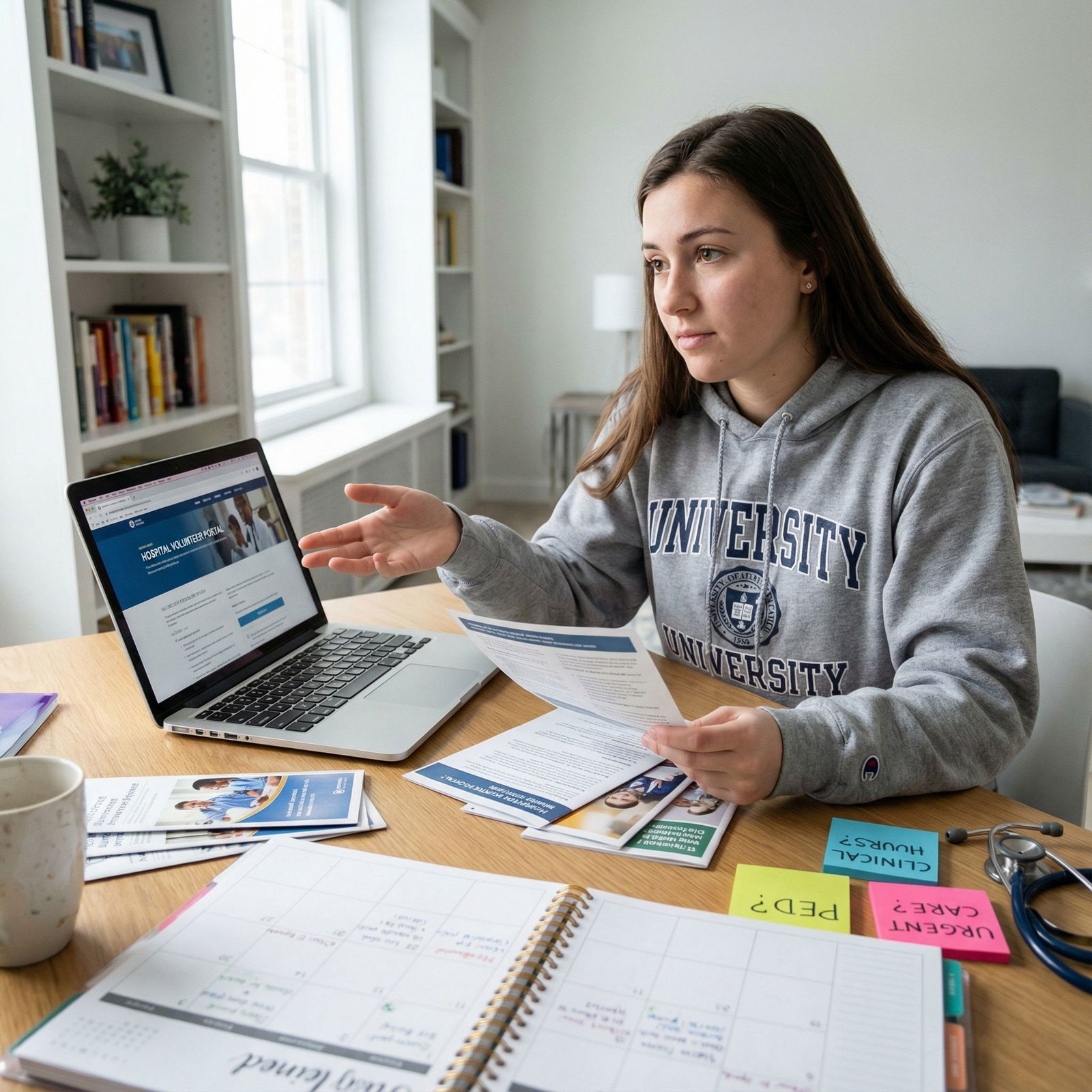
Choosing the right experience is less about finding the “perfect” position and more about matching your goals, capacity, and interests with what a program actually offers. Below are essential Volunteer Selection Tips to guide your decision.
1. Align Opportunities With Your Career Interests
Your long-term medical interests should strongly influence where you volunteer.
Ask yourself:
- Am I drawn to a particular specialty or patient population?
- Do I want fast-paced acute care or continuity-based primary care?
- Would I prefer a hospital, outpatient clinic, community health center, or long-term care setting?
Examples:
- Pediatrics: Volunteer in a children’s hospital, pediatric clinic, school-based health center, or child life program.
- Emergency Medicine: Look for ED volunteer roles, crisis response teams, or EMS ride-along opportunities.
- Primary Care / Family Medicine: Seek community health clinics, free clinics, or FQHCs (Federally Qualified Health Centers).
- Psychiatry / Mental Health: Explore crisis hotlines, behavioral health programs, addiction treatment centers, or inpatient psychiatric units.
- Global or Public Health: Engage with organizations focused on underserved populations, refugee health, migrant health, or international clinics (with careful vetting).
Your interests may change over time, and that’s normal. Think of each role as data-gathering: Does this setting energize me, drain me, or leave me curious to see more?
2. Be Realistic About Time Commitment and Consistency
Admissions committees care more about consistent, long-term involvement than a long list of short, scattered experiences.
Consider:
- Weekly time requirements (e.g., 3–4 hours per shift)
- Minimum duration (e.g., 3, 6, or 12 months)
- Your current workload: classes, MCAT prep, job, family responsibilities
Aim for a sustainable schedule. It’s better to commit to:
- One 3-hour shift each week for a year
than to:
- Overcommit to three different roles and quit after a month.
Before applying, map your schedule for the semester or year and decide what is realistic to avoid burnout and maintain reliability.
3. Understand the Level of Patient Interaction
Not all Clinical Volunteering roles offer the same degree of patient contact. Clarify this early:
- High direct interaction: Escorting patients, assisting at the bedside, working in triage, health education.
- Moderate interaction: Working at check-in, helping with intake forms, translator roles, telehealth support.
- Low interaction: Data entry, supply stocking, lab support, research-focused positions.
Both high- and low-contact roles have value, but your choice should match your goals and comfort level.
- If you’re early in your journey and unsure about patient-facing work, a moderate-contact role can be a good starting point.
- If you already know you want a highly clinical career, prioritize roles with significant patient interaction so you can speak authentically about those experiences later.
4. Identify Specific Skills You Want to Build
Volunteering should be intentional, not random. Ask:
- What do I want to be better at six months from now?
- Do I want more practice communicating with patients?
- Am I hoping to improve my medical Spanish or another language?
- Do I want to understand electronic health records (EHRs) or clinic workflows?
Examples of skills you might target:
- Clinical exposure: Taking vitals, observing procedures, learning basic clinical terminology.
- Communication: Explaining instructions, working with interpreters, de-escalating tense situations.
- Systems understanding: How referrals work, how social workers help with resources, discharge planning.
- Leadership and teamwork: Coordinating volunteers, helping train new members, leading small projects.
When interviewing or emailing programs, ask directly:
“Can you describe the typical responsibilities and what skills student volunteers commonly gain here?”
5. Consider the Patient Population and Setting
The population you serve deeply shapes your experience and your understanding of healthcare disparities.
Think about:
- Age groups: pediatrics, adults, geriatrics
- Communities: rural, urban, suburban, migrant, refugee, uninsured
- Clinical focus: chronic disease management, acute care, surgery, oncology, mental health, palliative care
Examples:
- Volunteering at a free clinic can expose you to uninsured and underinsured patients and teach you about barriers to care.
- Serving in a geriatric unit can deepen your understanding of dementia, polypharmacy, and caregiver burden.
- Working with a hospice organization can profoundly shape your views on end-of-life care, communication, and patient autonomy.
Choose populations that either strongly interest you or challenge you to grow. Both can be valuable for your development and your future Medical Career.
6. Location, Accessibility, and Logistics
The best opportunity on paper won’t matter if you can’t realistically get there.
Evaluate:
- Commute time and cost (public transit, parking, gas)
- Safety and comfort traveling early or late
- Whether shifts conflict with classes, labs, or exams
If you are in a rural area or have limited transportation, consider:
- Local primary care clinics
- Telehealth-based volunteering (e.g., remote patient outreach, health education hotlines)
- Campus health centers or student-run free clinics
Logistical fit is crucial for sustaining long-term involvement.
7. Program Structure, Training, and Supervision
High-quality clinical volunteering experiences usually have:
- A clear orientation and training process
- Defined roles and responsibilities
- Access to supervisors or coordinators
- Ongoing feedback or evaluations
Before committing, ask:
- “Is there a formal training period?”
- “Who will supervise me day-to-day?”
- “Are there opportunities to take on more responsibility over time?”
A structured program supports both patient safety and your learning, especially as an inexperienced student.
8. Reputation and Ethical Standards of the Organization
Not every Healthcare Opportunity is equally ethical or well-run. Research:
- The organization’s mission and values
- How long the program has existed
- Online reviews, student forums, or word-of-mouth feedback
- Whether it prioritizes patient safety and confidentiality
Be especially critical of international or short-term global health trips marketed to premeds:
- Avoid programs that let untrained students perform procedures or clinical tasks beyond their scope.
- Verify that local communities genuinely benefit and that care is continuous and supervised by licensed professionals.
You are responsible for upholding ethical standards even as a volunteer.
9. Potential for Growth, Advancement, and Mentorship
Some of the best Clinical Volunteering experiences allow you to:
- Stay involved for multiple years
- Move into leadership roles (e.g., volunteer coordinator, patient navigator lead)
- Participate in quality improvement (QI) or small research projects
- Build close relationships with physicians, nurses, social workers, or administrators
These relationships can lead to:
- Strong letters of recommendation
- Shadowing opportunities
- Research collaborations
- Job opportunities (e.g., medical scribe, clinical assistant)
When evaluating roles, ask whether past volunteers have moved into more advanced responsibilities over time.
10. Fit With Your Values and Personality
Finally, listen to your instincts.
Reflect on:
- Does this organization treat patients, staff, and volunteers with respect?
- Does the mission resonate with your personal values (e.g., equity, compassion, advocacy)?
- Can you see yourself genuinely caring about this work, not just enduring it for your CV?
You will learn and grow the most in environments where your values align with the culture and goals of the team.
How to Maximize Your Clinical Volunteering Once You Start
Getting into a program is only the first step. The impact on your Medical Career depends on what you do with the experience.
1. Be Proactive and Curious
Show up prepared and engaged:
- Arrive early, dress professionally, and understand basic expectations.
- Learn names—of staff, patients (when appropriate), and fellow volunteers.
- Ask thoughtful questions when there is downtime:
- “How do you decide which patients need social work support?”
- “What challenges do you see most often in this clinic?”
Look for small, appropriate ways to help:
- Restock supplies without being asked
- Offer to translate if you are fluent in another language (within institutional policies)
- Volunteer for extra tasks or special events when your schedule allows
Proactivity shows maturity and commitment, which staff notice and remember.
2. Build a Habit of Structured Reflection
Reflection turns experiences into insight. Consider:
- Keeping a confidential journal (never including identifiable patient details)
- Writing brief entries after each shift:
- What did I observe today?
- What surprised or challenged me?
- How did I respond emotionally?
- What did I learn about medicine, systems, or myself?
These reflections will help you:
- Process difficult encounters
- Identify patterns in what energizes you
- Generate authentic stories for personal statements and interviews
- Develop empathy and professional self-awareness
3. Network Intentionally and Respectfully
Clinical volunteering places you in daily contact with professionals who can shape your path.
Ways to build authentic connections:
- Ask staff about their training paths and career decisions:
“What made you choose this specialty?” - Express interest in learning more:
“If appropriate, would it be okay to shadow you for a few hours one day?” - Follow up with a brief thank-you email when someone takes time to teach or mentor you.
Over time, these relationships can evolve into mentorship, letters of recommendation, and opportunities you’d never find online.
4. Seek and Use Feedback
Don’t wait for formal evaluations. Periodically ask supervisors:
- “Is there anything I could be doing better?”
- “Am I fulfilling my role appropriately?”
- “Are there additional responsibilities you think I’m ready for?”
Be open and non-defensive about constructive criticism. Demonstrating growth over time is one of the most compelling things you can later describe to admissions committees.
5. Document Your Experience Thoroughly
From an application standpoint, detailed records are invaluable.
Track:
- Organization name and location
- Supervisor’s name and role
- Exact dates of involvement
- Approximate hours per week and total hours
- Specific roles and responsibilities
- Any leadership, projects, or special initiatives
You’ll use this information for:
- AMCAS/AACOMAS work & activities sections
- Medical school secondary essays
- Residency ERAS applications
- CVs for future opportunities
Having clear records also makes it easier to reflect on your growth over time.
6. Maintain Professionalism and Honor Commitments
Reliability is critical in clinical environments.
- If you must miss a shift, notify the appropriate person well in advance and follow the program’s protocol.
- Avoid last-minute cancellations except for emergencies or illness.
- If the role is not what you expected, have a respectful conversation rather than simply disappearing.
If you ultimately decide to transition to a different opportunity:
- Give adequate notice
- Offer to help train your replacement if feasible
- Express gratitude for the time and experience you gained
Your professional reputation starts now, as a volunteer.
Common Pitfalls to Avoid in Clinical Volunteering
Being aware of potential mistakes can help you make better choices.
- Chasing prestige over fit: A famous hospital isn’t automatically the best learning environment if your role is extremely limited or you can’t sustain the commute.
- Overcommitting: Signing up for too much too quickly can lead to burnout and unreliable attendance.
- Ignoring ethics and scope of practice: Never perform tasks you’re not trained or authorized to do, even if asked. Protect patients first.
- Using volunteering only as a résumé builder: Patients and staff can sense when you’re disengaged. Genuine curiosity and care lead to far richer experiences.
FAQs About Choosing and Using Clinical Volunteering for Your Medical Career
1. What is the best way to find strong clinical volunteering opportunities?
Use multiple channels:
- Hospital and clinic websites: Many have dedicated “Volunteer Services” pages with detailed program descriptions and application instructions.
- University resources: Premed advising offices, health professions advisors, and student organizations often maintain lists of local Healthcare Opportunities.
- Free clinics and community health centers: Search “[your city] free clinic” or “community health center” and look for a volunteer or “get involved” tab.
- Student-run clinics: Many universities and medical schools run student clinics that rely on undergraduate volunteers for operations and patient support.
- Public health departments and nonprofits: Organizations supporting chronic disease, maternal health, HIV care, or refugee health often have clinical-adjacent roles.
When possible, talk to current or former volunteers to get an honest sense of what the work is like and how much Hands-On Experience you’ll truly gain.
2. How much time should I commit, and what looks good on applications?
There’s no single formula, but as a general guideline:
- Aim for at least 2–4 hours per week over 6–12 months in one primary role.
- Sustained involvement in one or two high-quality roles is more impressive than many short-term experiences.
Admissions committees look for:
- Consistency and reliability
- Evidence of increased responsibility over time
- Reflections that show you actually learned and grew, not just clocked hours
Choose a commitment that challenges you but is realistically sustainable alongside school, work, and personal life.
3. Can non-clinical volunteering still help my medical school or residency application?
Yes—absolutely.
While Clinical Volunteering is crucial for demonstrating comfort in healthcare environments, non-clinical service also matters. Roles like:
- Homeless shelter volunteering
- Food banks and community pantries
- Tutoring or mentoring underserved youth
- Advocacy or public health outreach
demonstrate compassion, service orientation, and an ability to work with diverse populations—traits central to medicine.
The strongest applications typically combine:
- Substantial Clinical Volunteering / Hands-On Experience with patients
- Meaningful non-clinical community service
- Reflection on how both shaped your decision to pursue a Medical Career
4. How do I balance Clinical Volunteering with school, work, and personal life?
Balancing commitments requires honest planning and flexibility:
- Start small—one weekly shift—and add more only if you can handle it.
- Use a digital calendar or planner to block out fixed responsibilities first (classes, labs, exams, work). Fit volunteering around those.
- Communicate with supervisors early about exam weeks or special circumstances when you may need shifts adjusted.
- Prioritize sleep, nutrition, and downtime to avoid burnout.
If your grades or well-being are suffering, reevaluate your schedule. It’s better to step back and maintain academic excellence than to overextend and struggle in all areas.
5. How can I tell if a clinical volunteering opportunity is actually “good”?
Look for:
- Clear, realistic role descriptions
- Structured training and active supervision
- A culture of respect toward patients, staff, and volunteers
- Opportunities for direct patient interaction (if that’s your goal)
- Evidence of trust in volunteers over time (e.g., more responsibility, leadership roles)
- Alignment with your values and career interests
Ask direct questions during the application or orientation process and listen closely to how coordinators describe the experience. If something feels vague, disorganized, or ethically questionable, consider other options.
Choosing the right Clinical Volunteering experience is a strategic step in shaping your future in medicine. When you align opportunities with your interests, capacity, and values—and when you engage deeply, reflect regularly, and grow intentionally—volunteering becomes far more than a requirement. It becomes one of the most meaningful foundations of your Medical Career.