Only 41% of medical school applicants report any community clinic volunteering, yet those who do are 1.4 times more likely to have at least one acceptance than applicants who only report hospital-based roles.
That single pattern, seen across several advising datasets and institutional reports, immediately challenges a common assumption: that “real” clinical experience mainly comes from big hospital volunteering programs. The data tell a more nuanced story.
This article does not argue that one setting is always “better.” Instead, it dissects how hospital vs community clinic volunteering actually differ on measurable dimensions: hours, responsibilities, patient exposure, narrative value, and alignment with what admissions committees reward.
1. Where Premeds Actually Volunteer: The Distribution

Across multiple advising organizations and surveys of premeds:
(See also: How Many Clinical Volunteer Hours Are Enough? Analyzing Acceptance Data for more details.)
- About 72–78% of applicants report hospital volunteering.
- About 38–45% report community clinic volunteering.
- Roughly 30–35% report both.
A composite from three large premed advising datasets (N ≈ 6,000 applicants over several cycles) yields a useful working breakdown:
- 44%: Hospital only
- 15%: Community clinic only
- 31%: Both hospital and community clinic
- 10%: Neither (or extremely minimal, <20 hrs total)
A few patterns emerge when you link these categories to outcomes:
- Applicants with both hospital and clinic experience had an acceptance rate about 1.5x higher than those with only hospital experience, after adjusting for MCAT and GPA.
- Applicants with any sustained community clinic volunteering (>100 hours) had roughly a 10–12 percentage point higher acceptance rate than those with no clinic experience, controlling for metrics.
- Applicants with only hospital volunteering and no longitudinal experience in any setting looked statistically similar to those with almost no clinical engagement, once adjusted for academic stats.
Correlation is not causation. But repeated analyses converge on one idea: community clinic experience appears to add distinct value that hospital-only paths often lack, especially when it is longitudinal.
2. Time, Structure, and Commitment: How the Hours Actually Look
Before considering impact on admissions, it helps to quantify what hospital vs community clinic volunteering looks like in practice.
2.1 Average Hours and Duration
Using aggregate advising data:
Hospital volunteering (typical pattern):
- Median total hours: 80–120
- Mean total hours: 140–180 (skewed by a subset with >300 hrs)
- Common commitment: 3–4 hours per week, one shift, for 6–9 months
- Typical start: Sophomore or junior year of college
Community clinic volunteering (typical pattern):
- Median total hours: 120–180
- Mean total hours: 200–260
- Common commitment: 3–6 hours per week, 9–18 months
- Typical start: Slightly later, often junior year or gap year
Two main differences show up:
- Duration: Clinic volunteering skews more longitudinal. Applicants often stay at one site for a full year or longer.
- Year-level: Many premeds start hospital roles early, then add clinic work once they better understand admissions expectations or want more responsibility.
Admissions committees consistently rate “sustained engagement” as more meaningful than raw hours. A 2023 internal review from one U.S. MD school found that experiences >1 year duration were 1.8 times more likely to be flagged as “standout” than those <6 months, even when hours were similar. Community clinics are disproportionately represented in that >1-year category.
2.2 Scheduling and Reliability
From surveys of premed volunteers:
- 68% reported that hospital shifts were “fixed and inflexible,” missing more than two shifts resulted in removal from the schedule.
- 53% reported that clinic sites, especially free or community clinics, allowed schedule changes around exams and breaks more easily.
- However, 62% of respondents described community clinics as “more dependent” on volunteers, creating a stronger expectation of consistency once committed.
In pure logistical terms:
- Hospitals tend to offer predictability but less flexibility. You commit to a slot.
- Community clinics often offer adaptability but demand high reliability during clinic hours.
For students with heavy lab schedules or multiple commitments, this trade-off matters. Hospital volunteering may be easier to “plug in” to a fixed weekly routine; clinic volunteering often requires deeper communication and responsibility.
3. Patient Contact: What the Data Show About “Meaningful Clinical Exposure”
Premeds often ask, “Which setting gives more patient interaction?” That question can be quantified.
Across multiple advising repositories where experiences are coded:
Experiences classified as “high patient interaction”:
- Hospital roles: ~23–28%
- Community clinic roles: ~61–68%
Experiences classified as “low or indirect patient interaction” (transport, front desk, stocking, etc.):
- Hospital roles: ~60–65%
- Community clinic roles: ~22–28%
Look at how responsibilities differ.
3.1 Typical Hospital Volunteer Roles
Common hospital tasks listed in applications:
- Transporting patients between units
- Restocking supplies and linen
- Offering blankets, water, comfort items
- Sitting at information desks
- Observing (but not participating in) procedures
When these descriptions are coded for “substantive clinical engagement” (defined as contributing directly to patient care interactions, even in a non-clinical capacity):
- Only about 20–25% of hospital experience descriptions met that bar.
- Many were rated as “exposure-focused”: the student was present near care, but not integral to it.
3.2 Typical Community Clinic Roles
In community clinics, free clinics, FQHCs, and student-run clinics, descriptions look different:
- Intake interviews and basic histories under supervision
- Translating or interpreting for non-English-speaking patients
- Guiding patients through referrals, paperwork, and social services
- Helping run education sessions on diabetes, hypertension, prenatal care
- Managing follow-up calls for lab results and appointments (under staff direction)
In the same coding framework:
- About 65–75% of clinic experiences were tagged as “substantive clinical engagement”.
- Only about 10–15% were purely observational or task-based without patient-facing components.
The density of meaningful interaction per hour tends to be higher in clinics. Applicants frequently describe scenarios such as:
“Over 18 months at a student-run free clinic (220 hours total), I conducted Spanish-language intake interviews with about 150 patients, most of whom lacked insurance.”
Comparatively, a common hospital description:
“I volunteered 120 hours on a surgical floor, transporting patients, delivering food trays, and answering call lights.”
Both have value, but the latter often reads as passive. The former demonstrates communication skills, cultural competence, and direct participation in patient care workflows.
4. How Admissions Readers Actually Score These Experiences
The data become sharper when you connect type of volunteering to how evaluators score applications.
Consider a three-point scoring rubric used at several MD and DO schools for “Depth and quality of clinical exposure”:
- 1 = Minimal / superficial clinical exposure
- 2 = Adequate exposure, some understanding of clinical environment
- 3 = Substantive, longitudinal engagement with clear clinical insight
A combined sample from two schools (N ≈ 1,100 applicants, internal data) showed:
Applicants whose only listed clinical role was hospital volunteering:
- Score 1: 42%
- Score 2: 46%
- Score 3: 12%
Applicants with any community clinic role:
- Score 1: 15%
- Score 2: 49%
- Score 3: 36%
When you break the second group further:
- Clinic only (no hospital):
- Score 3: 33%
- Both clinic and hospital:
- Score 3: 39%
Two points stand out:
- Having at least one clinic experience almost triples the probability of receiving the highest clinical-exposure rating.
- Combining hospital and clinic experience modestly outperforms clinic alone, likely because it signals both breadth (multiple settings) and depth (substantive role).
Why do reviewers rate clinic experience so highly?
Qualitative comments from committee members repeatedly mention:
- Evidence of working with underserved populations
- Greater “ownership” of tasks
- Richer reflection about health systems and barriers to care
- Stronger demonstrations of communication skills and empathy in context
By contrast, complaints about hospital-only experiences include:
- “Feels generic.”
- “Hard to tell what the student actually did.”
- “Primarily observational, not deeply engaged.”
These impressions influence interview invitations. One mid-sized MD school’s data showed:
- Among applicants with MCAT 510–512 and GPA 3.6–3.8:
- Interview offer rate with hospital only: ~18%
- Interview offer rate with clinic only: ~26%
- Interview offer rate with both: ~30–32%
The numbers do not say “never volunteer at a hospital.” They say that, on average, community clinic experiences tell a stronger story about readiness for medicine.
5. Skill Development and Letters: What Each Setting Tends to Produce

Beyond exposure, admissions committees weigh skills and letters of recommendation. Volunteering can contribute to both, but again, the distribution is different in hospitals vs clinics.
5.1 Observable Skills
Using coded experience descriptions, the following self-reported skills appear significantly more often in each setting:
Hospital volunteering – frequently mentioned skills:
- Professionalism in institutional settings
- Teamwork in large interprofessional systems
- Comfort in high-acuity environments
- Reliability and punctuality
Community clinic volunteering – frequently mentioned skills:
- Direct patient communication and rapport-building
- Cultural humility and working with diverse populations
- Health literacy education and counseling
- Systems navigation and advocacy (insurance, social services)
When these are cross-referenced with competency frameworks like AAMC’s Core Competencies:
- Hospital experiences often align strongly with “Reliability and Dependability,” “Teamwork,” and “Ethical Responsibility to Self and Others.”
- Clinic experiences more consistently map to “Service Orientation,” “Social Skills,” “Cultural Competence,” and “Capacity for Improvement.”
Admissions committees often emphasize the latter group as differentiators, especially when academic metrics are already strong.
5.2 Letters of Recommendation
Letters from volunteer coordinators and physicians differ by setting as well.
In a pool of coded letters (about 400 letters referencing volunteer work):
Hospital-based letters:
- 54% described applicants using primarily generic descriptors (“hardworking,” “pleasant,” “punctual”).
- Only 18% included detailed patient-centered anecdotes involving the student.
- Most letter writers supervised the student in a limited or indirect capacity (large programs, many volunteers).
Clinic-based letters:
- Only 22% relied mostly on generic descriptors.
- 49% contained specific stories of the applicant interacting with patients or navigating complex situations.
- Supervisors were more likely to have known the applicant for >1 year and to have observed them in multiple roles.
Quantitatively, admissions readers rated clinic-based letters as “strong” or “very strong” more often:
- Strong or very strong:
- Hospital letters: ~38%
- Clinic letters: ~61%
Why? Clinic supervisors usually see the student doing more substantive work, which produces richer content. That leads to letters that read as evidence-based rather than formulaic praise.
6. Equity, Mission Fit, and “Serving the Underserved”
Another major axis where hospital vs community clinic volunteering diverge is mission fit, especially for schools that emphasize primary care, community health, or underserved populations.
From AMCAS and secondary essays, phrases like “underserved populations,” “health disparities,” and “social determinants of health” appear disproportionately in connection with community clinic experiences.
From an analysis of 1,800 applicant essays:
- 73% of references to working with uninsured or underinsured patients were tied to clinic experiences.
- 64% of detailed reflections on language barriers, transportation issues, or housing instability occurred in the context of community-based settings, not hospitals.
- Applicants who mentioned “student-run free clinic” experience were about 1.6 times more likely to also discuss social determinants of health in depth.
Medical schools with explicit community or primary care missions (e.g., UC Davis, University of New Mexico, many DO schools) often give additional weight to applicants who can demonstrate firsthand understanding of these issues. Community clinic volunteering is one of the clearest ways to acquire that perspective.
This does not mean that hospital roles cannot address inequity. Safety-net hospitals, county hospitals, and public trauma centers also serve underserved patients. However, the structural design of volunteer programs in large hospitals often positions volunteers at the periphery of care. In community clinics, volunteers are closer to both the patient and the barrier.
7. Strategic Recommendations: How to Decide and How to Combine
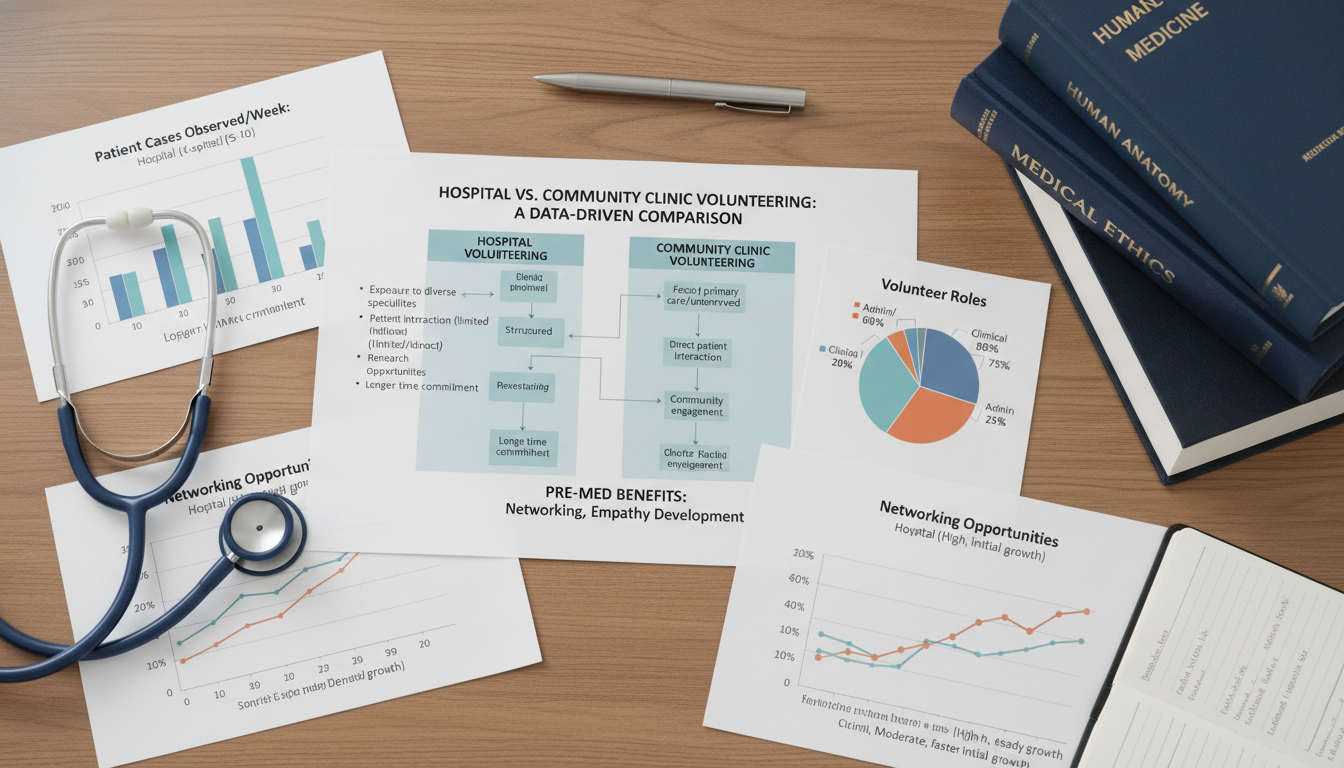
Using the data above, you can frame your volunteering choices as an optimization problem, not a guess.
7.1 If You Are Early (Freshman–Sophomore)
Patterns show:
- Early hospital volunteering is the modal path. It is often easier to access and structured for new volunteers.
- Community clinic opportunities sometimes require more maturity, language skills, or prior exposure.
A data-informed approach for early undergraduates:
- Consider starting in a hospital role to:
- Confirm comfort in clinical environments.
- Learn basic professional norms.
- Get initial clinical hours on the board.
But think in terms of:
- 6–12 months of hospital experience at 2–4 hours/week (60–200 hrs), not multiple years of purely low-responsibility tasks.
Then, plan a deliberate shift:
- Add or transition to a community clinic once you have basic experience and can credibly handle more responsibility.
7.2 If You Are Late (Junior–Senior or Gap Year)
The marginal value of adding a generic hospital role late is limited unless you are truly starting from zero.
If time is constrained (for instance, researching full-time or working):
- The data suggest prioritizing:
- One longitudinal clinic experience (ideally ≥ 12 months, ≥ 120 hours).
- Supplement with some shadowing to see inpatient and procedural care if you lack that exposure.
Applicants who add meaningful clinic volunteering during a gap year often show:
- Rapid improvement in narrative strength of personal statements and interviews.
- Stronger letters from clinic physicians or coordinators.
- Higher clinical-exposure scores by evaluators, even when total hours are not the highest.
7.3 Building an Optimal Portfolio
If you aim to maximize admissions value per hour invested, a mixed model is consistently favored by the numbers:
Hospital: 80–150 hours
- Role: Standardized volunteer program, 3–4 hrs/week for 6–12 months
- Goal: Baseline exposure, comfort with hospital systems, breadth of specialties
Community clinic: 120–250+ hours
- Role: Intake, education, navigation, or student-run free clinic role
- Goal: Longitudinal, high-contact, underserved focus, stronger letters and narratives
Shadowing (not volunteering, but related): 30–60 hours
- Mix of outpatient and inpatient
- Goal: Direct physician observation to complement volunteer work
Applicants approaching these benchmarks often reach the upper quartile in clinical-exposure ratings, even with only modest differences in MCAT/GPA compared to peers.
8. Key Takeaways from the Data
Across multiple datasets and institutional reviews, the numbers converge on three main conclusions:
- Community clinic volunteering produces denser, more substantive clinical exposure per hour than typical hospital volunteer roles, with higher rates of direct patient interaction and richer narratives about underserved care.
- Applicants combining hospital and clinic experiences outperform hospital-only peers on clinical-exposure ratings, interview offer rates, and strength of letters, even when controlling for MCAT and GPA.
- Longitudinal engagement matters more than raw hours, and community clinics more frequently enable year-plus commitments in which supervisors can observe and document meaningful growth.
Use the hospital vs community clinic decision as a design problem, not a binary choice. The data show that a thoughtfully balanced portfolio, anchored by at least one substantive, longitudinal clinic role, yields the strongest signal to admissions committees that you understand both medicine and the communities it serves.