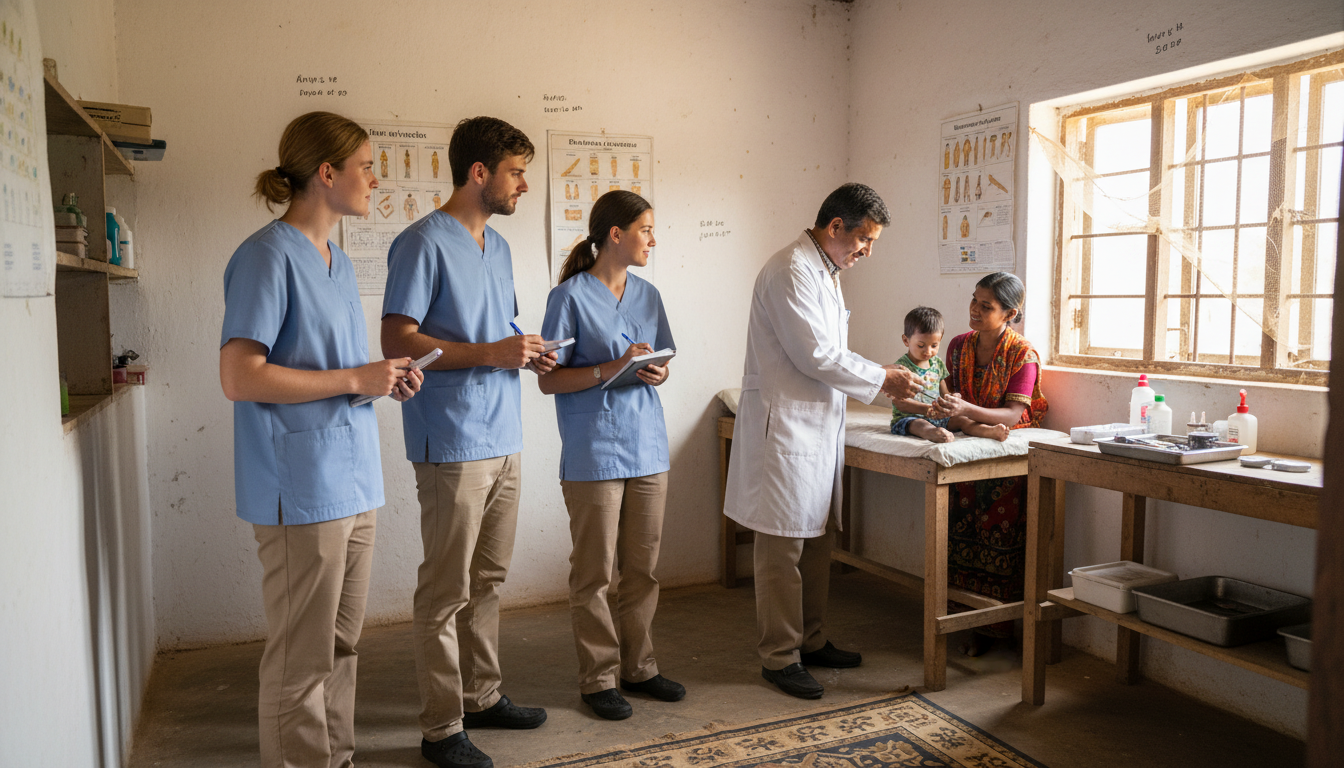
What happens when you sink thousands of dollars into an overseas “medical mission trip” and then find out admissions committees barely count it as clinical experience—or worse, quietly see it as a red flag?
Let’s cut through the glossy photos and Instagram narratives.
The premed and early-med pipeline has a serious mission-trip mythology problem: the belief that a one- or two-week international “medical service” trip is a golden ticket for your AMCAS/AACOMAS or ERAS application, especially in the “clinical volunteering” and “service” boxes.
(See also: Volunteering in the ER: Overrated or Essential for Future Physicians? for insights on clinical volunteering.)
The reality is much less romantic. And in some cases, it is uncomfortably close to unethical.
You are not the first person to wonder whether these trips are meaningful clinical exposure or just expensive voluntourism. Admissions committees, program directors, and global health experts have already been dissecting this for years. Their verdict is not what the marketing brochures tell you.
Let’s dismantle the big myths.
Myth #1: “Mission Trips Count as Strong Clinical Experience”
This is the core narrative: fly abroad, wear scrubs, stand near sick people, and suddenly you have “clinical hours” that will impress any US admissions committee.
Here’s what the data and insider commentary actually show.
How adcoms really view this
Most US MD and DO schools, as well as many residency programs, prioritize sustained clinical engagement in the US health system:
- Regular hospital volunteering (6–12+ months)
- Longitudinal clinic roles (scribing, MA, patient transport, hospice)
- Consistent free clinic or community health work
By contrast, a 7–10 day trip abroad is viewed as:
- Short-term
- Episodic, not sustained
- Often poorly supervised
- Often more “exposure” than genuine service
Several admissions deans have said this bluntly at premed conferences and webinars:
- They value long-term, local clinical engagement over “one-and-done” travel.
- They worry many short-term trips are more about the applicant than the patients.
Inside adcom rooms, the discussion often goes like this:
“They did a week in Honduras and list it as 100 clinical hours. What did they actually do? Do they have any consistent US clinical experience?”
When you stack your application with a flashy mission trip but weak or minimal local clinical experience, it reads like you were chasing a story, not reality-based preparation.
Is it clinical? Sometimes. Barely. Often not.
Clinical experience, from an adcom’s perspective, means activities where you:
- Interact with patients
- Are in a healthcare setting
- Observe or support the health care process
- Have some sense of continuity, responsibility, or real role
A week of:
- Handing out vitamins
- Briefly taking vitals
- Playing with kids while wearing a stethoscope
- Sitting in on makeshift “clinics” where you don’t speak the language
…is thin clinical experience at best, especially when there’s no longitudinal follow-up, no structured supervision, and no integration with the local health system.
The harsh truth: mission trips are often treated as supplementary, not core, clinical exposure.
Myth #2: “These Trips Show I Care About the Underserved”
This is the emotional hook used by organizations selling trips: you’re helping the poor and underserved, so your compassion and altruism will shine on your application.
Reality check: caring about the underserved isn’t proven by going somewhere exotic. It’s proven by what you do when no plane ticket or photo-op is involved.
Adcoms look for consistency, not geography
You can say you care about marginalized populations, but adcoms quietly ask:
- Do you work with underserved patients locally?
- Have you engaged with structural issues (housing, food insecurity, access to care)?
- Have you shown up consistently for communities over time?
If your only “underserved” experience is a one-off in Guatemala, and you’ve never volunteered at:
- A free clinic in your city
- A community health center
- A shelter, syringe-exchange program, or street medicine team
- A clinic for migrant farmworkers in your own state
…it looks suspiciously like poverty tourism dressed up as service.
Many faculty involved in global health explicitly say they prefer to see:
- Ongoing involvement with immigrant/refugee communities at home
- Work with low-income or marginalized US communities
- Advocacy or community organizing that demonstrates insight into health disparities
Geographic distance does not automatically equal moral depth.
Myth #3: “Everyone Does It. It Must Be Good For My Application.”
This myth survives because premeds talk to each other more than they listen to people who review applications.
The logic is: if other applicants are doing mission trips and getting accepted, then mission trips must be helping. But correlation is not causation.
What’s usually going on
When you see a successful applicant who did a mission trip, you often also see:
- Strong MCAT and GPA
- Thousands of local clinical hours
- Solid research or meaningful long-term volunteering
- Strong letters and compelling personal narrative
The mission trip is incidental—sometimes even the least impressive thing on the CV.
Yet students fixate on the wrong variable: “They went to Peru. I should go to Peru.”
Adcom perspectives shared on forums, podcasts, and panels repeatedly state:
- Mission trips rarely “make” an application.
- They can sometimes hurt if they suggest unethical involvement or naiveté.
- Almost nobody is admitted because they went on a week-long trip.
If your strategy is: “Everyone else is doing it, so I should too,” you are already behind students who ask: “What actually builds my skills, insight, and reliability as a future physician?”
Myth #4: “If I’m Allowed to Do Clinical Procedures Abroad, That’s Great Experience”
This is where things get ethically dangerous.
Many mission trips, especially loosely supervised or non-academic ones, allow or even encourage students to:
- Take vitals and document “exams” unsupervised
- Perform phlebotomy or injections without proper training
- Assist with dental extractions or minor procedures
- Give medical advice via translators with minimal oversight
There’s a name for this in global health ethics circles: “scope-of-practice dumping.” You do things abroad that would be completely illegal (or malpractice) to let you do in the US.
How this looks to informed reviewers
Global health faculty and ethically aware admissions committee members do not see this as “impressive hands-on clinical experience.”
They see:
- Potential exploitation of vulnerable populations
- Violations of local standards and US professional norms
- A student who either doesn’t recognize ethical issues or did not question them
If you ever find yourself writing in an application:
“I helped pull teeth in rural Nicaragua”
“I helped suture wounds as an undergraduate in rural Kenya”
…expect some raised eyebrows. A few places will flat-out view that as a red flag for judgment and professionalism.
The Association of American Medical Colleges (AAMC) and groups like the Consortium of Universities for Global Health (CUGH) have been clear about ethical standards in short-term global health experiences. A key theme: students should not do abroad what they are not allowed to do at home.
If your experience contradicts that principle, reframe carefully and honestly—and reflect on what you learned about ethical boundaries, not the “cool skills” you got.
Myth #5: “Mission Trips Are the Best Way to Show Global Health Interest”
If you’re genuinely interested in global health, a mission trip is often the worst-designed way to demonstrate that to serious global health faculty.
Short-term trips frequently:
- Ignore local health systems and bypass local providers
- Provide episodic care with no continuity or data
- Bring unneeded supplies while ignoring real capacity-building
- Reinforce harmful savior narratives
Meanwhile, robust global health interest can be shown in ways that do not require a passport:
- Working with local refugee or immigrant communities
- Doing research on TB, HIV, malaria, maternal health, or health systems
- Taking coursework in global health, anthropology, public health
- Engaging with NGOs that do long-term, locally-led work
Experienced global health faculty look for:
- Humility and respect for local expertise
- Awareness of colonialism, power dynamics, and sustainability
- Understanding of how health systems actually function
A one-week photo-op with kids and stethoscopes doesn’t demonstrate that.
So What Does Count? Reframing and Reality-Checking
You might be thinking: “Too late. I already did a mission trip. Now what?”
You’re not doomed. You just have to frame it honestly, modestly, and ethically, and situate it within a broader pattern of legitimate experience.
How to present a past mission trip without shooting yourself in the foot
Be precise about your role
- Say “observed,” “assisted with logistics,” “helped with patient flow,” “took vitals under supervision” if that’s accurate.
- Don’t inflate. Don’t say “provided care” if you’re an undergrad or M1/2.
Acknowledge limitations
- You can say you realized the ethical and sustainability challenges of short-term medical trips.
- Reflect on your discomfort if you saw students doing things beyond their training.
Emphasize what you learned, not what you “did to help”
- Focus on insights into health systems, resource constraints, communication barriers.
- Talk about how it motivated you to commit to long-term, local service or to pursue structured, ethically sound global health training later.
Do not make it your “centerpiece”
- If your personal statement revolves around “saving people” on a trip, you risk sounding naïve at best, exploitative at worst.
- Use it as one experience in a broader portfolio, not your defining story.
If you haven’t gone yet: questions to ask before you book
If you’re still considering a trip, treat yourself like an adult in training for a profession, not a consumer buying experience points.
Ask the organization:
- Who provides the medical care? Are they licensed local clinicians?
- What can students do? How is scope-of-practice enforced?
- How is care integrated with the local health system?
- Is there a long-term presence, or is this a pop-up clinic?
- How is patient follow-up handled?
- Is there a local partner organization that leads priorities?
If answers are hand-wavy or defensive, that’s your signal.
Also ask yourself:
- Have I already built sustained clinical experience at home?
- Am I doing this primarily for learning and service, or for my CV and photos?
- Could this money and time be better spent on local, long-term work?
Where Your Time and Money Actually Pay Off
If you want your application—premed or residency—to have real substance:
Build deep, local, sustained clinical experience
Examples that consistently earn respect:
- 1–2+ years as a hospital volunteer with consistent shifts
- Long-term free clinic role where you build relationships with staff and patients
- Part-time job as a scribe, EMT, CNA, MA, or tech
- Longitudinal involvement with a hospice program
- Ongoing work in a community mental health clinic or primary care site
These experiences:
- Show reliability and commitment
- Expose you to the unglamorous reality of healthcare
- Give you stories grounded in continuity, not novelty
Combine clinical with structural understanding
If “global” or “underserved” are genuinely important to you, back that up:
- Take courses in public health, sociology, medical anthropology
- Volunteer where poverty and structural barriers are visible: FQHCs, shelters, syringe programs, migrant clinics
- Engage with advocacy or community-based organizations run by the communities they serve
This creates an application that says: I’m not just chasing experiences. I’m trying to understand the system I’m joining.
The Bottom Line: Mission Trips Are Not Magic
Here’s what the data and lived reality of admissions actually show:
- Short-term “mission trips” are not high-yield clinical experiences.
- They’re frequently overvalued by applicants and undervalued (or scrutinized) by committees.
- Unethical or over-scoped activities abroad can be a liability, not an asset.
- The best applications are built on sustained, humble, local engagement—whether or not you ever leave the country.
Mission trips can have personal meaning. They can spark questions, self-reflection, and a desire to do better global health work in the future. But as a strategy to “boost your application,” they are often overrated, risky, and expensive compared to simply showing up week after week in your own community.
Years from now, you won’t remember the registration fee or the perfect photo with mountain backdrops. You’ll remember whether you built a foundation of honest, ethical, sustained service—or whether you chased shortcuts that looked impressive from far away but vanished under closer inspection.