
The belief that only direct patient care volunteering “counts” is one of the most persistent and damaging myths in premed culture.
It is not just wrong. It warps how students choose activities, fuels pointless anxiety, and pushes people into roles that neither fit them nor actually prepare them for medicine.
The Myth: “If I’m Not Touching Patients, It Doesn’t Count”
You know the script:
(See also: Volunteering in the ER: Overrated or Essential for Future Physicians? for more insights.)
- “Shadowing doesn’t count, you need clinical volunteering.”
- “Transport and front desk are basically worthless; med schools want hands-on patient care.”
- “Scribing is good, but better to be a tech because that’s real clinical work.”
- “Hospice is ok, but CNA > MA > everything else.”
This hierarchy gets repeated on Reddit threads, in premed group chats, and sometimes even by well-meaning advisors. The message is simple and wrong: if you are not directly taking care of patients, you’re wasting your time.
Admissions committees do not think this way.
What they actually care about is whether you have:
- Sustained exposure to real clinical environments
- Clear evidence you understand what physicians actually do
- Growth in empathy, communication, and professionalism with sick or vulnerable people
- Maturity about the realities of healthcare systems
You can get all four with or without direct patient care.
What Admissions Committees Really Look For
Let’s strip the emotion and online lore out of this. When you read admission deans’ public statements, conference talks, and AAMC guidance, the themes are consistent.
They are not counting how many blood pressures you took.
They’re trying to answer some basic questions:
- Have you spent enough time around illness, suffering, and healthcare systems to know what you’re signing up for?
- Have you worked with people who are sick, scared, confused, or vulnerable?
- Have you seen physicians at work long enough to understand the job, not just the status?
- Have you shown up consistently, over time, in service-related roles?
Here’s what that means very concretely:
A student who spends 300 hours over 2 years volunteering in the emergency department as a greeter, transporter, and interpreter, talking with families, seeing every kind of human crisis walk through the door, then reflecting thoughtfully on those experiences — that’s strong clinical exposure.
Another student who is a CNA for 100 hours over one summer, does the bare minimum, learns no names, and can’t describe a single moment of moral complexity? On paper, they had direct patient care. In reality, they learned very little of what admissions committees care about.
The form of the role matters less than the substance of your experience and what you can explain you learned from it.
Clinical ≠ Physical Tasks
The biggest conceptual mistake premeds make is equating “clinical” with “touching the patient.”
That’s not how hospitals, clinics, or med schools think.
Clinical means your work is meaningfully embedded in patient care: you are interacting with patients, families, or the healthcare team in ways related to illness, diagnosis, treatment, or support.
Plenty of high-yield clinical experiences involve zero medical procedures:
- Sitting with a confused elderly patient to prevent wandering while the nurse manages three other patients.
- Explaining in simple language what “fasting before surgery” means to a worried parent at pre-op registration.
- Calling patients to remind them of follow-up appointments in a free clinic and hearing why they missed the last one.
- Helping at a mobile clinic, managing intake and listening as people describe why they avoided doctors for years.
None of those involve drawing blood or performing exams. All of them are undeniably clinical.
Meanwhile, there are roles that involve tasks near patients that are not inherently clinical if you never engage with the human or the illness context:
- Stocking supplies late at night without interacting with anyone
- Running lab specimens from one place to another in total isolation
- Doing back-office data entry at a hospital with no patient or team contact
Those can be useful service, but if they’re 100% divorced from the lived reality of patients and clinicians, they’re weaker as “clinical” exposure.
The key question is simple: are you consistently confronting the realities of patient care? Not: did you get to put a stethoscope on someone’s chest.
The Data: What Actually Predicts Success Is Not What Reddit Thinks
Look at what large-scale data sets and admissions outcomes actually show.
Programs and studies that examine predictors of medical school performance and professionalism rarely, if ever, distinguish between “direct patient care” vs “indirect clinical exposure” in a fetishized way. They focus on:
- Service orientation
- Resilience
- Ethical and moral reasoning
- Communication and teamwork
- Comfort with ambiguity and suffering
These traits show up in:
- Long-term volunteering on a palliative care unit, even if you’re mostly talking and listening
- Consistent work in a free clinic doing registration and language interpretation
- Scribing in a busy ED, where you never physically touch a patient but see every dimension of clinical decision-making
- Volunteer coordinator roles where you’re managing logistics to keep a clinic functioning
There’s no evidence that taking more vitals early makes you a better M2 or intern. There is plenty of evidence that people who’ve confronted suffering, resource limitations, and messy real-world care — in any capacity — tend to transition smoother into clinical training.
Medical schools know this. They’re not blinded by checklists of “CNA vs MA vs scribe”.
They’re reading your activities and asking:
- What did this person actually see?
- How did this change how they think?
- Can they articulate why medicine, not just “helping people,” appeals to them?
Direct patient care can be a powerful way to answer those questions. It’s not the only way.
Shadowing vs Volunteering vs Direct Care: Stop Ranking, Start Integrating
Another flawed mental model: people rank experiences instead of seeing them as complementary.
Here’s the rough reality, stripped of the mythology:
- Shadowing is essential to understand the physician’s role and daily life. It is observational by design. It’s weak as your only clinical exposure, but critical as part of the mix.
- Clinical volunteering (patient-facing but not hands-on) is often where empathy, communication, and understanding of systems actually grow. You talk to people. You see staff burnout. You hear what scares patients at 2 am.
- Direct patient care roles (CNA, EMT, MA, tech) teach workflows, physical caregiving, and basic clinical skills. They also teach you what it’s like to serve as front-line staff, not the doctor.
The strongest applicants typically have a blend of these, not 800 hours in just one category.
A very common and very successful pattern looks like this:
- 40–80 hours shadowing across multiple specialties
- 150–300 hours of longitudinal clinical volunteering (often non-hands-on) over 1–2 years
- Optional but helpful: 200–500 hours in a direct care role if it fits your life and interests
Notice what’s missing: the idea that “if it’s not direct care, it ‘doesn’t count’.”
Admissions committees are perfectly happy with clinical narratives that emphasize:
- Hospice volunteering and extended conversations with families
- ED volunteering in a support role, seeing acute crises day after day
- Long-term clinic volunteering doing intake and patient education
- Scribing, with deep exposure to thinking, documentation, and team dynamics
You don’t have to rank everything by “who did the most procedures.”
Concrete Examples: What “Non–Direct Care” Can Actually Do For You
Let’s get out of abstraction. Here’s how seemingly “less clinical” roles can be more educational than hands-on ones.
Example 1: ED Volunteer vs Tech
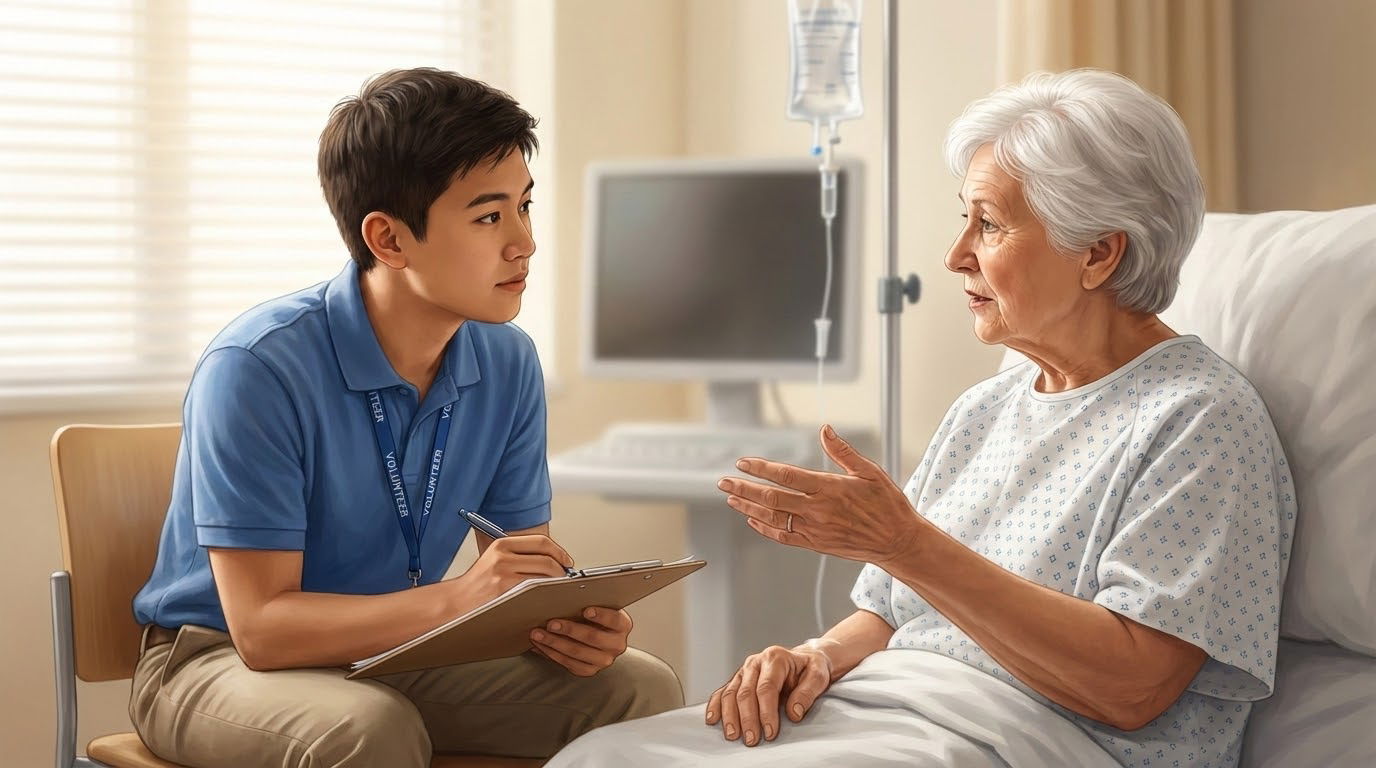
Student A: ED volunteer. No vitals, no IVs. They:
- Greet patients
- Walk families from waiting room to exam room
- Translate basic explanations for Spanish-speaking families
- Sit with elderly patients while nurses manage five things at once
- Stock rooms between patients
On paper? “Not direct care.” In reality: they’re hearing unfiltered stories about why people delayed care, how terrified parents think through risk, what chronic illness does to a marriage, and how clinicians triage under pressure.
Student B: ED tech. They:
- Draw blood and do EKGs
- Transport patients
- Clean stretchers
Fantastic exposure, but if they focus only on tasks and never reflect, they may come away knowing how to place leads but not how medicine intersects with poverty, health literacy, or racial inequities.
Which one “counts” more? Neither. The value comes from what the student pays attention to and can later articulate.
Example 2: Hospice Volunteer vs MA
Hospice volunteer:
- Listens to life stories
- Learns to sit with silence and grief
- Sees how families make decisions about comfort vs prolonging life
- Watches physicians manage expectations and uncertainty
Medical assistant:
- Takes vitals
- Rooms patients
- Preps for procedures
Both are good. But if your personal statement is about confronting mortality, grappling with communication at end-of-life, and understanding patient autonomy, the “non–direct care” hospice work will be far richer narrative ground.
What Actually Makes Clinical Volunteering “High Yield”
The common denominator in strong clinical experiences has nothing to do with whether you’re allowed to touch patients.
High-yield experiences share three features:
Proximity to illness and vulnerability
You’re around people who are sick, scared, in pain, or navigating complicated health systems.Active engagement, not passive presence
You’re not a ghost. You talk, listen, help, translate, or coordinate. You’re part of the flow of care, even if at a basic level.Reflection and meaning-making
You take time to think and write. You notice patterns in how clinicians think and how patients react. You wrestle with questions: What surprised me? What disturbed me? How did this change my view of medicine?
You can build all three as:
- A scribe who watches every conversation and decision
- A front-desk volunteer in a free clinic who hears the anxiety in each voice
- A hospital volunteer who sits with isolated patients and hears what they’re actually afraid of
If your clinical experience gives you real answers to questions like:
- “What frustrates you about the healthcare system, and how might you want to impact that as a physician?”
- “Tell me about a challenging interaction with a patient or family and what you learned.”
- “What have you seen that made you doubt whether medicine was right for you — and how did you resolve that?”
…then it has helped you, regardless of your title or whether you did procedures.
Common Traps Premeds Fall Into
A myth this entrenched creates predictable behavior — and predictable mistakes.
Chasing titles over fit
Students force themselves into EMT or CNA roles they hate because they believe it’s the only “real” option. They burn out, quit early, or show up disengaged. That hurts more than it helps.Short, intense bursts instead of long, steady engagement
People panic and do 150 hours of clinical “boot camp” in one summer instead of 3–4 hours a week for a year. Medical schools see through the box-checking. Longitudinal beats concentrated almost every time.Neglecting reflection
They collect hours like Pokémon cards and never stop to think about what any of it means. Then they stare at secondary prompts about “a meaningful patient interaction” and realize they can’t remember a single name.Writing off powerful roles because they’re not hands-on
Students decline hospice, palliative, behavioral health, or free-clinic front desk positions that would radically deepen their understanding of suffering and systems, because they’re fixated on “direct patient care” branding.
Stop optimizing for Reddit approval. Start optimizing for:
- Rich human experiences around illness
- Roles you can sustain and grow in
- Situations that challenge your assumptions about medicine and yourself
Those are the experiences that give you something to say in your application that doesn’t sound like everyone else.
How to Decide If an Experience “Helps You” Clinically
Instead of asking “Is this direct patient care?” ask:
- Will I be interacting directly with patients or families, or the clinicians who care for them?
- Will I see people when they’re sick, scared, in pain, dying, or vulnerable?
- Will I be close enough to observe how the healthcare team communicates, decides, and struggles?
- Can I do this long enough to build relationships and notice change over time?
- Am I willing to reflect regularly on what I’m seeing and learning?
If the answer to most of those is yes, the experience will almost certainly “help you” from an admissions and preparation standpoint — even if you never take a single vital sign.
If the answer to most is no, then it may be great community service, but weaker as core clinical exposure, even if you’re inside a hospital.
The Bottom Line
Three points to keep straight:
Clinical volunteering does not have to be direct patient care to be valuable. What matters is sustained, reflective exposure to illness, vulnerability, and the realities of healthcare, not the number of procedures you perform.
Admissions committees care far more about depth, continuity, and insight than your job title. A non–hands-on ED volunteer or hospice role can be more educational and impressive than a shallow, task-focused CNA or EMT stint.
Choose experiences that put you close to patients and teams, that you can stick with, and that challenge how you think. If those conditions are met, it will absolutely “help you” — whether you’re drawing blood or simply holding someone’s hand at 3 am.