
You’re standing at the volunteer office desk with a pen in your hand, staring at a list of open positions:
- Front desk greeter – Main Lobby
- ED runner – Emergency Department
- PACU support – Post-Anesthesia Care Unit
- Geriatrics companion – Inpatient
- Oncology infusion – Outpatient
- Primary care clinic assistant – Family Medicine Center
You need clinical hours. You also know you “should” get research, but no PI is returning your emails and the lab websites all say “positions full.”
Here’s the part nobody in premed advising tells you: certain clinical volunteer roles are designed—whether they say it or not—to be feeders into research projects, QI work, and faculty mentorship. Others are dead ends for networking, no matter how “clinical” they look on paper.
(See also: Volunteer Stories That Win Interviewers Over for more details.)
I’ve sat in meetings where attendings decide which volunteers to pull into projects. I’ve seen which roles faculty constantly mine for “helpful students” and which roles they never even think of when they need research help.
Let me walk you through where the real doors are—and how to walk through them without being that annoying “I want research!” person everyone avoids.
The Hidden Rule: Proximity Beats Prestige
Before we dissect specific roles, you need to understand the game board.
Faculty don’t recruit research help from:
- cold emails
- generic premed “research interest” notes
- mass volunteer email lists
They pull from whoever is already physically and psychologically close to their work.
Three things matter more than your GPA, your school, or your prior experience:
Proximity to decision-makers
Are you around attendings, fellows, and residents when they are:- complaining about needing help with a project?
- talking about “we should study this”?
- updating each other on ongoing studies or QI?
Consistency and visibility
Do they see you every week in the same setting, being normal, reliable, and not needy?Perceived usefulness
Do they already know you as “the volunteer who always gets things done” rather than “that premed kid constantly asking about shadowing”?
If a volunteer role gives you those three, it’s a research door, even if the description never mentions the R-word.
If it doesn’t, you might still get clinical exposure, but the odds of it turning into a research opportunity are slim.
Now let’s dissect the clinical settings that quietly function as research feeders.
1. Outpatient Specialty Clinics: The Quiet Goldmine
If you’re at or near an academic center, outpatient specialty clinics are where the most low-friction research gets done. Not bench work—clinical outcomes, QI, database building, retrospective chart review. The stuff that actually fills CVs.
The clinics that open the most doors:
- Oncology (especially breast, heme/onc)
- Cardiology and heart failure clinics
- Endocrinology (diabetes, obesity, thyroid)
- Pulmonology (asthma, COPD, sleep)
- Infectious disease (HIV clinics, transplant ID)
- Rheumatology and IBD clinics in GI
Why these? Because these fields run on registries, longitudinal follow-up, and endless QI initiatives. They constantly need:
- follow-up call logs updated
- survey data collected
- education materials revised and tested
- outcome measures tracked across visits
This is where “just a volunteer” becomes “part of the project.”
What the volunteer posting looks like
It will not say: “volunteer will have access to research opportunities.”
You’ll see wording like:
- “Assist with room turnover, patient flow, and patient education materials.”
- “Help staff distribute and collect patient surveys.”
- “Support clinic operations by organizing educational resources and tracking follow-up information.”
Faculty designed those surveys. Those “education materials” are likely part of a QI or IRB-approved project. The “tracking” often feeds a database.
I’ve personally seen:
- A breast oncology clinic volunteer start by handing patients symptom questionnaires and, three months later, be invited to help clean the dataset and sit in on research meetings. That turned into a poster at ASCO.
- A diabetes clinic volunteer routinely calling no-show patients for rescheduling. The attending realized this student was documenting meticulously and pulled them into a QI project on reducing no-show rates. Student became second author.
How to turn clinic volunteering into research (without being annoying)
You don’t walk in and say, “I want research.”
You do this instead:
Master the clinic flow first.
For 4–6 weeks, just be irritatingly competent:- Always on time
- Ask smart operational questions
- Anticipate tasks (restocking, room prep, forms)
Signal interest to the right person, the right way.
The key person is rarely the attending at first. It’s often:- the clinic nurse manager
- the clinical research coordinator
- the fellow who’s there 3 days a week
Example script to a research coordinator after you’ve built rapport:
“I’ve noticed a lot of patients fill out that asthma control survey. Is that part of an ongoing project or mostly for clinic use? I’m trying to understand how clinic data gets used for research.”
That question does two things: shows you’re observant and frames you as someone who wants to understand systems, not just grab a line on your CV.
- Offer concrete help on an existing workflow.
Once someone mentions “this goes into our registry” or “we’re studying X”, you follow with:
“If there’s ever a need for someone to help with data entry or cleaning older charts, I’d be very interested. I’m here every Thursday afternoon and can stay a little later if needed.”
Notice: specific availability, specific type of work, no pressure.
This is how attending conversations actually go later:
“We need someone to help extract data from the EHR for the COPD project.”
“There’s that volunteer—she’s here every Thursday and she’s very reliable. Let me ask if she’s interested.”
That’s where the door opens.
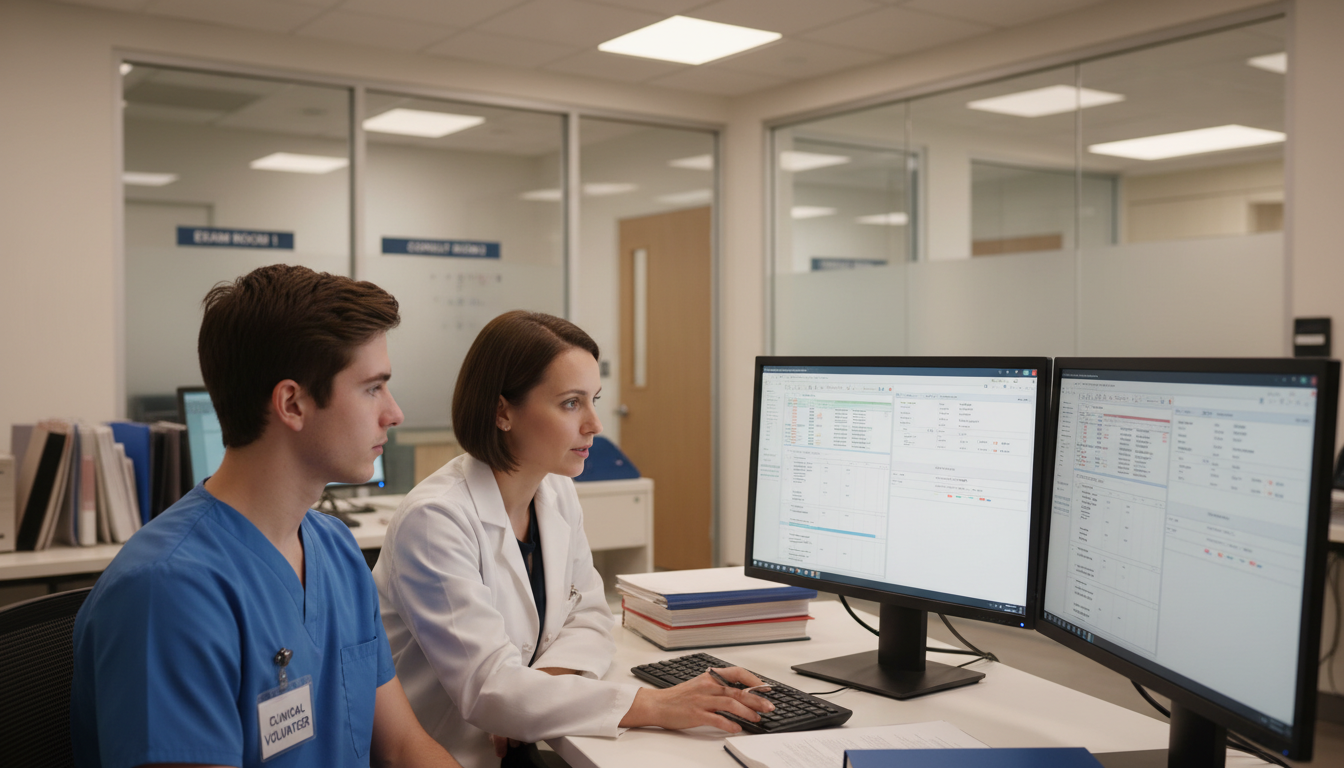
2. Emergency Department Volunteers: High Chaos, High Yield (If You Know the Angle)
The ED volunteer posting usually sounds like grunt work: stocking rooms, transporting patients, grabbing blankets.
But the ED is a research engine. At major academic centers, there’s almost always:
- an ED research coordinator team
- active enrollment for head injury, sepsis, chest pain, and stroke studies
- QI focused on throughput, triage, and resource use
The volunteers who end up near that research machine aren’t the ones hiding in supply closets. They’re the ones who become part of the ED “ecosystem.”
Where the secret doors actually are
Look for ED roles that mention:
- “Supporting nursing/physician staff with patient satisfaction surveys.”
- “Assisting with patient flow and data collection for quality improvement.”
- “Working alongside staff to improve patient experience.”
Those are often wrappers around QI and research activity. The same team that tracks patient satisfaction may be pulling data for studies, and the same coordinator who trains volunteers to collect survey data is juggling multiple IRB protocols.
Behind the scenes in more than one ED I’ve seen:
- Volunteers who consistently offered to help with “paperwork or tracking stuff” get pulled into prospective data collection: time stamps, checklist completion, family communication logs.
- One ED volunteer who was always at the nurses’ station, calmly updating whiteboards and offering to help with simple tasks, got introduced to the research coordinator. That turned into paid night-shift research assistant work, then two EM abstracts.
How to position yourself in the ED
- Spend your first few shifts at the nurses’ station, not wandering the halls.
Ask pragmatic questions:
- “Do you have any logs or forms you track that I can help keep up to date?”
- “Who do I ask if I want to help with patient surveys or follow-up calls?”
You’ll hear names like “our QI person”, “our research coordinator”, or “Dr. X who runs our sepsis project.” That’s your lead.
- Learn the names of the charge nurses and mid-levels.
They are the gatekeepers. When research staff ask, “Is there anyone reliable we can loop in?” it’s these people who either remember you or don’t.
- Once you’ve proven yourself, ask one targeted question to the research coordinator:
“I’ve really enjoyed helping with [surveys / logs]. For someone at my level, are there usually opportunities to help more with data or QI projects over time?”
You’re not asking for authorship. You’re asking for work. That lands very differently.
3. Primary Care and Community Clinics: QI Heavy, IRB-Lite
Family medicine centers, internal medicine resident clinics, FQHCs, and student-run free clinics all look like “just clinic” from the outside. On the inside, they survive on QI.
They must constantly measure:
- no-show rates
- blood pressure control
- A1c trends
- vaccination coverage
- cancer screening uptake
Those measurements are research-adjacent. Very often they become posters, local presentations, or full papers.
The roles that quietly matter
Volunteer roles in these settings often include:
- calling patients to remind or reschedule
- helping distribute and track depression, anxiety, or substance use screenings
- updating patient education handouts and tracking who receives what
That all feeds directly into ongoing or planned QI projects.
What I’ve seen repeatedly:
- A student-run free clinic “front desk” volunteer who carefully documented reasons for cancellations and no-shows was invited to join a resident’s QI project on improving appointment adherence. Student built the REDCap survey, became co-author.
- A premed at a community health center, initially doing insurance verification help and basic vitals, was later asked to help a faculty member pull chart data on colon cancer screening status by zip code. That turned into a large QI poster and an MPH connection.
How to leverage these clinics
Step one: learn what metrics they care about.
Ask a clinic manager or resident:
“What are the main numbers you all are always tracking or trying to improve? I see dashboards on the walls but don’t quite know how they’re used.”
They’ll talk about hypertension control rates, missed appointments, etc. Those are your signposts. Next:
“Is any of that being studied formally, or more just for internal improvement? I’m curious how projects start here.”
That question often triggers: “Well actually, Dr. K is working on something with our mammography rates” or “Our residents do QI projects every year.”
That’s your opening to say:
“If any of the residents or faculty need help with some of the background work—data gathering, making simple databases—I’d be really interested in helping over time. I’ll be here through the semester every Tuesday.”
You’re offering longitudinal help with unglamorous tasks. To a clinic drowning in busywork, that’s like gold.
4. Oncology Infusion and Dialysis: Long Encounters, Deep Relationships
Oncology infusion centers and dialysis units are overlooked by premeds chasing “fast-paced” environments. But these are some of the best places to build deep, durable relationships with faculty—and those relationships are what spawn research invitations.
Why? Because:
- Patients come repeatedly, on schedules
- Attendings, NPs, and nurses see the same faces for months to years
- There’s a lot of symptom management, education, and supportive care—prime ground for QI and outcomes projects
Volunteers in these areas commonly:
- Help with patient comfort and non-medical support
- Distribute symptom scales, depression screens, or quality-of-life surveys
- Assist with tracking educational handouts or supportive program participation
Behind the curtain, many of these “routine” tasks are part of:
- palliative care integration studies
- survivorship research
- symptom control and side-effect management projects
How students actually get pulled in
Typical pattern I’ve watched:
- Volunteer spends months in infusion, being consistently kind, calm, and helpful. Staff trust them.
- NP or attending says offhand, “We’re trying to study fatigue in our chemo patients but can never keep up with data collection.”
- Volunteer says, “If you ever need someone to help with the data tracking part, I’d be happy to learn how you’re doing it now. I’m here every Friday morning.”
- They start by helping collect or enter survey data.
- They get invited to a team meeting. Next, a poster. Then a manuscript if they stick around.
No cold email. No formal “research position.” Just embedded help in a setting where continuity matters.
5. The Pediatric and NICU Trap: High Emotion, Low Access (Usually)
Pediatrics units, NICUs, PICUs are catnip to premeds. They feel meaningful and intense. But from a research-access standpoint, they’re often heavily firewalled, sometimes for legal and privacy reasons.
You’ll see volunteer roles like:
- “Child life volunteer—playroom support”
- “NICU cuddler”
- “PICU family liaison”
Nothing wrong with those. If you love kids, do them. But recognize: these roles are structurally separated from research workflows. Child life has its own universe. NICU research tends to be tightly controlled and data-heavy, not something random volunteers touch.
There are exceptions—large children’s hospitals with organized “student research volunteer” tracks tied to specific units—but those are explicit programs, not hidden opportunities.
If you choose these roles, do it for meaning and clinical empathy, not as your main research pipeline.
How to Read Between the Lines of Volunteer Postings
Let’s decode some common phrasing so you can spot research-adjacent roles before you sign up.
Phrases that often signal a research/QI door:
- “Assist with patient surveys or questionnaires”
- “Help track patient outcomes or follow-up information”
- “Support quality improvement initiatives in the clinic”
- “Work closely with clinic leadership to improve patient experience”
- “Assist with data collection related to clinic operations”
Phrases that usually do not connect to research:
- “Greet visitors and provide directions in the lobby”
- “Deliver flowers, mail, and comfort items”
- “Provide companionship and conversation for patients”
- “Assist with general hospitality services”
Again, nothing wrong with the second group. But if your goal is clinical volunteering and research access, prioritize the first.
When in doubt, during the orientation or first shift, ask your supervisor:
“Are there any ongoing quality improvement or research projects that volunteers sometimes help with, even on small tasks?”
You’re not asking for immediate involvement. You’re just surfacing whether that ecosystem exists.
When You’re Already Volunteering Somewhere “Dead” for Research
Say you’re currently a lobby greeter or inpatient visitor volunteer and realizing it’s not research-friendly. You don’t have to quit tomorrow.
Do this instead:
- Do your job well for at least a few weeks so you leave a good impression. You might need them as a reference.
- Schedule a quick conversation with the volunteer coordinator:
“I’ve really appreciated this role and learned a lot from patient interactions. I’m also very interested in learning how quality improvement and research tie into patient care. Are there any volunteer roles in outpatient clinics or ED that tend to intersect with QI or data collection that I could be considered for next semester?”
Volunteer coordinators know which departments constantly ask for “good students.” They’ll flag oncology clinic, the ED, or primary care for you—because those departments have discovered that volunteers can be leveraged for research-adjacent grunt work.
That’s what you want.
The Behavioral Side: How Faculty Decide Whom to Invite
Let me be blunt: faculty don’t pick the “smartest” volunteer. They pick whoever feels lowest risk and highest reliability.
On the back end, the conversation looks like this:
“There’s that volunteer who’s always on time, never on their phone, and doesn’t act entitled. Let’s ask them first.”
They’re watching for:
- You follow HIPAA and don’t gossip
- You don’t overstep into clinical tasks
- You don’t constantly angle for shadowing during busy times
- You ask informed questions at quiet moments
- You show up when you say you will, for months
Students lose opportunities by:
- mentioning “I need X for my application” too early
- pushing for authorship or “guarantees”
- flaking out once work becomes unglamorous
If you can quietly signal long-term commitment and comfort with boring tasks, your odds go way up.
FAQ (Exactly 5 Questions)
1. I’m just a premed. Can I really get authorship from volunteering in a clinic?
Yes, but not in a month. The pattern I’ve watched: you volunteer 4–6 months, get pulled into data collection or chart review, then stay with that project through analysis or manuscript prep. If you’re consistently doing real intellectual or sustained work—not just handing out forms—faculty will often include you as a middle author on a poster or paper. It’s not guaranteed, but it’s very common in busy clinics with heavy QI/research output.
2. Should I tell the volunteer coordinator up front that I’m looking for research?
Phrase it carefully. Saying “I’m volunteering only to get research” turns people off. But saying, “I’m very interested in clinical care and also curious about how research and QI happen in clinics—are there roles where volunteers sometimes intersect with that?” is acceptable. You’re framing it as a learning interest, not a transaction.
3. How long do I need to volunteer before asking about research or QI help?
Typically 4–8 consistent shifts. Long enough that staff know your face, trust your reliability, and have seen you do the basics well. Before that, any research ask feels premature. After a month or two, one gentle, well-timed question to a coordinator, fellow, or attending is reasonable.
4. What if my hospital forbids volunteers from doing anything with data?
Some institutions wall off volunteers from direct data handling. You can still get involved by helping with: patient surveys (where staff enter data), educational materials, workflow mapping, or observational tasks that feed into QI. In those settings, the next step is often transitioning into a paid research assistant or student worker role once you’ve proven yourself as a volunteer—and then you can access data under the right approvals.
5. I’m already late in the game. Is it worth switching to a more research-friendly volunteer role now?
If you have at least 6–12 months before you apply, yes. Switch now. One year of strategically chosen clinic or ED volunteering can realistically yield: a strong letter from a faculty member, real involvement in QI or a small study, and at least a poster or abstract-level output if you’re consistent and proactive. If you’re only a few months from applying, focus less on output and more on relationship-building and letter potential.
Key Takeaways
Certain clinical volunteer settings—subspecialty outpatient clinics, ED roles tied to surveys or QI, primary care/community clinics, and infusion/dialysis units—are quietly wired into research and QI pipelines. Your job is to place yourself where data and decisions flow, then become so reliable and useful that when someone mutters, “We need help with this project,” your name is the first one they think of.