Stop listening to social media. Every year, I watch brilliant applicants tank their residency match because they overread prestige labels and completely ignore how match odds actually vary by specialty, applicant profile, and school resources. They hear "top-tier" and assume it's impossible. They hear "mid-tier" and assume it's a safety net.
Both assumptions are dead wrong.
Let's define our terms practically, stripping away the mythical nonsense. "Top-tier" means highly resourced, research-heavy, reputation-advantaged programs with massive national signaling power. "Mid-tier" means incredibly solid, clinically excellent programs that just happen to have less national name recognition.
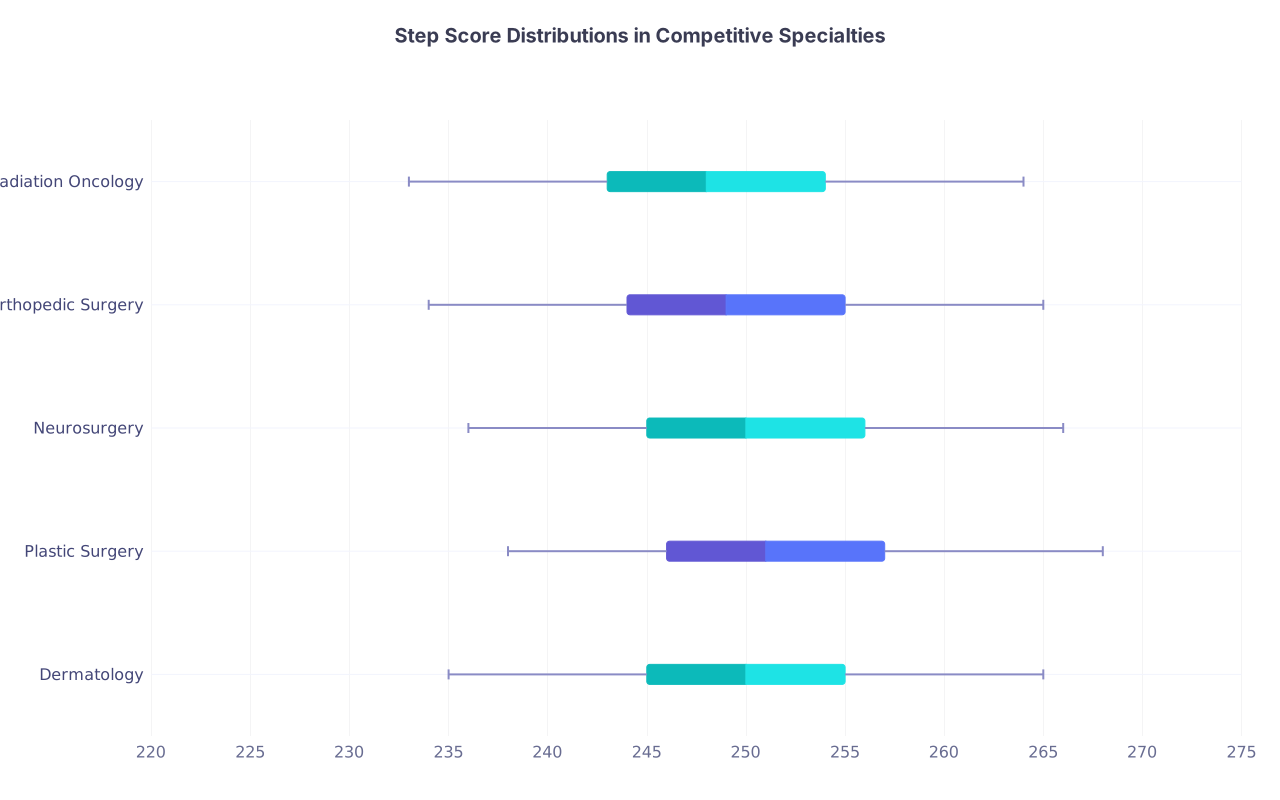
We are going to look at orthopedics, otolaryngology (ENT), and dermatology. People group these three together as the "hyper-competitive" holy trinity. But lumping them together is a massive mistake. They have wildly different match dynamics, distinct filtering mechanisms, and unique pitfalls.
I'm giving you this data to help you avoid false assumptions. Use it to calibrate your strategy. Do not use it to predict your individual outcome or to justify a lazy application. The numbers don't lie, but the way applicants interpret them is usually a disaster.
This article is for educational purposes only. It is not financial advice, not legal advice, and not tax advice. Figures vary by individual circumstances, so consult a qualified professional before acting.
How to read the data without making the classic ranking mistake
Here is the trap: applicants think match odds are just about the program's brand name. They aren't. Match odds reflect your applicant strength, your letters, your research fit, your rotation network, your geographic preferences, and your home-program advantages.
Do not cherry-pick anecdotes. I see students read one subreddit thread about a guy from a mid-tier school matching at a top-tier ortho program and suddenly think the playing field is perfectly level. It's not. One outlier does not represent the whole field.
You also need to know the difference between your metrics. Match rate, interview yield, and program tier placement are not interchangeable. A program might have a high match rate for its own students but a brutal interview yield for outsiders.
Watch out for these common data traps:
- Self-selection: Weak applicants don't apply to top-tier derm programs. The data looks skewed because the applicant pool is already pre-filtered.
- Limited sample sizes: Drawing conclusions from a single class of four residents is statistical malpractice.
- Elite clustering: Elite applicants naturally cluster at elite programs, making the top-tier gap look wider than the actual educational difference.
Orthopedics: where the top-tier gap is real, but not the whole story
Ortho has brutal selection pressure. There is no sugarcoating it. Top-tier ortho programs heavily concentrate applicants with the deepest research portfolios, the highest board scores, and the strongest institutional backing. If you are aiming for a top-10 ortho program, you need a massive research output and a home program that actively advocates for you on the national stage.
But here is where people make a fatal error: they assume "mid-tier" ortho means "safe."
Mid-tier ortho programs still match highly capable, incredibly hard-working applicants. If you have strong away rotations, fierce home-program advocacy, and a coherent commitment narrative, you can match well. But mid-tier ortho is still ortho. The specialty is so competitive that your presentation and specialty-specific productivity matter everywhere.
Avoid these red flags at all costs:
- Weak standardized test performance (especially Step 2 now that Step 1 is pass/fail).
- Zero ortho-specific research.
- Lukewarm or generic letters of recommendation.
- A late specialty decision that leaves you scrambling for away rotations.
ENT: prestige matters, but geographic and networking effects can distort the picture
ENT is a small world. Everyone knows everyone. Because of this, ENT match dynamics heavily reward strong mentorship networks, sub-internship performance, and institutional reputation. The top-tier advantage is highly visible here, but it is not absolute.
Mid-tier applicants actually perform very well in ENT when they leverage strong local advocacy and targeted experiences. Geographic flexibility is your best friend here. If you are willing to go where the network supports you, rather than just where the coastline is nice, your odds improve dramatically.
Do not assume ENT is just "ortho but smaller." The pathways and evaluation signals are entirely different. ENT heavily weights audition rotations and interpersonal fit.
I see applicants make the same mistakes every cycle:
- Underestimating the sheer weight of letters of recommendation from known ENT faculty.
- Booking audition rotations too late in the season.
- Failing to signal fit during the sub-I, treating it like a standard clinical rotation instead of a month-long interview.
Dermatology: the specialty where school reputation can look decisive, but the data can mislead
Dermatology is the ultimate prestige trap. Top-tier derm programs attract applicants with exceptional academic metrics and absurd research output. When you look at the match lists, it looks like only Ivy League students match at top-tier derm. This makes the reputation effect look much larger than it actually is.
Mid-tier medical schools still produce strong derm matches. How? Through polished applications, relentless advocacy, and clear specialty alignment.
But you must understand that derm data is incredibly vulnerable to self-selection bias. Applicants apply strategically. They apply broadly across different tiers. The danger here is confusing "fewer spots" with "top-tier only." The real issue isn't that mid-tier students can't match top-tier derm; the issue is how intensely the entire applicant pool is filtered before an interview is even granted.
If your application lacks a massive derm research portfolio and a strong home-derm advocate, applying to 40 top-tier programs is a waste of money. You will just be filtered out at the screening stage.
What applicants should do instead of chasing prestige myths
Stop obsessing over US News rankings and start building a specialty-specific strategy. Your research, your letters, your rotations, your exam scores, and your narrative consistency should drive your decisions. Prestige labeling is a distraction.
Here is the safest, most realistic interpretation of the data: top-tier odds are usually narrower, but mid-tier is absolutely not a backup bucket if your application is weak. A weak application will fail at a mid-tier ortho program just as fast as it will at a top-tier one.
Avoid the common trap of applying only by name recognition. I've seen students ignore realistic fit, geography, and mentorship access just to put a "brand name" on their rank list. That is a great way to end up unmatched.
Use the data to calibrate your expectations. Apply broadly, signal wisely, and leverage your home program's network. Don't use the data to self-sabotage by assuming you aren't "prestigious" enough, and don't use it to overconfidently ignore the very real risks of these hyper-competitive fields. Do the work. Build the application. Let the results follow.