
The way most students compare “competitiveness” between surgical fields is wrong. They stare at Step cutoffs, gossip about match rates, and then draw confident conclusions from bad data. You can do better than that.
You’re asking the right question: how do you actually compare competitiveness between similar surgical specialties—things like ortho vs neurosurgery, ENT vs plastics, urology vs general surgery with surg onc? Here’s the framework I’d use if I were sitting next to you planning your applications.
The Only Honest Definition of “Competitiveness”
Let me be blunt: competitiveness is not “average Step score” or “percent unmatched” in isolation. Those are surface numbers.
Real competitiveness is: How hard is it for someone like you to reliably match into a program you’d actually be willing to attend?
That definition forces you to consider:
- Your stats and profile vs typical matched applicants
- The number and type of spots available
- How programs screen and value different factors
- Regional and program tier preferences
- Backup options if things go sideways
If you remember nothing else from this article, remember this: you compare fields by comparing your personal match probability in each one, not by comparing abstract national averages.
Step 1: Know the Hard Numbers For Each Surgical Field
Before we talk nuance, you need baseline data for each specialty you’re comparing. For similar surgical fields, you should look at:
- Total number of PGY-1 positions
- US MD/DO match rate
- Average/median Step 2 CK for matched applicants
- Proportion of applicants with home vs away rotations
- Research output for matched applicants
- Percentage of international grads (if relevant to you)
Here’s a simplified comparison for a few common surgical specialties. Numbers are illustrative and rounded, but the pattern is what matters.
| Specialty | Relative Competitiveness* | Typical Step 2 CK Range (Matched) | US MD Match Rate |
|---|---|---|---|
| Orthopedic Surg | Very High | 250+ | ~80–85% |
| Neurosurgery | Extreme (tiny field) | 250+ | ~75–80% |
| Plastics (Ind) | Very High | 250+ | ~70–80% |
| ENT (Oto) | Very High | 245–255 | ~80–85% |
| Urology | High | 245–255 | ~85–90% |
| General Surg | Moderate–High (varies) | 235–245 (wider spread) | ~90%+ |
*“Relative Competitiveness” is a synthesis of scores, match rates, spots, and how often good applicants still go unmatched.
Now, raw numbers only tell you where the bar tends to be set. They don’t tell you how you compare. That’s next.
Step 2: Build a Personal Competitiveness Profile
You cannot compare competitiveness without putting your own data on the table. Here’s what programs actually weigh heavily in surgical fields:
- Step 2 CK (Step 1 is pass/fail—still matters somewhat, but CK is the filter now)
- Clinical grades, especially surgery and medicine
- Quality and specificity of letters (from surgeons in that field)
- Home and away rotations performance
- Research in that specialty (or at least surgical research)
- Red flags: failures, professionalism issues, gaps
Do this exercise on paper:
- Step 2 CK:
Below 235, 235–245, 246–255, 256–265, 266+ - Class performance:
Honors-heavy, mixed, mostly passes - Surgical evaluations:
Glowing, solid, or soft/brief - Research:
None, 1–2 minor projects, or multiple abstracts/pubs/posters in that field - Home program:
Strong in your field, weak, or no home program - Letters:
2–3 strong from specialists in that field vs mostly generalists
Then ask, specialty by specialty: “Would I look like a typical matched applicant for this field or an outlier trying to claw in?”
This is the first major filter. For example:
- You with a 258 CK, 3 surgery honors, solid ENT research, and a home ENT program? For ENT, you’re in a competitive lane. For ortho with zero ortho exposure, you’re weaker despite the high score.
- You with a 240 CK, average surgery evals, good work ethic but no research? Probably a stretch for integrated plastics at academic powerhouses, but realistically viable for a wide range of general surgery programs and some urology with a strategic list.
Step 3: Understand Supply, Demand, and Backup Paths
Two things make a specialty “brutal” even when scores look similar:
- Tiny number of spots
- No good backup path within the same match system
Neurosurgery and plastics are classic here: small fields, few programs, and if you strike out, you do not just slide into “community neurosurgery” or “mid-tier plastics” the way you might with general surgery.
General surgery is a different beast:
- Tons of spots across academic and community programs
- Wide variance in selectivity
- Built-in backup: if you overshoot on reach programs, you still have realistic safety nets with careful planning
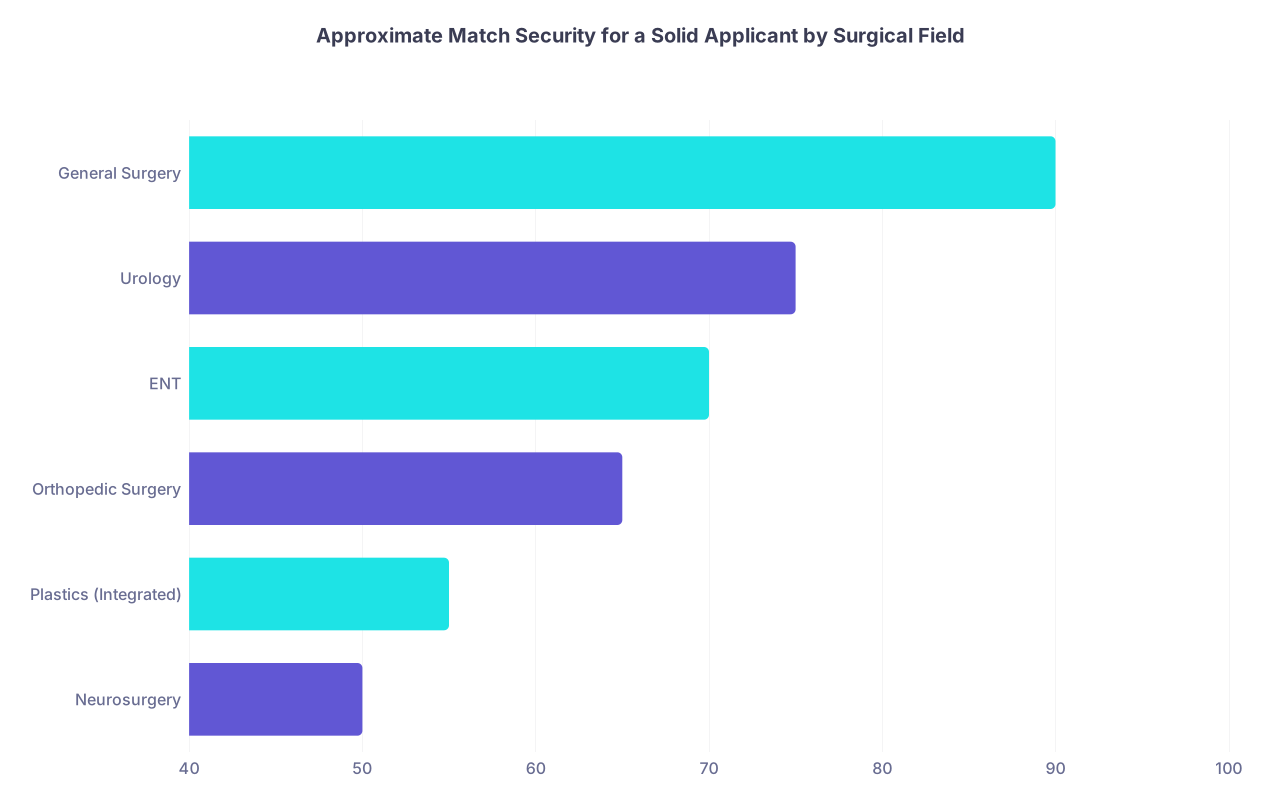
Let me make this concrete with a simple visual: odds of matching if you are a “solid but not superstar” applicant in each field.
| Category | Value |
|---|---|
| Neurosurgery | 50 |
| Plastics (Integrated) | 55 |
| Orthopedic Surgery | 65 |
| ENT | 70 |
| Urology | 75 |
| General Surgery | 90 |
Interpretation: A solid applicant (not the top 10–20%, but clearly within the typical range for matched applicants) has very different risk profiles. The closer you get to neurosurgery/plastics territory, the more “all or nothing” the game feels.
So when you compare something like ENT vs general surgery with a future fellowship in ENT-adjacent fields (surg onc, HPV, endocrine), you are partly choosing between:
- Slightly higher prestige/narrow niche vs
- Much more comfortable match safety with flexibility and fellowship options
That tradeoff is usually more important than a 3–5 point difference in average Step scores.
Step 4: Compare What Each Field Actually Demands of Applicants
Different surgical specialties select for different “signals.” You need to compare not only how competitive they are, but how competitive you are relative to what they care about.
Here’s the rough pattern for several similar surgical fields:
- Orthopedic surgery: loves high CK, ortho research, multiple ortho aways, athlete/military vibes; culture values fit and workhorse mentality heavily.
- Neurosurgery: intense research emphasis (often serious basic science or clinical neuro work), long lead time (early commitment), extremely strong letters from neurosurgeons.
- ENT (Oto): decent emphasis on research, very big on personality fit and communication, a lot of smaller programs that know each other; aways matter.
- Urology: uses its own match, likes strong exam scores, surgical acumen, and often some urology research; slightly less “I started planning this in M1” than neurosurg/plastics.
- Plastics (integrated): heavy emphasis on aesthetics/reconstructive interest, strong plastics research, advanced exposure; arguably one of the most research-sensitive at academic centers.
- General surgery: big spread. Ivy/elite academics can be nearly as score-sensitive as ENT/ortho; mid-tier and community programs care more about work ethic, strong surgery letters, and no red flags.
If your CV is “research‑light but clinically strong,” then plastics vs general surgery isn’t even close in reality. On paper, they might look “similarly competitive” (both surgical, both hard), but for you, plastics might be a 5–10% realistic shot at a place you’d like, while general surgery might be 80–90% with a balanced list.
You do not care about abstract competitiveness. You care about your personal odds of a decent outcome.
Step 5: Use a Simple Rating Tool – Not Vibes
Here’s a method I’ve used with students that actually works. For each specialty you’re comparing, score these on a 1–5 scale (1 = poor fit / high risk, 5 = strong fit / low risk):
- My scores/grades vs typical matched applicant
- My research profile vs expectations in this field
- My exposure and letters in this specialty
- Number of realistic programs I could apply to (geography + stats)
- Backup options if I do not match this year
- How early and convincingly I can commit my application narrative to this field
Add them up. Typical patterns I see:
- Student A (high Step, lots of ENT work, zero ortho exposure):
ENT = 24/30, Ortho = 14/30 - Student B (mid-240s, no research, strong general surgery evals):
General surgery = 23/30, Urology = 16/30, ENT = 15/30 - Student C (258, strong research, early neurosurg involvement, but geography-limited):
Neurosurgery = 20/30 (strong profile, but fewer programs acceptable), General surgery = 26/30
The point: once you quantify this honestly, it becomes obvious that two fields that “look similar” from a distance are not similar for you.
Step 6: Consider Lifestyle and Identity, Not Just Difficulty
Here’s the trap: Some students treat competitiveness as a proxy for prestige or worth. “Harder to match must mean better.” That’s how you end up in the wrong field for the wrong reason.
When comparing similar surgical tracks, ask yourself:
- Do I actually like the bread-and-butter cases in this field? Or do I just like saying the name?
- Can I tolerate the call structure and complication profile? (Neurosurgery and trauma-heavy general surgery are not the same lifestyle as elective ENT.)
- Am I okay narrowing to a tiny field with limited practice settings?
- If I end up in a lower-tier program in this field, will I still be happy? Or would I rather be in a strong mid-tier program in a slightly “less competitive” field?
You don’t want to win the wrong game.
Step 7: Look at Match Outcomes, Not Just Inputs
Programs’ expectations tell you one side of the story. Match outcomes tell you the other: who actually goes unmatched?
Two patterns:
- In small, hyper-competitive specialties (neurosurgery, plastics, ENT, ortho), a nontrivial chunk of strong applicants still don’t match their chosen field.
- In larger, tiered specialties (general surgery, to some extent urology), the main reason strong applicants go unmatched is a catastrophically unbalanced rank list (all reaches, poor geographic strategy, or severe red flags).
If you want to be data-driven, look at NRMP or specialty match reports and pay attention to:
- Unmatched rates for US MDs/DOs who ranked X+ programs
- Unmatched rates even among applicants above certain score thresholds
- Distribution of “back-up specialties” for unmatched applicants in that field
Then ask: “If I swing and miss here, what’s my Plan B? And does that feel acceptable?”
A Quick Visual Framework
Here’s a simple way to think about comparing similar surgical fields: risk vs flexibility.

| Step | Description |
|---|---|
| Step 1 | Choose Surgical Field |
| Step 2 | High risk |
| Step 3 | Lower risk |
| Step 4 | Very high competitiveness for you |
| Step 5 | High but manageable risk |
| Step 6 | Moderate competitiveness for you |
| Step 7 | Field Size and Spots |
| Step 8 | Backup Options? |
| Step 9 | Program Tier You Need |
This is exactly why neurosurgery and plastics “feel” more brutal than general surgery or urology, even for pretty strong students: tiny field + weak backup.
Pulling It All Together
So how do you actually compare competitiveness between, say:
- ENT vs integrated plastics
- Ortho vs neurosurgery
- Urology vs general surgery
- General surgery vs ENT with plans for fellowship?
You do it by walking through this sequence:
- Get the hard data for each field (spots, match rates, typical CK range, research expectations).
- Build an honest, written profile of your own competitiveness signals.
- Rate your fit relative to what each field values, not what Reddit says is “hard.”
- Consider field size and backup options—this is where risk really hides.
- Run a sanity check with someone who sees lots of applicants (PD, APD, or genuinely engaged advisor).
If you do all of that, you’ll usually land here: the fields that seemed “equally competitive” at first are clearly not equally risky for you personally.
FAQ (7 Questions)
1. Are Step scores still the main way to compare competitiveness between surgical fields?
They’re a big piece, but not the main one anymore. Step 2 CK is heavily used as a screen, especially after Step 1 went pass/fail, but you can’t rank competitiveness by CK alone. Ortho and ENT might have similar score expectations at many places, yet neurosurgery with similar scores is more dangerous because of fewer spots and less flexibility. Scores tell you what door you can knock on. They don’t tell you how likely it is someone opens it.
2. Is neurosurgery really harder to match than plastics or orthopedics?
For most applicants, yes, mainly because of the combination of extremely high expectations, tiny program numbers, and a culture that expects early, clear commitment plus heavy research. Integrated plastics is right there with it in terms of selectivity. Ortho is brutal too, but the field is larger, there’s a wider range of programs, and some mid-tier programs are realistic for strong applicants who might not clear the neurosurg/plastics bar.
3. How does general surgery actually compare to other surgical fields in competitiveness?
“General surgery” is not one thing. Top academic GS programs can be close to ENT/ortho in score and research expectations. But once you consider the entire spectrum—community, regional academics, mid-tier institutions—general surgery becomes much more forgiving. That doesn’t mean it’s “easy”; it means there are enough spots and enough tiers that a solid, organized applicant can usually find a home if they rank a balanced list.
4. If I’m on the fence between two surgical fields, should I pick the less competitive one?
Not automatically. Picking a field you don’t actually want just because it looks a bit easier is a bad trade. But if you genuinely like two fields similarly, and one gives you dramatically safer match odds plus more flexible practice options, then yes—that should weigh heavily. You’re choosing an entire career, not just a Match Day flex.
5. How many away rotations do I need in very competitive surgical specialties?
For things like ortho, ENT, neurosurgery, and plastics, most serious applicants do 2–3 aways in that field. Some do more, but going beyond 3 is often diminishing returns and increases burnout and cost. In general surgery, 1–2 aways are common but not mandatory everywhere, especially if you have a strong home program. Aways are less about “checking a box” and more about getting letters and proving you can function as part of that specialty’s culture.
6. Can strong research compensate for a lower Step 2 CK in competitive surgical fields?
Sometimes it helps, but it’s not magic. In research-heavy fields like neurosurgery or plastics, a phenomenal research record with big-name mentors can get you serious looks even with a slightly below-average CK for that field. But if you’re 20–25 points below the typical matched range, research won’t fully rescue you at most academic programs. It can move you from “no chance” to “reach,” not from “longshot” to “lock.”
7. Who should I trust more: my school’s advisor or online match statistics?
Neither blindly. Use national stats to understand the landscape and your school’s advisor to calibrate what those stats mean for someone with your exact profile from your institution. The best signal: people who matched into the field in the last 2–3 years from your school. Compare your numbers and CV directly to theirs. That’s usually more predictive than any single spreadsheet or generic “you’ll be fine” reassurance.
Key takeaways: compare fields by your personal odds, not abstract averages, and factor in field size, backup options, and what each specialty actually values. Do that, and comparing competitiveness between similar surgical fields stops being guesswork and starts looking like a rational decision.