The myth that you must train at a big-name university hospital to match into a competitive specialty is exaggerated—and sometimes flat-out wrong.
Let me answer your core question clearly: Yes, community programs can be a viable path into competitive specialties—but only if you’re strategic, realistic, and willing to hustle harder than the average applicant.
If you’re looking for a guarantee, you’re not going to get one from any program, community or academic. But if you’re asking, “Can I start at a community internal medicine or surgery program and still realistically end up in cards, GI, derm, radiology, anesthesia, etc.?” the answer is: sometimes yes, often yes for mid-tier competitive fields, and rarely for the ultra-elite stuff unless you play the game very well.
Let’s break it down.
First: What Do We Even Mean by “Community Program” and “Competitive Specialty”?
People throw these words around without defining them, so let’s get on the same page.
Community program (in this context) usually means:
- Affiliated with (or loosely affiliated with) a medical school, but not the flagship tertiary university hospital; or completely non-university.
- Less NIH funding and less built-in research infrastructure.
- Smaller faculty, often more clinically focused, fewer “famous name” attendings.
- Variable reputation: some are outstanding and hidden gems; some are weak and give you almost no lift for fellowships or competitive fields.
Competitive specialties typically include:
- Very competitive: Dermatology, Plastic Surgery (integrated), Neurosurgery, Orthopedics, Otolaryngology, Urology, Ophthalmology, Radiation Oncology.
- Moderately competitive: Anesthesiology, Diagnostic Radiology, Emergency Medicine (varies by cycle), some IM subspecialties (Cards, GI, Heme/Onc), certain surgical fellowships.
You’re likely asking one of three things:
- Can I match directly into a competitive specialty from a community residency (e.g., anesthesia, radiology, EM, or fellowships like GI)?
- Can I start at a community internal medicine or surgery program and still get a top fellowship (cards, GI, critical care, etc.)?
- Does being at a community program automatically kill my chances at the “fancy” stuff (derm, plastics, etc.)?
Short answers:
- Often yes, if the program is strong and you do the right things.
- Often yes, especially for cards, critical care, heme/onc, pulm; tougher but still possible for GI.
- For derm/plastics/neurosurgery if you’re not already in those fields—it’s extremely hard and often unrealistic. Not impossible, but you’d need an unusual trajectory.
How Much Does Program Type Really Matter?
Here’s the hierarchy people won’t say out loud, but everyone knows exists:
| Program Type | Relative Power for Competitive Matches |
|---|---|
| Top-tier academic (big-name) | Very High |
| Solid academic (regional name) | High |
| Strong hybrid community-affiliated | Moderate to High |
| Average community program | Moderate |
| Weak or unknown community program | Low |
Where you train affects:
- How seriously your LORs are taken.
- Whether PDs and faculty “know” each other across institutions.
- Volume/quality of cases and complexity of patients.
- Access to research and mentorship.
But here’s the part people ignore: resident performance at the same program is not equal. Every program—yes, even community—has 1–3 residents per year who absolutely crush it and match very well. And they almost always do the same things:
- Make themselves the “go-to” resident for faculty.
- Produce tangible output: research, QI projects, teaching awards.
- Build relationships with subspecialists early.
- Use away electives and networking aggressively.
So no, being at a community program doesn’t automatically kill your shot. But it lowers your default trajectory. Your outcome becomes much more dependent on what you do instead of what the institution does for you.
When Community Programs Are a Strong Path
Community programs actually punch above their weight for certain pathways—if you choose well.
1. For Mid-Competitive Fellowships from IM or Surgery
If you’re going into:
- Cardiology
- Pulm/critical care
- Heme/Onc
- Nephrology
- Endocrine
- Most surgical subspecialty fellowships (MIS, trauma, critical care, vascular depending on program)
…a strong community program with:
- in-house fellowships, or
- tight affiliation with an academic center
can absolutely get you there.
What works in your favor:
- You can often log tons of procedures and independent responsibility.
- Faculty may be highly clinically skilled and well-connected regionally.
- If the program already has a history of matching people into those fellowships, you’re not reinventing the wheel.
Ask this before you sign:
- Where did your last 5 graduating residents match for fellowship?
- How many go into fellowship vs hospitalist vs primary care?
- Do you have in-house cardiology/GI/fellowship programs? How often do your own residents match there?
If they hesitate or give vague answers, that’s your sign.
2. For Anesthesia, Radiology, EM, and Some Other “Entry” Specialties
You don’t have to be at a massive academic center to match:
- Anesthesia
- Diagnostic radiology
- Emergency medicine
- PM&R
- Sometimes pathology
What matters more:
- Board scores and clinical performance.
- Strong, credible letters from people in that specialty.
- Some research or scholarly activity in the field, if possible.
I’ve watched residents from purely community IM prelim years pivot into anesthesia or radiology because they:
- Did strong away rotations.
- Had an attending pick up the phone for them.
- Showed a clear track record of interest and competence.
Not easy. But doable.
When Community Programs Make Things Much Harder
Let’s be blunt.
If your goal is:
- Dermatology
- Integrated plastics
- Neurosurgery
- ENT
- Or a “fellowship into a fellowship” level elite spot (like advanced advanced GI with heavy research expectations)
…starting from an average, research-light community IM program and hoping to back-door your way in later is usually fantasy.
Why?
- These fields are hyper-network and research driven.
- PDs in these specialties know each other and the usual feeder programs.
- They want applicants with years of early, focused work in that field, not last-minute conversions.
Could you theoretically:
- Do IM at a community program,
- Do 10–20 derm publications,
- Network like crazy,
- Do a second residency in derm later?
Yes. Rare story, extremely high effort, usually requires personal connections or a long detour. That’s not a “viable path”; that’s a “very narrow, very uphill path.”
If you’re already in a community program and dreaming of one of these, I’d say:
- Get brutally honest advising from someone outside your program.
- Consider whether a more competitive but related specialty (e.g., hospitalist with procedures, critical care, interventional pain, etc.) gives you a life you’d actually like without torturing yourself for 5+ years.
What You Must Do Differently at a Community Program
If you’re going to use a community program as a launchpad, you can’t behave like an average resident. You just can’t.
1. Choose the Right Community Program Upfront
All community programs are not created equal. Some are quietly excellent. Others are warm bodies factories.
Key filters:
- Documented fellowship match list in your field of interest.
- At least a few faculty with academic ties (appointments at a university, publications, regional leadership roles).
- Presence of subspecialty services you care about (cards, GI, etc.) on site.
If they can’t show you where recent grads went, walk away.
2. Own Your Research Strategy
You won’t have an NIH machine churning out projects for you. So you have to be proactive.
Realistic moves:
- Partner with motivated faculty even if they’re not hardcore researchers. Case reports and small retrospective projects still count.
- Link with academic collaborators at a nearby university through:
- Electives
- Conferences
- Cold emails with a clear ask and a defined project.
- Protect small chunks of time weekly, not “I’ll do research when things slow down.” They never slow down.
You don’t need 20 papers from a community IM program to get into cards. But you do need something that shows initiative and academic engagement.
3. Make Yourself Unignorable Clinically
This is your main currency.
You want:
- The cardiologist to think, “If I had a fellowship spot, I’d give it to this resident.”
- The PD to put you in the “call me if anyone asks about them” category.
That means:
- Be early, prepared, and reliable. Not performative—actually solid.
- Learn the bread-and-butter cold and manage patients without being reckless.
- Volunteer for high-yield experiences (ICU, night float, procedures) instead of ducking them.
People talk. A glowing informal endorsement from a trusted attending can outweigh the name of your institution.
How PDs Actually View Community Applicants
Here’s the unfiltered version I’ve heard at selection meetings.
When a fellowship PD sees:
- Applicant from “Famous University IM” with okay letters and a couple papers, vs.
- Applicant from “Regional Community IM” with stellar letters, evidence of grind, and solid scores
The thought process isn’t “automatic reject.” It’s:
- “Do I trust this program’s training?”
- “Do I trust these letters?”
- “Does this person clearly outperform their environment?”
If your application signals:
- Strong clinical performance (good narrative comments, not just checkboxes),
- Rising responsibility (chief, committee work, teaching),
- Tangible initiatives (QI project, curriculum, research),
- And your PD is willing to personally advocate for you,
You’re competitive. Not automatically, but credibly.
Where do community applicants lose?
- Weak or generic letters.
- No documentation of prior graduates matching into their requested fellowship.
- Programs with terrible reputations (PDs remember the one terrible resident from that place 6 years ago).
Practical Moves If You’re Already in a Community Program
You’re in a community residency now and aiming higher. Here’s the playbook.
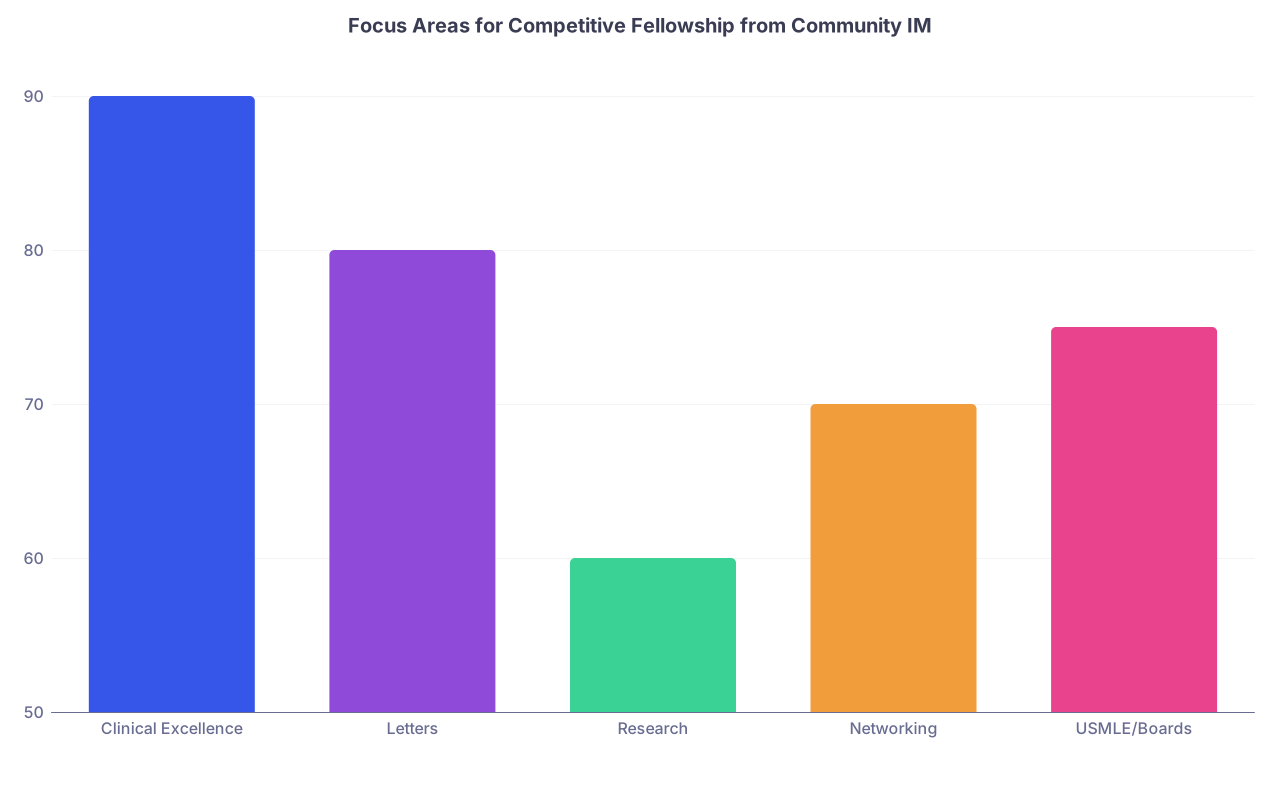
| Category | Value |
|---|---|
| Clinical Excellence | 90 |
| Letters | 80 |
| Research | 60 |
| Networking | 70 |
| USMLE/Boards | 75 |
- Identify 2–3 subspecialists early who could become your champions.
- Ask to join or start a modest research or QI project with them.
- Crush their rotation. Then stay in touch—send updates, ask smart questions, offer to help on future work.
- Do at least one away elective at a strong academic center in your target field.
- Go to at least one national or regional conference and present something (poster, case, anything).
- Have your PD explicitly mention in your letter that you’re one of their top residents in X years, if it’s true. Program directors read that closely.
And be realistic: if your program has zero track record of matching people into your target field, you’re not doomed—but you are behind. You’ll need more away rotations, more external mentors, and probably a broader list of programs when you apply.
Quick Comparison: Academic vs Community Start for Competitive Goals
| Factor | Academic Program | Community Program |
|---|---|---|
| Built-in research | Strong | Variable, often limited |
| Name recognition | High | Ranges from moderate to low |
| Networking | Easier | Must be actively created |
| Clinical autonomy | Sometimes less early | Often more, especially later |
| Path to top fellowships | Smoother on average | Possible but requires standout effort |
Visualizing a Smart Strategy from a Community Program

| Step | Description |
|---|---|
| Step 1 | Start Community IM |
| Step 2 | Target in house subspecialists |
| Step 3 | Find external mentors |
| Step 4 | Join projects early |
| Step 5 | Crush key rotations |
| Step 6 | Secure strong letters |
| Step 7 | Do away elective at academic center |
| Step 8 | Present at conference |
| Step 9 | Apply widely for fellowship |
| Step 10 | Strong Program Match History |
FAQ: Community Programs and Competitive Specialties
Can you get cardiology or GI from a community internal medicine residency?
Yes for cardiology and pulm/crit; GI is tougher but still possible from strong community programs with either in-house fellowships or consistent recent match history. If no one from your program has matched GI in years, you’re starting from a serious deficit.Do program directors discriminate against community program applicants?
They don’t “discriminate,” but they absolutely calibrate expectations based on where you trained. An A+ at a respected community program can beat a B- at a mid-tier academic place. But a weak app from a no-name community program is an easy pass in a competitive pile.Is it smarter to be a top resident at a community program or average at a big academic program?
For competitive fellowships, being top at a solid community or hybrid program often beats being invisible at a big name. The ideal is being top at a big academic center, obviously—but between the two options you gave, top performer usually wins.Can a prelim year at a community program lead to a categorical spot in a competitive specialty?
Sometimes. People have jumped from prelim medicine/surgery into anesthesia, radiology, EM, or even categorical IM at better programs. The key: strong letters, good scores, clear interest in that field, and aggressive networking. But it’s not something to bank on casually.Do I absolutely need research to match into a competitive fellowship from a community program?
“Absolutely need” is strong, but practically, yes—you usually need some. From community, research is your signal that you can function academically. Even a few posters and small retrospective projects can move the needle, especially paired with strong clinical letters.Should I try to transfer from my community residency to an academic program?
Only if: (1) your current program has a poor reputation or toxic culture, or (2) your goals absolutely require heavy research (e.g., you want to be a physician-scientist in cards EP). Transfers are logistically hard and politically messy. Often it’s more realistic to crush it where you are, then use away rotations and networking for fellowship.If I haven’t matched into a competitive specialty yet, is doing community IM or surgery “settling”?
Not necessarily. It’s only “settling” if you stop trying afterward and blame the system. Community IM or surgery can be a platform for a ton of fulfilling, well-paid, procedure-heavy careers—and still a legit springboard to many fellowships if you’re deliberate.
Bottom line:
- Community programs can be a viable path into competitive specialties, especially for mid-high competitiveness fields and many fellowships—if the program is decent and you outperform your environment.
- Your margin for error is smaller. You need stronger letters, clearer initiative, and more intentional networking than the average academic resident.
- Don’t romanticize unicorn outcomes. Use hard data (match lists, faculty connections, prior graduates) and then commit to being the resident everyone wants to work with and write for. That’s what actually moves you from “community” to “competitive.”