The default advice about taking a research year is backwards.
Too many students take one because they’re scared, not because they have a real plan.
Here’s the blunt answer:
A research year can absolutely move you into a more competitive specialty — but only if three conditions are true:
- You’re already in the ballpark academically (Step scores, grades, some experiences).
- You’ll get real output: strong letters, serious mentorship, ideally pubs/abstracts.
- You’re using the year as part of a clear, targeted strategy — not as a panic button.
Let’s walk through how to decide, specialty by specialty, and what actually changes your odds.
1. When a Research Year Actually Helps
A research year is most valuable when:
- The specialty is research-heavy and prestige-conscious
- You’re at or near the borderline of competitiveness
- You can plug into a high-yield lab or department with a track record of matching residents
Think radiology at a big-name academic center. Plastic surgery at a place pumping out 10+ papers per year. Dermatology where the chair personally calls PDs.
Here’s how research years typically move the needle:
- They fix one major weakness: lack of research, weak letters, no connection to the field.
- They demonstrate commitment to the specialty.
- They put you in front of people who make calls during interview season.
They do not magically erase:
- Multiple exam failures
- Horrible professionalism red flags
- A complete lack of clinical performance
They’re a lever, not a reset button.
2. Specialty-by-Specialty: Is a Research Year Worth It?
This is what most people actually care about. So let’s be concrete.
| Specialty | Research Year Value | Notes |
|---|---|---|
| Dermatology | Very High | Often expected if weak on CV |
| Plastic Surgery | Very High | Especially for re-applicants |
| Neurosurgery | Very High | Many programs built around it |
| Ortho Surgery | High | Big boost for mid-range apps |
| ENT (OTO-HNS) | High | Helps if lacking in research |
| Rad Onc | High | Field is research-oriented |
| Radiology (DR) | Moderate–High | More for top programs |
| Ophthalmology | Moderate–High | Helps for weaker apps |
Now the flip side:
- Internal Medicine, Family Med, Psych, Peds, EM, OB-GYN (for most programs):
A research year is usually not necessary unless:- You’re aiming at top 5–10 programs in the country, or
- You’re building a long-term physician-scientist track record.
If you’re thinking of stepping down from derm/plastics/ENT to IM or peds, a research year just to “look good” is usually a waste of time and money. Programs in those fields care more about clinical performance, fit, and Step 2 than whether you took a gap year for a couple of posters.
3. The Three-Question Test: Should You Take a Research Year?
Use this filter. Be honest; otherwise it’s garbage-in, garbage-out.
Question 1: Are you within striking distance on paper?
You’re likely in range if:
- Step 2 is within ~5–10 points of the average matched applicant for that field
- You don’t have multiple failures or severe academic issues
- You have at least some exposure to the field (shadowing, an elective, even basic involvement)
If your scores are far below the usual matched range or you’ve repeatedly failed exams, a research year won’t fix the fundamental problem. In those cases, building a strong application for a less competitive specialty is usually smarter.
Question 2: Do you have access to a high-yield research setup?
High-yield =
- A PI or department with a history of matching students into that specialty
- Chances at authorship (not just data entry)
- A realistic shot at multiple outputs (abstracts, posters, maybe a paper or two)
- A mentor who’s actually known in the field and writes strong letters
If your plan is “I’ll cold email 200 people and maybe someone will let me help with a chart review remotely,” that’s not a research year. That’s wishful thinking.
Question 3: Is this about strategy — or fear?
Wrong reasons:
- “Everyone in my class applying derm is doing a research year.”
- “I’m terrified I won’t match so I’ll just stall.”
- “I don’t know what I want, so I’ll do research and figure it out.”
Right reasons:
- “I love [specific specialty] and know I want an academic or subspecialty career.”
- “My main gap is research and letters, and I have a concrete offer in a strong department.”
- “I’m willing to live with the cost and extra year to maximize my chance at this specific path.”
If you can’t answer why this specialty, at this time, with this mentor — pause.
4. What a Strong Research Year Actually Looks Like
The difference between a CV-changing research year and a shrug-year is massive.
A good year usually includes:
- 1–3 first- or second-author manuscripts submitted or accepted
- Several abstracts/posters at national conferences
- Being known in the department as “the student who works hard and gets things done”
- A letter from a well-known faculty member describing you as one of the top students they’ve worked with
- Real integration: attending conferences, journal clubs, M&Ms, maybe helping with QI projects
A mediocre year:
- One poster where you’re middle-of-the-pack author
- A few “manuscripts in preparation” that never get submitted
- PI barely knows your name
- No clear narrative of growth or commitment to the field
Programs can smell the difference in 10 seconds reading your ERAS.
5. How Much Does a Research Year Move Your Match Odds?
There’s no perfect formula, but this is the rough pattern I’ve seen:
For top-tier but not insane specialties (radiology, ortho, ENT, ophtho):
If you’re already near the competitive range, a strong research year can shift you from “maybe 30–40% chance if you apply broadly” to “60–70% and likely more interviews, especially at academic places.”For hyper-competitive ones (derm, plastics, neurosurg):
It can be the difference between “essentially no realistic shot” and “legit shot if everything else lines up.”For less competitive fields:
It might nudge you toward more academic programs or fellowships later, but it won’t be the deciding factor to match at all.
Here’s the key:
Programs don’t reward the gap year itself. They reward the story and output.
6. The Financial and Life Cost (People Underestimate This)
You’re giving up:
- One full year of attending salary later on (which can be easily $250–400k+ depending on specialty)
- A year of your life where your friends may move on, match, start residency
- Often living on a small stipend or loans
Is it worth it? Sometimes absolutely. If that year helps you match into the specialty where you’ll work for 30 years, the math can still be very much in your favor.
But it’s not free, and pretending it is will bite you.
7. How to Decide Between “Take the Year” vs “Pivot to a Less Competitive Specialty”
Here’s the real fork in the road many students are sitting at.
Use this framework:
You should strongly consider a research year if:
- You’d genuinely be unhappy long-term in less competitive alternatives
- Your scores and performance are not disastrous for the target field
- You have lined up (not just “plan to find”) a solid research position with a clear mentor
- You understand the cost and still feel pulled toward that specialty
You should seriously consider pivoting if:
- You’re chasing the specialty largely for status, lifestyle myths, or peer pressure
- You have major academic red flags that a year of research won’t clean up
- You’re ambivalent and keep saying things like “I mean I could be happy in a bunch of things”
- You can see yourself thriving in a slightly less competitive field that still offers procedures, good pay, and subspecialization (e.g., anesthesiology, IM subspecialties, PM&R, etc.)
One pattern I’ve seen a lot:
Students who pivot intentionally (not as a last-ditch panic) often end up quite happy — especially if they choose a field with fellowships, procedural options, and flexibility. Students who do a research year out of fear, get mediocre output, then still have to pivot? They’re usually more burned out and resentful.
8. If You Do It, How to Make the Research Year High-Yield
If you’ve decided to commit, treat it like your job. Because it is.
Before you sign on, ask:
“How have prior students from this position matched, and where?”
“What kind of projects will I own, and what’s the expected authorship?”
“How often will I meet with you directly?”Set specific targets by month 2:
- X abstracts submitted
- Y manuscripts in draft
- Z conferences you’ll attend
Stay visible: go to every departmental conference you can. Present. Ask questions. Be the friendly, reliable one.
Don’t disappear from clinical medicine entirely. Shadow in that specialty, do a couple of sub-Is later, keep your clinical brain alive.
If at 6 months in you have nothing concrete, you need to have a blunt talk with your mentor and possibly recalibrate.
9. Red Flags: When a Research Year is a Bad Idea
Walk away or rethink if:
- You don’t have any clear offer but think “I’ll figure it out later.”
- The PI is vague: “We have lots of projects, we’ll see what happens.”
- The department has no track record of matching people into that specialty.
- Your primary motivation, if you’re honest, is “I don’t know what else to do.”
Unstructured “maybe something will pan out” research years are where time and money go to die.

| Step | Description |
|---|---|
| Step 1 | Want more competitive specialty |
| Step 2 | Consider less competitive fields |
| Step 3 | Try to get concrete offer first |
| Step 4 | Take focused research year |
| Step 5 | In score range? |
| Step 6 | Have strong research offer? |
| Step 7 | Willing to accept extra year cost? |
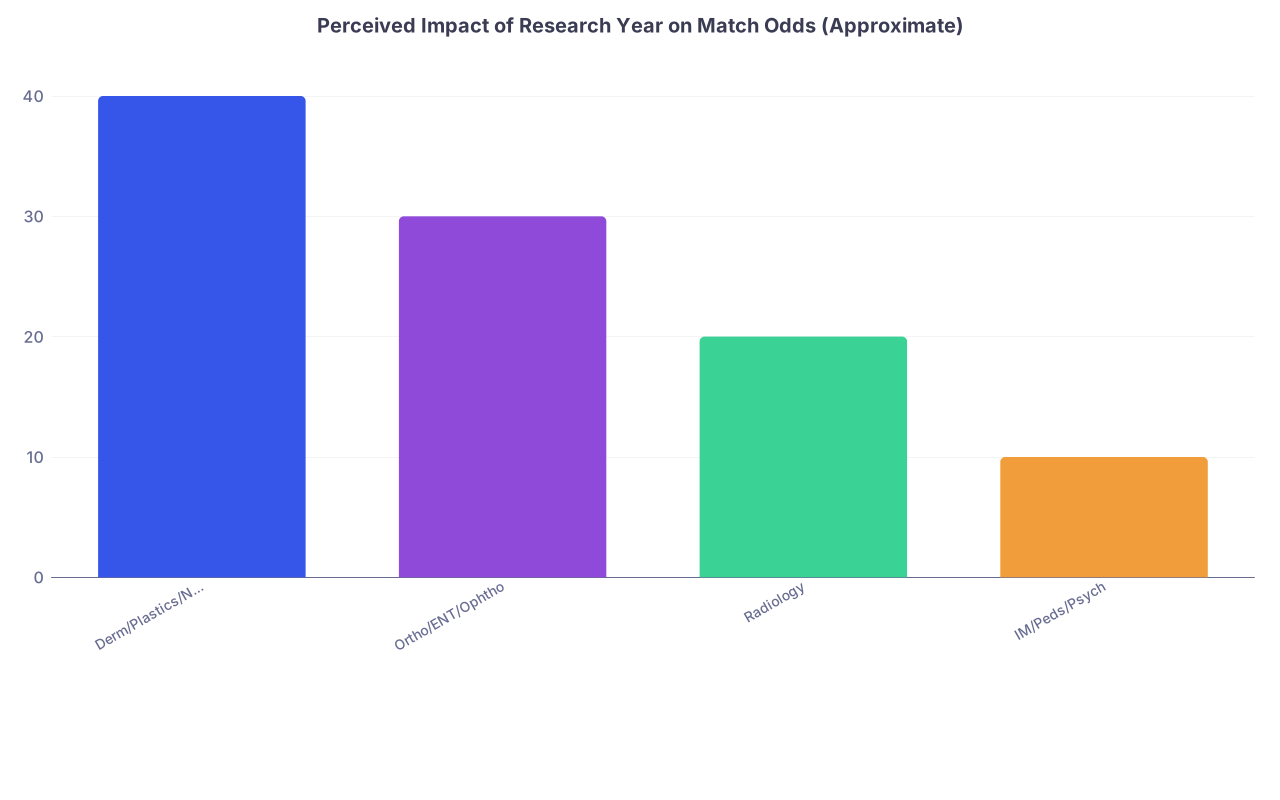
| Category | Value |
|---|---|
| Derm/Plastics/Neurosurg | 40 |
| Ortho/ENT/Ophtho | 30 |
| Radiology | 20 |
| IM/Peds/Psych | 10 |
(Values here are illustrative: approximate percentage point increase in match probability for borderline applicants who complete a strong, structured research year.)
FAQ: Research Year for Competitive Specialties
1. Will a research year make up for a low Step 1 (or a fail)?
Sometimes it can soften the blow, but it won’t erase it. Programs might think: “Clearly some issues, but they rebounded and are productive.” If your Step 2 is strong and everything else is solid, the research year can help. If Step 2 is also weak or you’ve got multiple fails, research is not the right fix; consider a less competitive field where your full application can still be competitive.
2. Is a research year basically required for derm, plastics, or neurosurgery now?
Not “required,” but it’s creeping toward “strongly expected” for applicants who aren’t already stellar on every axis. If you’re from a lower-ranked med school, have average scores, or started research late, a structured research year at a strong institution can be the difference between no interviews and a real shot. Top-of-class students at powerhouse schools with multiple publications sometimes skip it and still match just fine.
3. Should I take a research year if I’m not 100% sure about the specialty?
Usually no. That’s an expensive way to explore. You’re better off doing extra electives, shadowing, talking to residents, and being honest with yourself. A research year is a good move when you already know: “This is my field,” and you’re closing a gap — not when you’re still shopping.
4. What if I can only get a research position in a different specialty than the one I want?
That’s low-yield if your primary goal is matching a competitive field. Derm programs don’t care much that you did a year of nephrology research. It might help slightly as evidence of academic productivity, but it won’t replace derm-focused work, derm mentors, or derm letters. If the choice is “random research” vs “no research year,” I’d skip it and focus on strengthening other parts of your app.
5. Does it matter if I do the research year at my home institution vs somewhere big-name?
Yes, it can. A year in a nationally known department with a plugged-in mentor is usually higher yield — especially if your home program is small or weak in that specialty. But a strong, structured year with a committed mentor at your home place is better than a chaotic, name-brand year where no one knows or cares about you. Prioritize mentorship and track record of matching students over just the logo.
6. I already applied once and didn’t match. Should I reapply with a research year?
If you’re dead set on that specialty and your main weakness was lack of research/letters/visibility, then yes, a research year can absolutely turn a reapplication into a success story — if done right. But first dissect your prior application with someone honest (PD, advisor, mentor). If your fundamental issue was very low scores, poor interview performance, or professionalism concerns, simply adding research won’t fix the root problem. In those cases, a deliberate pivot to another specialty may be the smarter, safer play.
Bottom line:
- A research year is powerful leverage for certain specialties — if you’re already in the ballpark and have a real plan with real mentors.
- Don’t do it as a reflex or a stall tactic. Do it as a targeted move toward a specialty you’re genuinely committed to.
- If your gut answer to “Would I still choose this path if it takes one extra year and more debt?” is anything short of yes, you probably shouldn’t take the research year.