You’re a third‑year at a newer med school. Your class doesn’t have much of a Match track record yet. You love something brutally competitive—derm, ortho, plastics, ENT, neurosurgery, maybe IR. And now the anxiety hits:
“Is it even worth applying from my school? Or am I setting myself up to fail?”
Here’s the blunt answer:
Yes, it can be worth it. But only if you’re realistic, strategic, and willing to accept a higher risk of not matching.
Let me walk through how to decide if it’s worth it for you, not in the abstract.
1. The Core Question: Are You Competitive Enough That School Age Matters Less?
Programs don’t reject you just because you’re from a newer school. But when they’re screening hundreds of apps for a tiny number of interview spots, they use shorthand signals:
- Known schools with proven residents
- Letters from known faculty
- Board scores, clerkship grades, class rank
- Research that fits their specialty
At older schools, those signals are easier to generate. At a newer school, you’re swimming upstream.
So the real question isn’t “Is my school too new?” It’s:
Am I so strong on objective metrics and connections that my school’s newness becomes a smaller factor, not a fatal flaw?
Here’s a rough mental test. If you’re aiming for a top‑tier competitive specialty from a newer school, I want to see most of this:
- Step 2 in the top quartile for that specialty’s applicants
- Honors in core rotations related to the specialty
- Strong specialty‑specific letters (ideally at least 1–2 from outside institutions with known faculty)
- Real research in that field (poster/pubs/serious involvement)
- Evidence you can function on a busy service (sub‑I evals that say things like “functioning at early intern level”)
If you’re nowhere near this and your school doesn’t have a track record in that field yet, applying only to a hyper‑competitive specialty is usually a bad bet.
But there is middle ground: targeted, high‑effort application plus a serious backup plan.
2. How Much Does Being at a Newer Med School Actually Hurt You?
Let’s separate myth from reality.
What “newer school” usually means:
- Fewer or no home residency programs in competitive specialties
- Fewer well‑known faculty who can pick up the phone for you
- Less of a track record: PDs don’t know yet if “honors” at your school means superstar or just above average
- Less built‑in research infrastructure in small or niche specialties
What it does not mean:
- You’re automatically blocked from derm/ortho/ENT/etc.
- Your application will be trashed on sight
- You can’t be a top candidate if your metrics and experiences are strong
Here’s how I’ve seen it play out:
Scenario A:
Student at a 5‑year‑old MD school. Step 2: 255. 2 ortho away rotations, strong letters from known surgeons, 3 pubs (2 ortho‑related). Applied broadly, interviewed at a mix of mid‑tier and community programs, matched ortho. Their school being newer was a footnote, not a barrier.
Scenario B:
Student at 3‑year‑old DO school, wants derm. Average scores, minimal research, no home derm program, no away rotations due to poor planning. Applied to 80 derm programs, 0 interviews. No backup plan. Went unmatched. This wasn’t because the school was new. This was because the profile was weak for that specialty and there was no plan B.
Your school’s age is a multiplier, not a death sentence. Strong candidate + newer school = uphill but doable. Weak candidate + newer school + competitive specialty = very high risk.
3. Specialty Snapshot: Where Newer‑School Applicants Struggle More
Let’s lay out how “being from a newer school” interacts with competitiveness across specialties.
| Specialty Tier | Examples | Relative Difficulty from Newer School |
|---|---|---|
| Ultra-competitive | Derm, Plastics, Ortho, ENT, Neurosurg | Very high – need standout metrics, aways, research |
| Competitive | EM (at top sites), Anes, Radiology, IR, Urology | Moderate to high – strong app still needed |
| Middle | IM, Gen Surg, Peds, OB/GYN | Variable – academic vs community matters |
| Less competitive | FM, Psych, Neurology, PM&R | Often very doable with solid baseline app |
For ultra‑competitive fields, your school’s lack of brand/track record matters more because:
- Programs have an absurd number of high‑scoring applicants from name‑brand schools.
- They lean heavily on trusted letters and known institutions.
- They use any unclear signal as a reason to move on.
That doesn’t mean “don’t apply.” It means if you’re an average or slightly above average candidate for that field, you’re not “just as likely” as your friend at a top‑20 school. You’re not.
4. Hard Metrics: Where Do You Actually Stand?
Don’t guess. Put numbers on the problem.
Compare your Step 2 and profile to the field
Pull recent NRMP and specialty‑specific data. Then be honest:
- Are you above, at, or below the matched mean for that specialty?
- Did you honor relevant rotations?
- Do you have actual specialty‑specific letters from people who train residents in that field?
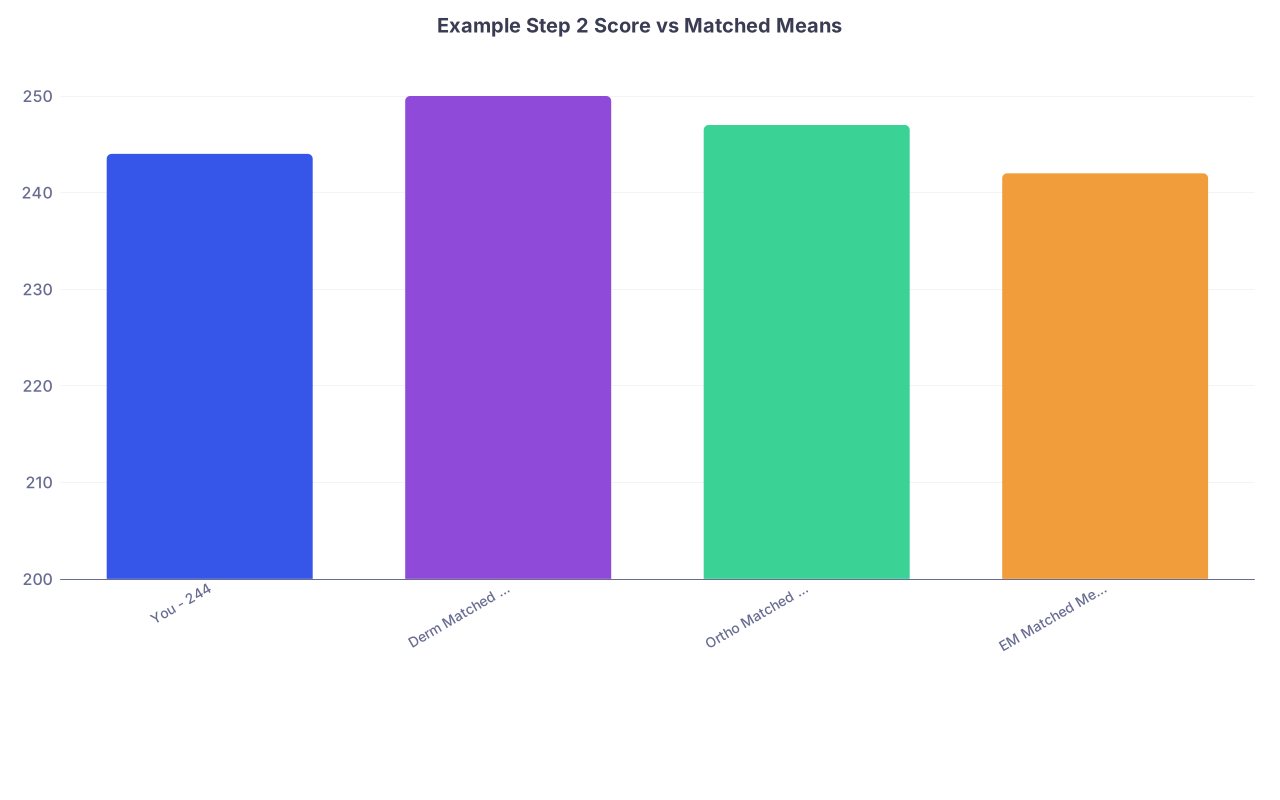
| Category | Value |
|---|---|
| You - 244 | 244 |
| Derm Matched Mean - 250 | 250 |
| Ortho Matched Mean - 247 | 247 |
| EM Matched Mean - 242 | 242 |
If you’re:
- 10+ points above matched mean → your school’s newness hurts less.
- Around the mean → your school’s newness hurts more; you need other strengths.
- Below the mean → from a newer school, this is almost always a “you must have a serious backup” situation for ultra‑competitive fields.
Reality check with someone who knows
Have at least two people review your file:
- One at your own school (dean’s office, specialty advisor)
- One in the specialty at another institution (from an away, research, or cold email)
Ask them bluntly:
“If I were your student, would you advise me to go all‑in on [specialty], or pair it with a strong backup?”
If both hesitate, treat that as real data.
5. Strategic Moves That Actually Help from a Newer School
If you’re still in the game mentally and your metrics are at least plausible, here’s how you shift the odds.
1. Away rotations are non‑negotiable for many fields
From a newer school, aways are your brand name.
- Aim for 2 aways in that specialty (ortho, ENT, derm, etc.).
- Treat them like month‑long job interviews. Show up early, be coachable, read every night.
- Your goal: leave with at least one strong letter from a program that actually matches residents in your dream field.
If your school doesn’t have the specialty at all (no home derm, for example), then your aways and those letters are 90% of your “this person can actually do this work” signal.
2. Get at least one recognizable name on your side
Programs notice letters from people they’ve worked with, co‑authored with, or heard speak at conferences.
How to do this from a newer school:
- Join multi‑center research through national specialty organizations.
- Ask your school to help you set up an away with a department that has a history of taking your graduates (if any data exists).
- Be the best student a faculty member has seen in years, then ask them directly if they’d be comfortable writing a “very strong” letter.
Vague “good worker” letters from unknown faculty are basically neutral. You need at least one letter that feels enthusiastic and specific.
3. Build a real backup—don’t just talk about having one
The biggest mistake I see: “I’ll just have a backup,” but then the backup application is weak, last‑minute, and clearly second‑choice. Programs can see that.
Serious backup means:
- You’d genuinely be OK training and working in that field
- You do at least one sub‑I or strong rotation in it
- You get at least one letter from that specialty
- You adjust your personal statement and ERAS thoughtfully—not copy‑paste with a few words changed
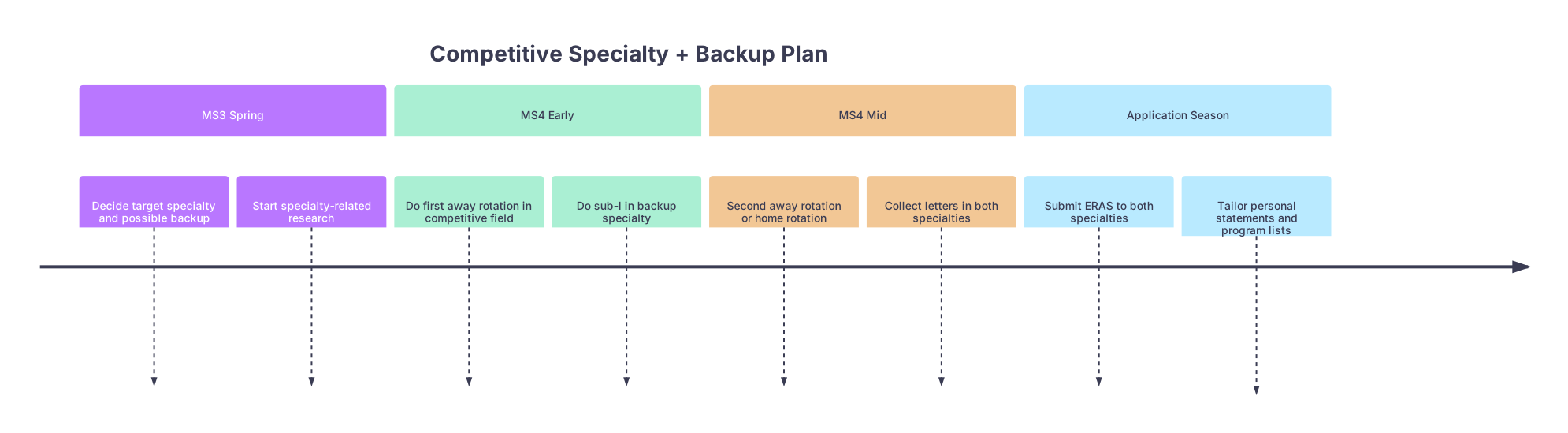
If you’re not willing to put in real effort on a backup, then you’re implicitly accepting a higher chance of SOAP or not matching.
6. When Is It Not Worth Applying?
You need a line in the sand. Here are times I’d tell you flat‑out: don’t apply (or only apply to a tiny number as a “reach” while going all‑in on backup).
I’d be very cautious about going hard on an ultra‑competitive specialty from a newer school if:
- Your Step 2 is below the unmatched mean for that field
- You have no away rotations and no way to get them (timing, life, etc.)
- You have no research and are late MS4 trying to “add something”
- Every advisor who knows the specialty says some version of, “I’d be worried if you didn’t have a strong backup”
You’re allowed to apply anywhere. That’s your money and your time. But you should understand the real odds, not the sugar‑coated ones.
7. How to Build Your Program List from a Newer School
If you decide it is worth applying, the next trap is building the wrong list.
Typical advice: “Apply broadly.” Useless sentence. Here’s what that means in practice from a newer school:
- Mix academic and community programs.
- Don’t fixate on city prestige. You might need to go where others don’t want to.
- Target programs that:
- Have previously matched DOs or grads from mid‑tier/non‑brand schools
- Aren’t all in the same geographic hotspot(s)
- Have a reputation for actually training rather than just flexing their name on Twitter
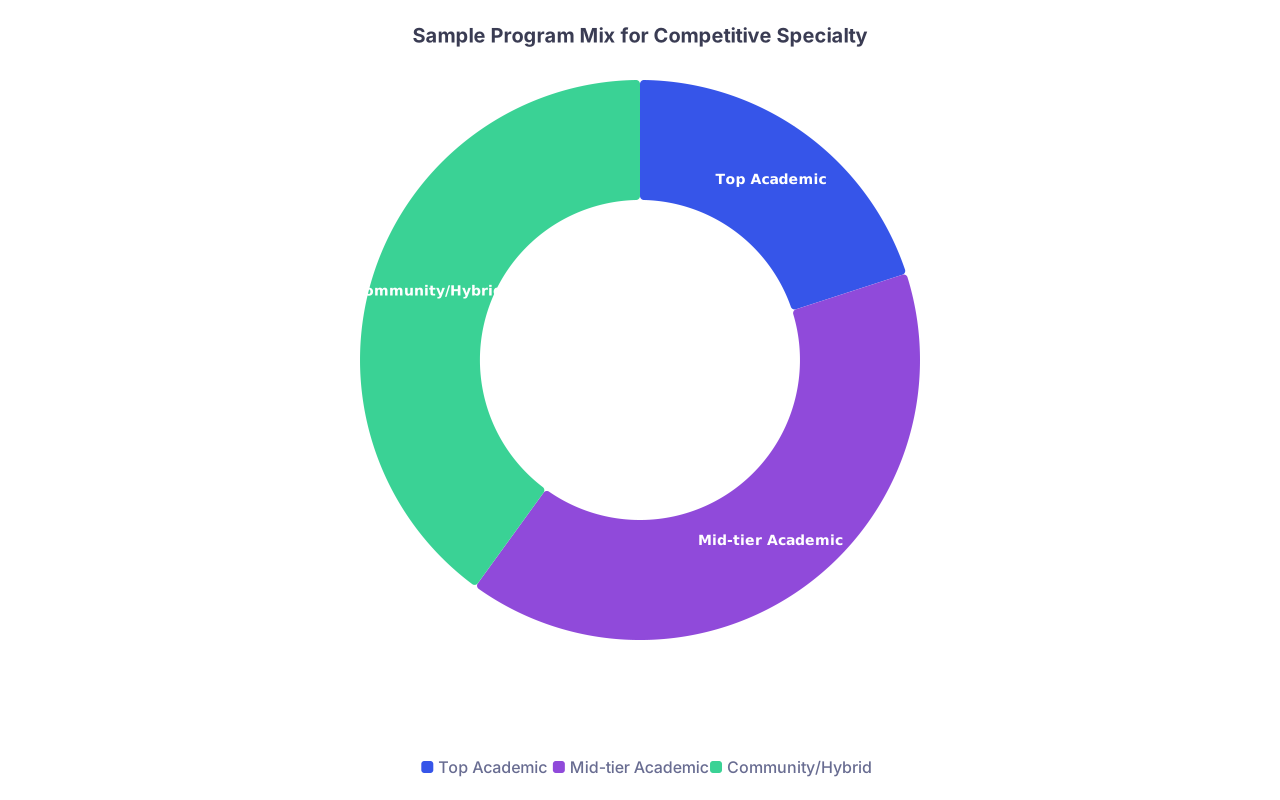
| Category | Value |
|---|---|
| Top Academic | 20 |
| Mid-tier Academic | 40 |
| Community/Hybrid | 40 |
That mix will vary by field, but if your list is 80% big‑name university programs in major coastal cities, expect a painful season.
8. Mental Framing: What “Worth It” Actually Means
“Worth it” is not the same for everyone.
For some students, “worth it” means:
- “I’ll take a 20–30% lower chance of matching this year because I have to try for derm once.”
For others, “worth it” means:
- “I’d rather do a field I like 80% as much but have a 95% match chance.”
You need to decide which mindset is yours.
If:
- You’re financially and emotionally capable of handling a possible extra year, SOAP, or pivot
- You’ve done everything you reasonably can to maximize your app
- You accept that your school being newer increases risk but doesn’t make it impossible
…then yes, it can be worth applying to a competitive specialty from a newer med school.
If you know that not matching would wreck you, you have no desire for a backup specialty, and your metrics are mediocre for your dream field, then no—it’s probably not worth it. You’re gambling with bad odds.

FAQ: Applying to Competitive Specialties from a Newer Med School
1. Can I match into derm/ortho/ENT from a brand‑new med school?
Yes, but it’s rare without standout metrics and support. You’ll usually need:
- Step 2 well above the specialty’s matched mean
- 1–2 strong away rotations with excellent letters
- Specialty‑specific research, ideally with at least one publication or national presentation
If you’re average on metrics and have no away rotations, the odds drop fast. Apply only if you have a serious backup plan.
2. Do programs bias against newer or unranked schools?
Some do, quietly and indirectly. They don’t have experience with your school, so they don’t know how to interpret your grades or letters. That doesn’t mean automatic rejection, but it means:
- They’ll rely more on Step scores, letters from known faculty, and away performance.
- They may be more hesitant to take a risk on a borderline app from a school they don’t know.
Your job is to stack as many clear, objective positives as possible so they don’t have to guess.
3. How many programs should I apply to if I’m from a newer school?
More than your classmate at a well‑known school with the same stats. For ultra‑competitive specialties, it’s not crazy to see:
- 60–80+ applications for derm, ortho, ENT, neurosurg
- 40–60+ for radiology, anesthesia, IR, urology
And that’s usually with a backup specialty also on your ERAS. The point isn’t to spray blindly—it’s to build a deep, intelligently targeted list that reflects your actual competitiveness.
4. Are away rotations more important for me than for students at older schools?
Yes, in many competitive fields they’re your main chance to prove you can actually function at that level.
From a newer school with no home program, aways are:
- How you show you can handle the workload and culture
- How you get letters from people PDs recognize
- Often how you get on a program’s “realistic rank” radar
If you’re serious about a competitive specialty, treat aways as mandatory, not optional.
5. Should I dual‑apply if I’m from a newer school and want a competitive specialty?
If you’re not clearly above‑average for that specialty, yes, you should strongly consider it. Dual‑apply if:
- Your scores are around or slightly below the matched mean
- You lack key pieces like research or strong specialty letters
- Advisors are “concerned” but not completely pessimistic
Pick a backup you can live with, not one you’ll resent. Do real work in that backup so your application there doesn’t scream “second choice.”
6. What if my school has no home residency in my chosen field?
Then your priority list is:
- Secure away rotations at solid programs in that field.
- Get at least one very strong letter from a residency‑training faculty member in that specialty.
- Join or initiate research projects—even small ones—in that field, ideally with multi‑institutional or national collaborators.
- Make sure your core rotations and Step scores are as strong as possible.
You’re not disqualified, but you have to hustle harder to build what others get by default.
7. Bottom line: How do I decide if it’s “worth it” for me?
Ask yourself four questions:
- Are my scores and clinical performance at least solid for this specialty, not weak?
- Do I have (or can I get) strong specialty‑specific letters and aways?
- Am I willing to create a real, not fake, backup plan?
- Could I tolerate not matching and needing a Plan C?
If you can honestly say yes to 1–3 and you can emotionally handle #4, then applying from a newer med school can absolutely be worth it. If not, you’re probably forcing a bad bet.
Key takeaways:
- Being from a newer med school doesn’t block you from competitive specialties—but it magnifies weaknesses and makes average applications much riskier.
- Strong metrics, targeted aways, real letters, and a serious backup plan are non‑negotiable if you want to take a shot without being reckless.
- “Worth it” depends on your actual competitiveness and your risk tolerance—don’t borrow someone else’s dream or someone else’s odds.