
The honest answer: trying to seriously apply to more than two competitive specialties at once is usually a bad plan.
Not impossible. But usually dumb, inefficient, and self-sabotaging.
Let me walk you through why, where the real limits are, and how to make it work if you’re truly split between fields.
The Core Reality: Breadth Kills Depth
Residency programs don’t want “generic strong applicants.” They want people who look committed to their field.
When you spread yourself across multiple competitive specialties, you run into three hard constraints:
- Time – you don’t have infinite time for rotations, letters, research, and interviews.
- Signaling – you dilute the message: “I’m all in on your specialty.”
- Money and energy – ERAS fees, travel, Zoom fatigue, rank list chaos.
For genuinely competitive specialties (think derm, plastics, ortho, ENT, neurosurgery, integrated IR, rad onc, sometimes EM in tight markets), you usually need:
- Multiple strong, field-specific letters.
- One or more away rotations or at least heavy exposure.
- Some specialty-aligned research or projects.
- A personal statement that actually sounds like you understand and care about the field.
Try doing that for three different competitive specialties and it falls apart fast.
Baseline rule of thumb:
If you’re talking competitive specialties (or combinations involving them), you can realistically:
- Go all-in on one competitive specialty with a backup plan in a less-competitive one.
- Or, in rare, very intentional cases, seriously pursue two adjacent competitive specialties.
More than that? You’re stretching yourself thin and programs can tell.
Competitive vs Noncompetitive: Know What You’re Actually Juggling
People mix up “competitive” with “has a long training path” or “sounds prestigious.”
Here’s the more useful lens: how many hoops do you have to jump through to look serious?
| Category | Examples |
|---|---|
| Ultra-competitive | Derm, Plastics, Ortho, Neurosurgery, ENT |
| Competitive | IR (integrated), Rad Onc, Urology, Ophtho |
| Mid-competitive | EM (varies), Anesthesia, Radiology, OB/GYN |
| Broad-entry fields | IM, Peds, Psych, FM, Path, Neurology |
Is this perfect? No. But it’s close enough for decision-making.
Notice what happens:
- Applying to derm + plastics + ENT? That’s three ultra-competitive fields, each with a completely different ecosystem, LOR expectations, away rotation cultures, and faculty networks. You’re not “ hedging.” You’re just unfocused.
- Applying ortho + IM? That’s an ortho application with IM as a backup. More realistic.
- Applying EM + IM? Very doable if you’re organized and strategic.
The more “ultra” the field, the less room you have to divide your attention.
The Realistic Limits: How Many At Once?
Here’s the actual answer you came for.
1 specialty (max focus)
Best when:
- You’re dead-set on one competitive field.
- Your metrics, letters, and experiences are aligned and strong.
- You’d rather take a year for research / reapply than pivot fields.
Pros: Strongest possible signal. Best coherence. Programs like this.
Cons: Risky if your numbers are marginal or you’re late to decide.
2 specialties (the upper realistic limit for most)
This is the “I love X, but I don’t want to go unmatched” strategy.
There are two sane versions of this:
Competitive + less-competitive
- Example: Ortho + IM, Derm + IM, ENT + FM, IR (independent path) + IM.
- You apply aggressively to the competitive one, but also build a real backup.
Adjacent mid‑competitive or overlapping fields
- Example: EM + IM, IM + Neuro, IM + Psych (triple-board places), Peds + FM.
- These combos share some letter-writers, rotations, or patient populations.
Pros:
- Real backup if things go south.
- Reasonable time and financial cost if managed carefully.
Cons:
- You must avoid looking flaky to both fields.
- You’ll write and track two versions of your story, letters, and programs.
3 specialties or more (almost always a mistake)
I’ve seen students try:
- Derm + Rad Onc + IM
- EM + Anesthesia + IM
- Ortho + Gen Surg + IM
The pattern is always the same:
- Letters are thin or generic for each field.
- Personal statements sound copy-pasted with keywords swapped.
- Interview invites cluster in only one specialty anyway.
- Rank list ends up chaotic and full of regret.
The problem isn’t that ERAS won’t let you. It will. The problem is each competitive specialty is its own full-time branding exercise. And you’re one person.
So my blunt answer:
- Genuinely competitive fields? Treat 1 as your main focus.
- Max you can realistically manage seriously? 2 specialties, with a clear “primary vs backup” structure.
The Hidden Constraint: Letters and Rotations
Applications live or die on letters and concrete evidence you’ve actually done the work in that field.
For each competitive specialty, you typically need:
- 2–3 letters from faculty in that specialty.
- Ideally, one from a big-name or PD-level person who actually knows you.
- A sub-I or away rotation where you impressed the team.
Now ask yourself: how many times can you realistically:
- Show up early, stay late, and be “that student” on a rotation?
- Get face time with attendings who will go to bat for you?
- Keep track of each specialty’s letter expectations and deadlines?
Doing that properly for one specialty is demanding. Two is work, but possible. Three is almost always shallow.
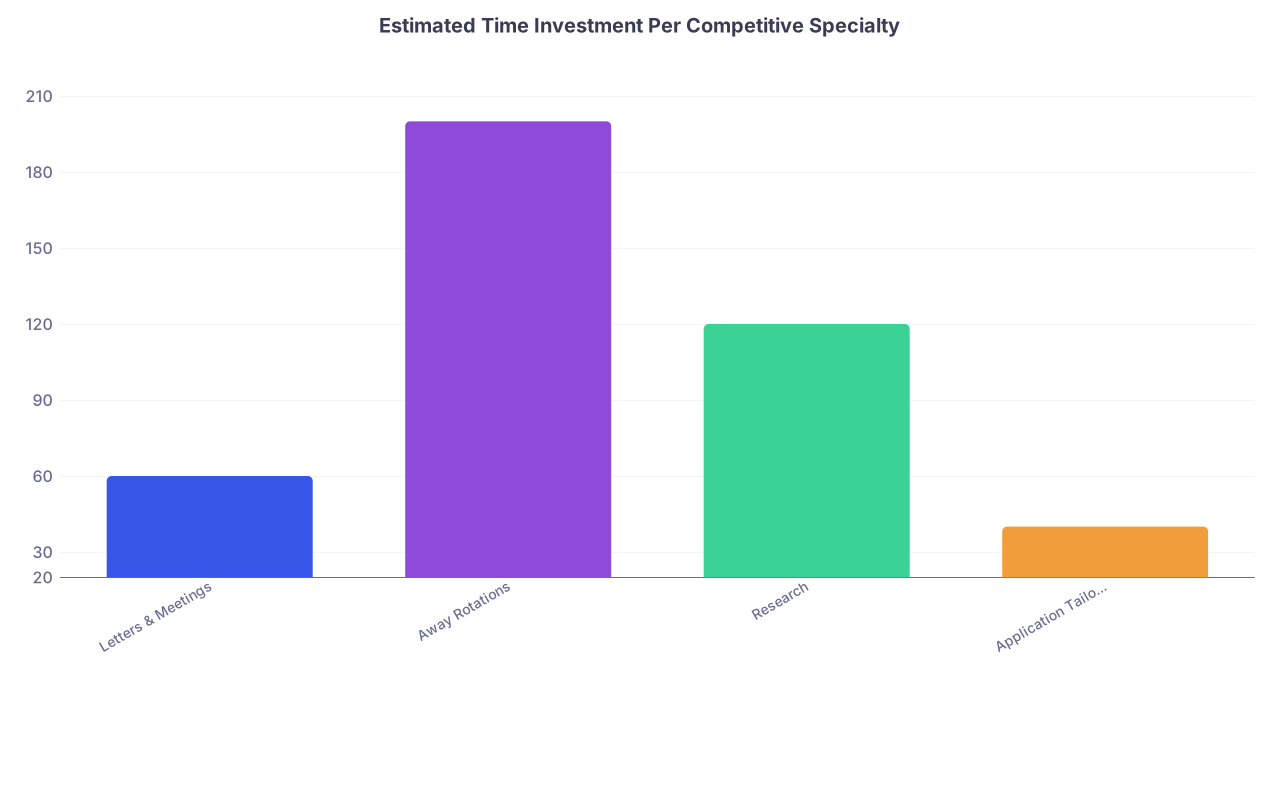
| Category | Value |
|---|---|
| Letters & Meetings | 60 |
| Away Rotations | 200 |
| Research | 120 |
| Application Tailoring | 40 |
Those numbers aren’t exact, but they’re directionally right. Each specialty can feel like a part-time job.
The Money and Interview Problem
Everyone underestimates this.
Each specialty you add:
- Increases ERAS fees (more programs, more apps).
- Multiplies interview scheduling chaos.
- Adds travel or Zoom days thinned across multiple interview seasons.
- Complicates your rank list emotionally: “Do I want low-tier in X or strong program in Y?”
Picture this:
You apply:
- 60 EM programs
- 40 IM programs
- 25 Anesthesia programs
You end up with:
- 10 EM interviews
- 9 IM interviews
- 4 Anesthesia interviews
You’re now looking at 20+ interview dates across 3 fields, all overlapping, and having to cancel some to attend others. You’ll end up no-showing or backing out of programs you spent time and money applying to. PDs talk. This can blow back on you.
If you’d just done EM + IM, maybe it’s 15 EM + 10 IM, with a much cleaner calendar and story.
How to Decide Your Actual Cap (and Combo)
Let’s make this practical. Here’s a simple way to decide what you can realistically handle.

| Step | Description |
|---|---|
| Step 1 | Choose dream specialty |
| Step 2 | Apply to 1 specialty |
| Step 3 | Add backup less-competitive field |
| Step 4 | 2 specialties realistic |
| Step 5 | Reassess goals or delay |
| Step 6 | Is it ultra-competitive |
| Step 7 | Are your metrics strong |
| Step 8 | Comfort going all in |
| Step 9 | Do fields share overlap |
Ask yourself:
- What’s my true “dream” field?
- Is that field ultra-competitive for people with my stats (Step, class rank, AOA, etc.)?
- If I went all-in and didn’t match, would I rather:
- Take a research year and reapply?
- Or pivot to a different specialty?
If you’d reapply → 1 specialty is defensible.
If you’d pivot → you probably want 2, with one clearly primary.
And then: do the fields you’re considering share genuine overlap or are you just panic-spraying?
Good combos:
- EM + IM
- IM + Neuro
- IM + Psych
- Peds + FM
- Derm + IM (as true backup)
- Ortho + IM (as backup)
Bad combos (in most cases):
- Derm + Ortho + IM
- ENT + Plastics + Gen Surg
- EM + Anesthesia + IM
- IR (integrated) + Derm + Rad Onc
Those “bad” ones can work in freak, highly curated situations. For 99% of applicants, they just make you look unfocused.
How to Execute a Two-Specialty Strategy Without Torpedoing Yourself
If you are going to apply to two, don’t half-commit to both. That’s how you end up unmatched in your “backup” because programs sensed you didn’t really want them.
Here’s how to do it right:
Pick a clear primary and clear backup.
Not “I’m kind of equally interested.” No. You need to know which one wins in a tie.Dedicate your most visible effort to your primary.
- More sub-I/aways in your primary.
- Primary specialty on your CV headline (if your school lets you state interests).
- Majority of your research aligned with the primary.
Build a real application for your backup.
That means:- At least 1–2 strong letters in that field.
- Some clinical time or elective.
- A personal statement that doesn’t sound like “I failed at X so here I am.”
Split your programs intentionally.
You don’t need 80 programs in each. You might do something like:- Ultra-competitive primary: 60–80 programs.
- Backup: 25–40 carefully chosen programs where your profile actually fits.
Don’t tell every program you’re “also applying to X.”
Some will ask. Be honest but strategic:- Focus on why their specialty would be a great fit.
- Don’t sound like you’re auditioning everywhere and committed nowhere.
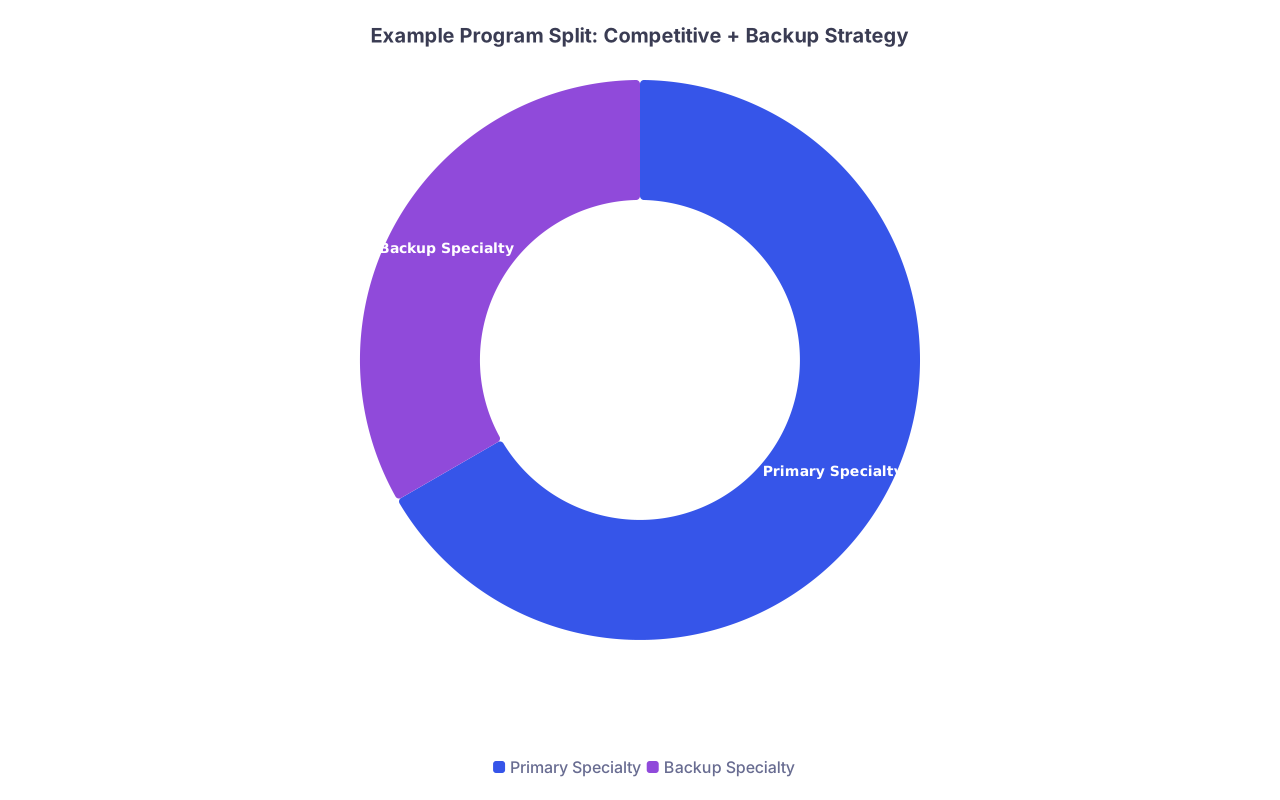
| Category | Value |
|---|---|
| Primary Specialty | 70 |
| Backup Specialty | 35 |
That kind of ratio is common and workable.
Common Mistakes When Applying to Multiple Specialties
I’ve seen these enough times to know they’re predictable:
One-size-fits-all personal statement.
“I love continuity of care… but also procedures… and emergencies… and long-term patient relationships.” This screams, “I don’t know what I’m doing.”Asking the same letter writers to cover different fields vaguely.
“To whom it may concern, this student would be excellent in any field.” Translation: “I have no idea what they’re actually good at.”Not tracking program requirements carefully.
Some EM programs want SLOEs; some derm programs expect specific letter types; some IM programs care about Step 2 timing. Tripling fields triples that complexity.Overapplying out of panic.
“If I apply to 80 EM + 80 IM + 60 Anesthesia, I’m safe.” No. You’re broke, exhausted, and still not sending a clear signal.
Quick sanity check before you submit
Before you lock in 2 specialties, answer these:
- Do I have at least 2 strong, field-specific letters for each specialty?
- Can I explain, in one sentence, why I’m applying to each field without sounding like I’m just hedging?
- Do I have enough interview time realistically blocked off to attend interviews in both?
- If I only matched into my “backup,” would I actually be okay training in it?
If you can’t confidently say yes to all four, you’re probably trying to do too much.
Key Takeaways
- You can seriously apply to one competitive specialty, or two specialties max if you’re disciplined. More than that usually weakens every application.
- The bottleneck isn’t ERAS; it’s letters, rotations, signal, and your ability to convince each field you genuinely want them.
- The smartest move for most students: pick a clear primary specialty, build a real backup in a related or less-competitive field, and commit fully to both rather than pretending you can chase three or four at once.